Scalars & Vectors
Learn it by playing
Answer these questions to earn energy, then fish and explore. No account needed.
Lesson notes
Scalar & Vector Quantities
- A scalar is a quantity that has only a magnitude (size).
- A vector is a quantity that has both a magnitude and a direction.
- Distance is a scalar because it describes how far an object has travelled overall, but not the direction.
- Displacement is a vector because it describes how far an object is from its starting point and in what direction.
- Example: A hiker's displacement is the straight-line distance from start to finish, while the distance walked is the total path length.
- To decide if a quantity is a vector, ask: can it have a minus sign? For example, negative displacement is possible, but negative energy is not.
Representing Vectors
- Vectors are represented by an arrow.
- The arrowhead indicates the direction of the vector.
- The length of the arrow represents the magnitude of the vector.
- Component vectors are sometimes drawn with a dotted line and a subscript indicating horizontal or vertical, e.g. Fx for the horizontal component and Fy for the vertical component of force F.
Combining Vectors
- Vectors can be combined by adding or subtracting them to produce the resultant vector (also called the 'net' vector).
- Triangle method: Step 1: link the vectors head-to-tail. Step 2: the resultant vector is formed by connecting the tail of the first vector to the head of the second vector.
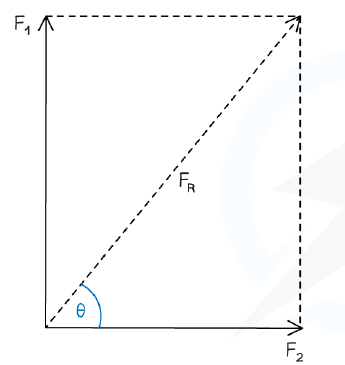
- Parallelogram method: Step 1: link the vectors tail-to-tail. Step 2: complete the parallelogram. Step 3: the resultant vector is the diagonal of the parallelogram.
Vector Multiplication
- The product of a scalar and a vector is always a vector.
- Example: mass (scalar) × acceleration (vector) = force (vector): F = m × a.
- Example: mass (scalar) × velocity (vector) = momentum (vector): p = m × v.
Resolving Vectors
- Resolving a vector is the opposite of adding vectors: a single resultant vector is represented by two vectors that together have the same effect.
- The two parts are called components.
- For a force vector of magnitude F at an angle θ to the horizontal: horizontal component Fx = F cos θ, vertical component Fy = F sin θ.
- The magnitude of the resultant vector is found using Pythagoras' Theorem.
- The direction of the resultant vector is found from the angle it makes with the horizontal or vertical, using trigonometry (sine, cosine, or tangent).
- Tip: cos θ is always the adjacent side of the right-angled triangle (making a 'cos sandwich').
Forces as Vectors
- Forces are vectors and are often represented by free-body force diagrams.
- Rules for drawing a free-body diagram: draw a point at the centre of mass; draw the body free from contact; draw forces as vectors with length proportional to magnitude; draw the tail from the centre of mass and use the tip to indicate direction.
- Common forces on objects: weight, normal reaction force, tension (from cords and strings), and friction.
- Use conventional symbols: w or mg for weight; N or R for normal reaction force.
Vector diagram of two perpendicular forces resolved into a resultant force
Forces on an Inclined Plane
- An inclined plane is a flat surface tilted at an angle θ.
- The weight vector (W = mg) always acts vertically downwards.
- On an inclined plane, weight can be split into components: perpendicular to the slope W = mg cos θ, parallel to the slope W = mg sin θ.
- The normal (or reaction) force R is always perpendicular to the surface.
- If there is no friction, the parallel component of weight, mg sin θ, causes the object to move down the slope.
- If the object is not moving perpendicular to the slope, the normal force is R = mg cos θ.
Equilibrium
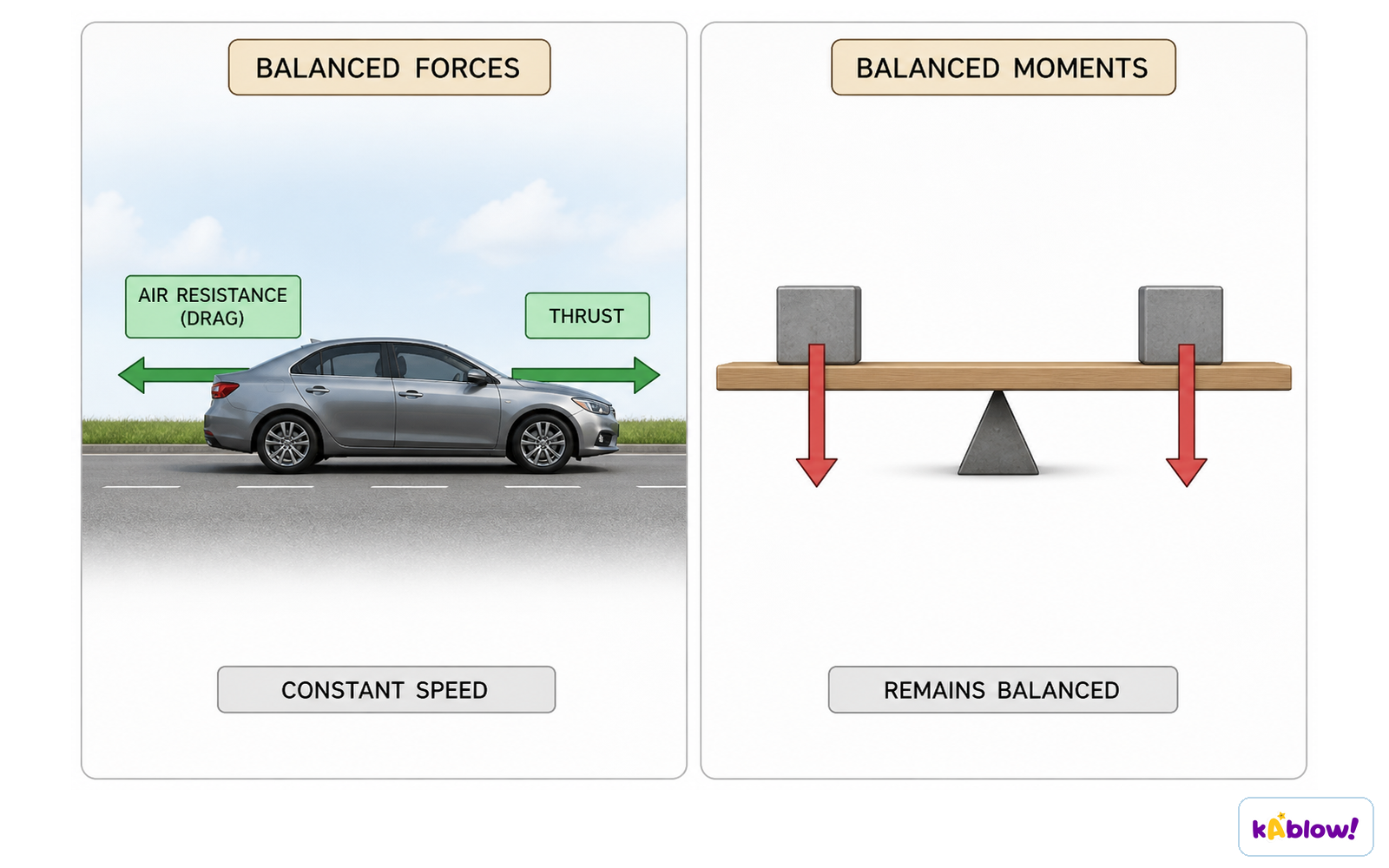
- Forces are in equilibrium if an object is either at rest or moving at constant velocity.
- In equilibrium, coplanar forces are represented by closed vector triangles.
- The vectors, when joined together, form a closed path.
- Three forces on an object in equilibrium form a closed vector triangle.
Systems in equilibrium
Scale Diagrams
- Use calculation if the vectors are perpendicular; use a scale drawing if the vectors are not perpendicular.
- Scale drawing involves drawing lengths and angles accurately using a sharp pencil, ruler, and protractor.
- Steps: link vectors head-to-tail; draw the resultant using the triangle or parallelogram method; measure the length of the resultant with a ruler; measure the angle (from North if it is a bearing) with a protractor.
- A scale may be given, such as 1 cm = 1 km.
- The final answer must be converted back to the units needed, e.g. for a scale of 1 cm = 2 km, a 5 cm length represents 10 km.
- Scale diagram questions typically involve vector triangles that do not contain a right angle.
Slides
Sign up free to view the lesson slides
Step through every slide for this topic — plus flashcards and revision notes — with a free account.
Practice questions
Free preview — 8 of 62 questions. Sign up to see them all.
1.Which of the following is a scalar quantity?
Easy- ADisplacement
- BVelocity
- CDistance
- DForce
2.Which of the following is a vector quantity?
Easy- AMass
- BTime
- CDisplacement
- DSpeed
3.A scalar quantity has both magnitude and direction.
EasyTrue or false?
4.Which of the following correctly describes the difference between distance and displacement?
Easy- ADistance is a vector; displacement is a scalar.
- BDistance is a scalar; displacement is a vector.
- CBoth are scalars.
- DBoth are vectors.
5.A vector is represented by an arrow. What does the length of the arrow represent?
Easy- AThe direction of the vector
- BThe magnitude of the vector
- CThe unit of the vector
- DThe component of the vector
6.Which of the following is NOT a scalar quantity?
Medium- AEnergy
- BMass
- CVelocity
- DTemperature
7.The product of a scalar and a vector is always a vector.
EasyTrue or false?
8.Which of the following gives the correct horizontal and vertical components of a force F at an angle θ to the horizontal?
Medium- AHorizontal = F sin θ, vertical = F cos θ
- BHorizontal = F cos θ, vertical = F sin θ
- CHorizontal = F tan θ, vertical = F cos θ
- DHorizontal = F sin θ, vertical = F tan θ
Unlock all 62 questions, flashcards & more
Create a free account to see every question, the slides, flashcards and revision notes for this topic.