Electromagnetic Spectrum
Learn it by playing
Answer these questions to earn energy, then fish and explore. No account needed.
Lesson notes
Electromagnetic Waves
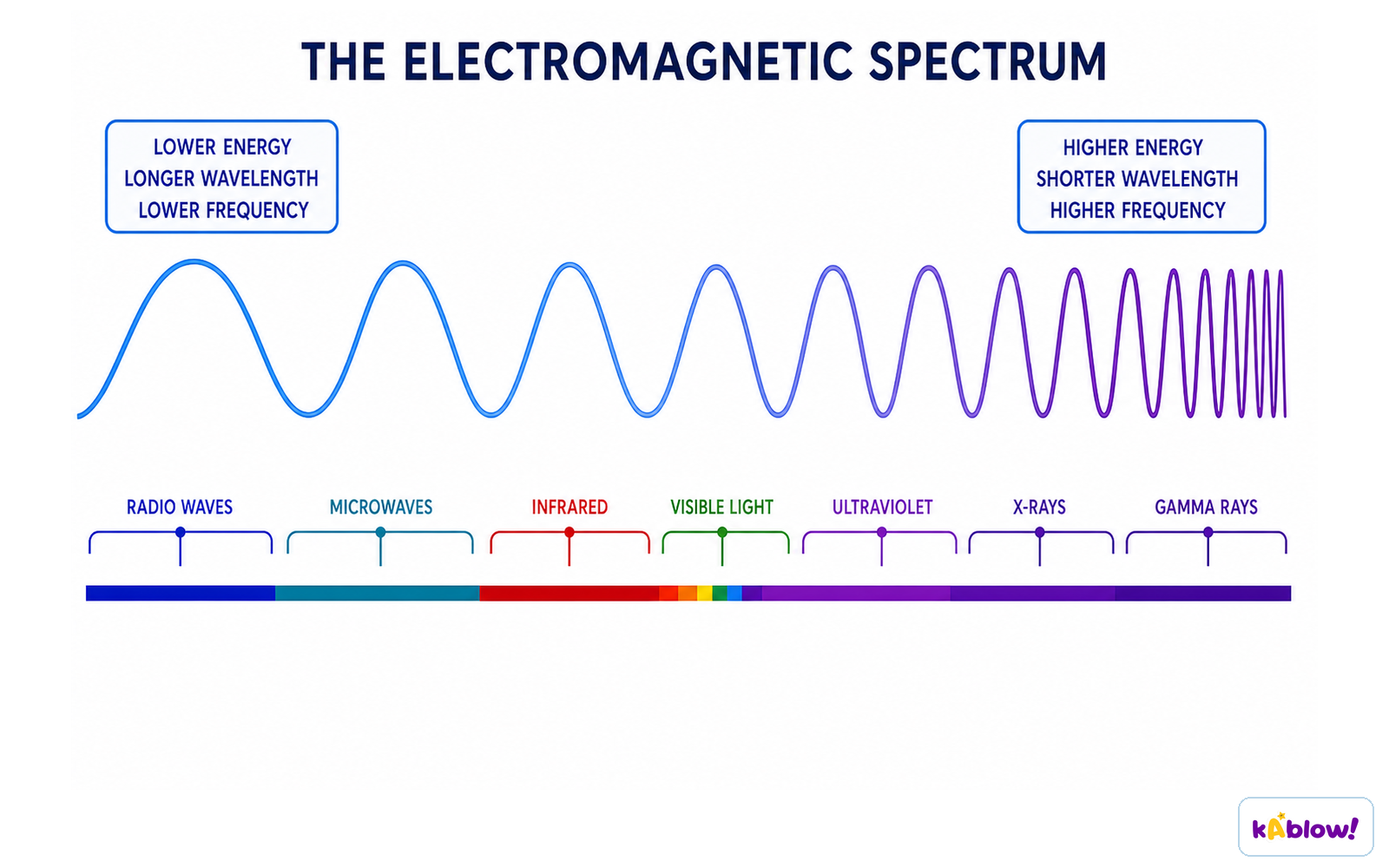
- The electromagnetic spectrum is arranged in order of wavelength or frequency.
- Regions with long wavelength have low frequency and vice versa.
- Order from longest to shortest wavelength: radio waves, microwaves, infrared, visible light, ultraviolet, X-rays, gamma rays.
- Visible light is a small part of the EM spectrum.
- All EM waves are transverse waves that transfer energy.
- All EM waves travel at the same high speed in a vacuum: 3.0 × 10⁸ m/s.
The electromagnetic spectrum, showing the seven regions in order of decreasing wavelength (increasing frequency), from radio waves to gamma rays.
Uses of Electromagnetic Waves
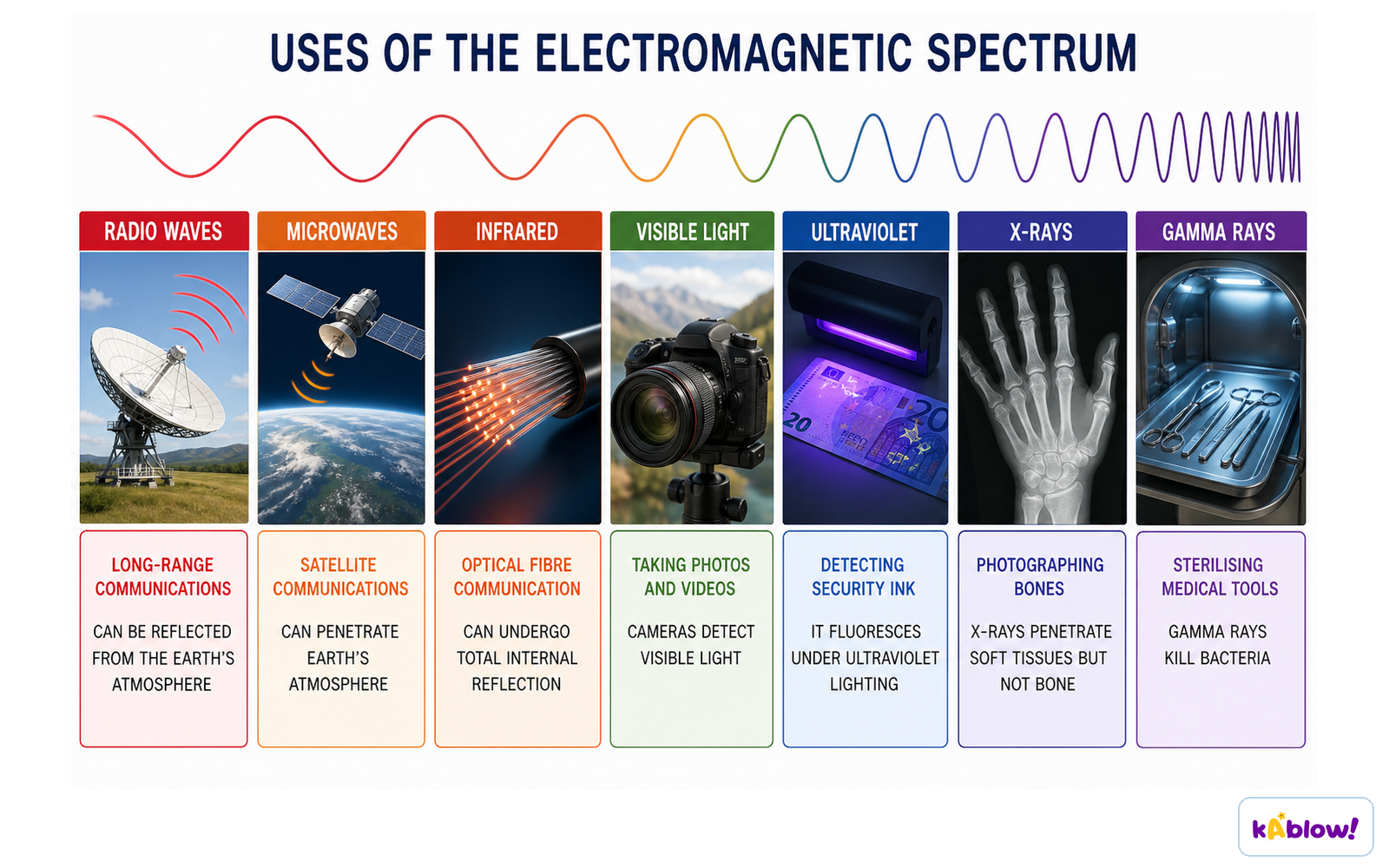
- Radio waves: radio and television transmissions, radar.
- Microwaves: satellite TV, mobile phones, microwave ovens.
- Infrared: TV remote controllers, thermal imaging.
- Visible light: vision, photography.
- Ultraviolet: detecting fake banknotes.
- X-rays: medical scanning, security scanners.
- Gamma rays: detection and treatment of cancer.
A summary of the uses of each region of the electromagnetic spectrum, with the reason each region is suited to its use.
Dangers of Electromagnetic Waves
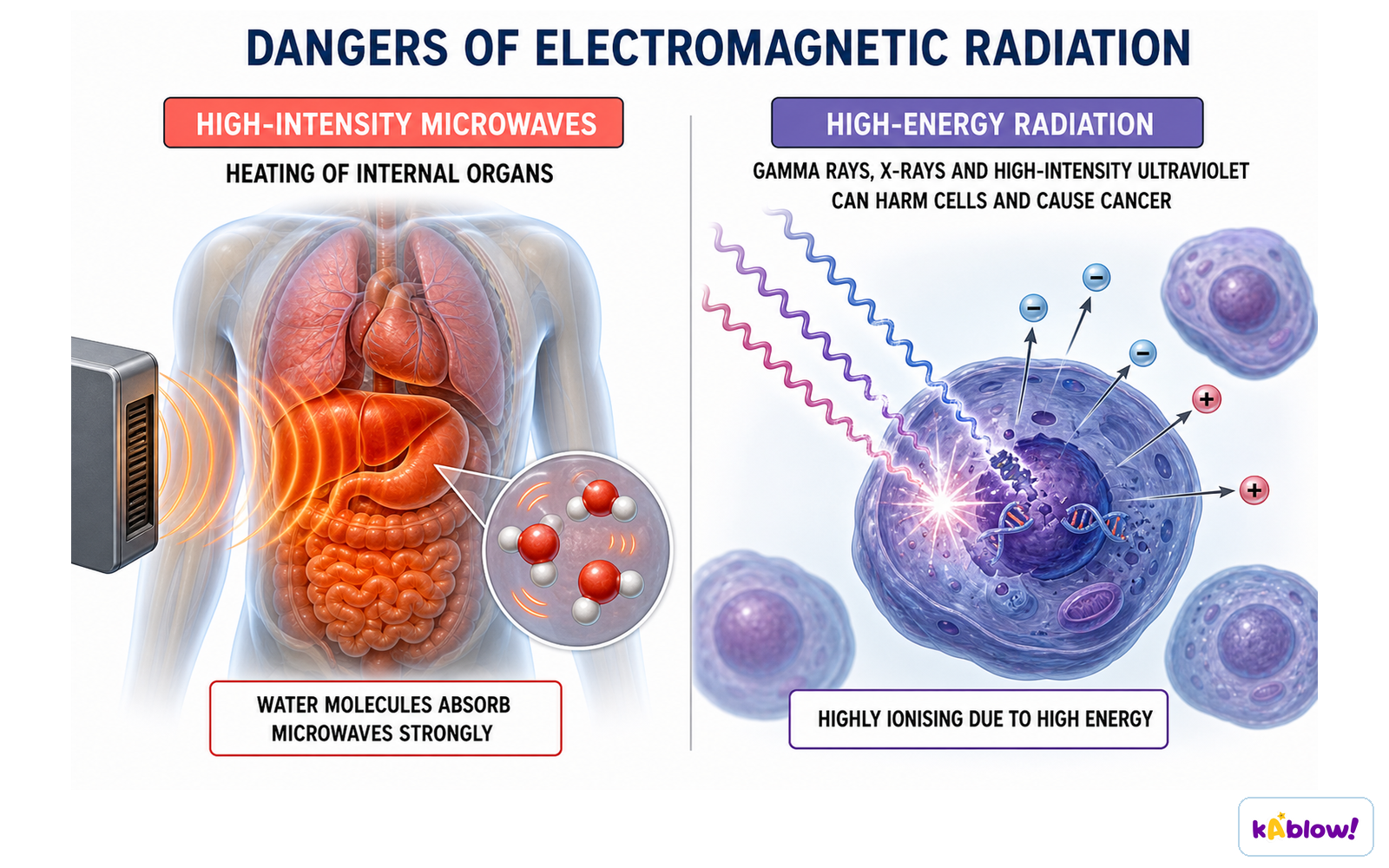
- As frequency increases, energy of EM waves increases.
- Beyond visible (UV, X-rays, gamma rays) waves are ionising – they can remove electrons from atoms.
- Higher frequency EM waves are more ionising.
- Ultraviolet: damages surface cells and eyes, leading to skin cancer and eye conditions.
- X-rays and gamma rays: can cause mutation or damage to cells in the body, leading to cancer.
- Sunscreen absorbs UV; good sunglasses absorb UV to protect eyes.
The dangers of high-intensity microwaves, and of gamma rays, X-rays and high-intensity ultraviolet, with the reason each is harmful.
Slides
Sign up free to view the lesson slides
Step through every slide for this topic — plus flashcards and revision notes — with a free account.
Practice questions
Free preview — 8 of 51 questions. Sign up to see them all.
1.Arrange the following regions of the electromagnetic spectrum in order of decreasing wavelength (longest first).
Easy- ultraviolet
- microwaves
- visible light
- radio waves
2.All electromagnetic waves travel at the same speed in a vacuum.
EasyTrue or false?
3.State one use of microwaves.
Easy4.State two harmful effects of excessive exposure to ultraviolet radiation.
Easy5.Complete the sentence:
MediumThe electromagnetic spectrum is arranged in order of decreasing ____ and increasing ____.
6.What is the speed of electromagnetic waves in a vacuum? Give your answer in m/s.
Easy- A300000000
- B360000000
- C330000000
- D270000000
7.Which type of electromagnetic radiation is used for thermal imaging?
Easy- AInfrared
- BUltraviolet
- CMicrowaves
- DRadio waves
8.X-rays and gamma rays are the most ionising types of electromagnetic waves.
EasyTrue or false?
Unlock all 51 questions & more
Create a free account to see every question, the slides, flashcards and revision notes for this topic.