Artificial Intelligence
Learn it by playing
Answer these questions to earn energy, then fish and explore. No account needed.
Lesson notes
What is Artificial Intelligence?
- Artificial Intelligence (AI) is a machine that can simulate intelligent behaviours similar to a human.
- AI systems can learn (acquire new information), decide (analyse and make choices), and act autonomously (take actions without human input).
- Weak AI (narrow AI) is designed to perform a specific task or set of tasks.
- Strong AI (AGI) is designed to perform any intellectual task that a human can do.
An AI system takes in data, applies a model or rules, and produces a prediction, classification or decision.
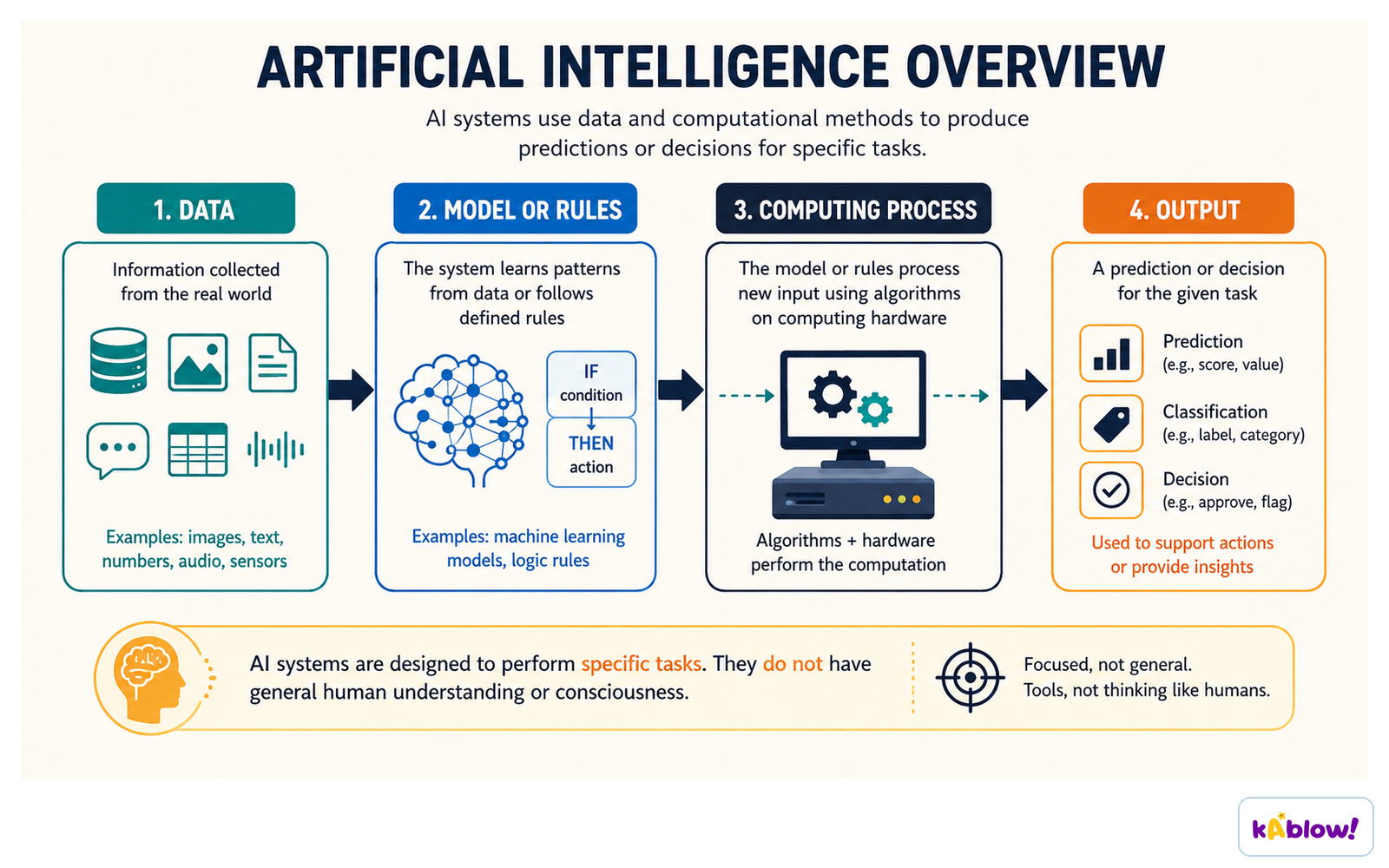
Characteristics of AI
- AI systems require collection of data – large amounts of data to perform tasks.
- They have rules for using data – data is processed using rules or algorithms to make decisions and predictions.
- They have the ability to reason – use logical reasoning to evaluate information and make decisions.
- AI can change its own rules and data based on learning.
Advantages and Disadvantages of AI
- Advantages: increased efficiency, increased accuracy, scalability.
- Disadvantages: job losses, potential for biased decision making, ethical concerns over its use.
Expert Systems
- An expert system mimics human knowledge and experience to solve problems or answer questions.
- Examples: equipment troubleshooting, technical support, medical diagnosis.
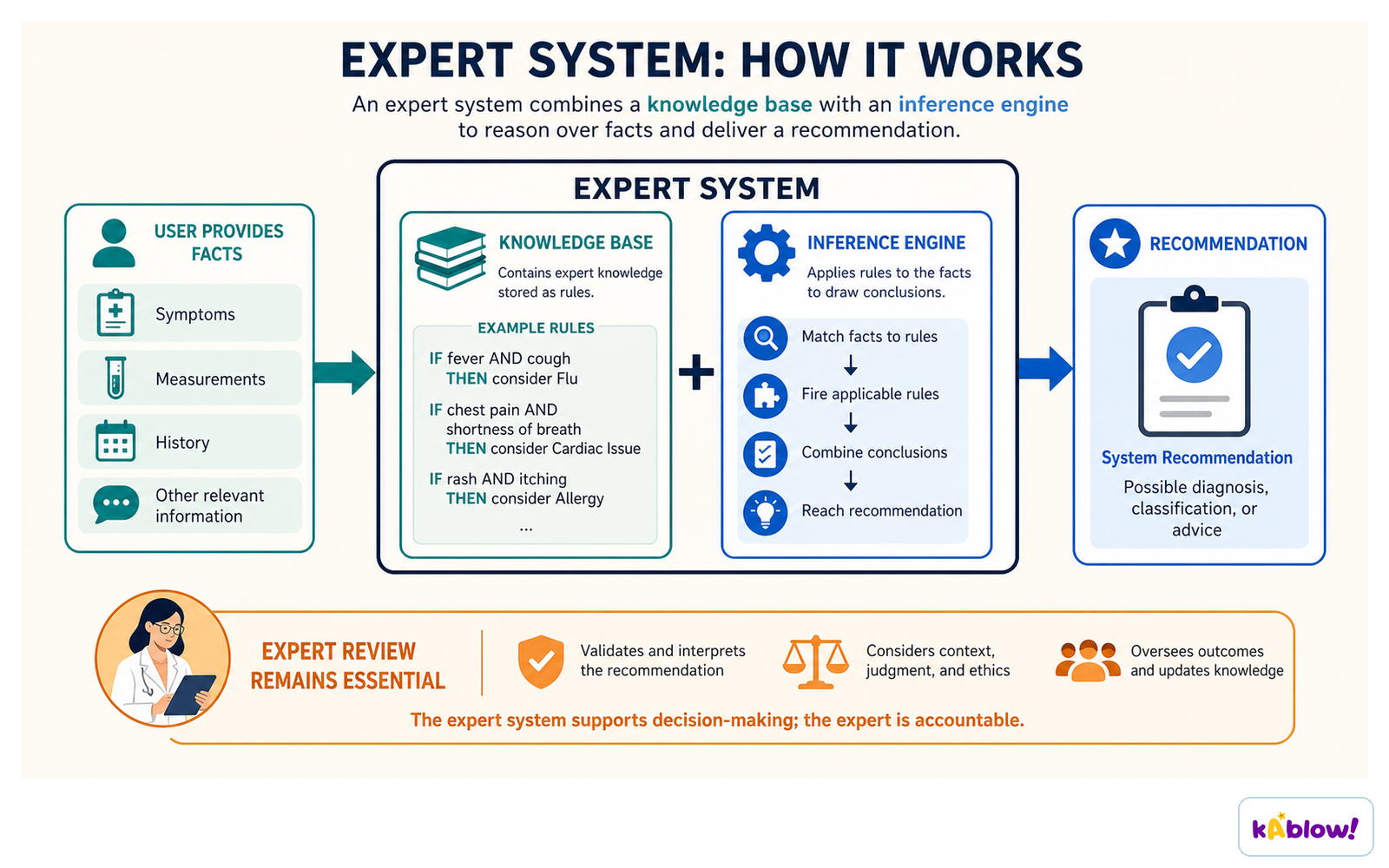
- Four key components: knowledge base (database of facts), rule base (set of rules/logic), inference engine (applies rules to facts), interface (user interaction).
- Advantages: consistent results, faster responses, can store large amounts of data, unbiased.
- Disadvantages: only as good as the data entered, responses lack human emotion, requires training to use correctly.
An expert system reasons over a knowledge base with an inference engine to reach a recommendation.
Machine Learning
- Machine learning (ML) is a method to achieve AI by giving a machine data so it can learn over time.
- Uses algorithms to analyse data and identify patterns or relationships.
- Advantages: reduces manual work, detects patterns and makes predictions more accurately than humans in many cases, continuously improves performance.
- Disadvantages: needs vast amounts of quality data, requires high processing power and resources.
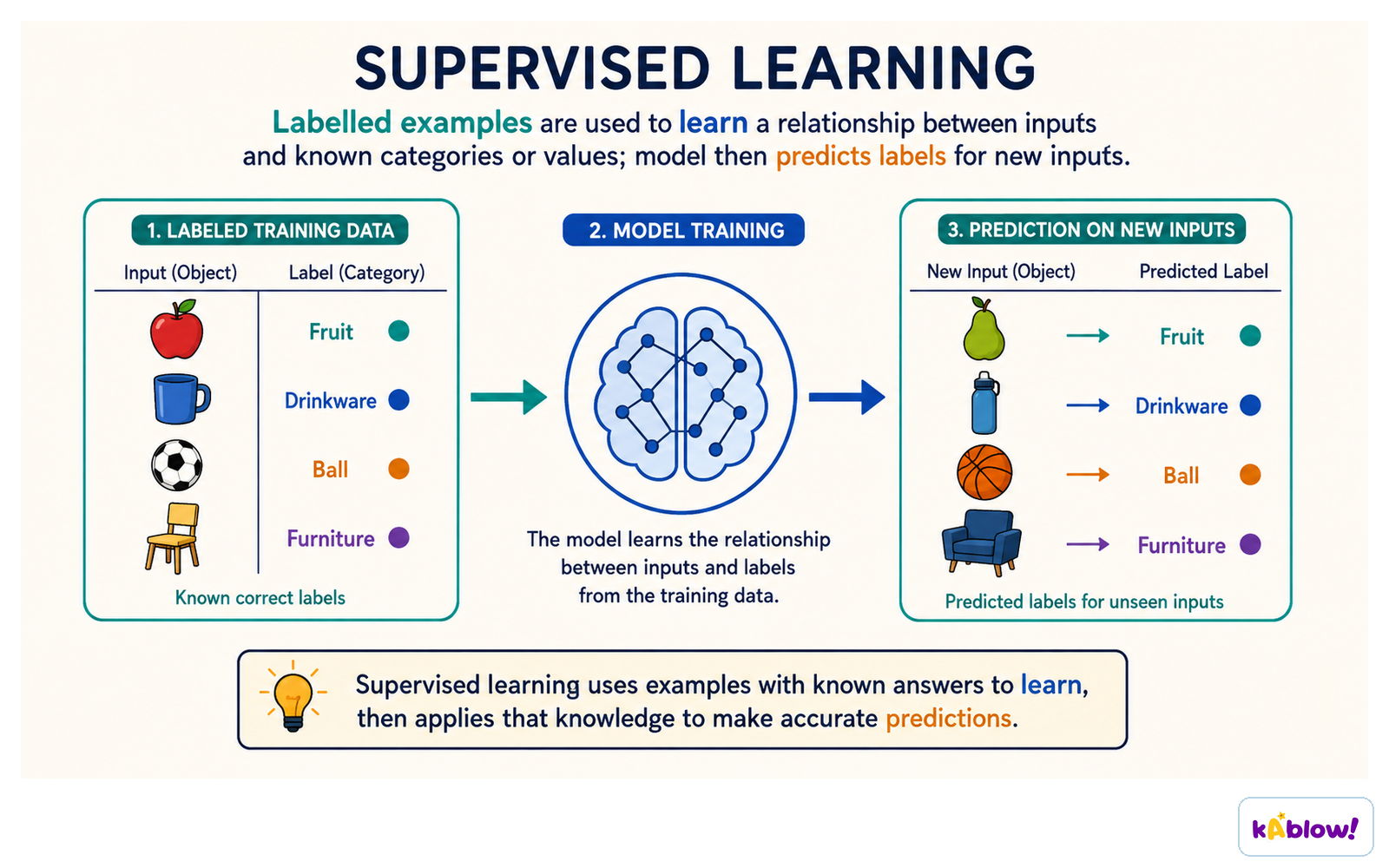
Supervised learning uses labelled examples to learn the relationship between inputs and categories, then predicts labels for new inputs.
Worked Example: Characteristics of AI
- Collects data.
- Stores rules for using the data.
- Ability to reason.
- Ability to learn (uses machine learning) by adapting from mistakes, changing its own rules/data, or being trained.
- Makes predictions to make decisions.
- Finds/analyses patterns.
Slides
Sign up free to view the lesson slides
Step through every slide for this topic — plus flashcards and revision notes — with a free account.
Practice questions
Free preview — 8 of 50 questions. Sign up to see them all.
1.What is artificial intelligence (AI)?
Easy- AA machine that can simulate intelligent behaviours similar to a human
- BA robot that can perform physical tasks
- CA computer program that can only perform calculations
- DA system that can only store data
2.Which of the following is a characteristic of AI?
Easy- ACollection of data
- BAbility to store data only
- CAbility to perform physical tasks
- DAbility to communicate with humans
3.What is the difference between weak AI and strong AI?
Medium- AWeak AI is designed for specific tasks; strong AI can perform any intellectual task a human can
- BWeak AI can perform any task; strong AI is limited to specific tasks
- CWeak AI has human-like consciousness; strong AI does not
- DWeak AI is used in robots; strong AI is used in software
4.Which component of an expert system stores facts used to generate rules?
Easy- AKnowledge base
- BRule base
- CInference engine
- DInterface
5.In an expert system, which component applies rules to facts to solve problems?
Easy- AInference engine
- BKnowledge base
- CRule base
- DInterface
6.Which of the following is an advantage of expert systems?
Easy- AConsistent results
- BRequires training to use correctly
- CResponses can be cold and lack human emotion
- DOnly as good as the data entered
7.What is machine learning?
Easy- AA method that helps achieve AI by giving a machine data to learn over time
- BA type of AI that can perform any task
- CA system that stores data without processing
- DA method that replaces AI
8.Which of the following is a disadvantage of machine learning?
Easy- ARequires vast amounts of quality data to perform well
- BReduces the need for manual work
- CCan detect patterns more accurately than humans
- DContinuously improves performance
Unlock all 50 questions & more
Create a free account to see every question, the slides, flashcards and revision notes for this topic.