Bearings Constructions And Scale Drawings
Learn it by playing
Answer these questions to earn energy, then fish and explore. No account needed.
Lesson notes
Bearings
- Bearings are a way of describing an angle, commonly used in navigation.
- Three rules: measured from North, measured clockwise, written with 3 digits (e.g., 059°).
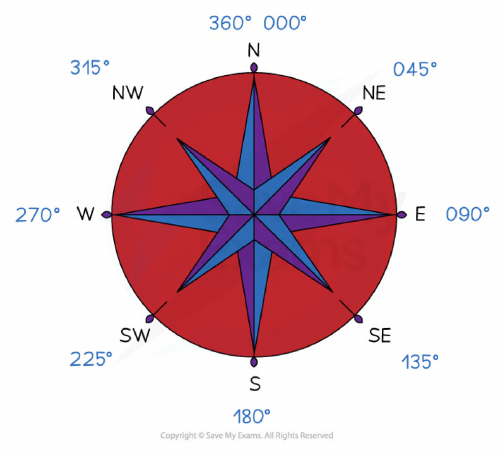
- Compass directions have standard bearings: N=000°, E=090°, S=180°, W=270°.
- To find bearing of B from A: start at A, draw North line, measure clockwise angle to B.
- If bearing of A from B is <180°, add 180° to get bearing of B from A; if >180°, subtract 180°.
- Always draw a clear diagram and label angles carefully.
Bearings of compass points
Scale
- Scale is a ratio comparing drawn size to real-life size (e.g., 1:50000).
- To find actual distance: measure on drawing, multiply by scale factor, convert units.
- To find drawing length: convert actual distance to same units, divide by scale factor.
- Common conversions: 1 km = 1000 m = 100000 cm.
- Always check if answer is sensible (e.g., actual distance > drawing distance).
Constructing Triangles (SSS)
- SSS triangle construction uses three given side lengths.
- Tools: pencil, ruler, compasses.
- Step 1: Draw the longest side as base using ruler.
- Step 2: Set compass to one side length, draw arc from one endpoint above base.
- Step 3: Set compass to third side length, draw arc from other endpoint to intersect first arc.
- Step 4: Draw lines from base endpoints to intersection point.
- Do not erase construction arcs – they show your method.
- Label vertices and side lengths as required.
Constructing triangle ABC
Scale Drawings
- Scale drawing uses a given scale to represent real objects or distances.
- Use ruler and protractor for accurate measurements and bearings.
- To mark a point given distance and bearing: draw North line, measure bearing clockwise, draw line to scale distance.
- For combined conditions (e.g., within distance range and bearing range), construct and shade the region.
- Always leave construction lines and arcs visible for marks.
Plotting a route by bearing and scale
Slides
Sign up free to view the lesson slides
Step through every slide for this topic — plus flashcards and revision notes — with a free account.
Practice questions
Free preview — 8 of 58 questions. Sign up to see them all.
1.What are the three rules for bearings?
Easy- AMeasured from North, clockwise, written with three digits
- BMeasured from South, anticlockwise, written with three digits
- CMeasured from East, clockwise, written with two digits
- DMeasured from North, anticlockwise, written with three digits
2.The bearing of B from A is 105°. What is the bearing of A from B?
Medium- A285°
- B075°
- C255°
- D195°
3.A map has a scale of 1:50000. What does 1 cm on the map represent in real life?
Easy- A50000 cm
- B5000 cm
- C500 m
- D5 km
4.In a scale drawing, 1 cm represents 40 cm. If the window on the drawing is 3 cm long and 2 cm high, what are the actual dimensions?
Easy- A120 cm by 80 cm
- B40 cm by 30 cm
- C12 cm by 8 cm
- D160 cm by 120 cm
5.Using a ruler and compasses only, to construct a triangle with sides 5 cm, 7 cm and 9 cm, which side should you draw first?
Medium- AThe longest side (9 cm)
- BThe shortest side (5 cm)
- CAny side, it doesn't matter
- DThe side of length 7 cm
6.What is the compass direction for a bearing of 090°?
Easy- AEast
- BNorth
- CWest
- DSouth
7.The bearing of a lighthouse from a boat is 135°. What is the bearing of the boat from the lighthouse?
Medium- A315°
- B045°
- C225°
- D135°
8.On a map with scale 1:150000, the distance between two towns is 5.8 cm. What is the actual distance in km?
Medium- A8.7 km
- B87 km
- C0.87 km
- D870 km
Unlock all 58 questions, flashcards & more
Create a free account to see every question, the slides, flashcards and revision notes for this topic.