Percentages
Learn it by playing
Answer these questions to earn energy, then fish and explore. No account needed.
Lesson notes
Percentages of Amounts
- Percentage means 'out of 100' (e.g., 50% = 50/100).
- To find 50%, halve the amount; to find 25%, halve twice; to find 10%, divide by 10; to find 1%, divide by 100.
- Use these as building blocks: e.g., 20% = 10% × 2; 5% = 10% ÷ 2.
- With a calculator, use a multiplier (decimal equivalent): e.g., 12% = 0.12, so 12% of 650 = 0.12 × 650 = 78.
- To express one number as a percentage of another, write as a fraction, convert to decimal, then multiply by 100.
Percentage Increases & Decreases
- To increase by a percentage, find the percentage and add to the original. E.g., increase 30 by 10%: 10% of 30 = 3, new = 33.
- Equivalently, find (100 + increase)% of the original using multiplier >1. E.g., increase 80 by 15%: multiplier 1.15, new = 1.15 × 80 = 92.
- To decrease by a percentage, find the percentage and subtract from the original. E.g., decrease 30 by 10%: 10% of 30 = 3, new = 27.
- Equivalently, find (100 – decrease)% of the original using multiplier <1. E.g., decrease 80 by 15%: multiplier 0.85, new = 0.85 × 80 = 68.
Percentage Change
- Percentage change = (After – Before) / Before × 100. Positive = increase, negative = decrease.
- Alternatively, find multiplier m = After / Before. m > 1 means increase; m < 1 means decrease.
- Percentage profit/loss uses cost price and selling price: m = Selling Price / Cost Price, or % profit = (SP – CP) / CP × 100.
- A positive % profit means profit; a negative % profit means loss.
Worked Examples (from source)
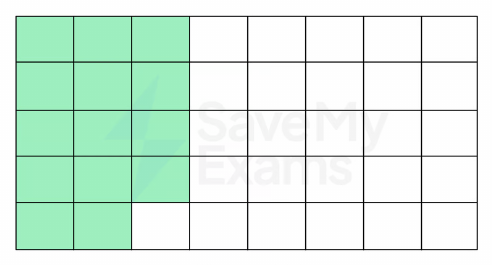
- Shade 35% of a 40-square grid: 10% = 4, 30% = 12, 5% = 2, total 14 squares shaded.
- Express $150 deposit as % of $1200: 150/1200 = 0.125 = 12.5%.
- Increase 200 kg by 21%: multiplier 1.21 → 242 kg.
- Discount 35% on £500: multiplier 0.65 → £325.
- Students from 250 to 310: change = (310-250)/250 × 100 = 24% increase.
- Car sold for £5600 from £8000: loss = (5600-8000)/8000 × 100 = -30% (30% loss).
35% of a 40-square grid
Slides
Sign up free to view the lesson slides
Step through every slide for this topic — plus flashcards and revision notes — with a free account.
Practice questions
Free preview — 8 of 40 questions. Sign up to see them all.
1.Write down the fraction of the rectangle that is shaded. (The rectangle has 10 equal squares, 3 shaded.)
Easy- A3/10
- B1/3
- C3/7
- D10/3
2.Find the percentage of the rectangle that is not shaded. (The rectangle has 10 equal squares, 3 shaded.)
Easy- A70%
- B30%
- C3%
- D7%
3.In 2019 the rent for a café was $7275. In 2020 the rent was $7566. Calculate the percentage increase in the rent between 2019 and 2020.
Medium- A4%
- B3.8%
- C4.2%
- D3.6%
4.There are 480 cabins on a ship. On one cruise, 456 of these cabins were used. Find the percentage of cabins that were used.
Easy- A95%
- B90%
- C85%
- D80%
5.Last year the cost of a cruise was $4600. This year the cost of the same cruise is $4784. Work out the percentage increase in the cost.
Medium- A4%
- B3.8%
- C4.2%
- D3.6%
6.A plane ticket costs $680 plus a tax of 16%. Find the total cost of this ticket.
Easy- A$788.80
- B$696
- C$789
- D$108.80
7.Work out 5% of $25.
Easy- A$1.25
- B$1.50
- C$0.50
- D$2.50
8.Work out 142 as a percentage of 304.
Medium- A46.7%
- B46.5%
- C47%
- D46.2%
Unlock all 40 questions, flashcards & more
Create a free account to see every question, the slides, flashcards and revision notes for this topic.