Compound Measures
Learn it by playing
Answer these questions to earn energy, then fish and explore. No account needed.
Lesson notes
Compound Measures
- A compound measure uses more than one measurement (e.g., speed = distance ÷ time).
- Compound measures measure rates: how one quantity changes per unit of another.
- Examples: speed, density, pressure, flow rate, population density, fuel consumption.
- Units derive from the formula: e.g., speed in km/h means distance (km) per time (h).
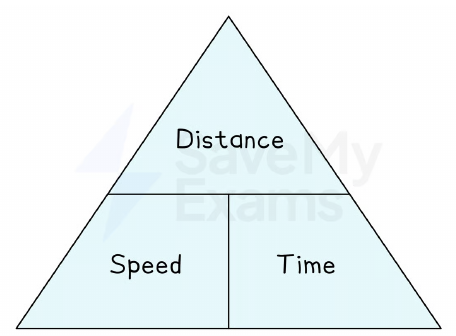
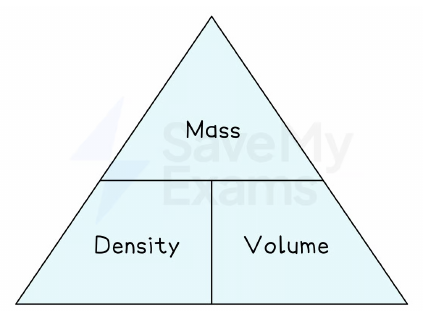
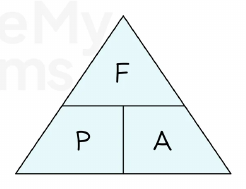
- A formula triangle helps rearrange: top variable = product of bottom two; bottom variable = top ÷ other bottom.
Speed, Distance & Time
- Speed = distance ÷ time (average speed over whole journey).
- Common units: m/s, km/h, miles per hour (mph).
- Distance = speed × time; Time = distance ÷ speed.
- For multi-part journeys, calculate each part separately then combine.
- Ensure consistent units: convert minutes to hours, metres to km, etc.
Speed, Distance, Time Formula Triangle
Density, Mass & Volume
- Density = mass ÷ volume (mass per unit volume).
- Common units: g/cm³, kg/m³.
- Mass = density × volume; Volume = mass ÷ density.
- Check unit consistency: e.g., convert kg to g if density is in g/cm³.
- May need to calculate volume from geometry first (e.g., cuboid, cylinder).
Density, Mass, Volume Formula Triangle
Pressure, Force & Area
- Pressure = force ÷ area (force per unit area).
- Common units: N/m² (Pascals, Pa).
- Force = pressure × area; Area = force ÷ pressure.
- Weight is a force (different from mass).
- Area must be in m² when pressure is in N/m².
Pressure, Force, Area Formula Triangle
Unit Conversions
- Convert speed: m/s to km/h multiply by 3.6; km/h to m/s divide by 3.6.
- Convert time: hours to minutes multiply by 60; minutes to seconds multiply by 60.
- Convert mass: kg to g multiply by 1000; g to kg divide by 1000.
- Convert volume: m³ to cm³ multiply by 1,000,000; cm³ to m³ divide by 1,000,000.
- Always check final answer units required by the question.
Problem-Solving Tips
- Use formula triangles to rearrange equations quickly.
- For multi-stage problems, break into steps: find missing variable for each stage.
- Watch for mixed units (e.g., minutes and hours) – convert to same unit.
- When using density, ensure mass and volume units match.
- In pressure problems, remember that force may be given as weight.
Slides
Sign up free to view the lesson slides
Step through every slide for this topic — plus flashcards and revision notes — with a free account.
Practice questions
Free preview — 8 of 73 questions. Sign up to see them all.
1.The density of a substance is 2.5 g/cm³. What is the mass of a block of this substance with volume 400 cm³?
Easy- A1000 g
- B160 g
- C100 g
- D1000 kg
2.A car travels 120 km in 2 hours. What is its average speed?
Easy- A60 km/h
- B240 km/h
- C0.0167 km/h
- D120 km/h
3.Pressure is defined as:
Easy- Aforce × area
- Bforce ÷ area
- Carea ÷ force
- Dmass ÷ volume
4.A force of 200 N acts on an area of 5 m². What is the pressure?
Easy- A40 Pa
- B1000 Pa
- C0.025 Pa
- D40 N
5.A solid metal cuboid has mass 4 kg and volume 600 cm³. Calculate its density in g/cm³.
Medium- A6.67 g/cm³
- B0.00667 g/cm³
- C0.15 g/cm³
- D2400 g/cm³
6.A box exerts a pressure of 42 N/m² on a table. The face in contact is 2 m by 1.25 m. Find the force exerted by the box on the table.
Medium- A105 N
- B84 N
- C52.5 N
- D16.8 N
7.A car travels at 108 km/h for 20 seconds. How far does it travel in metres?
Medium- A600 m
- B2160 m
- C540 m
- D3000 m
8.A gold bar has mass 12.5 kg and density 19.3 g/cm³. Find its volume correct to 3 significant figures.
Medium- A648 cm³
- B0.648 cm³
- C6480 cm³
- D241 cm³
Unlock all 73 questions & more
Create a free account to see every question, the slides, flashcards and revision notes for this topic.