Pressure
Learn it by playing
Answer these questions to earn energy, then fish and explore. No account needed.
Lesson notes
Pressure & Forces
- Pressure is defined as the force per unit area.
- Unit: pascal (Pa) = 1 N/m².
- Equation: p = F / A, where p = pressure (Pa), F = force (N), A = area (m²).
- A given force over a small area produces a large pressure.
- A given force over a large area produces a small pressure.
- Example: Tractors have large tyres to reduce pressure and avoid sinking into mud.
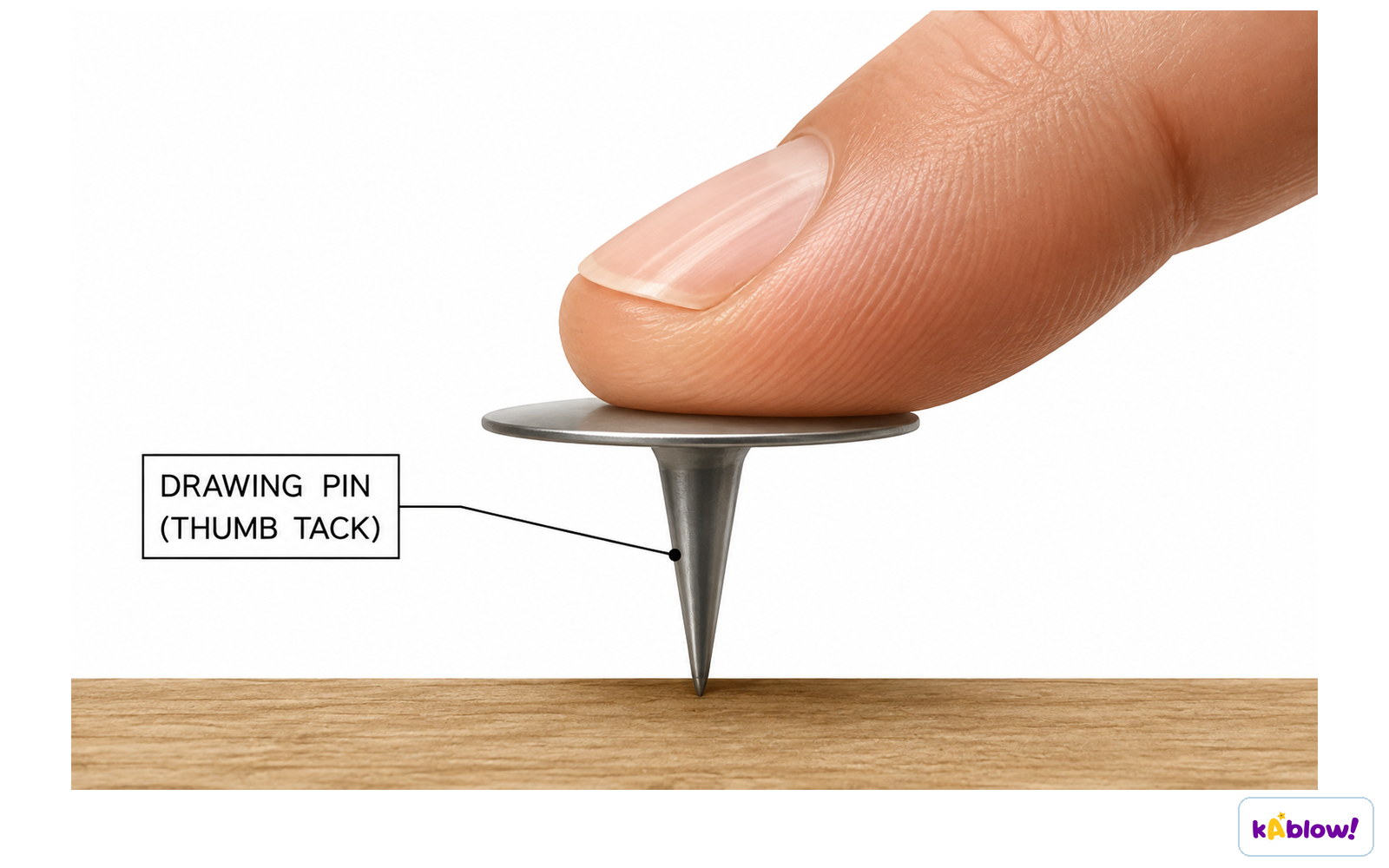
- Example: Drawing pins have a sharp point (small area) to concentrate force and push into walls.
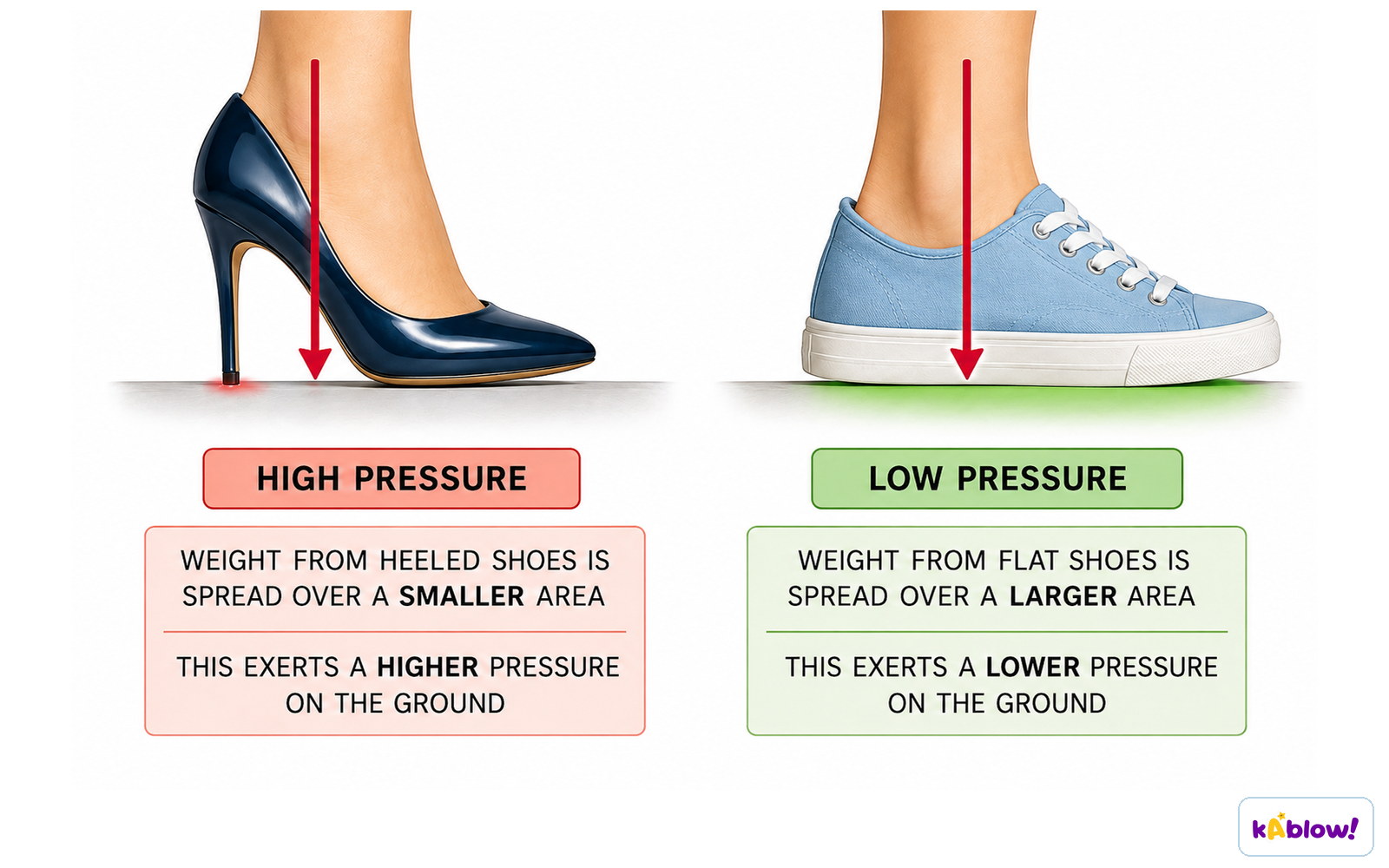
- Example: High heels have a small area, exerting high pressure and sinking into soft ground.
A finger pressing a thumbtack into a surface
Pressure in a Liquid
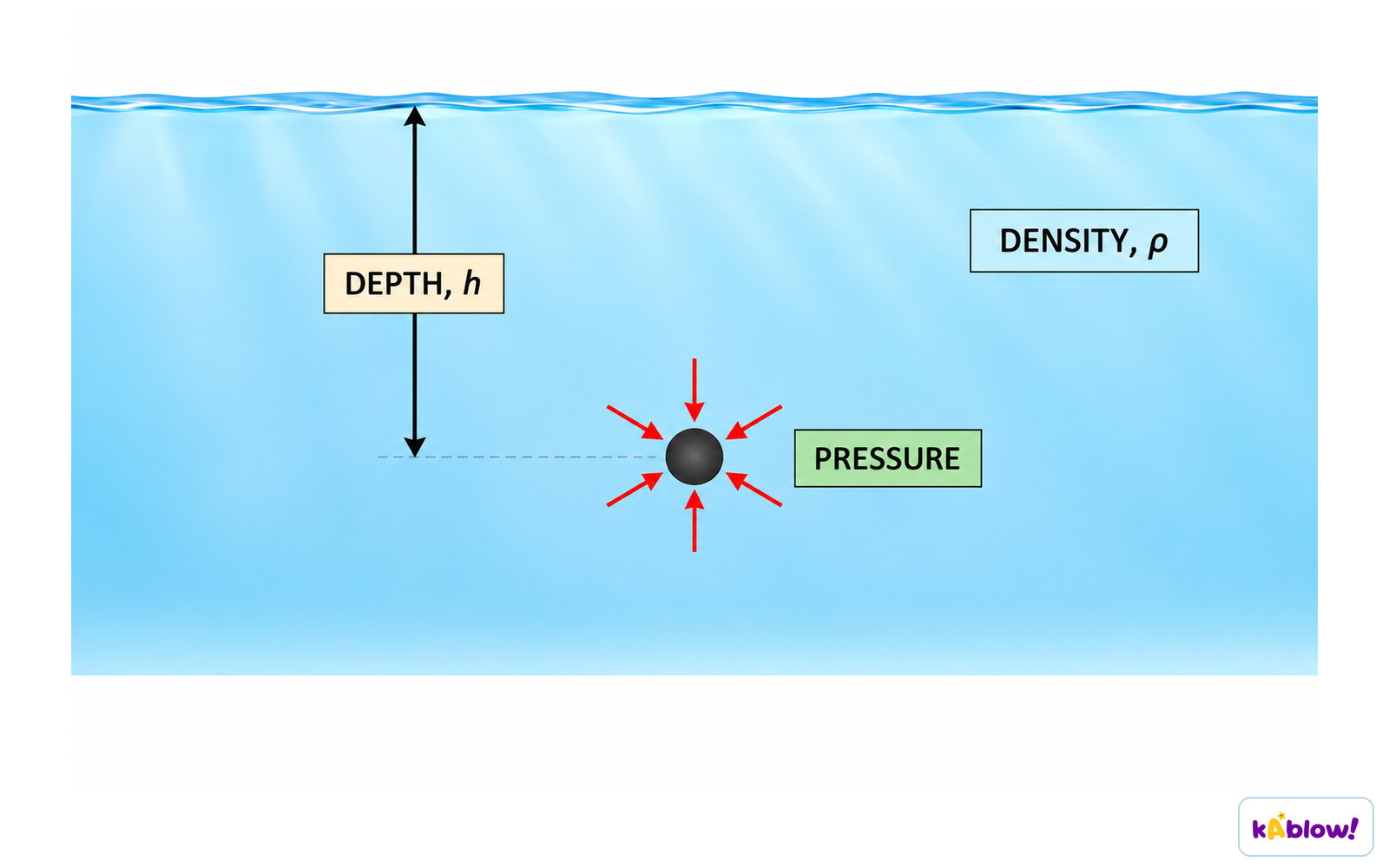
- Pressure in a liquid increases with depth due to the weight of liquid above.
- Pressure also increases with density of the liquid.
- At the same depth, pressure acts equally in all directions.
- Liquid pressure is given by: Δp = ρgΔh (Extended tier only).
- Δp = change in pressure (Pa), ρ = density (kg/m³), g = gravitational field strength (N/kg), Δh = change in depth (m).
- Total pressure at a depth includes atmospheric pressure (≈ 100 kPa).
- Example: A hole at the bottom of a water column produces a stronger jet than one at the top.
Pressure in a liquid increases with depth and acts equally in all directions
Calculating Pressure in Solids
- Use p = F / A for solid objects.
- Weight (force) = mass × gravitational field strength (W = mg).
- Ensure area is in m²; convert cm² to m² by dividing by 10 000.
- Worked example: A student of weight 550 N standing on two feet (total area 0.020 m²) exerts pressure = 550 / 0.020 = 27 500 Pa.
Calculating Pressure in Liquids (Extended)
- Use Δp = ρgΔh to find pressure difference due to depth.
- Example: At 5.0 m depth in water (ρ = 1000 kg/m³, g = 9.8 N/kg), Δp = 1000 × 9.8 × 5.0 = 49 000 Pa.
- Total pressure = Δp + atmospheric pressure = 49 000 + 100 000 = 149 000 Pa.
- Rearrange: Δh = Δp / (ρg) to find depth from pressure.
Applications of Pressure
- High pressure applications: knives, nails, high heels – small area concentrates force.
- Low pressure applications: snowshoes, skis, tractor tyres – large area spreads force.
- Adding weight (e.g., roof rack) increases pressure on the ground.
- Using narrower skis increases pressure on snow.
High heels exert higher pressure than flat shoes because the weight is spread over a smaller area.
Gas Pressure (Extended)
- Gas pressure is caused by molecules colliding with container walls.
- Increasing temperature increases molecular speed and collision frequency, raising pressure.
- Pressure in a gas also varies with depth and density (as a fluid).
Slides
Sign up free to view the lesson slides
Step through every slide for this topic — plus flashcards and revision notes — with a free account.
Practice questions
Free preview — 8 of 43 questions. Sign up to see them all.
1.Pressure is defined as the force per unit _____.
Easy- Aarea
- Bvolume
- Cmass
- Dlength
2.Which of the following is the correct unit for pressure?
Easy- Apascal (Pa)
- Bnewton (N)
- Cmetre squared (m²)
- Dkilogram (kg)
3.A tractor has large tyres to reduce the pressure on the ground. This is because pressure is inversely proportional to:
Easy- Aforce
- Barea
- Cweight
- Dvolume
4.The pressure beneath the surface of a liquid increases with:
Easy- Adepth and density
- Bdepth only
- Cdensity only
- Dsurface area
5.A drawing pin is pushed into a wall with a force of 50 N. The area of the point is 0.02 cm². What is the pressure exerted by the point on the wall?
Medium- A2500 N/cm²
- B250 N/cm²
- C25 N/cm²
- D2.5 N/cm²
6.A student of weight 550 N stands on both feet. The total area of his feet in contact with the ground is 0.020 m². What is the pressure exerted on the ground?
Medium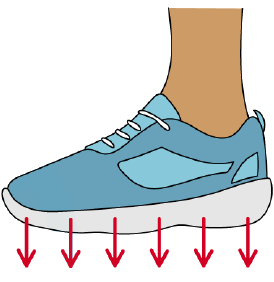
- A27 500 Pa
- B2750 Pa
- C27.5 Pa
- D275 000 Pa
7.A swimmer dives to a depth of 2.0 m in a swimming pool. The density of water is 1000 kg/m³ and gravitational field strength is 10 N/kg. What is the pressure due to the water at that depth?
Medium- A20 000 Pa
- B2000 Pa
- C200 Pa
- D20 Pa
8.A car of weight 20 000 N has four tyres, each with an area of 0.1 m² in contact with the road. What is the total pressure exerted by the car on the road?
Medium- A50 000 Pa
- B200 000 Pa
- C5000 Pa
- D20 000 Pa
Unlock all 43 questions & more
Create a free account to see every question, the slides, flashcards and revision notes for this topic.