Decomposition and pattern recognition
Learn it by playing
Answer these questions to earn energy, then fish and explore. No account needed.
Lesson notes
What is Decomposition?
- Decomposition is breaking a large, complex problem into smaller, more manageable sub-problems.
- It is a key part of computational thinking, helping to make problems easier to understand and solve.
- Each sub-problem can be tackled separately, often by different people or at different times.
- Decomposition is the opposite of composition, where smaller parts are combined to build a whole system.
- It is used in many areas of computing, including object-oriented programming, structured programming, and structured analysis.
Decomposition breaks a large problem into sub-problems that are solved separately and then combined.
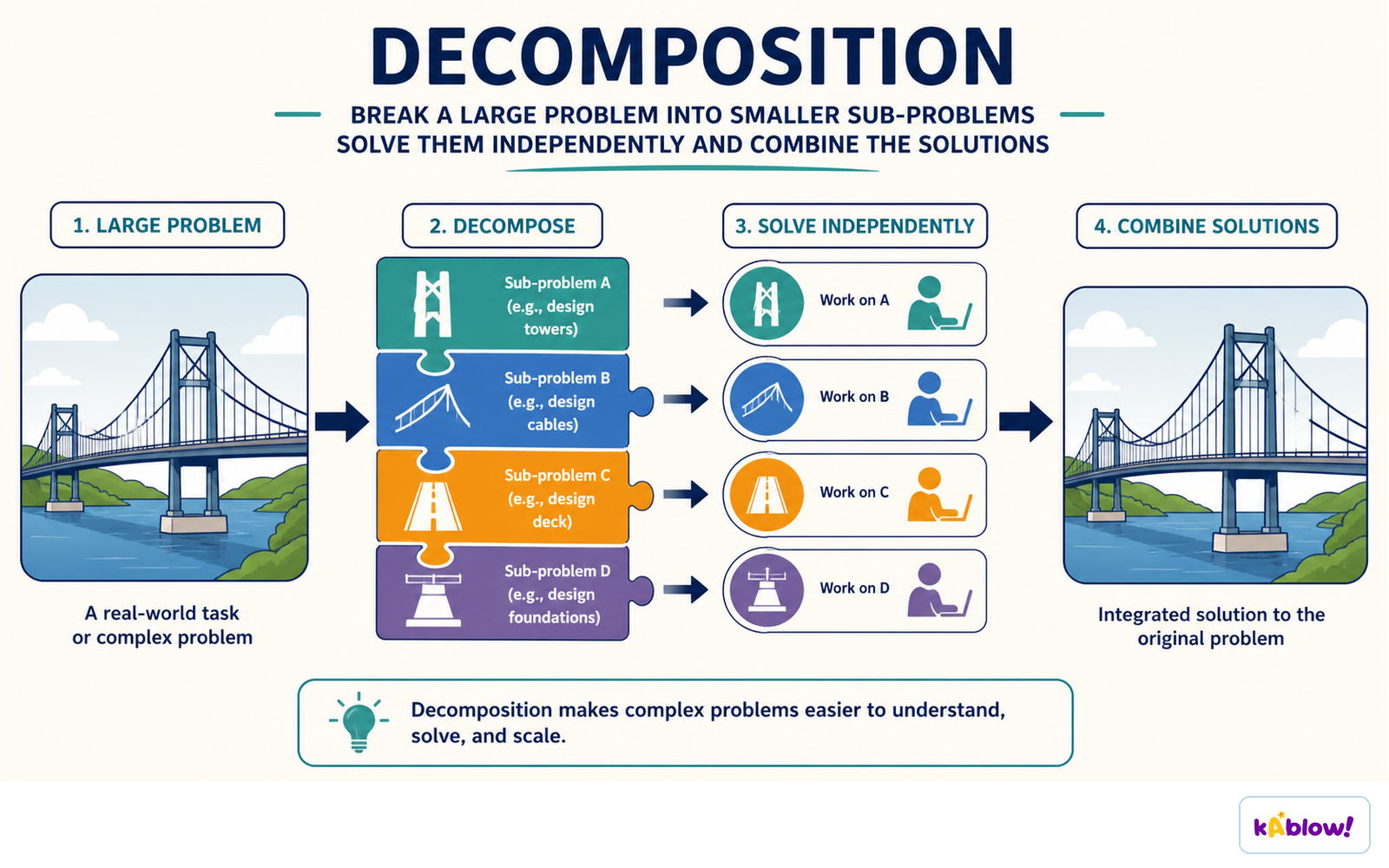
Why Decompose?
- Smaller problems are easier to understand and solve than one large problem.
- It improves modularity – each sub-problem becomes a module that can be developed and tested independently.
- It improves maintainability – if a change is needed, only the relevant module may need updating.
- It allows parallel working – different people can work on different sub-problems at the same time.
- It helps to minimise dependencies between parts, making the system more robust and easier to debug.
Pattern Recognition
- Pattern recognition is the process of identifying similarities or patterns within a problem or between different problems.
- Recognising patterns allows you to reuse solutions that have worked before, saving time and effort.
- Patterns can be found in data, processes, or structures.
- For example, in a program that draws shapes, the pattern of drawing a square and a rectangle can be generalised to drawing any four-sided shape.
- Pattern recognition helps in generalising a solution so it can be applied to a whole class of problems.
Generalisation
- Generalisation is taking a solution to one specific problem and making it work for a wider range of problems.
- It is closely linked to pattern recognition: once a pattern is spotted, a general solution can be designed.
- Generalised solutions are often implemented as functions, procedures, or classes that can be reused.
- For example, a function to calculate the area of a rectangle can be generalised to work for any rectangle, not just one specific size.
- Generalisation reduces duplication and makes code more efficient and easier to maintain.
Decomposition Paradigms
- A decomposition paradigm is a strategy for organising a program into parts.
- Popular paradigms include procedural, modular, abstract data type, and object-oriented.
- Functional decomposition describes a system as a series of functions, each performing a specific task.
- Object-oriented decomposition breaks a system into classes or objects, each with its own data and methods.
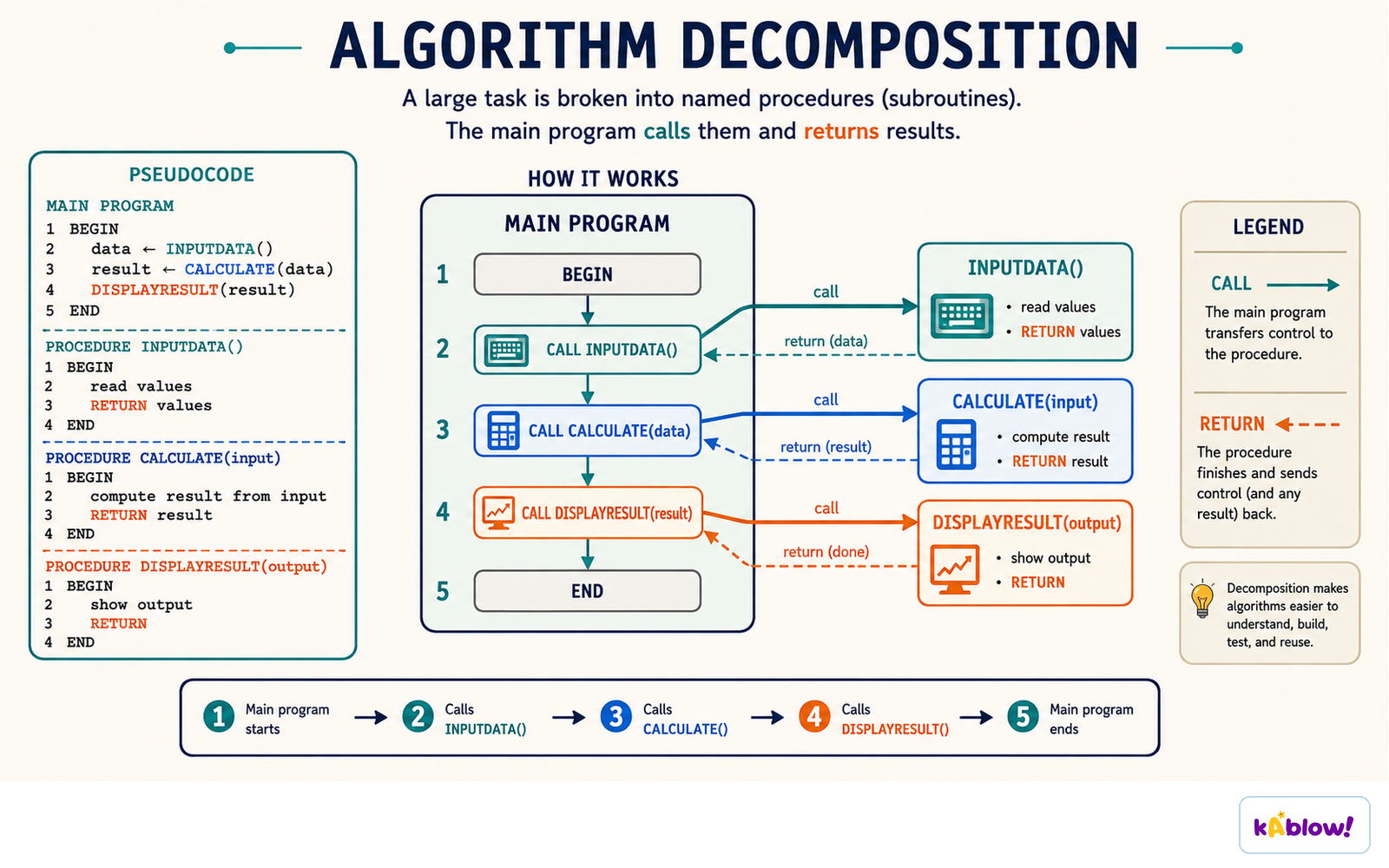
- Algorithmic decomposition breaks a process into well-defined steps, often used in structured programming.
Decomposition Diagrams
- A decomposition diagram shows a complex system broken down into lower-level, more detailed components.
- It provides a logical hierarchical view of a system, showing how parts relate to the whole.
- Decomposition diagrams can represent organisational structures, functional processes, or data subjects.
- They help in planning and communicating the structure of a solution before coding begins.
- For example, a diagram for a 'make a cup of tea' problem might break it into 'boil water', 'add tea bag', 'pour water', and 'add milk'.
A large task broken into named procedures that the main program calls in turn.
Planning Before Coding
- Decomposition and pattern recognition are essential for planning a solution before writing code.
- By breaking a problem down, you can identify the main components and how they interact.
- Patterns help you decide which existing solutions or libraries can be reused.
- Planning reduces errors and makes the coding process more efficient.
- It also makes it easier to test each part individually.
Real-World Example: Making a Cup of Tea
- Decompose the problem into steps: boil water, add tea bag to cup, pour water, wait, remove tea bag, add milk and sugar.
- Pattern recognition: the step 'boil water' is the same as in making coffee or hot chocolate – the solution can be reused.
- Generalise: create a function 'boilWater()' that can be used for any hot drink.
- Each step can be tested separately, e.g., check the water is boiling before pouring.
- This approach makes the problem easier to manage and the solution reusable.
Slides
Sign up free to view the lesson slides
Step through every slide for this topic — plus flashcards and revision notes — with a free account.
Practice questions
Free preview — 8 of 52 questions. Sign up to see them all.
1.What is decomposition in computer science?
Easy- ABreaking a large problem into smaller sub-problems
- BCombining small parts into a larger system
- CWriting code without planning
- DFinding patterns in data
2.Decomposition is the opposite of composition.
EasyTrue or false?
3.Which of the following is an example of decomposition?
Easy- APlanning a birthday party by listing tasks: booking a venue, sending invitations, ordering a cake
- BWriting a single, long paragraph to describe a holiday
- CCopying a recipe exactly as written
- DChoosing a colour scheme for a website
4.Match each term to its correct description.
Easy- Decomposition
- Pattern recognition
- Composition
- Breaking a problem into smaller parts
- Spotting similarities between problems
- Combining parts to form a whole
5.In the context of decomposition, what does 'pattern recognition' help with?
Medium- AReusing solutions for similar sub-problems
- BMaking the problem larger
- CEliminating the need for planning
- DCombining all sub-problems into one
6.Pattern recognition is the process of breaking a problem into smaller parts.
EasyTrue or false?
7.Which of the following are benefits of decomposition? (Select all that apply)
Medium- AMakes a problem easier to understand
- BAllows different people to work on different parts
- CMakes the problem more complex
- DHelps identify reusable patterns
8.Put the steps of solving a problem using decomposition in the correct order.
Medium- Break the problem into smaller sub-problems
- Look for patterns among the sub-problems
- Develop a solution for each sub-problem
- Combine the solutions to solve the original problem
Unlock all 52 questions, flashcards & more
Create a free account to see every question, the slides, flashcards and revision notes for this topic.