How data travels: packets, protocols and IP addresses
Learn it by playing
Answer these questions to earn energy, then fish and explore. No account needed.
Lesson notes
Data Packets
- Data is split into small chunks called packets before being sent over a network.
- Each packet travels independently across the network, possibly taking different routes.
- Packets are reassembled in the correct order at the destination.
- This makes transmission efficient and resilient to failures.
Protocols
- Protocols are shared rules that allow devices to communicate.
- They define how data is packetized, addressed, transmitted, routed, and received.
- Without protocols, devices from different manufacturers could not understand each other.
- The Internet protocol suite (TCP/IP) is a framework for organising these protocols.
IP Addresses
- An IP address is a unique identifier for a device on a network.
- It allows packets to be routed to the correct destination.
- IP addresses are part of the Internet Protocol (IP).
- They are used in the internet layer of the TCP/IP model.
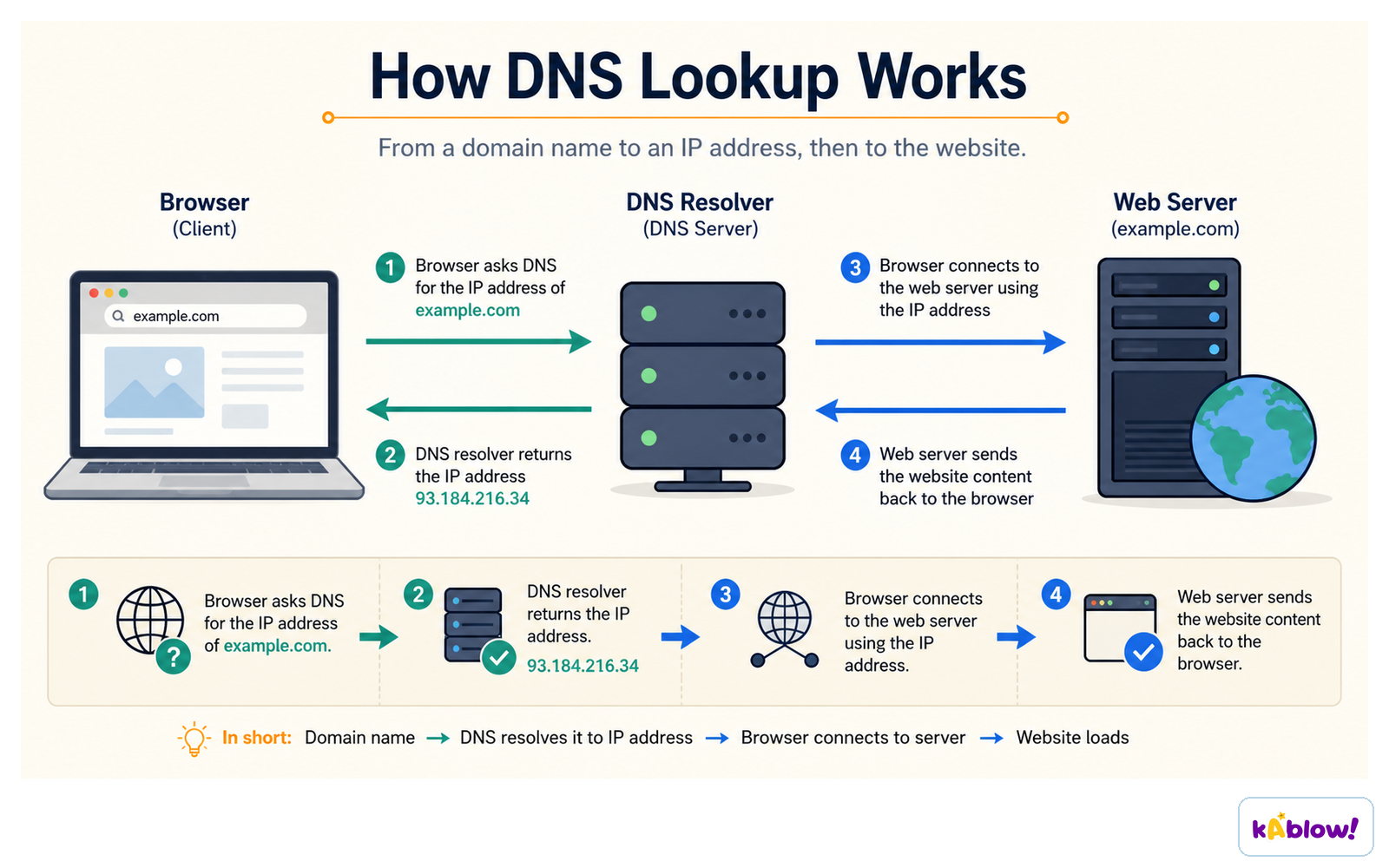
DNS resolves a domain name to an IP address so the browser can connect to the web server.
TCP/IP Model
- The TCP/IP model has four layers: link, internet, transport, and application.
- The link layer handles communication within a single network segment.
- The internet layer provides internetworking between networks (uses IP).
- The transport layer manages host-to-host communication (uses TCP or UDP).
- The application layer supports process-to-process data exchange for applications.
TCP and UDP
- TCP (Transmission Control Protocol) is a reliable, connection-oriented service.
- TCP ensures packets arrive in order and without errors.
- UDP (User Datagram Protocol) is a connectionless service.
- UDP is faster but does not guarantee delivery or order.
Sending a Message
- When a message is sent, the application layer prepares the data.
- The transport layer (e.g., TCP) splits it into segments and adds port info.
- The internet layer adds IP addresses and creates packets.
- The link layer sends the packets over the physical network.
- At the destination, the layers are reversed to reassemble the message.
History and Development
- The Internet protocol suite originated from DARPA research in the late 1960s.
- The ARPANET was the precursor to the Internet, using early routers called IMPs.
- Vint Cerf and Bob Kahn designed the protocol in the early 1970s.
- Originally, TCP was a single protocol; it was later split into TCP and IP in 1978.
A message is split into numbered packets that may take different routes and are reassembled in order at the destination.
The internet protocol suite in layers: application, transport, internet and network access.
Slides
Sign up free to view the lesson slides
Step through every slide for this topic — plus flashcards and revision notes — with a free account.
Practice questions
Free preview — 8 of 59 questions. Sign up to see them all.
1.What does IP stand for in the context of computer networks?
Easy- AInternet Protocol
- BInternal Processing
- CIntegrated Program
- DInformation Packet
2.Data sent over a network is split into smaller pieces called packets.
EasyTrue or false?
3.Which protocol provides a reliable, connection-oriented service for transmitting data?
Medium- ATCP
- BUDP
- CIP
- DHTTP
4.Which of the following are layers in the Internet protocol suite? (Select all that apply)
Medium- ALink layer
- BInternet layer
- CTransport layer
- DSession layer
- EApplication layer
5.In the TCP/IP suite, UDP provides a reliable connection-oriented service.
EasyTrue or false?
6.In the original ARPANET, the network itself was responsible for ensuring reliable data transmission.
EasyTrue or false?
7.Match each layer of the Internet protocol suite to its function.
Medium- Link layer
- Internet layer
- Transport layer
- Handles host-to-host communication
- Provides internetworking between independent networks
- Contains communication methods for data within a single network segment
8.Arrange the following events in chronological order, from earliest to latest.
Medium- BBN selected to build IMPs
- First IMP shipped to UCLA
- First message 'LO' sent
- TCP split into IP and TCP
Unlock all 59 questions, flashcards & more
Create a free account to see every question, the slides, flashcards and revision notes for this topic.