Evaluating online information and trustworthiness
Learn it by playing
Answer these questions to earn energy, then fish and explore. No account needed.
Lesson notes
What is Information Literacy?
- Information literacy is the ability to recognise when information is needed, and to locate, evaluate, and use it effectively.
- It involves critical thinking and making balanced judgements about any information we find and use.
- Being information literate helps you develop informed views and participate fully in society.
- It is considered a basic human right in a digital world, promoting social inclusion.
- Information literacy includes skills like traditional literacy, computer literacy, and research skills.
- It empowers you to seek, evaluate, use, and create information to achieve personal, social, and educational goals.
Why Evaluate Online Information?
- The internet is full of misinformation (false or inaccurate information) and fake news (deliberately false stories).
- Anyone can publish online, so not all sources are reliable.
- Evaluating information helps you avoid being misled and make better decisions.
- It is essential for democratic participation – informed citizens make wiser choices.
- Search engines rank results by relevance and popularity, not by truthfulness.
- Being able to evaluate information protects you from scams and manipulation.
Key Criteria for Evaluating Trustworthiness
- Source: Who published the information? Is it a reputable organisation, expert, or official body?
- Author: Who wrote it? Are they qualified or experienced in the topic?
- Evidence: Are claims backed up with facts, data, or references?
- Date: When was it published or updated? Is it current enough for the topic?
- Bias: Does the author or publisher have a particular viewpoint or agenda?
- Cross-check: Verify the information with other reliable sources.
Spotting Misinformation and Fake News
- Misinformation is false or inaccurate information shared without intent to deceive.
- Disinformation is deliberately false information spread to mislead.
- Fake news often uses sensational headlines to attract clicks.
- Check the URL and domain – unusual endings like .com.co may be fake.
- Look for poor spelling and grammar – a sign of low-quality content.
- Be wary of emotional language that tries to provoke a reaction.
- Use fact-checking websites to verify claims.
Why Search Ranking is Not Truth
- Search engines use algorithms to rank pages based on relevance and popularity.
- Popularity does not equal accuracy – a viral post can be false.
- Search results are influenced by advertising – paid ads appear at the top.
- Personalised results may show content based on your past behaviour, creating a filter bubble.
- Always evaluate the source, not just the position in search results.
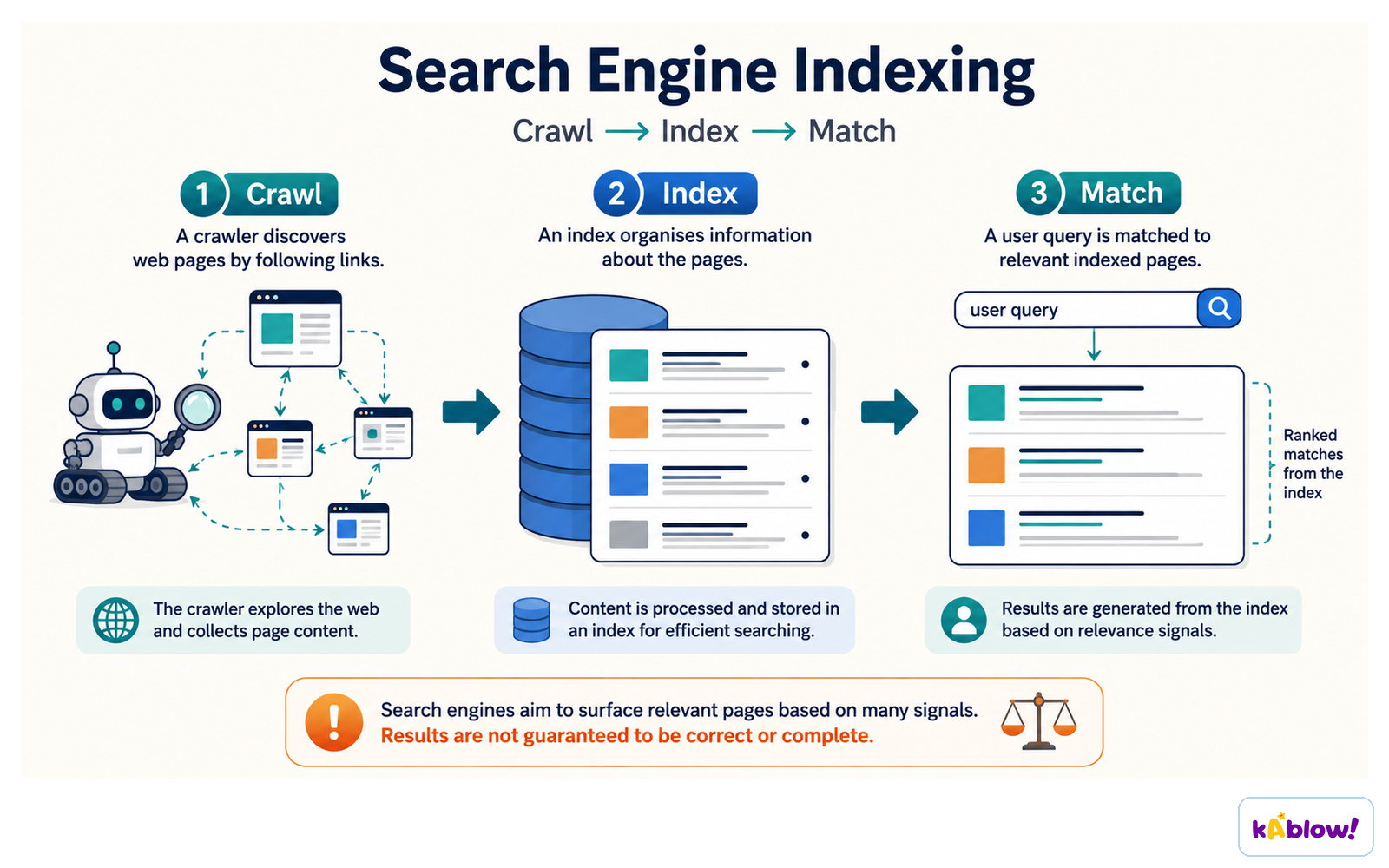
Crawlers discover pages, an index organises them, and a query is matched against that index: ranking reflects relevance signals, not truth.
Steps to Evaluate a Source
- Identify the source – who is the author or organisation?
- Check the purpose – is it to inform, persuade, sell, or entertain?
- Look for evidence – are there links, citations, or references?
- Check the date – is it recent enough for the topic?
- Assess bias – does it present multiple viewpoints or only one?
- Cross-check with other reliable sources to confirm the information.
The Role of Libraries and Information Professionals
- Libraries and librarians are key supporters of information literacy.
- Organisations like CILIP (Chartered Institute of Library and Information Professionals) define and promote information literacy.
- Librarians can help you find reliable sources and teach evaluation skills.
- Information literacy is a countermeasure to misinformation and fake news.
- Educators and librarians work to help people become critical consumers of information.
Information Literacy as a Life Skill
- Information literacy is not just for school – it is a lifelong skill.
- It helps you make informed decisions in health, finance, and civic life.
- It enables you to participate ethically in communities of learning.
- It is a human right that promotes social inclusion.
- Developing information literacy makes you a responsible digital citizen.
Slides
Sign up free to view the lesson slides
Step through every slide for this topic — plus flashcards and revision notes — with a free account.
Practice questions
Free preview — 8 of 59 questions. Sign up to see them all.
1.What does the acronym CILIP stand for in the context of information literacy in the UK?
Easy- AChartered Institute of Library and Information Professionals
- BCentral Information Literacy and Internet Protection
- CCouncil for Information Literacy and Internet Policy
- DChartered Institute for Legal and Information Professionals
2.Information literacy is only about finding information, not evaluating it.
EasyTrue or false?
3.According to the UK professional body CILIP, information literacy is defined as:
Easy- AThe ability to think critically and make balanced judgements about any information we find and use.
- BThe ability to use computers and software efficiently.
- CThe ability to memorize facts from various sources.
- DThe ability to create digital content for social media.
4.Search engine ranking is a reliable indicator of the truthfulness of a webpage.
MediumTrue or false?
5.When evaluating the trustworthiness of a website, which of the following is the LEAST reliable indicator?
Medium- AThe site's position in search results
- BThe author's credentials
- CThe presence of citations or references
- DThe date the information was published
6.Which of the following are key factors to consider when evaluating the trustworthiness of online information? (Select all that apply)
Medium- AThe author's expertise
- BThe number of likes on social media
- CThe presence of evidence or references
- DThe date of publication
- EThe website's visual design
7.The Alexandria Proclamation of 2005 declared information literacy a basic human right.
EasyTrue or false?
8.Which of the following best describes 'misinformation'?
Medium- AFalse information spread without the intention to deceive
- BFalse information spread deliberately to deceive
- CInformation that is biased but true
- DInformation that is outdated
Unlock all 59 questions, flashcards & more
Create a free account to see every question, the slides, flashcards and revision notes for this topic.