Extinction
Learn it by playing
Answer these questions to earn energy, then fish and explore. No account needed.
Lesson notes
What is Extinction?
- Extinction is the process where a species completely disappears from Earth.
- It occurs when environmental changes make survival difficult for a species.
- If a species cannot adapt quickly enough, it struggles to compete for resources like food and water.
- Fewer individuals survive to reproduce, and over time the entire species becomes extinct.
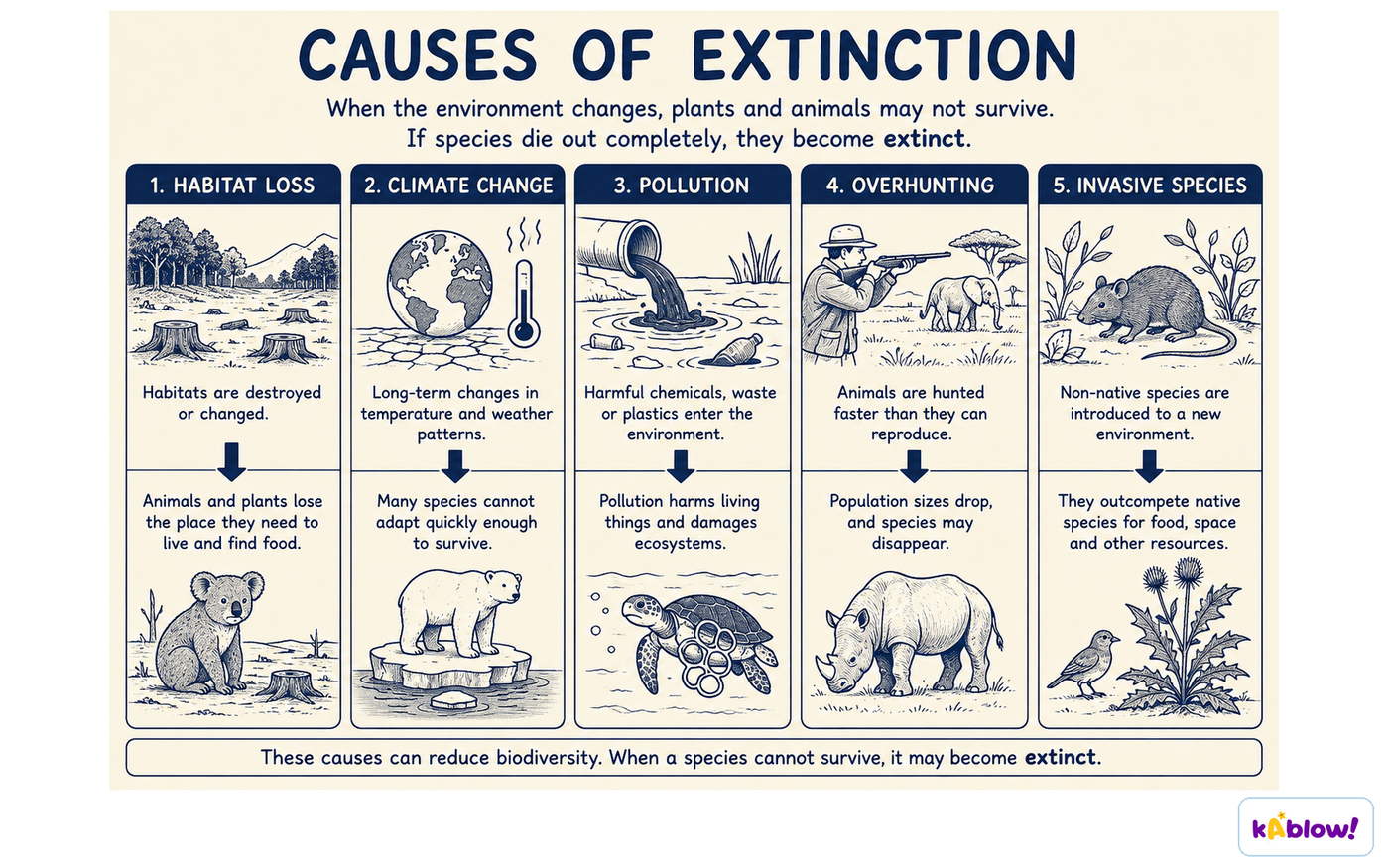
Causes of Extinction
- Climate change – if conditions become too hot, cold, dry or wet, some species cannot survive.
- Habitat loss – deforestation or draining wetlands destroys homes for animals and plants.
- Pollution – chemicals in air, water and soil can harm or kill sensitive species.
- Introduction of new species – non-native species with no predators can outcompete native species for resources.
Habitat loss, climate change, pollution, overhunting and invasive species can reduce populations and contribute to extinction.
What is Biodiversity?
- Biodiversity is the variety of all living things on Earth, including plants, animals and microorganisms.
- High biodiversity means many different species live in an ecosystem.
Importance of Biodiversity
- Ecosystem stability – species depend on each other; loss of one can affect many others.
- Resources – food, medicine and clean water come from biodiversity; losing species reduces these resources.
- Resilience to change – ecosystems with high biodiversity are more resilient to changes like climate change.
Gene Banks
- Gene banks store genetic material such as seeds, sperm, eggs or embryos.
- They help protect endangered species and could bring back extinct species.
- Preservation and research – scientists study stored genetic material to learn how to protect species.
- Restoration – gene banks can be used to breed new individuals and reintroduce species into the wild.
Slides
Sign up free to view the lesson slides
Step through every slide for this topic — plus flashcards and revision notes — with a free account.
Practice questions
Free preview — 8 of 55 questions. Sign up to see them all.
1.What is extinction?
Easy- AThe process where a species completely disappears from the Earth
- BThe process where a species evolves into a new species
- CThe process where a species migrates to a new habitat
- DThe process where a species becomes more numerous
2.Which of the following is NOT a cause of extinction mentioned in the source?
Easy- AClimate change
- BHabitat loss
- CNatural selection
- DIntroduction of new species
3.What is biodiversity?
Easy- AThe variety of all living things on Earth
- BThe number of individuals of a single species
- CThe total mass of all organisms in an area
- DThe genetic similarity within a population
4.Which of the following is a reason why maintaining biodiversity is important?
Easy- AIt ensures that all species are the same
- BIt makes ecosystems more vulnerable to change
- CIt provides resources such as food and medicine
- DIt reduces the number of species in an ecosystem
5.How can the introduction of a new species lead to extinction?
Medium- AThe new species provides food for native species
- BThe new species has no natural predators and outcompetes native species
- CThe new species increases the biodiversity of the ecosystem
- DThe new species helps native species adapt to changes
6.What is a gene bank?
Easy- AA place where genetic material is stored
- BA bank that provides money for conservation
- CA list of all the genes in a species
- DA facility that breeds endangered animals
7.Which of the following statements about gene banks is correct?
Easy- AGene banks can be used to reintroduce species into the wild
- BGene banks only store seeds from plants
- CGene banks are used to create new species
- DGene banks increase the rate of extinction
8.An ecosystem has high biodiversity. Which statement is most likely true?
Medium- AIt is less resilient to environmental changes
- BIt is more resilient to environmental changes
- CIt has fewer species than an ecosystem with low biodiversity
- DIt is more likely to experience extinction events
Unlock all 55 questions, flashcards & more
Create a free account to see every question, the slides, flashcards and revision notes for this topic.