Food chains and webs
Learn it by playing
Answer these questions to earn energy, then fish and explore. No account needed.
Lesson notes
Food Chains
- A food chain shows what eats what in a linear sequence.
- Example: grass → grasshopper → bird → fox.
- Producers make their own food through photosynthesis (e.g., grass, lettuce).
- Primary consumers eat producers (herbivores).
- Secondary consumers eat primary consumers.
- Tertiary consumers eat secondary consumers.
Energy flows from producers to consumers and decomposers. Nutrients can be recycled, but energy is transferred and dissipated rather than cycled.
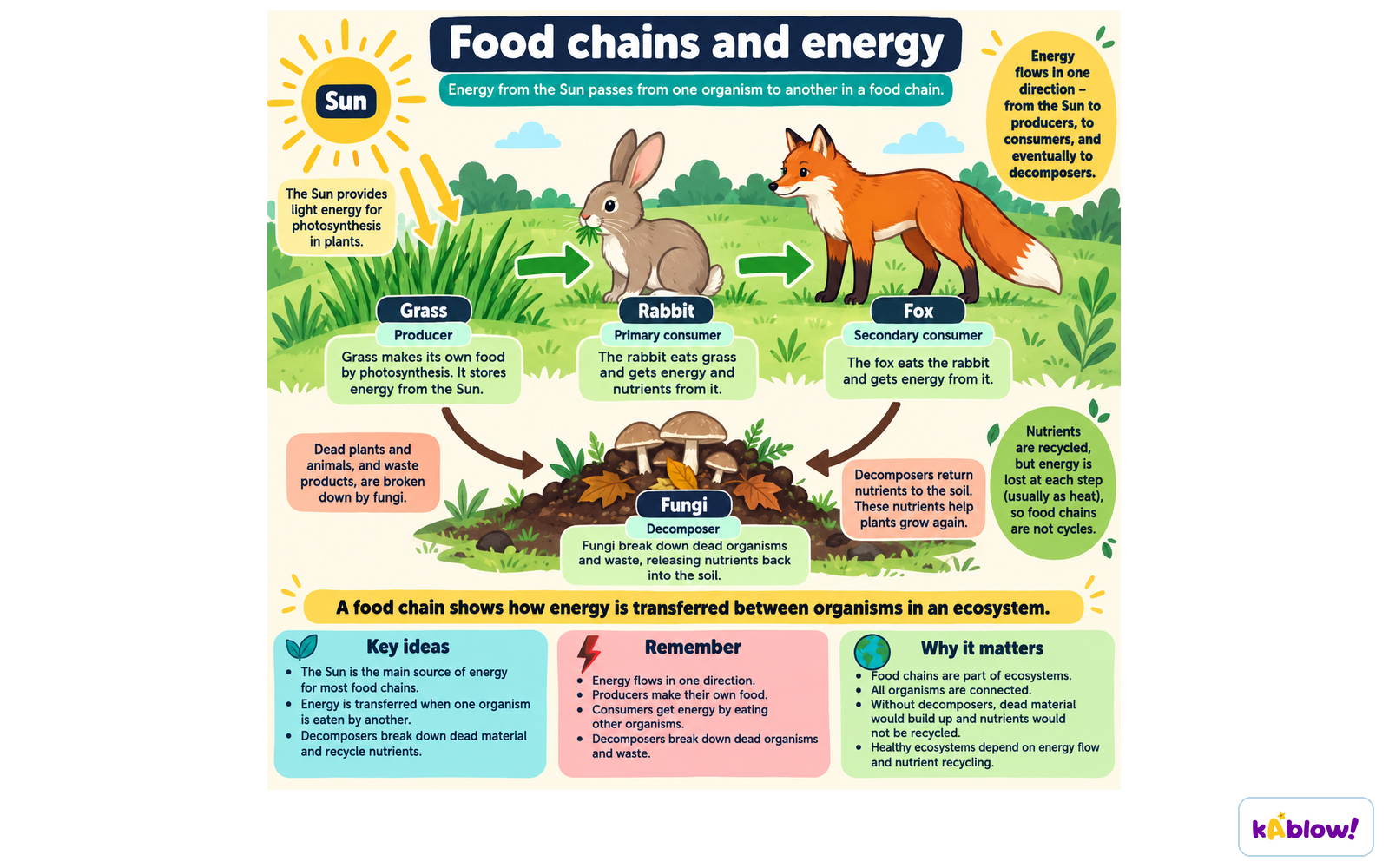
Key Definitions
- Herbivore: eats only plants.
- Carnivore: eats other animals.
- Omnivore: eats both plants and animals.
- Predator: an organism that eats another organism.
- Prey: the organism that a predator eats.
Food Webs
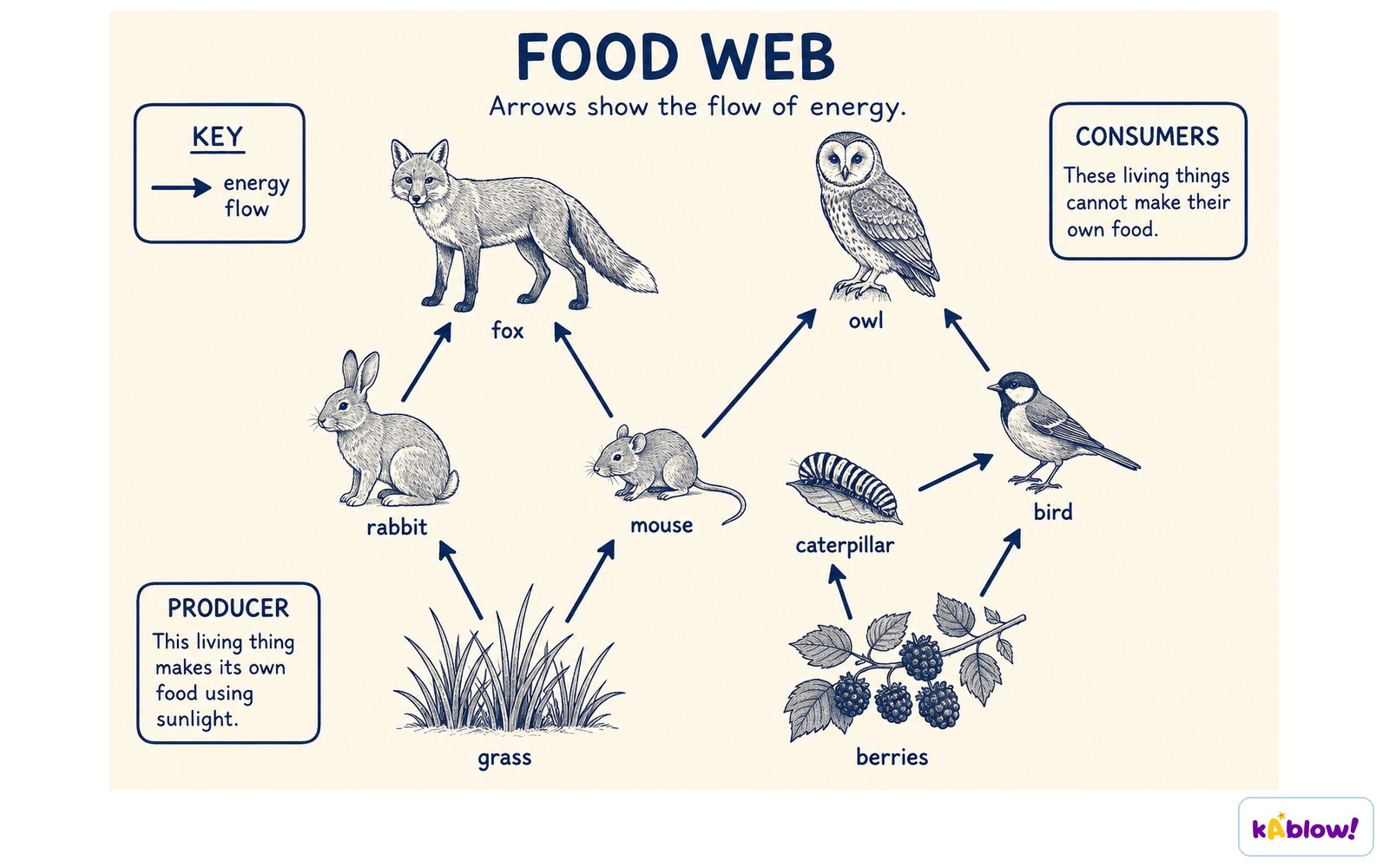
- A food web contains many interconnected food chains.
- It shows the complex feeding relationships in an ecosystem.
- If one part of the web is affected, it can affect other parts.
- Example: if carrots die, rabbit population may decrease due to less food.
A food web combines several food chains. Each arrow points from an organism being eaten to its consumer.
Energy Flow
- Energy flows from producers to consumers along food chains.
- Only about 10% of energy is passed to the next trophic level.
- The rest is lost as heat, waste, or used for life processes.
- Energy pyramids show the decreasing energy at each level.
Energy passes from the Sun to a producer and then to consumers. Less energy is available at each higher feeding level.
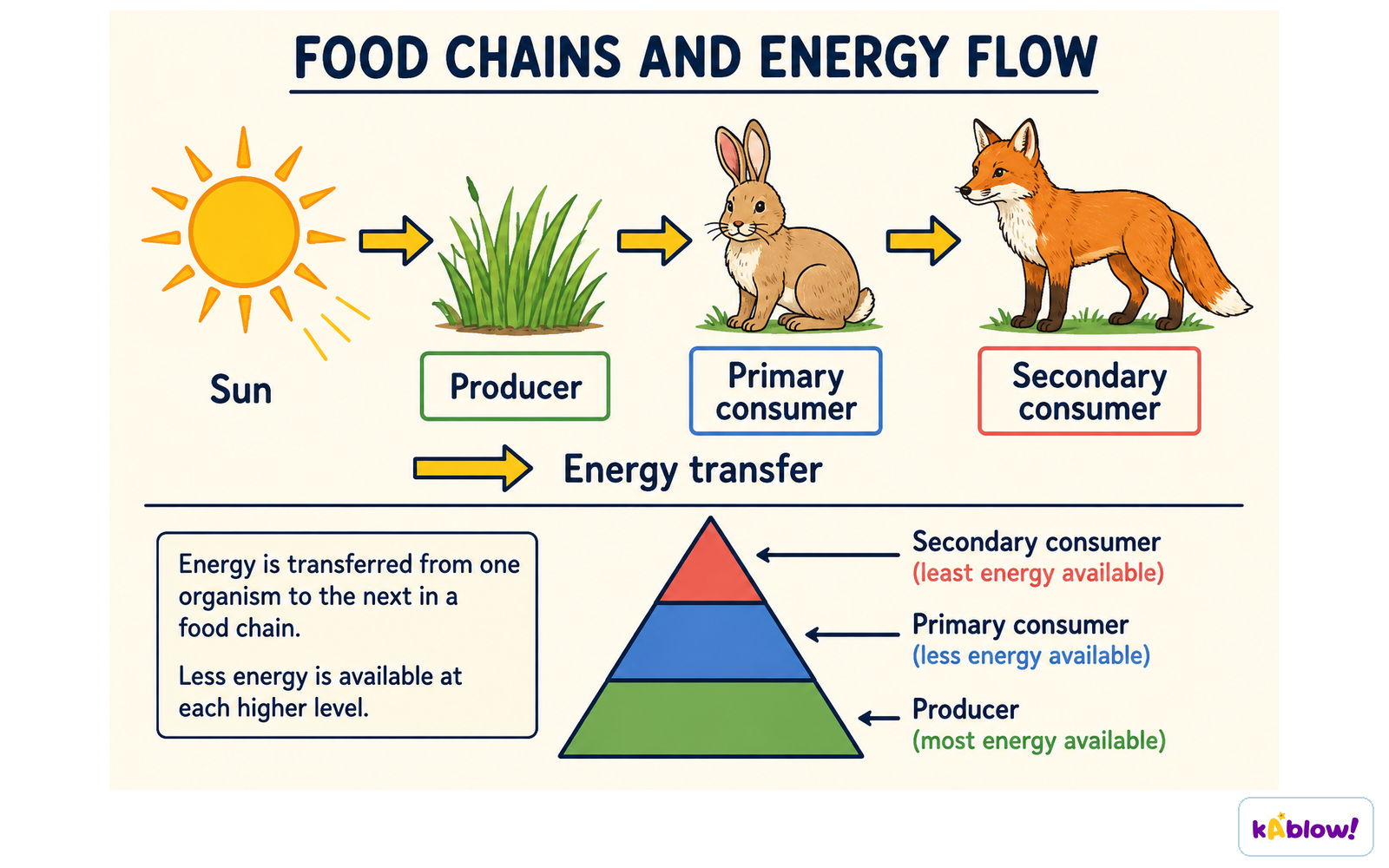
Energy pyramid showing trophic levels and energy loss.
Slides
Sign up free to view the lesson slides
Step through every slide for this topic — plus flashcards and revision notes — with a free account.
Practice questions
Free preview — 8 of 63 questions. Sign up to see them all.
1.What is a producer in a food chain?
Easy- AAn organism that makes its own food through photosynthesis
- BAn animal that eats plants
- CAn animal that eats other animals
- DAn organism that breaks down dead matter
2.What is a herbivore?
Easy- AAn animal that eats only plants
- BAn animal that eats other animals
- CAn animal that eats both plants and animals
- DAn organism that makes its own food
3.In a food chain: grass → rabbit → fox, what is the secondary consumer?
Easy- AFox
- BRabbit
- CGrass
- DGrass and rabbit
4.In a food web, if all the rabbits died, what would most likely happen to the fox population?
Medium- ADecrease because they have less food
- BIncrease because there is more grass
- CStay the same
- DIncrease because rabbits are competitors
5.Which of the following is always a carnivore?
Medium- ATertiary consumer
- BPrimary consumer
- CHerbivore
- DProducer
6.What is the role of a primary consumer in a food chain?
Easy- AIt eats the producer
- BIt eats the secondary consumer
- CIt makes its own food
- DIt breaks down dead organisms
7.Which term describes an animal that eats both plants and animals?
Easy- AOmnivore
- BHerbivore
- CCarnivore
- DProducer
8.In the food chain: lettuce → slug → sparrow → hawk, what is the prey of the hawk?
Easy- ASparrow
- BSlug
- CLettuce
- DHawk
Unlock all 63 questions, flashcards & more
Create a free account to see every question, the slides, flashcards and revision notes for this topic.