Gas exchange in humans
Learn it by playing
Answer these questions to earn energy, then fish and explore. No account needed.
Lesson notes
What is gas exchange?
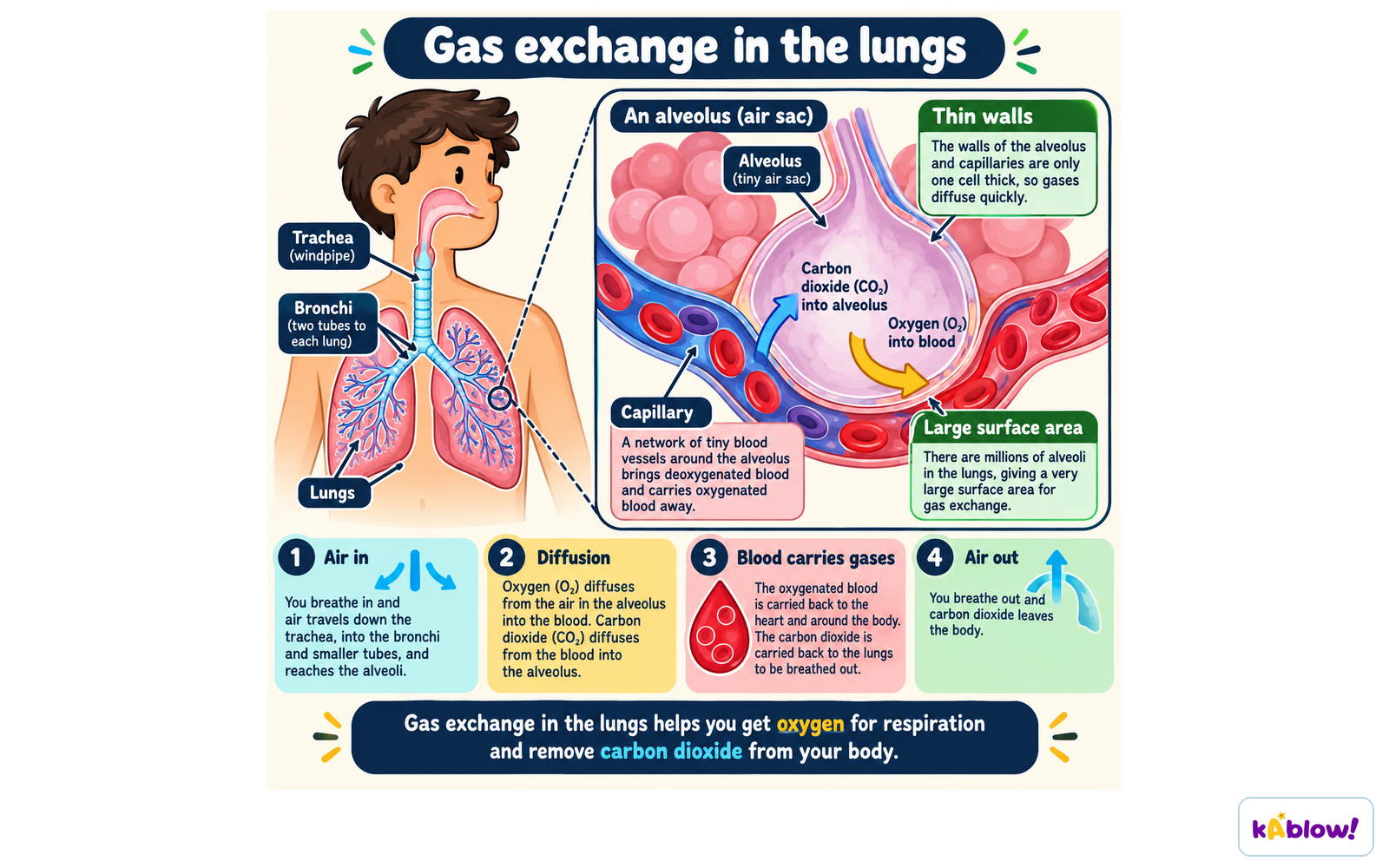
- Gas exchange is the process of taking in oxygen from the air and removing carbon dioxide from the bloodstream.
- It occurs in tiny air sacs called alveoli (singular: alveolus).
- Oxygen is needed for cellular respiration; carbon dioxide is a waste product.
Oxygen diffuses from the alveoli into the blood, while carbon dioxide diffuses from the blood into the alveoli.
The pathway of air
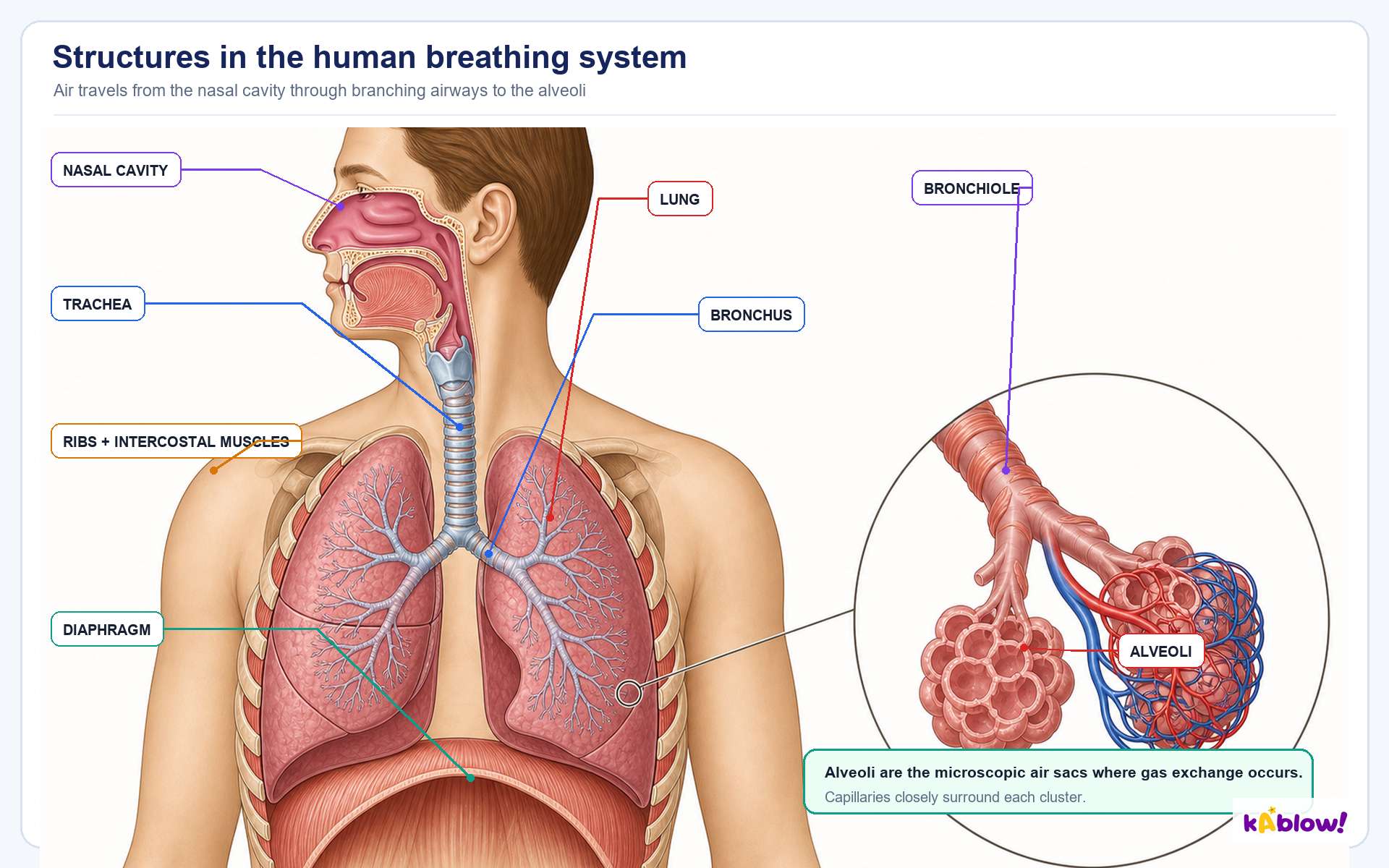
- Air enters through the nose or mouth and passes through the trachea.
- The trachea splits into two bronchi (one to each lung).
- Bronchi branch into smaller tubes called bronchioles.
- Bronchioles lead to the alveoli, where gas exchange happens.
Air passes from the nasal cavity through the trachea, bronchi and bronchioles to the alveoli; the diaphragm sits below the lungs.
Diffusion in the alveoli
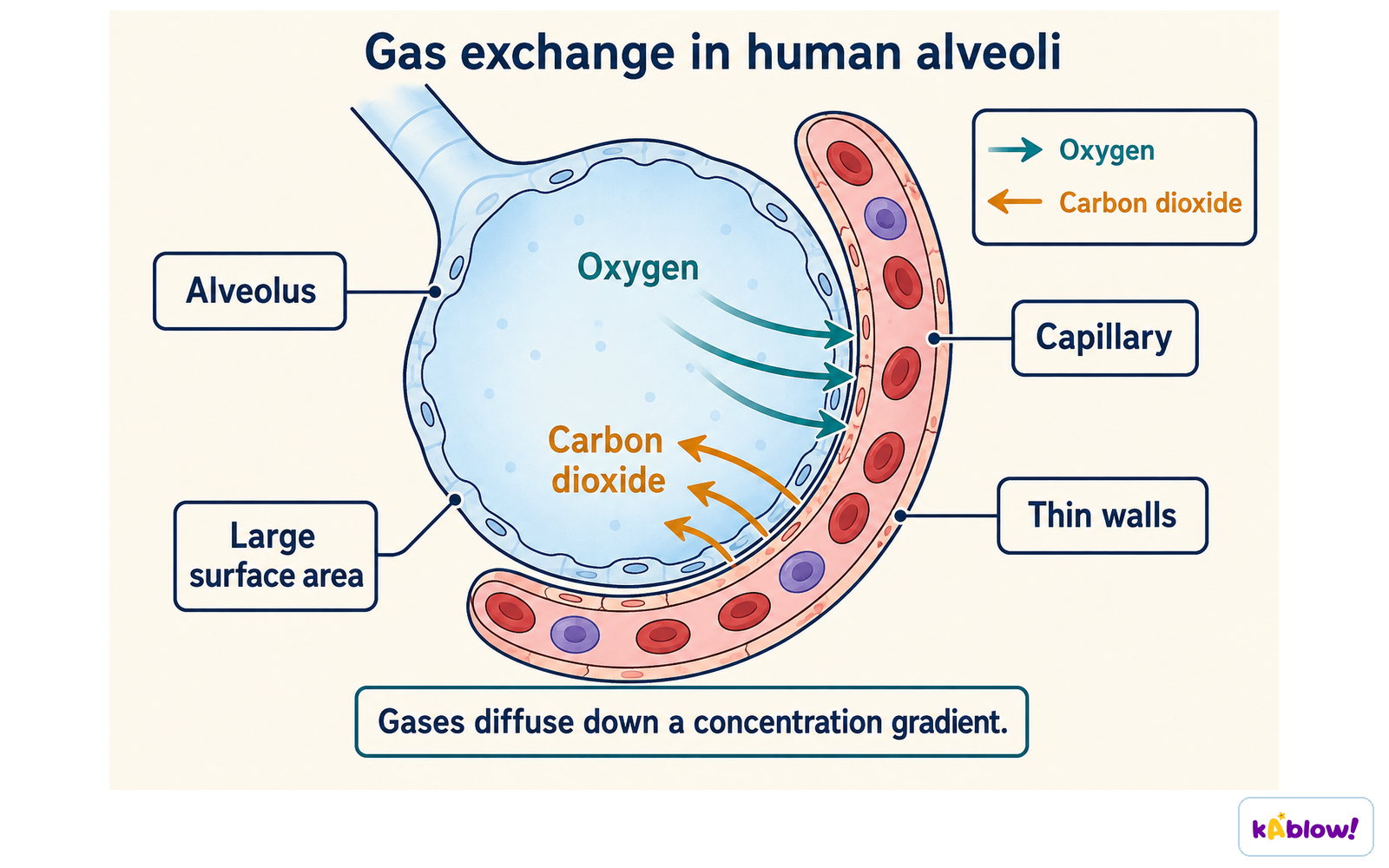
- Diffusion is the movement of particles from a high concentration to a low concentration.
- Oxygen diffuses from the alveoli (high concentration) into the blood in capillaries (low concentration).
- Carbon dioxide diffuses from the blood (high concentration) into the alveoli (low concentration).
- Capillaries are small blood vessels that wrap around each alveolus.
Oxygen and carbon dioxide diffuse in opposite directions across the thin walls of the alveolus and surrounding capillary.
How alveoli maximise diffusion
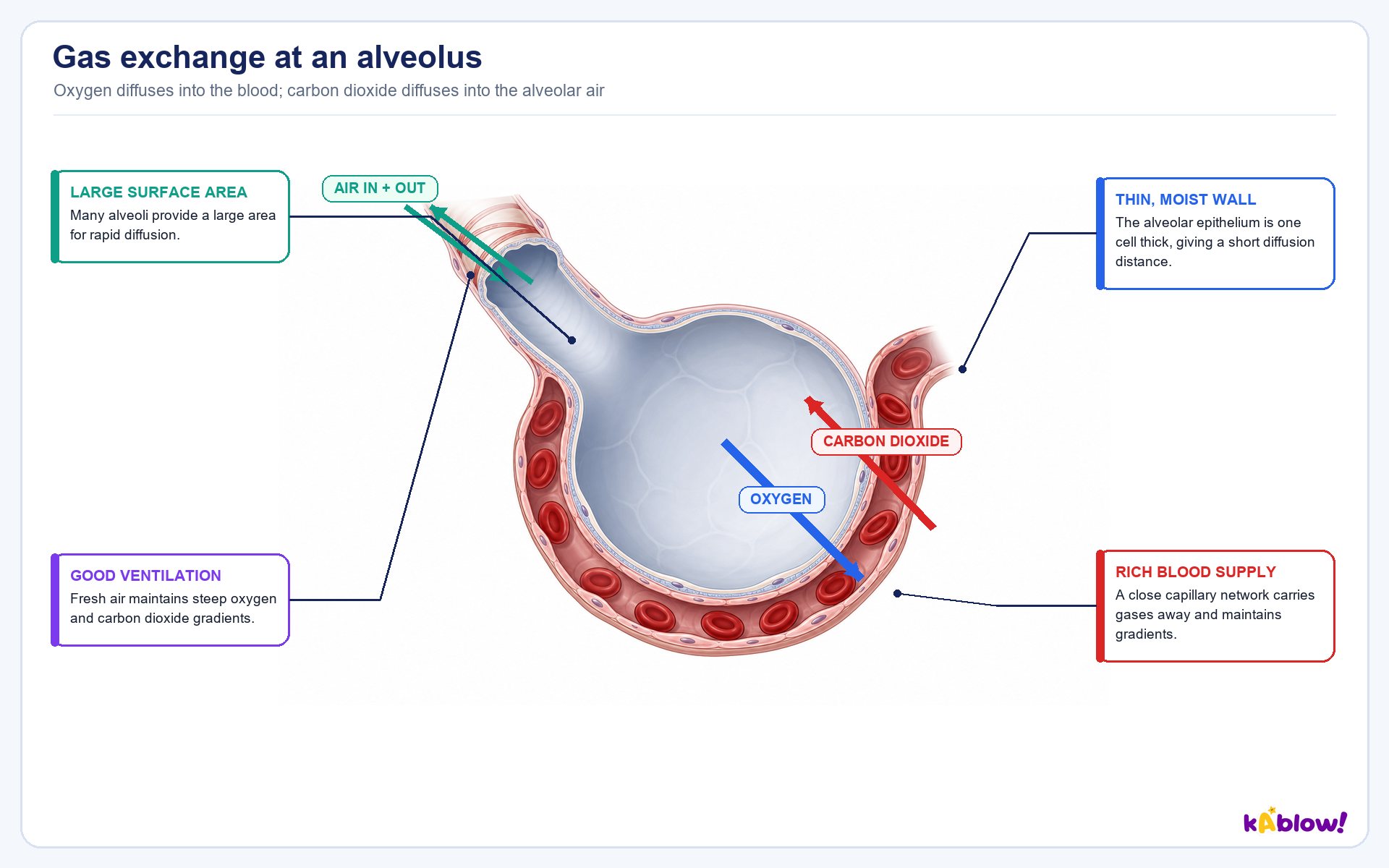
- They give the lungs a large surface area.
- They have a good blood supply with thin-walled capillaries.
- They are moist, so gases dissolve quickly.
A large surface area, a moist wall one cell thick, ventilation and a rich capillary supply keep diffusion rapid.
Exhalation of carbon dioxide
- Carbon dioxide moves from the alveoli into the bronchioles.
- Then through the bronchi and trachea.
- Finally, it is expelled through the nose or mouth.
Summary of gas exchange
- Gas exchange provides oxygen to the body's cells and removes carbon dioxide.
- It relies on diffusion across the thin walls of alveoli and capillaries.
- The structure of alveoli is adapted for efficient diffusion.
Slides
Sign up free to view the lesson slides
Step through every slide for this topic — plus flashcards and revision notes — with a free account.
Practice questions
Free preview — 8 of 56 questions. Sign up to see them all.
1.Which of the following is a waste product of cellular respiration that is removed from the body through the lungs?
Easy- ACarbon dioxide
- BOxygen
- CNitrogen
- DWater vapour
2.Diffusion is the movement of particles from an area of high concentration to an area of low concentration. Which of the following best describes this process?
Easy- AMovement from high to low concentration
- BMovement from low to high concentration
- CMovement only when there is a membrane
- DMovement only in liquids
3.Which of the following is NOT a way that alveoli maximise diffusion?
Easy- AThey have a good blood supply
- BThey are moist
- CThey have thick walls
- DThey provide a large surface area
4.What is the correct order of structures that air passes through when moving from the trachea to the alveoli?
Easy- ATrachea → bronchi → bronchioles → alveoli
- BTrachea → bronchioles → bronchi → alveoli
- CBronchi → trachea → bronchioles → alveoli
- DBronchioles → bronchi → trachea → alveoli
5.Which of the following best describes the concentration of oxygen in the blood before and after it passes through the alveoli?
Medium- AOxygen concentration is lower before and higher after
- BOxygen concentration is higher before and lower after
- COxygen concentration remains the same
- DOxygen is absent before and present after
6.Which of the following is the correct route that carbon dioxide takes when it is exhaled?
Easy- AAlveoli → bronchioles → bronchi → trachea → nose/mouth
- BAlveoli → bronchi → bronchioles → trachea → nose/mouth
- CTrachea → bronchi → bronchioles → alveoli → nose/mouth
- DBronchioles → alveoli → bronchi → trachea → nose/mouth
7.Alveoli are surrounded by capillaries. Which of the following statements about these blood vessels is correct?
Medium- ACapillaries have thin walls to allow diffusion
- BCapillaries have thick walls to withstand pressure
- CCapillaries carry blood away from the lungs only
- DCapillaries are the same size as alveoli
8.Which of the following best describes the function of the alveoli?
Easy- ASite of gas exchange between air and blood
- BTubes that carry air to the lungs
- CMuscles that help with breathing
- DStructures that produce mucus
Unlock all 56 questions, flashcards & more
Create a free account to see every question, the slides, flashcards and revision notes for this topic.