Making and separating solutions
Learn it by playing
Answer these questions to earn energy, then fish and explore. No account needed.
Lesson notes
Solutions and Dissolving
- When a solute dissolves in a solvent, a solution forms.
- Sugar and salt are soluble in water; sand is insoluble in water.
- Dissolving happens because solute particles mix evenly with solvent particles.
- Stirring and heating the solvent make a solute dissolve faster.
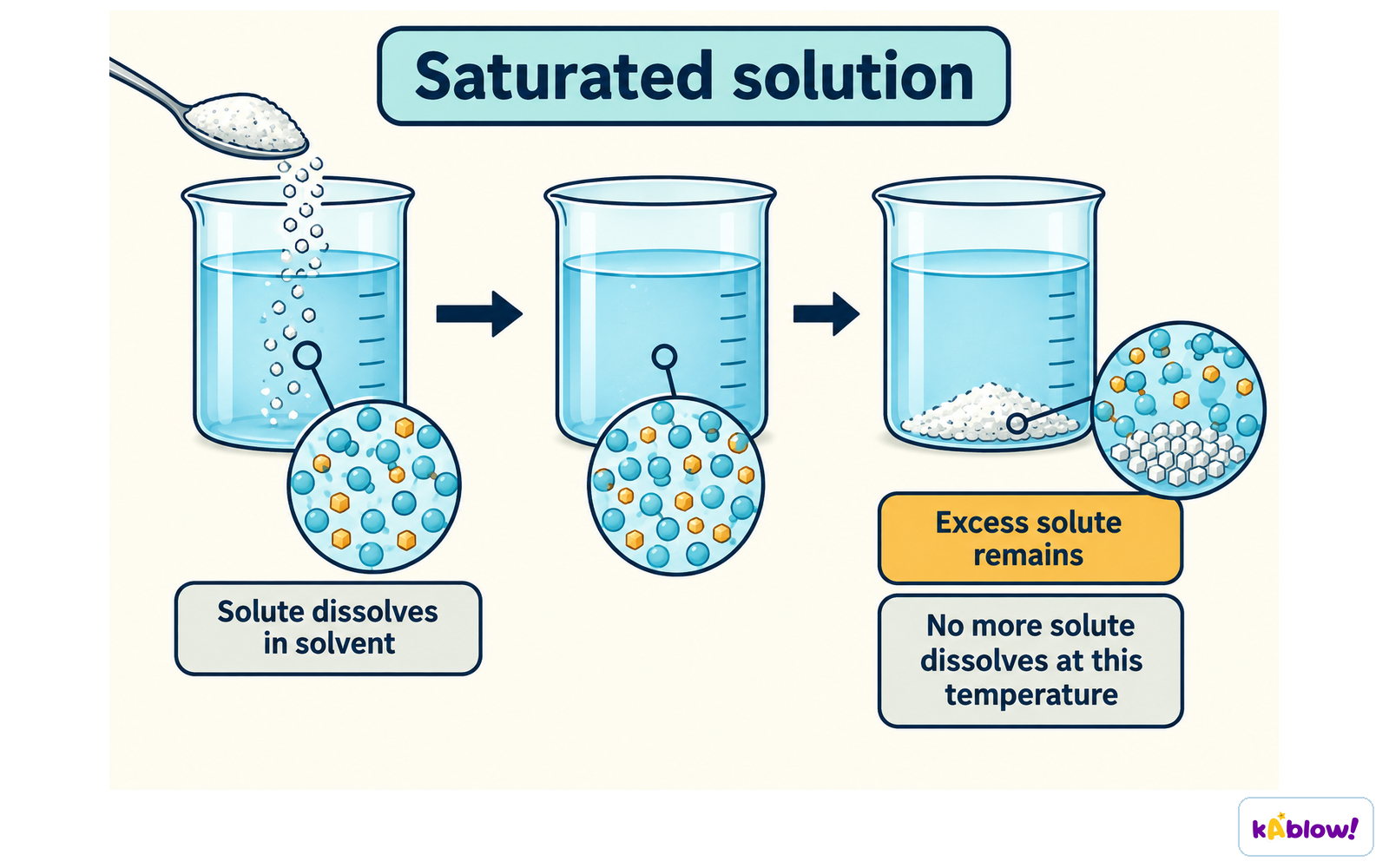
A solute dissolves in a solvent until the solution is saturated. At a fixed temperature, additional solute then remains undissolved.
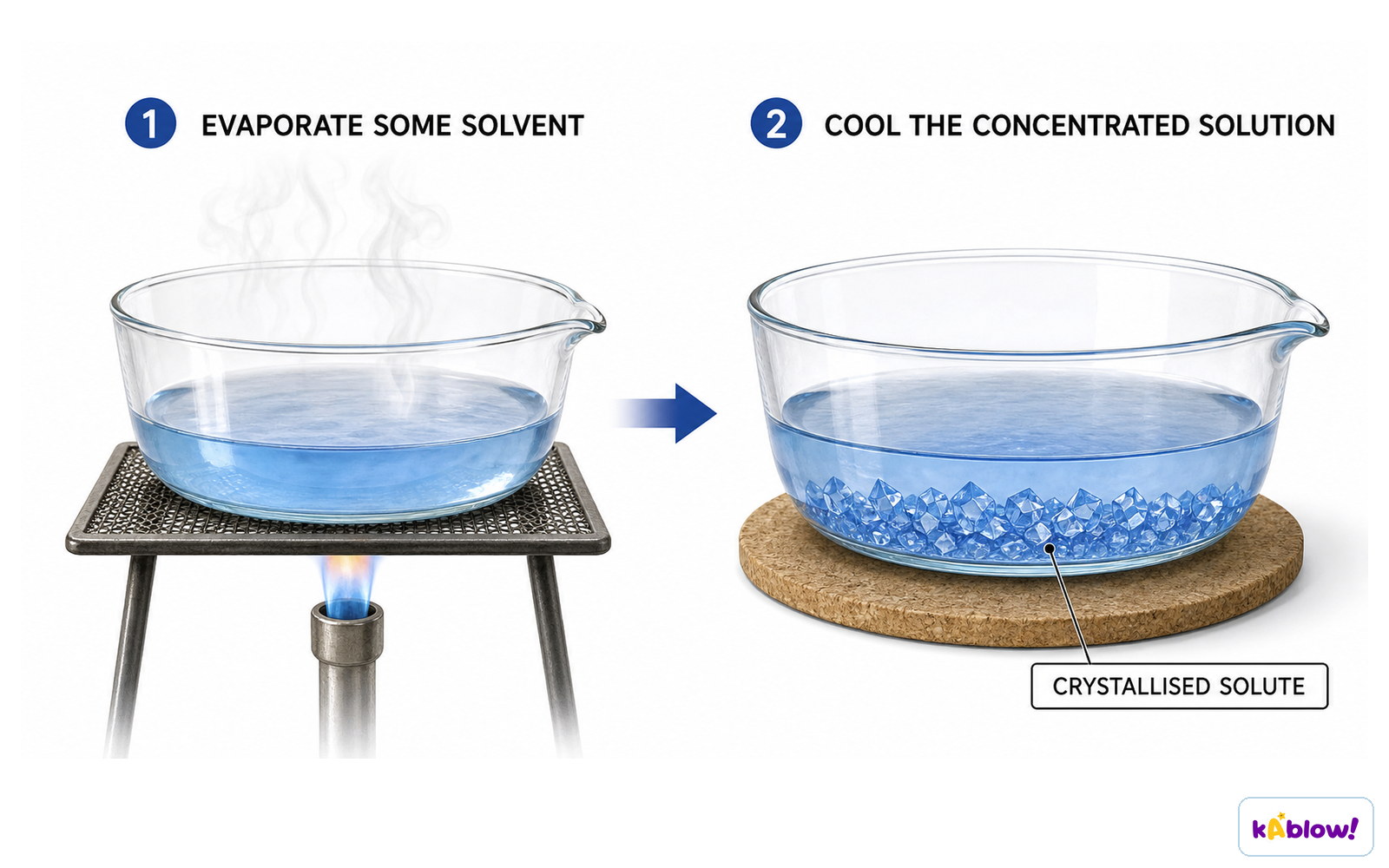
Separating a Soluble Solid from a Solution (Evaporation)
- To obtain a dissolved solid (e.g., copper sulphate), evaporate the solvent.
- Pour the solution into an evaporating basin and heat gently.
- As the solvent evaporates, crystals of the solute form.
- Remove from heat when enough solvent has evaporated, then leave to crystallise.
A solution is heated to evaporate some of the solvent; on cooling, the dissolved solid crystallises out.
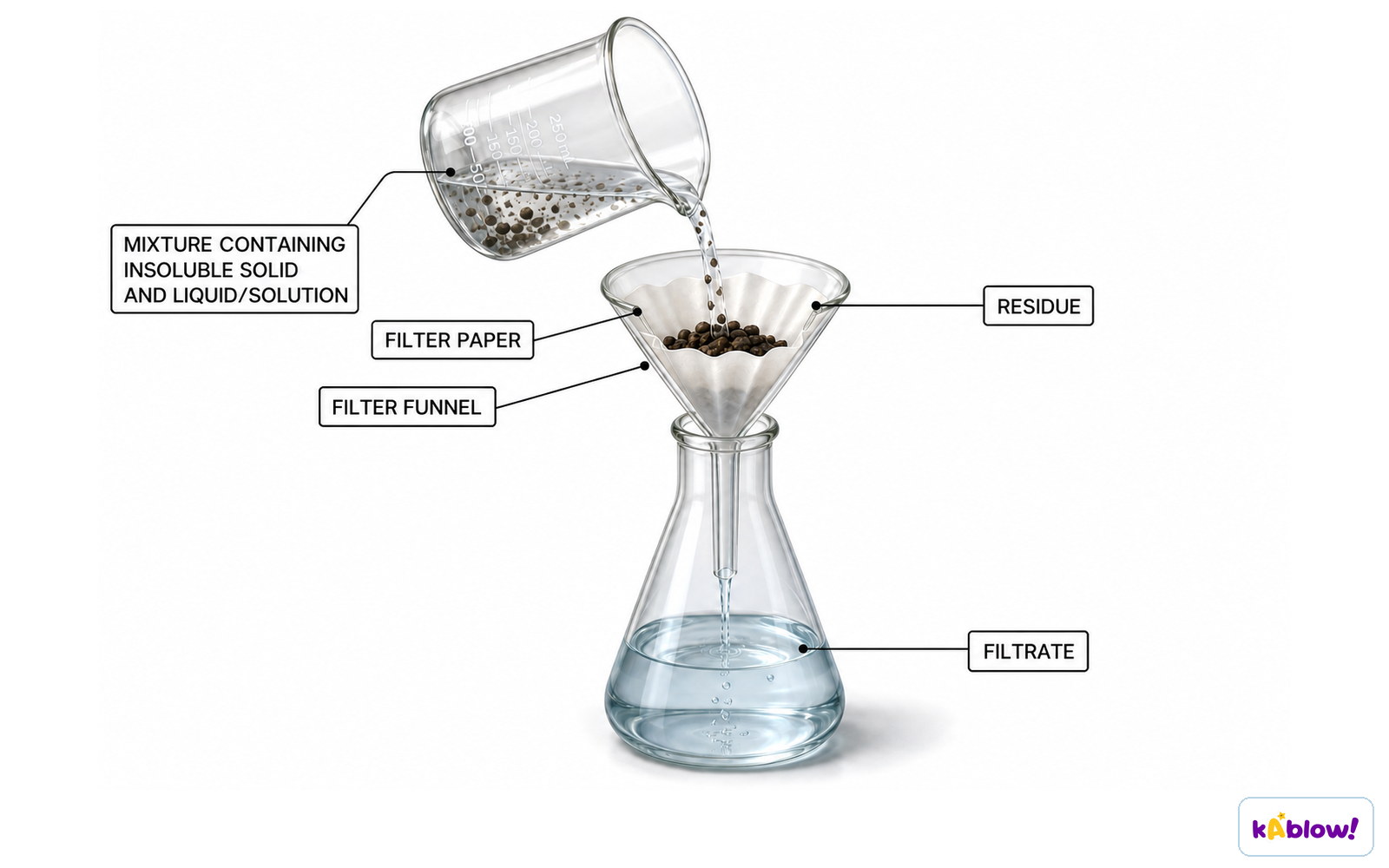
Separating an Insoluble Solid from a Liquid (Filtration)
- Use filtration to separate an insoluble solid (e.g., sand) from a liquid.
- Pour the mixture through filter paper in a funnel.
- Liquid particles (small) pass through the paper; solid particles (larger) are trapped.
- The liquid that passes through is called the filtrate; the trapped solid is the residue.
Filtration of a mixture of an insoluble solid and a liquid: the solid stays behind as the residue, the liquid passes through as the filtrate.
Particle arrangement in solids, liquids, and gases. Dissolving involves particles mixing, not changing state.
Slides
Sign up free to view the lesson slides
Step through every slide for this topic — plus flashcards and revision notes — with a free account.
Practice questions
Free preview — 8 of 57 questions. Sign up to see them all.
1.Which of the following is true about sand and water?
Easy- ASand is soluble in water.
- BSand is insoluble in water.
- CSand dissolves in water to form a solution.
- DSand and water cannot be separated by filtration.
2.What is the solute in a fizzy drink where carbon dioxide is dissolved in water?
Easy- AWater
- BCarbon dioxide
- CFizzy drink
- DSugar
3.Which of the following best defines the term 'soluble'?
Easy- AA substance that cannot dissolve in a solvent
- BA substance that can dissolve in a solvent
- CA liquid that dissolves other substances
- DA mixture of a solute and a solvent
4.Which of the following best defines the term 'insoluble'?
Easy- AA substance that can dissolve in a solvent
- BA substance that cannot dissolve in a solvent
- CA liquid that dissolves other substances
- DA mixture that cannot be separated
5.Which two methods can make sugar dissolve faster in water?
Easy- AHeating and stirring
- BCooling and stirring
- CHeating and leaving still
- DAdding more sugar and cooling
6.How would you separate sand from a mixture of sand and water?
Easy- AEvaporation
- BDistillation
- CFiltration
- DChromatography
7.Which method is used to obtain sugar crystals from a sugar solution?
Easy- AFiltration
- BEvaporation
- CDistillation
- DDecanting
8.In a solution of salt water, which component is the solvent?
Easy- ASalt
- BWater
- CBoth salt and water
- DNeither
Unlock all 57 questions, flashcards & more
Create a free account to see every question, the slides, flashcards and revision notes for this topic.