Neutralisation
Learn it by playing
Answer these questions to earn energy, then fish and explore. No account needed.
Lesson notes
What is Neutralisation?
- Neutralisation is a chemical reaction between an acid and a base.
- An acid has a pH less than 7; neutralisation raises the pH to 7.
- Signs of reaction include temperature rise and sometimes effervescence.
Bases and Alkalis
- A base is a substance that neutralises an acid.
- Metal oxides and metal hydroxides are bases.
- A soluble base is called an alkali.
Acid + Metal Oxide / Metal Hydroxide
- General equation: acid + metal oxide → salt + water
- General equation: acid + metal hydroxide → salt + water
- Hydrochloric acid forms chloride salts (e.g., iron chloride).
- Sulfuric acid forms sulfate salts (e.g., zinc sulfate).
- Nitric acid forms nitrate salts (e.g., calcium nitrate).
Acid + Metal Carbonate
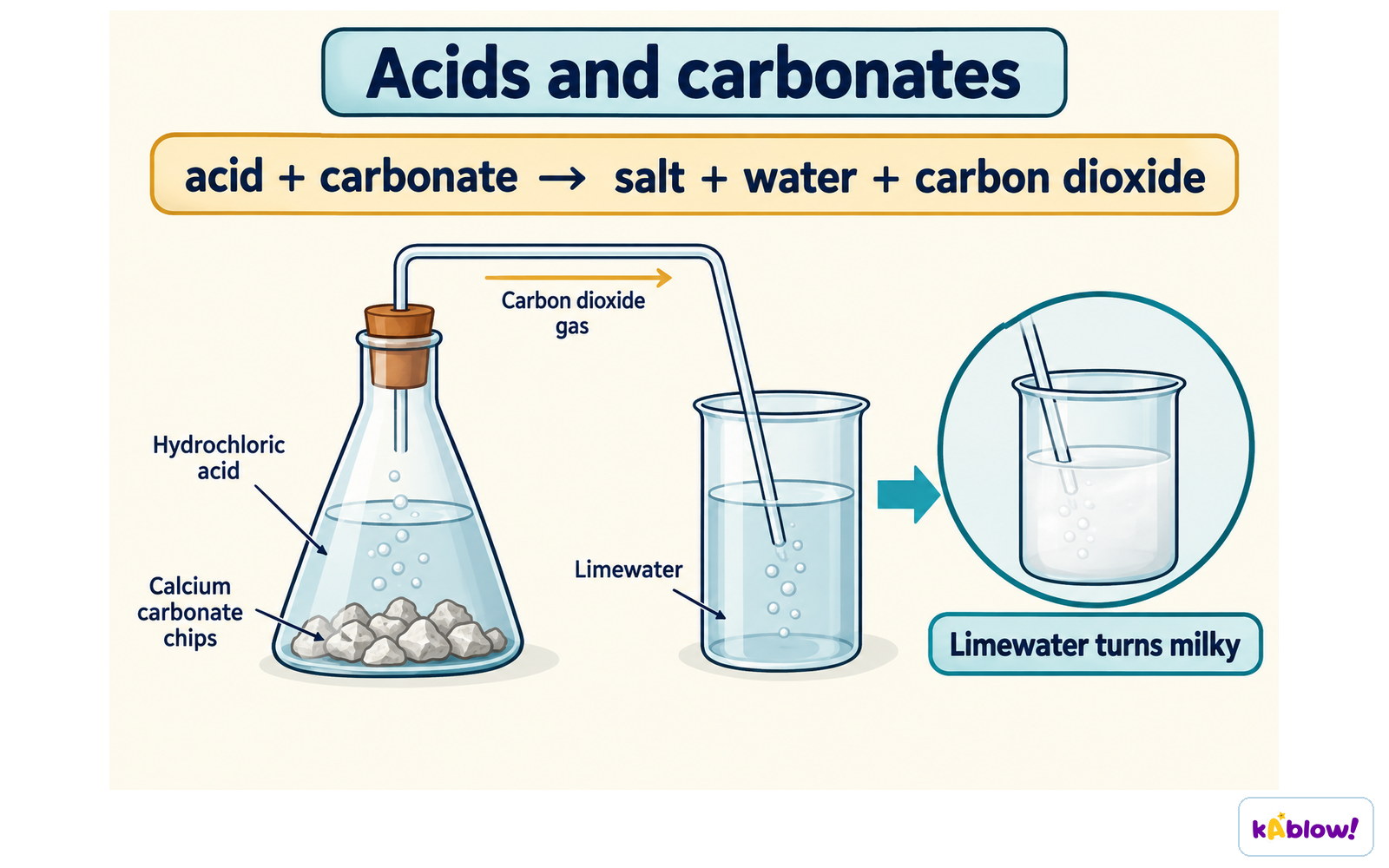
- General equation: acid + metal carbonate → salt + carbon dioxide + water
- Example: hydrochloric acid + calcium carbonate → calcium chloride + carbon dioxide + water
- Example: nitric acid + sodium carbonate → sodium nitrate + carbon dioxide + water
An acid reacts with a carbonate to make a salt, water and carbon dioxide. The carbon dioxide turns limewater milky.
Choosing an Indicator
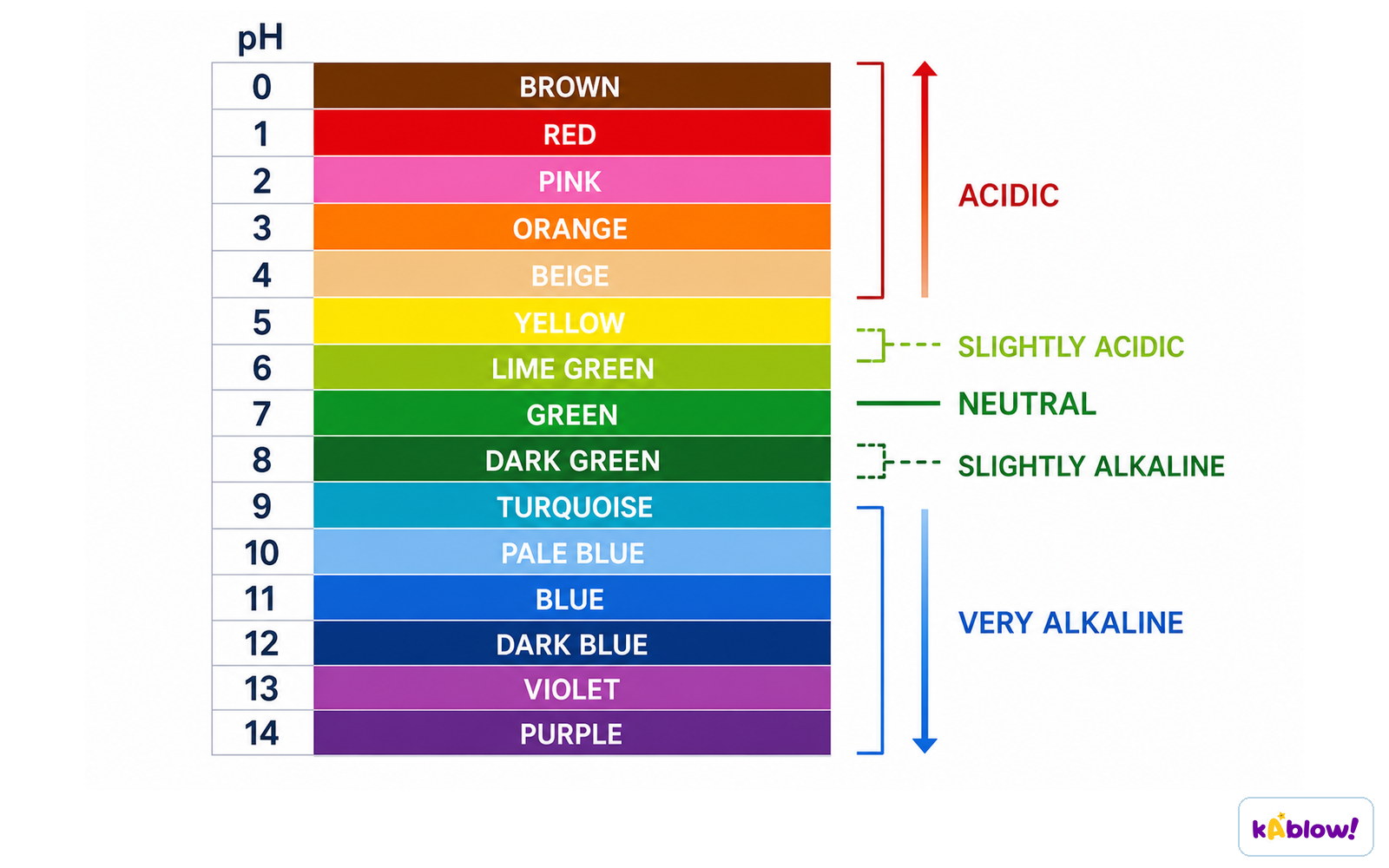
- Universal indicator shows a gradual colour change, making it hard to pinpoint pH 7.
- Better indicators with sudden colour change: litmus, phenolphthalein, or methyl orange.
Universal indicator changes colour across pH 0–14; match the observed colour to estimate a solution’s pH.
Particle arrangement in solid, liquid, and gas. Neutralisation often involves mixing solutions (liquids) and may produce gas (effervescence).
Slides
Sign up free to view the lesson slides
Step through every slide for this topic — plus flashcards and revision notes — with a free account.
Practice questions
Free preview — 8 of 64 questions. Sign up to see them all.
1.What is the pH of a neutral solution?
Easy- A7
- B0
- C14
- D1
2.Which of the following is the correct general word equation for the reaction between an acid and a metal oxide?
Easy- Aacid + metal oxide → salt + water
- Bacid + metal oxide → salt + hydrogen
- Cacid + metal oxide → salt + carbon dioxide + water
- Dacid + metal oxide → salt + oxygen
3.What is a base?
Easy- AA substance that neutralises an acid
- BA substance that turns blue litmus red
- CA substance with a pH less than 7
- DA substance that produces hydrogen ions in water
4.What is the pH of an acid?
Easy- ALess than 7
- BGreater than 7
- CEqual to 7
- DExactly 14
5.Which of the following is the correct word equation for the reaction between hydrochloric acid and sodium hydroxide?
Easy- Ahydrochloric acid + sodium hydroxide → sodium chloride + water
- Bhydrochloric acid + sodium hydroxide → sodium chloride + hydrogen
- Chydrochloric acid + sodium hydroxide → sodium sulfate + water
- Dhydrochloric acid + sodium hydroxide → sodium nitrate + water
6.What are the products of the reaction between sulfuric acid and calcium carbonate?
Medium- Acalcium sulfate, carbon dioxide and water
- Bcalcium chloride, carbon dioxide and water
- Ccalcium sulfate and water only
- Dcalcium nitrate, carbon dioxide and water
7.Which indicator is most suitable for detecting the endpoint of a neutralisation reaction?
Medium- AMethyl orange
- BUniversal indicator
- CRed cabbage juice
- DPhenolphthalein
8.When nitric acid reacts with magnesium hydroxide, what are the products?
Easy- Amagnesium nitrate and water
- Bmagnesium nitrate and hydrogen
- Cmagnesium sulfate and water
- Dmagnesium chloride and water
Unlock all 64 questions, flashcards & more
Create a free account to see every question, the slides, flashcards and revision notes for this topic.