Current
Learn it by playing
Answer these questions to earn energy, then fish and explore. No account needed.
Lesson notes
What is Current?
- Current is the flow of charge through a circuit.
- It is equal to how much charge flows past a point every second.
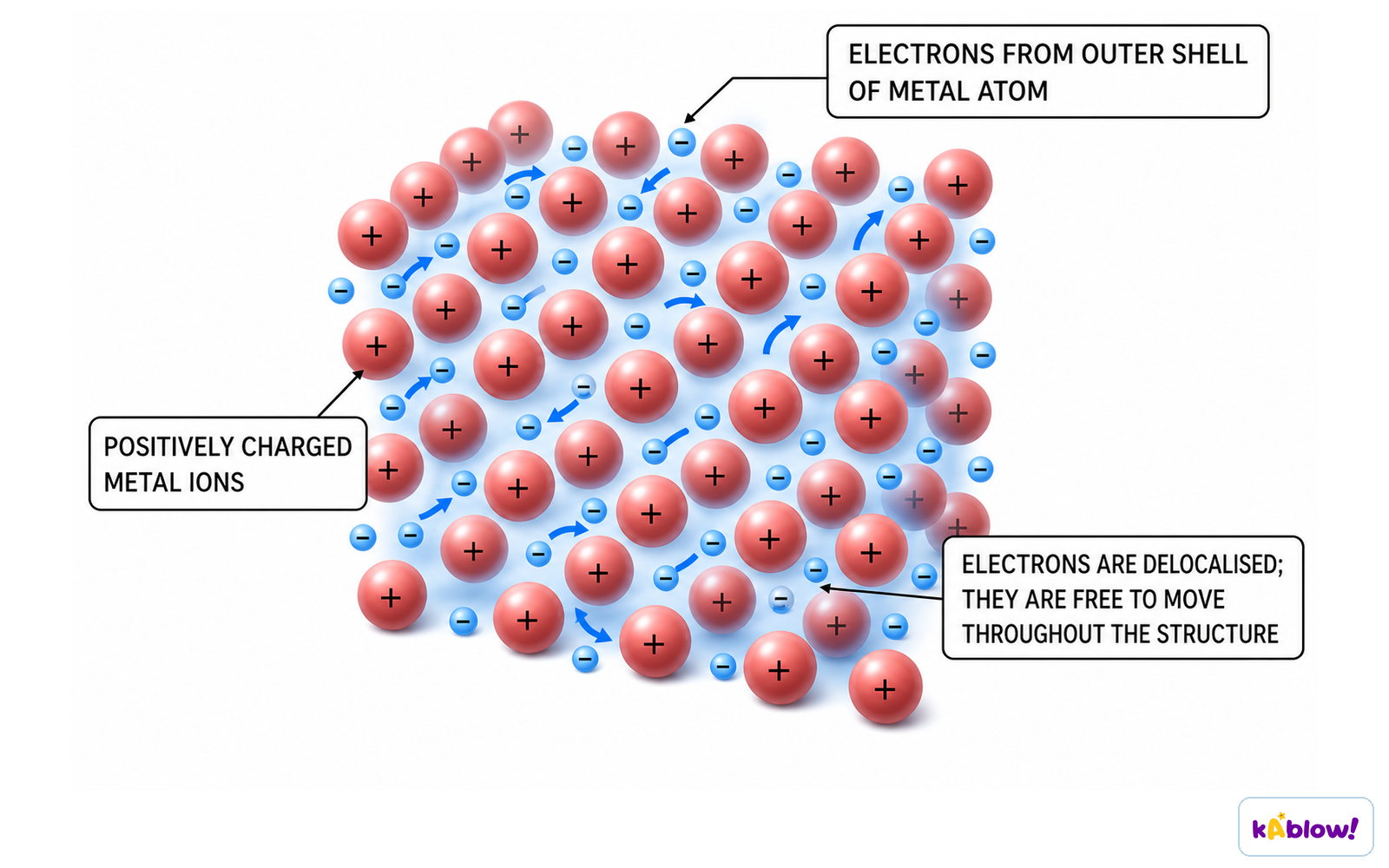
- The charged particles that flow are electrons (negatively charged).
- A complete circuit is needed for current to flow.
In a metal, positive ions sit in a fixed lattice while delocalised electrons are free to move.
Measuring Current
- Current is measured in amps (A).
- An ammeter measures current at a point in the circuit.
- The circuit symbol for an ammeter is a circle with an “A” inside.
Series Circuits
- A series circuit has only one path for current.
- Current is the same everywhere in a series circuit.
- Example: a series circuit with one lamp has 2 A at every point.
Parallel Circuits
- A parallel circuit has more than one path for current.
- At a junction, total current in equals total current out.
- Each branch draws current from the cell; total current is the sum of branch currents.
- Higher resistance in a path means lower current in that path.
Current and Resistance
- Resistance opposes current flow.
- In a parallel circuit with identical lamps, each branch has the same current.
- If one path has more lamps (more resistance), its current is less.
- Overall current from the battery is the sum of the branch currents.
A series circuit with a cell, switch, lamp, and ammeter. Current is the same at all points.
In a series circuit, the ammeter readings are equal (2 A everywhere).
Slides
Sign up free to view the lesson slides
Step through every slide for this topic — plus flashcards and revision notes — with a free account.
Practice questions
Free preview — 8 of 64 questions. Sign up to see them all.
1.What is the unit of electric current?
Easy- AAmps
- BVolts
- COhms
- DWatts
2.Which instrument is used to measure electric current?
Easy- AVoltmeter
- BAmmeter
- COhmmeter
- DGalvanometer
3.What particles flow through a circuit to create an electric current?
Easy- AProtons
- BNeutrons
- CElectrons
- DIons
4.In a series circuit, the current is:
Easy- Adifferent at different points
- Bthe same everywhere
- Chigher near the battery
- Dlower near the bulb
5.In a parallel circuit, the total current entering a junction is equal to:
Easy- Athe current in the smallest branch
- Bthe average of the branch currents
- Cthe total current leaving the junction
- Dthe current in the largest branch
6.A series circuit has a 2 A current. What is the current after passing through a lamp?
Easy- A0 A
- B1 A
- C2 A
- D4 A
7.In a parallel circuit with two identical lamps, the current in each branch is 2 A. What is the total current drawn from the battery?
Easy- A2 A
- B4 A
- C1 A
- D0 A
8.In a parallel circuit, one branch has a single lamp and the other branch has two identical lamps in series. The current through the single lamp is 2 A. What is the current through each of the two lamps?
Medium- A2 A each
- B1 A each
- C0.5 A each
- D4 A each
Unlock all 64 questions, flashcards & more
Create a free account to see every question, the slides, flashcards and revision notes for this topic.