Density
Learn it by playing
Answer these questions to earn energy, then fish and explore. No account needed.
Lesson notes
What is Density?
- Density is a measure of how much mass is contained in a given volume.
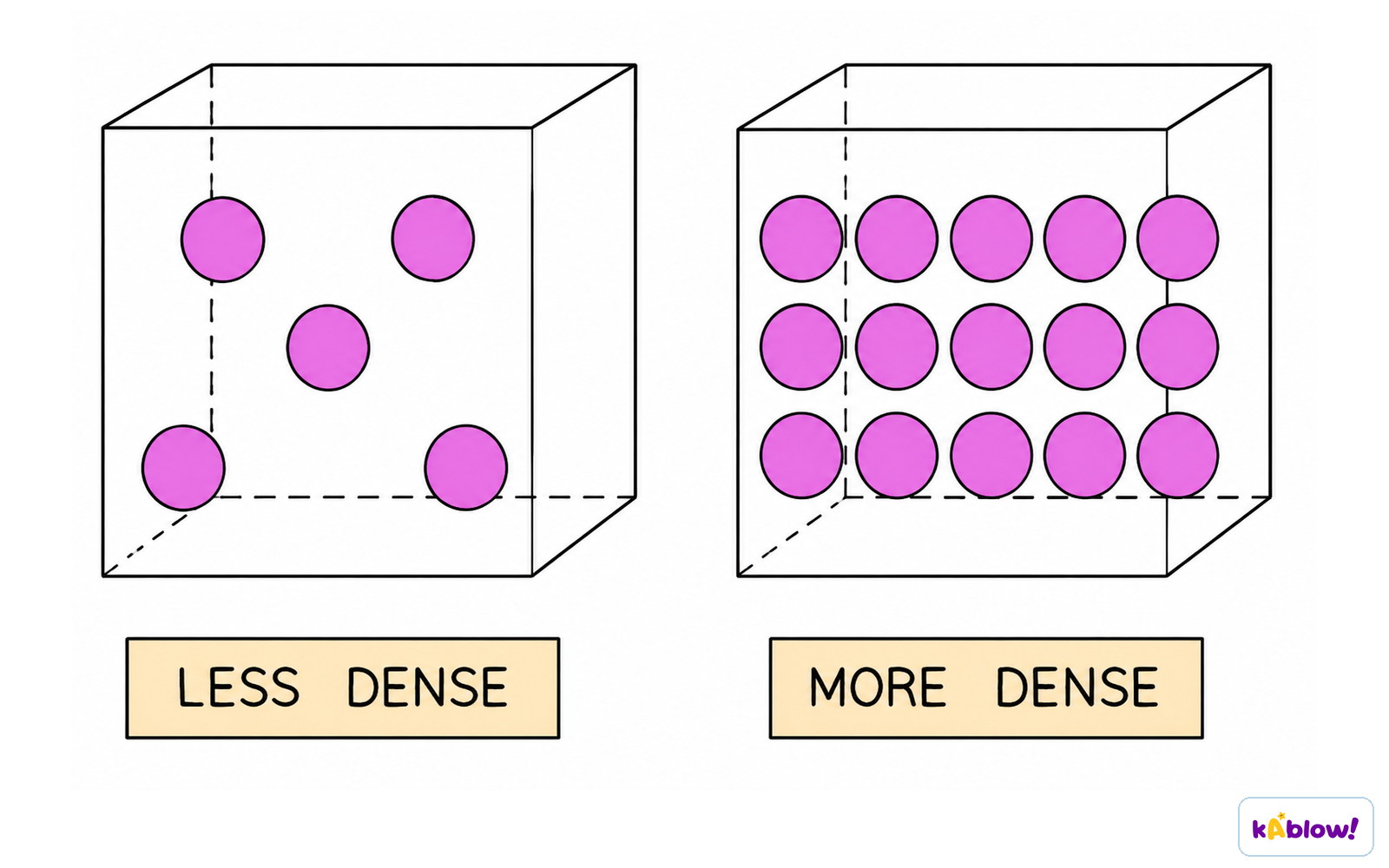
- If particles have the same mass, more particles in the same volume means higher density.
- Density determines whether an object floats or sinks in a fluid.
Particles packed less densely and more densely in equal volumes: a less-dense material compared with a more-dense material.
The Density Equation
- Density = Mass ÷ Volume
- Mass is the amount of matter in an object, measured in kilograms (kg).
- Volume is the space an object occupies, measured in cubic metres (m³).
- Density has units of kg/m³.
Calculating Density
- Example: Wood with mass 210 kg and volume 0.3 m³ has density = 210 ÷ 0.3 = 700 kg/m³.
- Always write the equation, substitute values, then calculate with units.
Rearranging the Equation
- To find volume: Volume = Mass ÷ Density.
- To find mass: Mass = Density × Volume.
- Example: Granite density 2700 kg/m³, mass 5400 kg → volume = 5400 ÷ 2700 = 2 m³.
Floating and Sinking
- Water density = 1000 kg/m³.
- Objects with density less than water float; objects with density greater than water sink.
- Wood (700 kg/m³) floats on water.
- Oil (800 kg/m³) floats on water because it is less dense.
Example Calculations
- Book: mass 1 kg, volume 0.002 m³ → density = 1 ÷ 0.002 = 500 kg/m³.
- Gold bar: mass 3.8 kg, volume 0.0002 m³ → density = 3.8 ÷ 0.0002 = 19,000 kg/m³.
- Rock: mass 300 kg, volume 0.1 m³ → density = 300 ÷ 0.1 = 3000 kg/m³.
Finding Volume from Density and Mass
- Steel density 7800 kg/m³, mass 3900 kg → volume = 3900 ÷ 7800 = 0.5 m³.
- Human body density 995 kg/m³, mass 70 kg → volume = 70 ÷ 995 ≈ 0.0704 m³.
- Crate: mass 250 kg, density 50 kg/m³ → volume = 250 ÷ 50 = 5 m³.
Finding Mass from Density and Volume
- Car: density 280 kg/m³, volume 4.2 m³ → mass = 280 × 4.2 = 1176 kg.
Particle arrangement in solids, liquids, and gases. Density is higher when particles are more closely packed.
Slides
Sign up free to view the lesson slides
Step through every slide for this topic — plus flashcards and revision notes — with a free account.
Practice questions
Free preview — 8 of 60 questions. Sign up to see them all.
1.Which equation correctly relates density, mass and volume?
Easy- ADensity = Mass × Volume
- BDensity = Mass ÷ Volume
- CDensity = Volume ÷ Mass
- DDensity = Mass + Volume
2.What are the standard SI units for density, mass and volume respectively?
Easy- Akg/m³, kg, m³
- Bkg, m³, kg/m³
- Cm³, kg, kg/m³
- Dkg/m³, m³, kg
3.Water has a density of 1000 kg/m³ and oil has a density of 800 kg/m³. What will happen when oil is poured into water?
Easy- AThe oil will sink because it is denser.
- BThe oil will float because it is less dense.
- CThe oil will mix completely.
- DThe oil will float because it has a higher density.
4.A book has a mass of 1 kg and a volume of 0.002 m³. What is its density?
Medium- A500 kg/m³
- B2000 kg/m³
- C0.002 kg/m³
- D5000 kg/m³
5.A gold bar has a mass of 3.8 kg and a volume of 0.0002 m³. Calculate its density.
Medium- A19000 kg/m³
- B1900 kg/m³
- C190 kg/m³
- D0.0000526 kg/m³
6.A rock has a mass of 300 kg and a volume of 0.1 m³. What is its density?
Medium- A30 kg/m³
- B3000 kg/m³
- C300 kg/m³
- D0.000333 kg/m³
7.Steel has a density of 7800 kg/m³. What is the volume of a steel object with a mass of 3900 kg?
Medium- A0.5 m³
- B2 m³
- C30,420,000 m³
- D0.5 kg/m³
8.The average human body density is 995 kg/m³. Why can humans float in water (density 1000 kg/m³)?
Medium- ABecause the human body is less dense than water.
- BBecause the human body is more dense than water.
- CBecause humans have air in their lungs.
- DBecause humans can swim.
Unlock all 60 questions, flashcards & more
Create a free account to see every question, the slides, flashcards and revision notes for this topic.