Electric motors
Learn it by playing
Answer these questions to earn energy, then fish and explore. No account needed.
Lesson notes
Construction of an Electric Motor
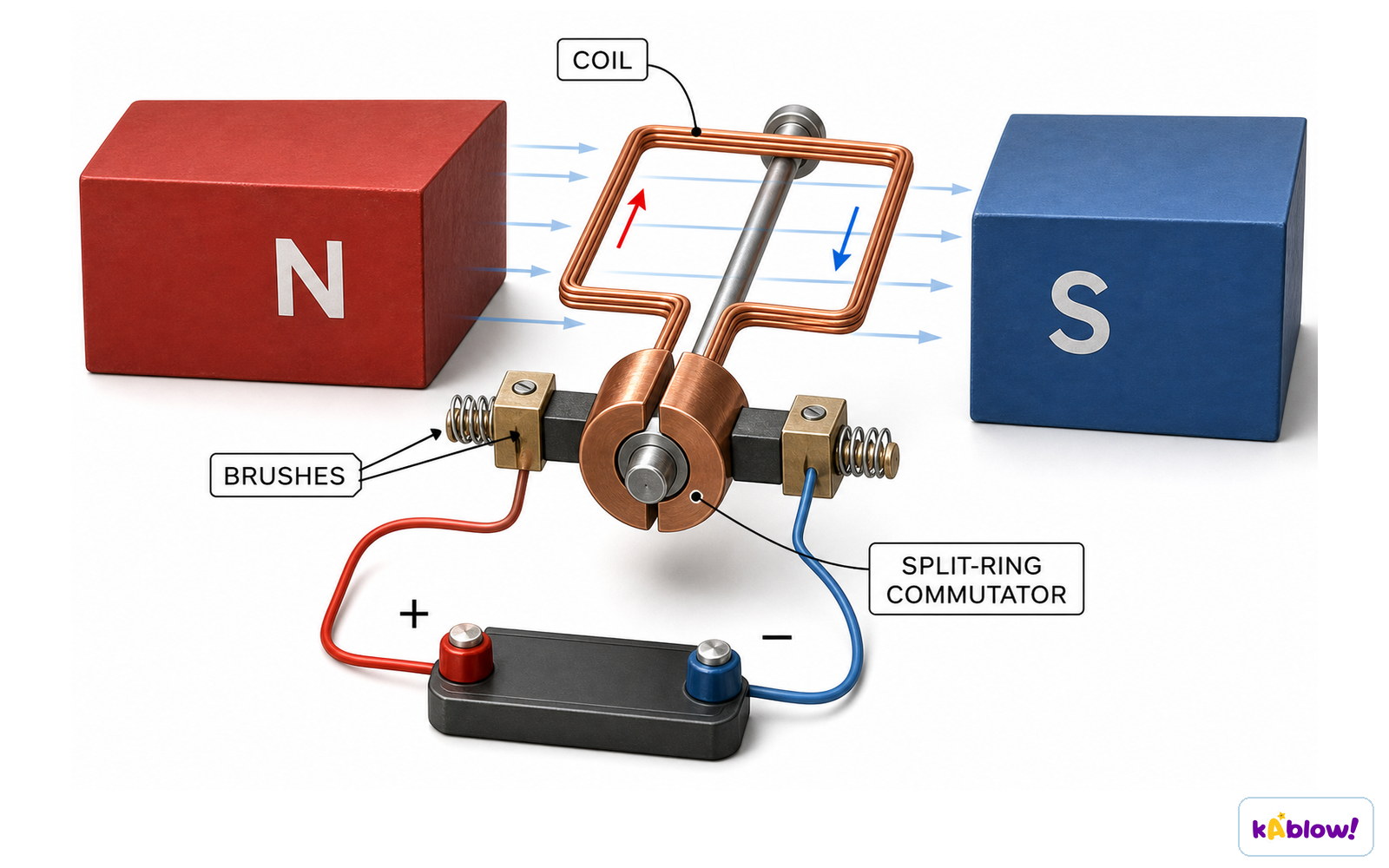
- An electric motor consists of a coil of wire (armature) placed inside a magnetic field produced by two permanent magnets.
- A battery supplies current to the coil.
- The brushes (made of carbon) rub against the split ring commutator, allowing the coil to rotate.
Structure of a simple d.c. motor, showing the coil, split-ring commutator, carbon brushes and magnetic field.
How the Motor Works
- When current flows through a wire, it creates its own magnetic field.
- This magnetic field interacts with the permanent magnetic field, producing a force on the coil.
- On the left side of the coil, the interaction causes an upwards force; on the right side, a downwards force (because current direction changes).
- These forces cause the coil to rotate.
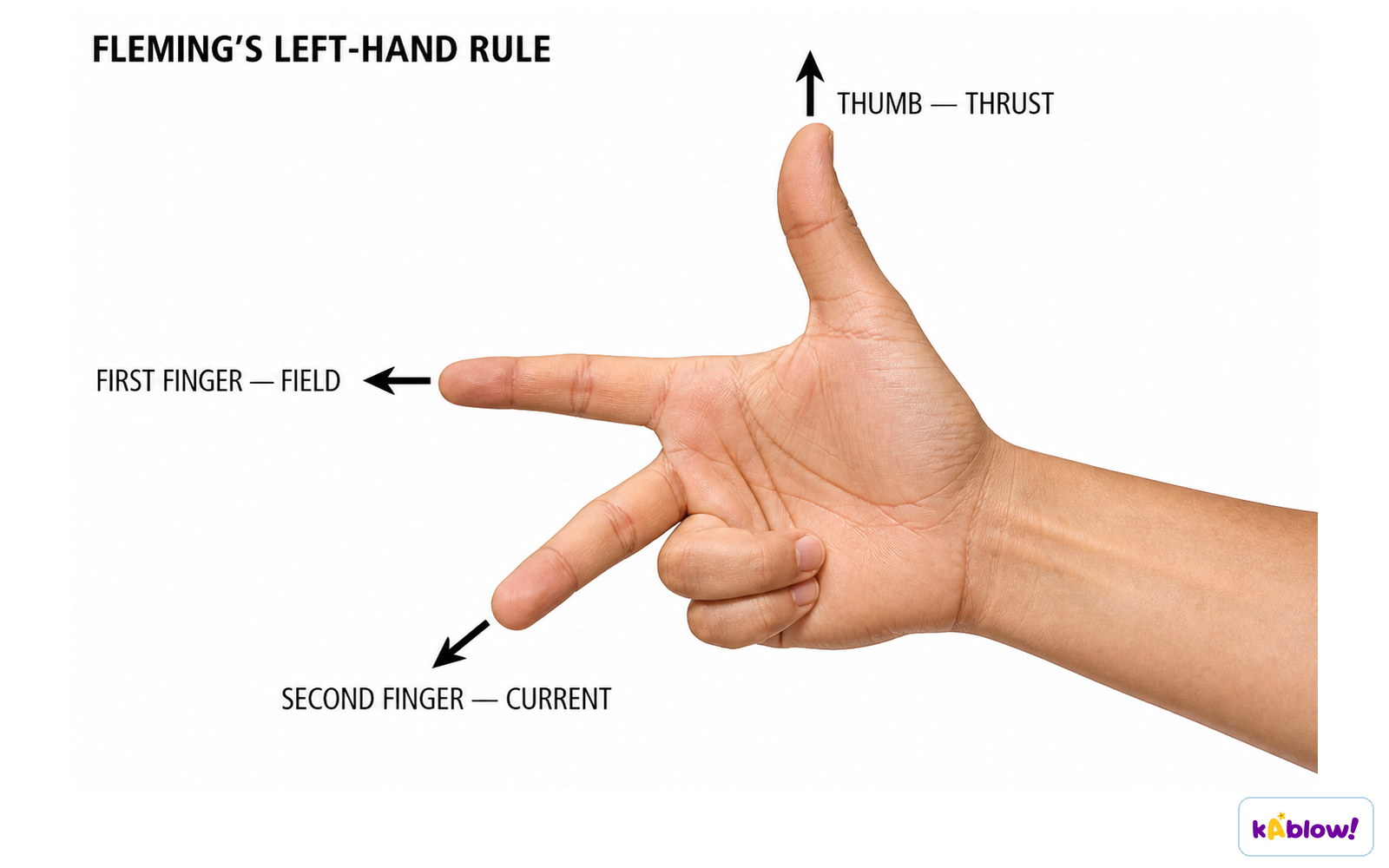
Fleming's left-hand rule: thumb = force (thrust), first finger = field, second finger = current.
Role of the Split Ring Commutator
- The split ring commutator reverses the direction of current every half turn.
- This reversal ensures the motor continues to rotate in the same direction.
- Without it, the forces would reverse after 180° and the coil would stop or reverse.
Increasing Motor Speed
- Increase the current flowing through the coil.
- Increase the number of turns in the coil.
- Increase the strength of the magnetic field.
Reversing Motor Direction
- Reverse the direction of the current (e.g., swap battery terminals).
- Reverse the direction of the magnetic field (e.g., swap the permanent magnets).
Key Facts
- Magnetic field lines point from north to south.
- The more turns in the coil, the greater the force on the coil.
- If current decreases, the motor spins slower.
Simple circuit showing battery, switch, coil (bulb symbol), and ammeter.
Slides
Sign up free to view the lesson slides
Step through every slide for this topic — plus flashcards and revision notes — with a free account.
Practice questions
Free preview — 8 of 51 questions. Sign up to see them all.
1.Which of the following statements is true?
Easy- AWhen a current flows through a wire, it creates a magnetic field.
- BMagnetic field lines point away from a south pole towards a north pole.
- CThe split ring commutator reverses the direction of the magnetic field every half turn.
- DIncreasing the number of turns in the coil decreases the force on the coil.
2.What are the components of an electric motor?
Easy- ACoil of wire, permanent magnets, split ring commutator, brushes, battery
- BCoil of wire, electromagnet, slip rings, brushes, battery
- CPermanent magnets, split ring commutator, resistor, capacitor
- DCoil of wire, permanent magnets, diode, brushes, battery
3.Why is there a force on the coil in an electric motor?
Medium- AThe magnetic field of the current-carrying coil interacts with the permanent magnetic field, producing a force.
- BThe coil is attracted to the north pole of the permanent magnet.
- CThe current in the coil creates an electric field that pushes the coil.
- DThe brushes push against the commutator, causing the coil to move.
4.What is the role of the split ring commutator in an electric motor?
Easy- AIt reverses the direction of the current every half turn so the motor continues to rotate in the same direction.
- BIt reverses the direction of the magnetic field every half turn.
- CIt increases the current supplied to the coil.
- DIt connects the coil to the battery continuously.
5.Which of the following is NOT a way to make an electric motor rotate faster?
Medium- ADecrease the number of turns in the coil.
- BIncrease the current flowing through the coil.
- CIncrease the number of turns in the coil.
- DIncrease the strength of the magnetic field.
6.Which two changes will cause an electric motor to rotate in the opposite direction?
Medium- AReverse the direction of the current or reverse the direction of the magnetic field.
- BIncrease the current or increase the magnetic field strength.
- CReverse the current and reverse the magnetic field at the same time.
- DDecrease the current or decrease the magnetic field strength.
7.What are the brushes in an electric motor made of?
Easy- ACarbon
- BCopper
- CIron
- DPlastic
8.The current supplied to an electric motor is switched off. Why does the motor stop spinning?
Medium- ANo current flows through the coil, so no magnetic field is produced and no force acts on the coil.
- BThe magnetic field disappears when the current is off.
- CThe commutator stops reversing the current.
- DThe brushes no longer make contact with the commutator.
Unlock all 51 questions, flashcards & more
Create a free account to see every question, the slides, flashcards and revision notes for this topic.