Introduction to forces
Learn it by playing
Answer these questions to earn energy, then fish and explore. No account needed.
Lesson notes
What is a Force?
- A force is a push, a pull or a twist.
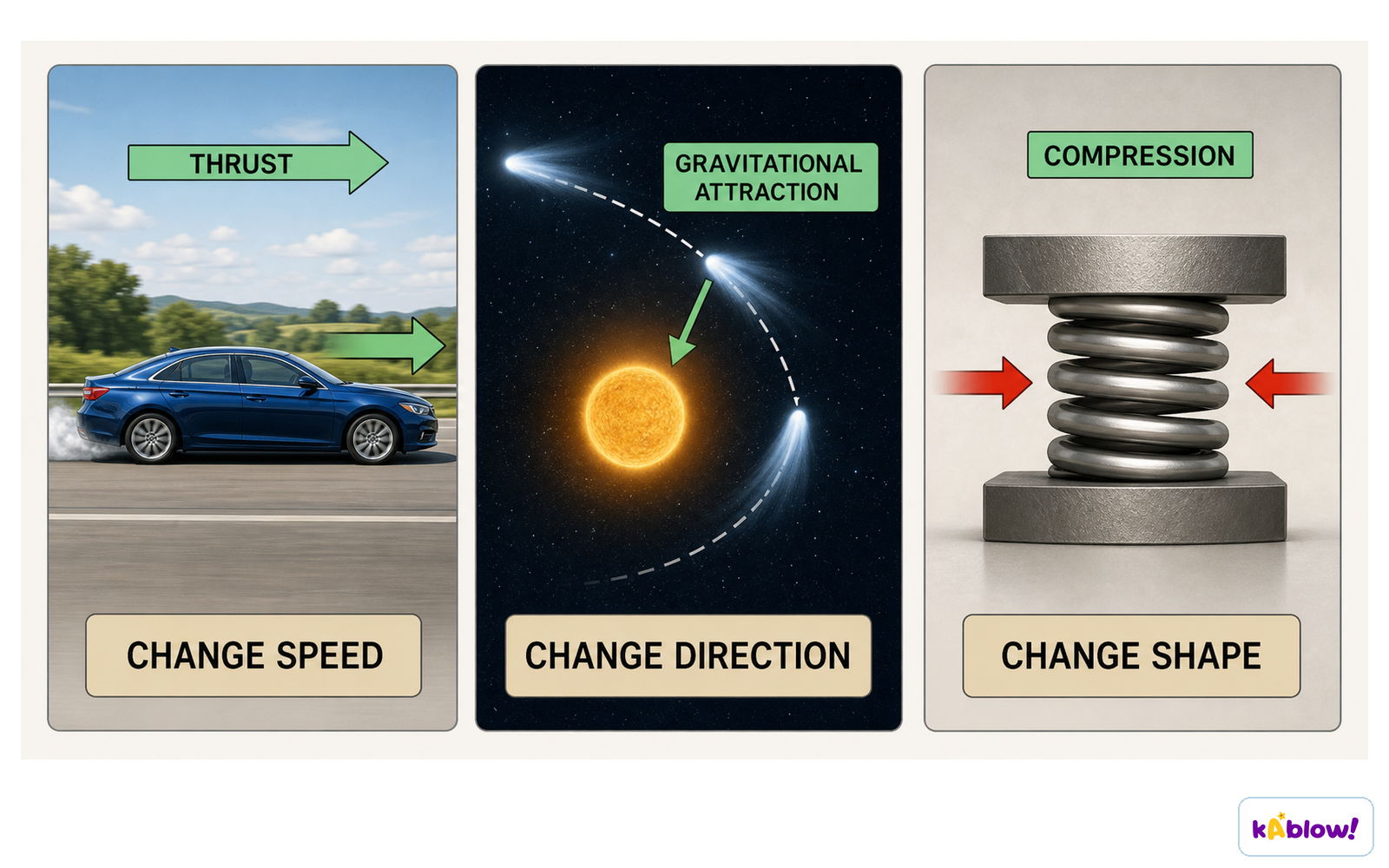
- Forces can change the speed, direction or shape of an object.
- The unit of force is the Newton (N).
- Forces are measured using a Newton meter.
A thrust force can cause a car to speed up, a gravitational force can cause a comet to change direction, compression forces can cause a spring to change shape.
Representing Forces
- Forces are represented by arrows in diagrams.
- The arrow shows the direction the force is acting.
- The length of the arrow indicates the size of the force (longer arrow = larger force).
Resultant Force
- The resultant force is the overall force when all individual forces are combined, taking direction into account.
- If forces act in the same direction, add them together.
- If forces act in opposite directions, subtract the smaller from the larger.
- The resultant force has both a size and a direction (e.g., 300 N to the right).
Balanced and Unbalanced Forces
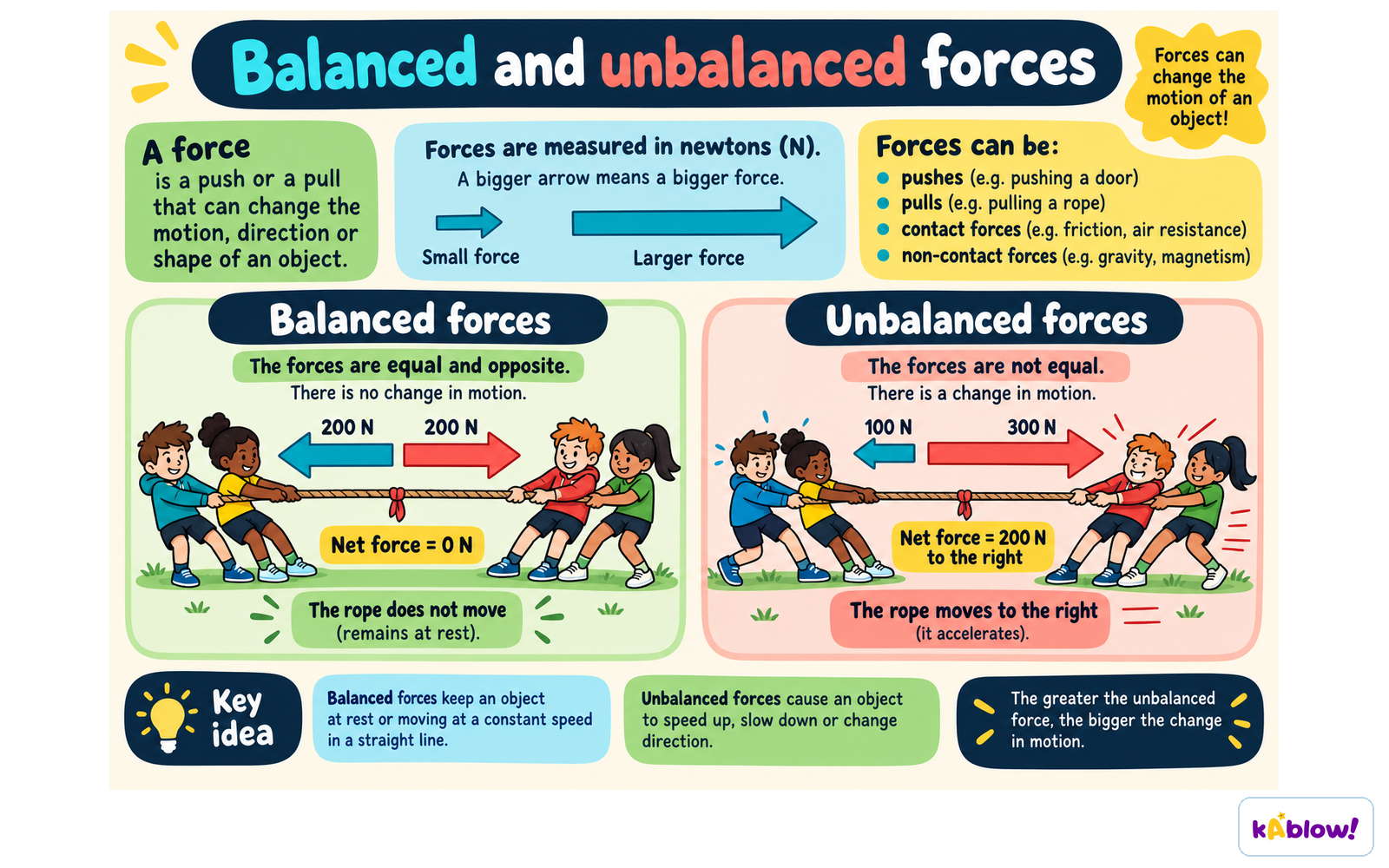
- When the resultant force is zero, the forces are balanced.
- Balanced forces mean the object is either stationary or moving at constant speed.
- When the resultant force is non‑zero, the forces are unbalanced.
- Unbalanced forces cause the object to accelerate in the direction of the resultant force.
Balanced forces have zero resultant force. In the unbalanced example, 300 N to the right minus 100 N to the left gives 200 N to the right.
Example: Forces in the Same Direction
- A crate has a 100 N force and a 200 N force both to the right.
- Resultant force = 100 N + 200 N = 300 N to the right.
- The crate will accelerate to the right.
Example: Forces in Opposite Directions
- A crate has a 200 N force to the right and a 100 N force to the left.
- Resultant force = 200 N − 100 N = 100 N to the right.
- The crate will accelerate to the right.
Example: Balanced Forces on a Car
- The car’s weight (down) and reaction force (up) are balanced.
- The thrust (forward) and air resistance (backward) are unbalanced.
- Resultant force = 4000 N to the right, so the car accelerates forward.
Slides
Sign up free to view the lesson slides
Step through every slide for this topic — plus flashcards and revision notes — with a free account.
Practice questions
Free preview — 8 of 53 questions. Sign up to see them all.
1.What is a force?
Easy- AA push, a pull or a twist
- BA type of energy
- CA measure of speed
- DA unit of mass
2.What is the unit of force?
Easy- ANewton (N)
- BJoule (J)
- CWatt (W)
- DKilogram (kg)
3.Which instrument is used to measure the size of a force?
Easy- ANewton meter
- BRuler
- CBalance
- DThermometer
4.Two forces of 100 N and 200 N act in the same direction. What is the resultant force?
Easy- A300 N in the direction of the forces
- B100 N in the direction of the larger force
- C200 N in the direction of the smaller force
- D0 N
5.Two forces of 100 N and 200 N act in opposite directions. What is the resultant force?
Easy- A100 N in the direction of the 200 N force
- B300 N in the direction of the 200 N force
- C100 N in the direction of the 100 N force
- D0 N
6.If the resultant force on an object is zero, what can be said about the object's motion?
Easy- AIt is either stationary or moving at constant speed
- BIt is accelerating
- CIt is decelerating
- DIt is changing direction
7.A car has a thrust of 4000 N to the right and air resistance of 2000 N to the left. What is the resultant force?
Medium- A2000 N to the right
- B6000 N to the right
- C2000 N to the left
- D0 N
8.In a tug of war, team A pulls with 300 N left and team B pulls with 250 N right. What is the resultant force and what happens?
Medium- A50 N left; the rope moves left
- B50 N right; the rope moves right
- C550 N left; the rope moves left
- D0 N; the rope does not move
Unlock all 53 questions, flashcards & more
Create a free account to see every question, the slides, flashcards and revision notes for this topic.