Power
Learn it by playing
Answer these questions to earn energy, then fish and explore. No account needed.
Lesson notes
Definition of Power
- Power is the rate at which energy is transferred.
- The unit of power is the Watt (W).
- One Watt equals one Joule per second (1 W = 1 J/s).
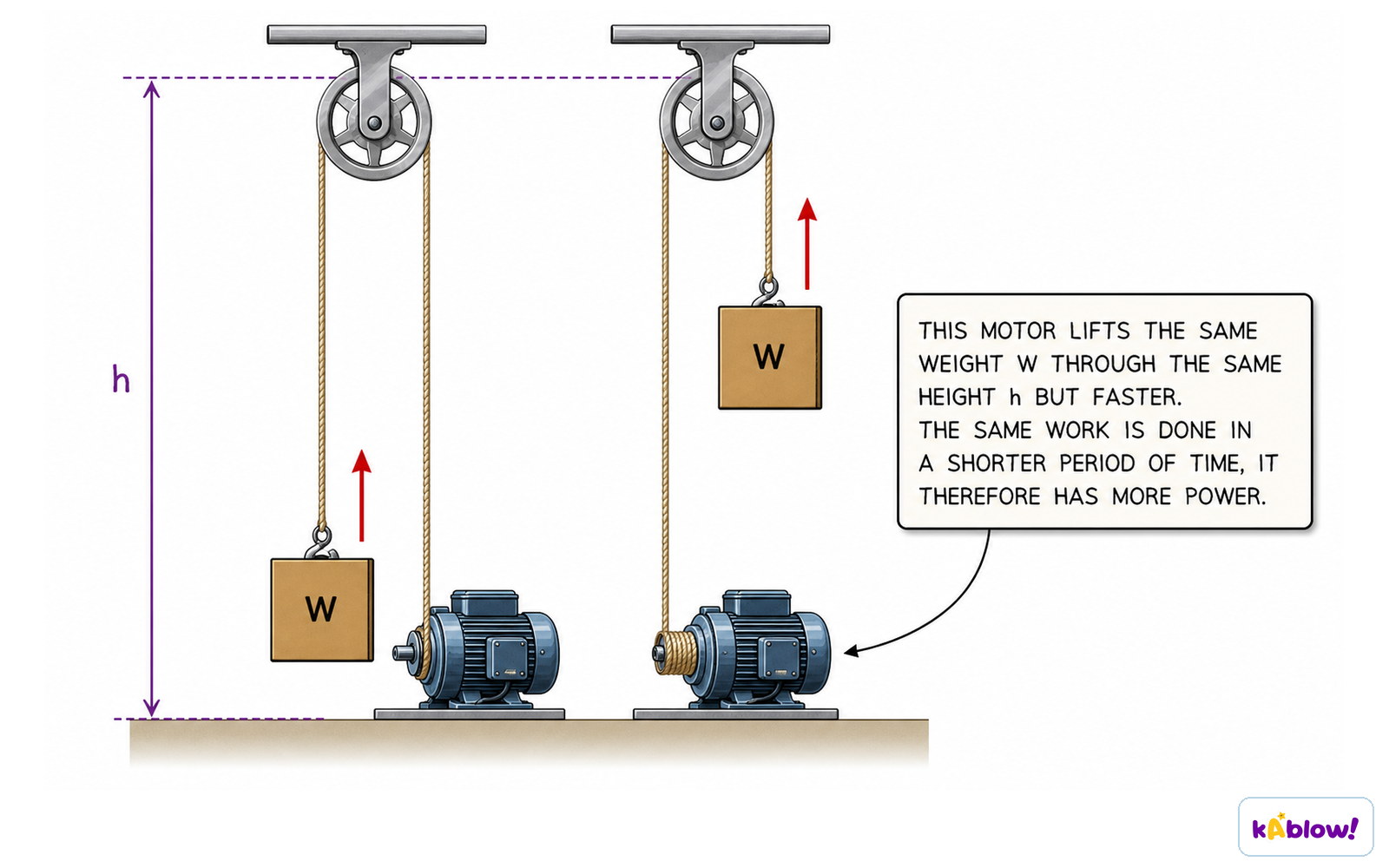
The motor that lifts the same weight through the same height in less time has more power
Power Equation
- The equation linking power, energy and time is: Power = Energy ÷ Time.
- In symbols: P = E ÷ t.
- Energy is measured in Joules (J), time in seconds (s).
- Rearranged: Energy = Power × Time (E = P × t).
Example Calculations
- Example 1: A 5 W torch used for 30 s transfers 150 J of energy (E = 5 × 30).
- Example 2: A toaster using 20,000 J in 100 s has a power of 200 W (P = 20,000 ÷ 100).
Kilowatts and Conversion
- Power can be given in kilowatts (kW); 1 kW = 1000 W.
- To convert kW to W: multiply by 1000.
- To convert W to kW: divide by 1000.
Worked Examples from Workbook
- Q3: Lamp: 2400 J in 40 s → Power = 2400 ÷ 40 = 60 W.
- Q4: Motor: 4000 J in 200 s → Power = 4000 ÷ 200 = 20 W.
- Q5: Microwave: 900 W for 15 s → Energy = 900 × 15 = 13,500 J.
- Q6: Radiator: 2000 W for 90 s → Energy = 2000 × 90 = 180,000 J.
- Q9: Washing machine: 2.2 kW for 20 min → Convert: 2.2 kW = 2200 W; 20 min = 1200 s; Energy = 2200 × 1200 = 2,640,000 J.
Key Points to Remember
- Always use consistent units: Joules, seconds, Watts.
- For time given in minutes, convert to seconds (×60).
- For power in kW, convert to W (×1000) before calculation.
A simple circuit to measure power: P = V × I (though not directly covered, the circuit illustrates energy transfer).
Slides
Sign up free to view the lesson slides
Step through every slide for this topic — plus flashcards and revision notes — with a free account.
Practice questions
Free preview — 8 of 54 questions. Sign up to see them all.
1.What is the unit of power?
Easy- AWatt (W)
- BJoule (J)
- CSecond (s)
- DKilowatt-hour (kWh)
2.Which equation correctly relates power (P), energy (E), and time (t)?
Easy- AP = E × t
- BP = E ÷ t
- CP = t ÷ E
- DP = E + t
3.How many watts are in one kilowatt?
Easy- A10 W
- B100 W
- C1000 W
- D1 000 000 W
4.A lamp uses 2400 J of energy in 40 s. What is its power?
Easy- A60 W
- B96 000 W
- C0.0167 W
- D600 W
5.A microwave has a power of 900 W. How much energy does it use in 15 s?
Easy- A60 J
- B13 500 J
- C900 J
- D135 J
6.An electric motor uses 4000 J of energy in 200 s. What is its power?
Easy- A20 W
- B200 W
- C800 000 W
- D0.05 W
7.A radiator has a power of 2000 W. How much energy does it use in 90 s?
Easy- A22.2 J
- B180 000 J
- C2000 J
- D22 222 J
8.A washing machine has a power of 2.2 kW. How much energy does it use in 20 minutes?
Medium- A44 J
- B2640 J
- C2 640 000 J
- D44 000 J
Unlock all 54 questions, flashcards & more
Create a free account to see every question, the slides, flashcards and revision notes for this topic.