Reflection
Learn it by playing
Answer these questions to earn energy, then fish and explore. No account needed.
For educators: ready-to-use lesson slides, revision notes, diagrams for Reflection (KS3 Science, Physics) — use them in your lesson, or run the topic as an interactive class activity your learners play as a live game.
Lesson notes
Key Facts about Light
- Light is a transverse wave.
- Transverse waves have vibrations perpendicular to the direction of wave travel.
- Light travels at 300 000 000 m/s (the speed of light).
- Light is part of the electromagnetic spectrum, which contains seven types of transverse waves.
An identical image of a tree is seen in the water due to reflection.

Specular Reflection
- Specular reflection occurs when light reflects from a very smooth surface, like a mirror.
- The incident ray is the ray approaching the surface.
- The normal is an imaginary line drawn at 90° to the surface.
- The angle of incidence is the angle between the incident ray and the normal.
- The reflected ray leaves the surface; its angle with the normal is the angle of reflection.
- The law of reflection states: angle of incidence = angle of reflection.
Diffuse Reflection
- Diffuse reflection happens when light reflects from a rough surface.
- Rays are reflected at many different angles because the surface is uneven.
- The law of reflection still holds for each individual ray (angle i = angle r).
- The overall effect is that the reflected light is scattered, not focused.
The Law of Reflection
- The law of reflection applies to all waves, not just light.
- It can be stated as: angle of incidence = angle of reflection.
- Both angles are measured from the normal, not from the surface.
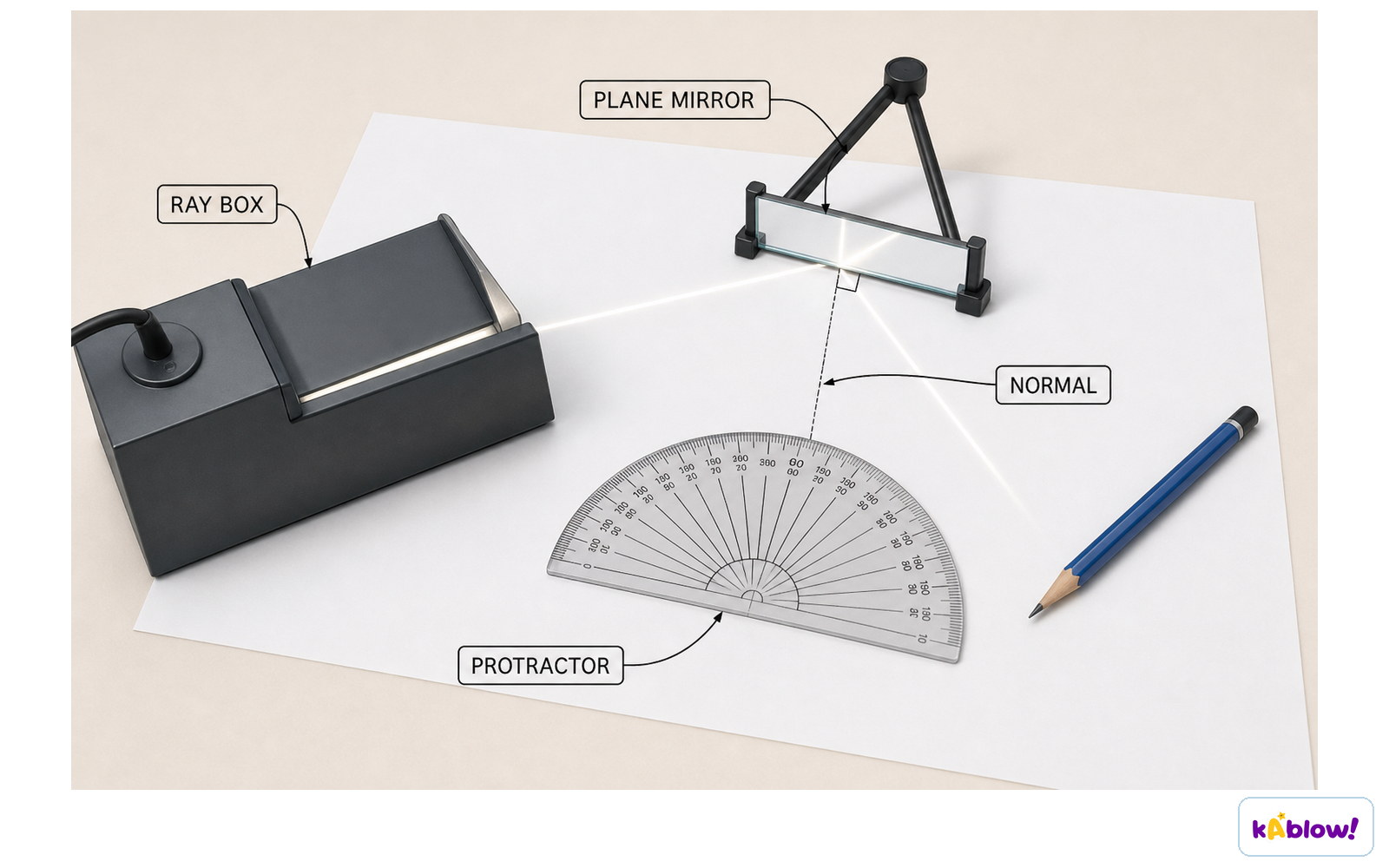
Ray box, plane mirror and protractor set up to investigate the law of reflection.
Specular reflection showing incident ray, reflected ray, normal, and equal angles of incidence and reflection.
Slides
Sign up free to view the lesson slides
Step through every slide for this topic — plus flashcards and revision notes — with a free account.
Practice questions
Free preview — 8 of 64 questions. Sign up to see them all.
1.Which of the following best describes light?
Easy- AA transverse wave
- BA longitudinal wave
- CA stationary wave
- DA mechanical wave
2.What is the speed of light?
Easy- A300 000 000 m/s
- B300 000 m/s
- C3 000 000 m/s
- D30 000 000 m/s
3.The law of reflection states that:
Easy- AThe angle of incidence equals the angle of reflection.
- BThe angle of incidence is greater than the angle of reflection.
- CThe angle of incidence is less than the angle of reflection.
- DThe angle of incidence is measured from the mirror surface.
4.Which type of reflection occurs when light hits a rough surface?
Easy- ADiffuse reflection
- BSpecular reflection
- CTotal internal reflection
- DRegular reflection
5.In a specular reflection, the reflected rays are:
Easy- AParallel to each other
- BScattered in many directions
- CAbsorbed by the surface
- DRefracted into the surface
6.What is the normal in a ray diagram?
Easy- AA line drawn at 90° to the mirror
- BThe incident ray
- CThe reflected ray
- DThe mirror surface
7.Which of the following is true about diffuse reflection?
Medium- AThe angle of incidence is still equal to the angle of reflection for each ray.
- BThe angle of incidence is not equal to the angle of reflection.
- CThe law of reflection does not apply.
- DThe surface is very smooth.
8.Which of the following waves obey the law of reflection?
Easy- ALight waves only
- BAll waves
- COnly transverse waves
- DOnly electromagnetic waves
Unlock all 64 questions, flashcards & more
Create a free account to see every question, the slides, flashcards and revision notes for this topic.
Past papers
Past-paper practice for this topic is coming soon.
Coming soon