Sound
Learn it by playing
Answer these questions to earn energy, then fish and explore. No account needed.
Lesson notes
What is Sound?
- Sound is produced by a vibrating object.
- The vibration transfers energy by making air particles collide.
- Sound is a longitudinal wave: vibrations are parallel to the direction of wave travel.
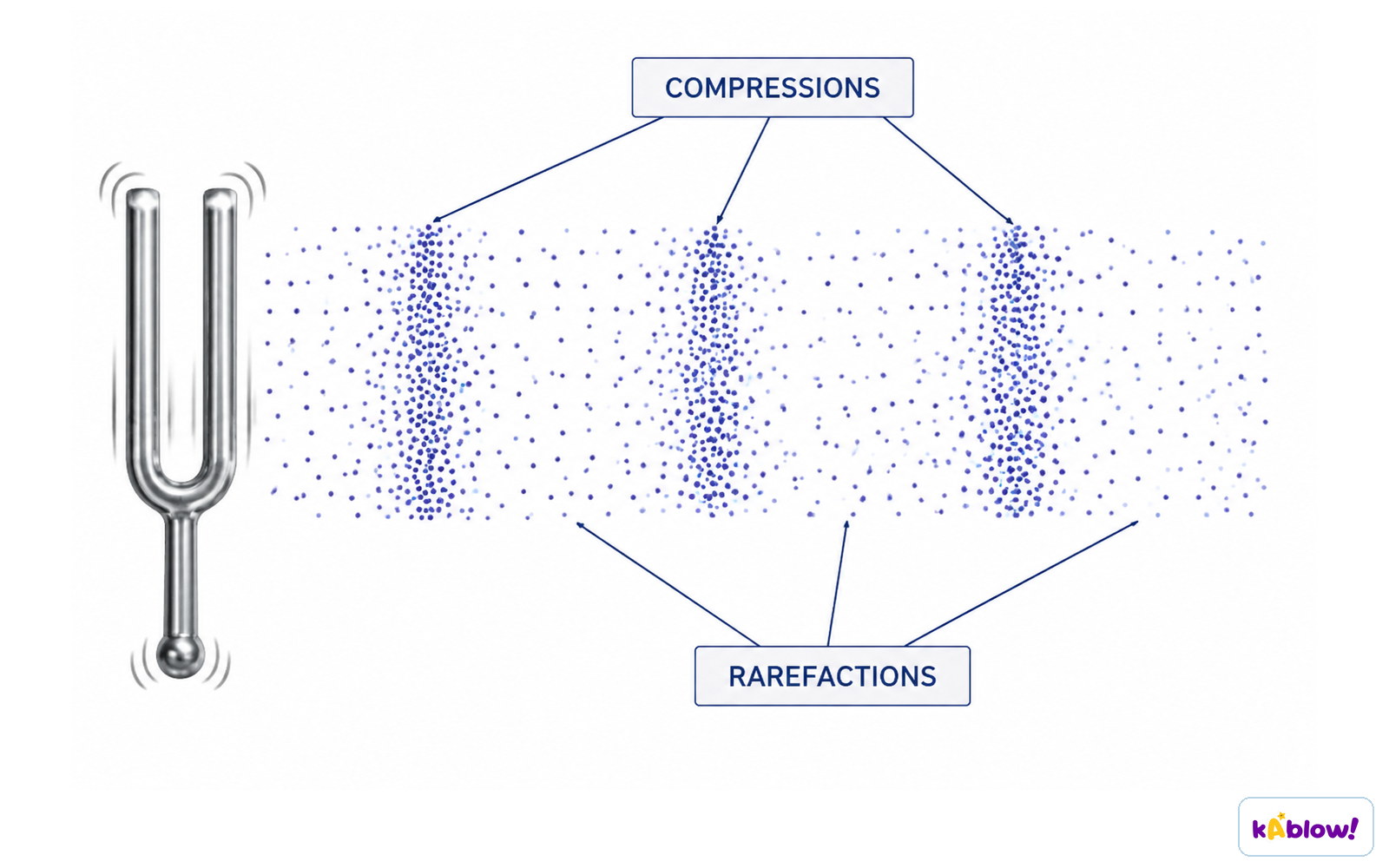
Compressions and Rarefactions
- Compressions are regions where air particles are close together.
- Rarefactions are regions where air particles are further apart.
- The wavelength is the distance between two consecutive compressions (or two rarefactions).
A vibrating tuning fork produces compressions and rarefactions in the air as a sound wave.
Frequency and Pitch
- Frequency is the number of waves passing a point per second, measured in Hertz (Hz).
- The higher the frequency, the higher the pitch.
- Human auditory range: 20 Hz to 20,000 Hz.
- Sound above 20,000 Hz is called ultrasound.
Amplitude and Volume
- Amplitude is the maximum displacement of particles from their rest position.
- The larger the amplitude, the louder the sound.
Detecting Sound
- A microphone converts sound waves into electrical signals.
- The electrical signal can be displayed on an oscilloscope.
- The human ear works similarly: sound vibrates the eardrum, which sends electrical signals to the brain.
Diagram showing reflection of a sound wave (not to scale; sound reflects similarly to light).
Slides
Sign up free to view the lesson slides
Step through every slide for this topic — plus flashcards and revision notes — with a free account.
Practice questions
Free preview — 8 of 55 questions. Sign up to see them all.
1.What causes a sound wave?
Easy- AA vibrating object
- BA stationary object
- CLight energy
- DHeat energy
2.Which type of wave is a sound wave?
Easy- ALongitudinal
- BTransverse
- CElectromagnetic
- DStationary
3.What is the frequency of a sound wave measured in?
Easy- AHertz (Hz)
- BDecibels (dB)
- CMetres (m)
- DSeconds (s)
4.The human auditory range is 20 Hz to 20 000 Hz. How many waves pass a point every second for a sound wave with a frequency of 20 000 Hz?
Easy- A20 000
- B20
- C200
- D2 000
5.Which statement about compressions and rarefactions is correct?
Easy- AA compression is where air particles are close together; a rarefaction is where they are further apart.
- BA compression is where air particles are further apart; a rarefaction is where they are close together.
- CA compression and rarefaction are the same.
- DA compression is a region of low pressure; a rarefaction is a region of high pressure.
6.Which of the following statements is true?
Easy- AA microphone turns a sound wave into an electrical signal.
- BA microphone turns an electrical signal into a sound wave.
- CA microphone amplifies a sound wave.
- DA microphone increases the frequency of a sound wave.
7.The wavelength of a sound wave is the distance between:
Easy- AOne compression and the next compression
- BA compression and a rarefaction
- CThe source and the observer
- DThe highest and lowest point of the wave
8.A sound wave has a frequency of 440 Hz. How many complete waves pass a point in 0.5 seconds?
Medium- A220
- B440
- C880
- D110
Unlock all 55 questions, flashcards & more
Create a free account to see every question, the slides, flashcards and revision notes for this topic.