Speed
Learn it by playing
Answer these questions to earn energy, then fish and explore. No account needed.
Lesson notes
What is Speed?
- Speed is a measure of the distance an object moves in a certain time.
- Common units include miles per hour (mph) and kilometres per hour (km/h).
- In physics, speed is usually measured in metres per second (m/s).
- Constant speed means the same distance is covered each second (e.g., 30 m/s = 30 m every second).
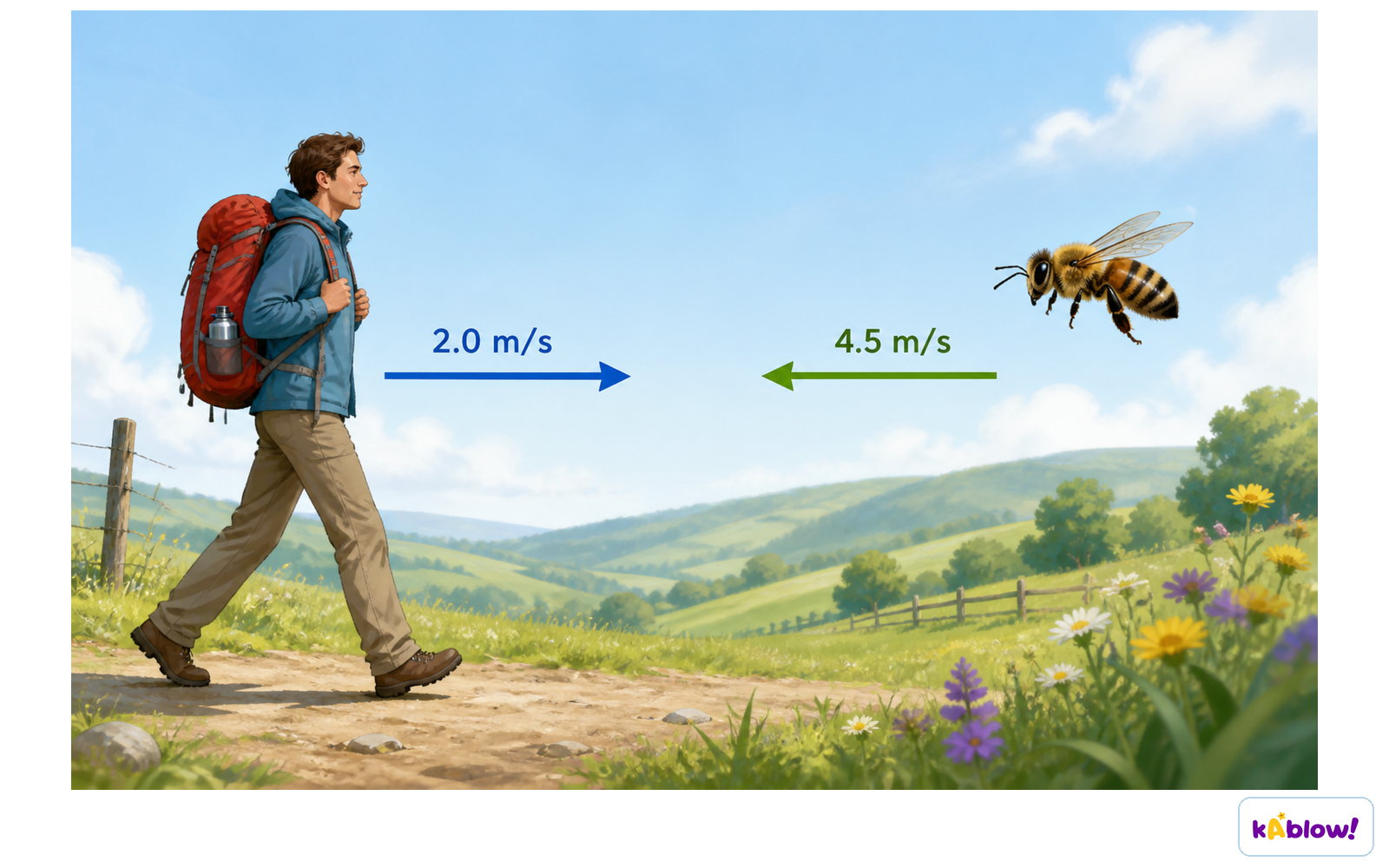
A person walking at 2.0 m/s and a bee flying at 4.5 m/s, illustrating average speed.
Calculating Speed
- The equation for speed is: Speed = Distance ÷ Time.
- Example: A car travels 400 m in 20 s → Speed = 400 ÷ 20 = 20 m/s.
- Always include the correct units (m/s) in your answer.
Calculating Distance
- Rearrange the speed equation: Distance = Speed × Time.
- Example: An athlete runs at 8 m/s for 50 s → Distance = 8 × 50 = 400 m.
Calculating Time
- Rearrange the speed equation: Time = Distance ÷ Speed.
- Use this when you know distance and speed and need to find time.
Relative Speed
- The speed of one object relative to another can be found by adding speeds.
- Example: Car at 30 m/s, train 20 m/s faster → train speed = 30 + 20 = 50 m/s.
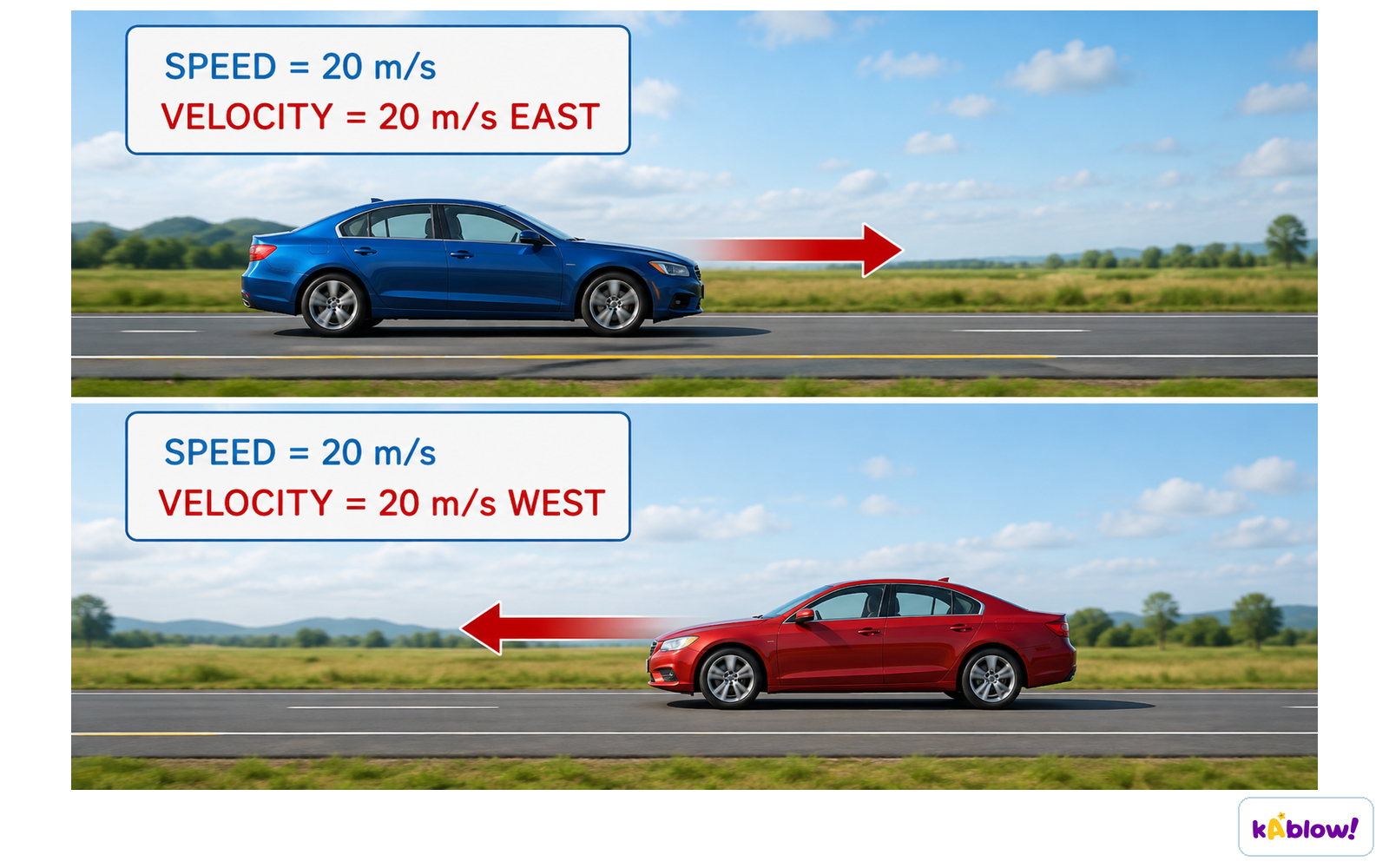
Two cars with the same speed but different velocities, illustrating that velocity includes direction.
Units and Conversions
- Speed units: m/s (metres per second), km/h (kilometres per hour), mph (miles per hour).
- In calculations, ensure distance and time are in compatible units (e.g., metres and seconds).
Worked Examples
- Cyclist: 120 m in 20 s → Speed = 120 ÷ 20 = 6 m/s.
- Runner: 1500 m in 500 s → Speed = 1500 ÷ 500 = 3 m/s.
- Dog walker: 1200 m in 1000 s → Speed = 1200 ÷ 1000 = 1.2 m/s.
Key Points
- Speed = Distance ÷ Time is the core formula.
- You can rearrange it to find distance or time.
- Constant speed means the object covers equal distances in equal time intervals.
Slides
Sign up free to view the lesson slides
Step through every slide for this topic — plus flashcards and revision notes — with a free account.
Practice questions
Free preview — 8 of 71 questions. Sign up to see them all.
1.What is speed a measure of?
Easy- AThe distance an object has moved in a certain time
- BThe time an object takes to move a certain distance
- CThe force acting on an object
- DThe mass of an object
2.Which of the following is the correct equation for speed?
Easy- ASpeed = Distance × Time
- BSpeed = Distance ÷ Time
- CSpeed = Time ÷ Distance
- DSpeed = Distance + Time
3.An object is travelling at a constant speed of 20 m/s. How far does it travel every second?
Easy- A20 m
- B10 m
- C40 m
- D5 m
4.A car is travelling at 20 m/s and a train is travelling 10 m/s faster than the car. What is the speed of the train?
Easy- A10 m/s
- B20 m/s
- C30 m/s
- D200 m/s
5.A cyclist travels a distance of 120 m in 20 seconds. What is the cyclist's speed?
Medium- A6 m/s
- B2400 m/s
- C0.17 m/s
- D100 m/s
6.A runner travels 1500 m in 500 s. What is the runner's speed?
Medium- A3 m/s
- B750000 m/s
- C0.33 m/s
- D1000 m/s
7.A sound wave travels 686 m in 2 seconds. What is the speed of sound?
Medium- A343 m/s
- B1372 m/s
- C344 m/s
- D684 m/s
8.Light travels 4,500,000,000 m in 15 seconds. What is the speed of light?
Medium- A300,000,000 m/s
- B300,000 m/s
- C67,500,000,000 m/s
- D4,500,000,015 m/s
Unlock all 71 questions, flashcards & more
Create a free account to see every question, the slides, flashcards and revision notes for this topic.