Principles of organisation
Aprenda jogando
Responda a estas perguntas para ganhar energia, depois pesque e explore. Sem precisar de conta.
Notas de aula
The Hierarchy of Organisation
- Living organisms are built up in levels of increasing complexity: cells, tissues, organs, organ systems and finally the organism.
- Cells are the basic building blocks of all living organisms.
- A tissue is a group of cells with a similar structure and function, working together.
- An organ is an aggregation of several different tissues performing a specific function.
- Organs are organised into organ systems, which work together to form the whole organism.
- The order matters: cells come first, then tissues, then organs, then organ systems — never the reverse.
Cells and Differentiation
- Cells are the fundamental unit of every living organism, from single-celled microbes to large multicellular plants and animals.
- Specialised cells have features that suit them to a particular job in the body.
- Differentiation is the process by which a cell becomes specialised for its role.
- Even single-celled organisms show organisation — the one cell carries out all life processes itself.
Summary of cell organisation in an animal and a plant

Tissues
- A tissue is a group of similar cells working together, not necessarily identical cells.
- Epithelial tissue covers and lines surfaces and structures in the body.
- Muscular tissue contracts to bring about movement.
- Glandular tissue produces and releases substances such as enzymes or hormones.
- Blood and bone are tissues, each containing several types of cell rather than just one.
Organs
- An organ is made of several different tissues combined to carry out a specific function.
- The stomach is an organ because it contains more than one tissue working together.
- The stomach includes muscular tissue to churn food, glandular tissue to release digestive substances, and epithelial tissue lining its surfaces.
- Classifying a structure as an organ depends on it being built from multiple tissues with a shared job.
Organs of the human digestive system
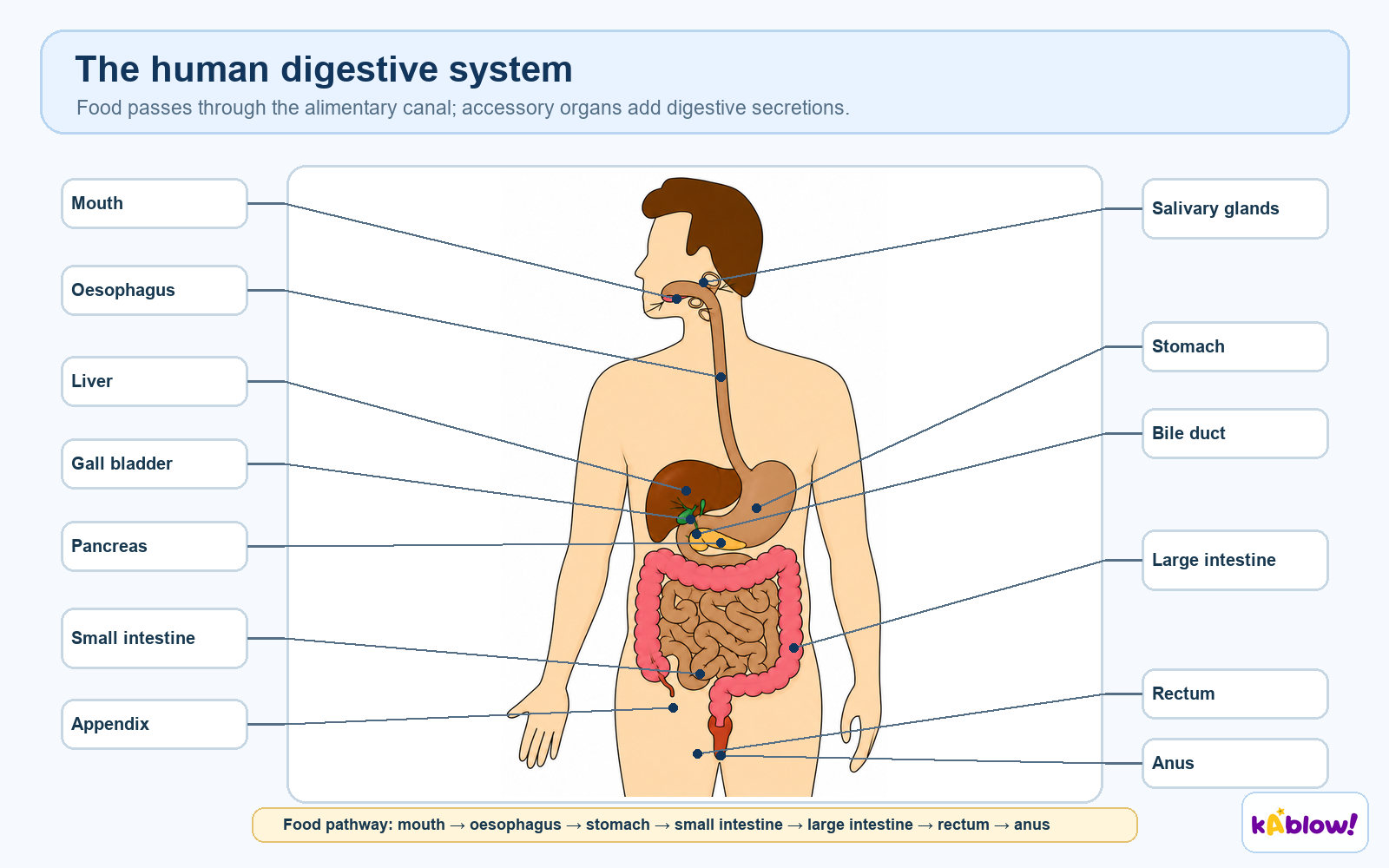
Organ Systems
- An organ system is a group of organs that work together to carry out a particular function.
- The digestive system is an example of an organ system, containing organs such as the stomach, small intestine and large intestine.
- Organs in a system cooperate so the system as a whole performs its role.
- An organ system is not the same as an organism — the organism is the complete living thing.
Cells form tissues, tissues form organs, organs form organ systems, and organ systems make up the whole organism.
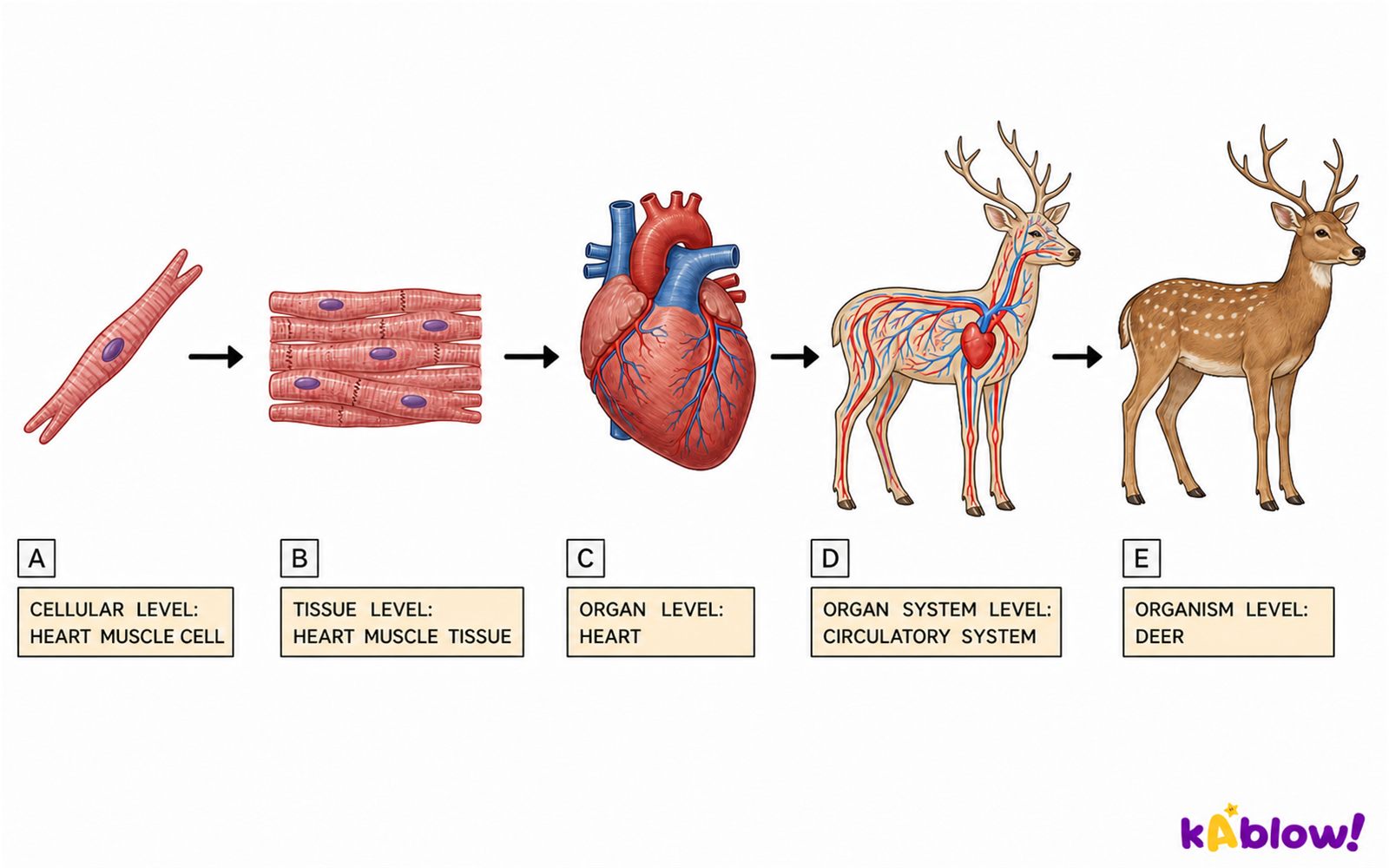
Organs in More Than One System
- Some organs belong to more than one organ system rather than just one.
- The pancreas is an example: it serves two organ systems, releasing digestive substances and producing hormones.
- This shows that organ systems overlap and are not always neatly separated.
Why Large Organisms Need Exchange and Transport Systems
- Large multicellular organisms have a small surface area compared with their volume.
- This makes it impossible for substances to reach every cell by simple diffusion from the outside alone.
- They therefore need specialised exchange surfaces and transport systems to move substances around the body.
- Single-celled organisms do not need these systems because their whole body is in direct contact with their surroundings.
Classifying Unfamiliar Structures
- To classify a structure, ask how many cell types and tissues it contains and what job it does.
- A group of similar cells with one function is a tissue.
- Several tissues combined for a specific function make an organ.
- Several organs working together form an organ system.
Slides
Sign up free to view the lesson slides
Step through every slide for this topic — plus flashcards and revision notes — with a free account.
Questões de prática
Prévia grátis — 8 de 59 perguntas. Cadastre-se para ver todas.
1.Which of the following is the correct order of organisation from smallest to largest?
Easy- ACell → tissue → organ → organ system → organism
- BTissue → cell → organ → organ system → organism
- CCell → organ → tissue → organ system → organism
- DOrgan → tissue → cell → organ system → organism
2.A tissue is a group of cells with a similar structure and function.
EasyTrue or false?
3.Which of the following is an organ?
Easy- AStomach
- BBlood
- CEpithelial tissue
- DDigestive system
4.Which of the following are examples of tissues? (Select all that apply)
Medium- AEpithelial tissue
- BMuscular tissue
- CGlandular tissue
- DStomach
- EDigestive system
5.Match each level of organisation to its correct description.
Medium- Cell
- Tissue
- Organ
- Organ system
- Basic building block of all living organisms
- A group of cells with similar structure and function
- An aggregation of tissues performing specific functions
- Organs that work together to perform a particular function
6.Why is the stomach described as an organ rather than a tissue?
Medium- AIt is made of several different tissues working together.
- BIt contains only one type of cell.
- CIt is part of the digestive system.
- DIt is the same as an organ system.
7.Which of the following statements about organs and organ systems are correct? (Select all that apply)
Medium- AAn organ is made of several tissues working together.
- BAn organ system is a group of organs working together.
- CEvery organ belongs to exactly one organ system.
- DThe pancreas is part of both the digestive and endocrine systems.
- EAn organism is the same as an organ system.
8.Blood is an example of an organ.
MediumTrue or false?
Unlock all 59 questions, flashcards & more
Crie uma conta grátis para ver todas as perguntas, os slides, flashcards e resumos de revisão deste tópico.