The Haber process and the use of NPK fertilisers
Aprenda jogando
Responda a estas perguntas para ganhar energia, depois pesque e explore. Sem precisar de conta.
Notas de aula
The Haber Process
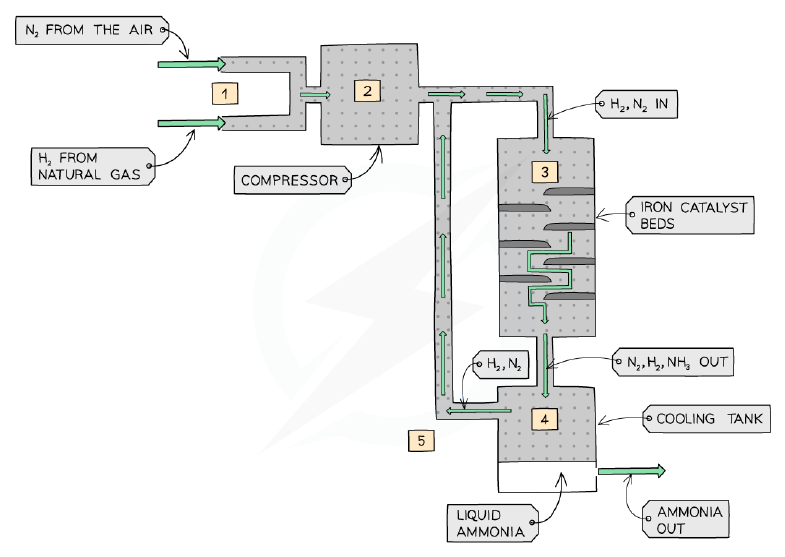
- The Haber process manufactures ammonia from nitrogen and hydrogen in a reversible reaction: N₂(g) + 3H₂(g) ⇌ 2NH₃(g).
- Nitrogen is obtained from the air (which is about 78% nitrogen) by fractional distillation.
- Hydrogen is obtained from natural gas (methane) in a process called steam reforming.
- The gases are passed over an iron catalyst at about 450°C and 200 atmospheres pressure.
- The reaction is exothermic in the forward direction (ΔH = –92 kJ mol⁻¹).
- On cooling, the ammonia liquefies and is removed; unreacted nitrogen and hydrogen are recycled back into the reactor.
Equilibrium and the Haber process
Dynamic Equilibrium
- Dynamic equilibrium occurs in a closed system when the rate of the forward reaction equals the rate of the reverse reaction.
- At equilibrium, the concentrations of reactants and products remain constant, but they are not necessarily equal.
- The reaction is still occurring in both directions; it has not stopped.
- Equilibrium is reached faster at higher pressure, higher temperature, higher concentration, or when a catalyst is used.
- Le Chatelier's Principle: if a change is made to a system at equilibrium, the equilibrium shifts to oppose the change.
Choosing Conditions: Temperature
- The forward reaction is exothermic, so a lower temperature would favour the forward reaction and give a higher yield of ammonia.
- However, at low temperatures the rate of reaction is very slow.
- A higher temperature favours the reverse (endothermic) reaction, giving a lower yield of ammonia.
- 450°C is a compromise temperature: it gives a reasonable yield at an acceptable rate.
- The chosen temperature balances yield, rate and cost.
Choosing Conditions: Pressure
- There are 4 moles of gas on the left (1 N₂ + 3 H₂) and 2 moles of gas on the right (2 NH₃).
- A higher pressure favours the forward reaction (fewer gas molecules) and gives a higher yield of ammonia.
- A lower pressure favours the reverse reaction (more gas molecules) and gives a lower yield.
- Very high pressures are dangerous and require expensive equipment.
- 200 atmospheres is a compromise pressure between yield, safety and cost.
The Role of the Catalyst
- An iron catalyst is used in the Haber process.
- A catalyst does not affect the position of equilibrium; it increases the rate of both forward and reverse reactions equally.
- It works by providing an alternative pathway with a lower activation energy.
- The catalyst helps the reaction reach equilibrium faster.
- It allows an acceptable yield at a lower temperature, reducing energy costs and preventing decomposition of ammonia.
Economic Considerations
- Chemical industries aim to make a profit, so they must consider costs.
- Raw materials for the Haber process are readily available and inexpensive to purify.
- High temperatures and pressures are expensive to maintain.
- The conditions chosen are a compromise between yield, rate and cost.
- If raw materials become too expensive or unavailable, the process may no longer be economically viable.
NPK Fertilisers
- NPK fertilisers contain compounds of nitrogen (N), phosphorus (P) and potassium (K).
- They are formulations of various salts containing appropriate percentages of each element.
- Nitrogen promotes healthy leaves.
- Phosphorus promotes healthy roots.
- Potassium promotes growth, healthy fruit and flowers.
- Artificial fertilisers can be designed for specific needs, unlike natural fertilisers such as manure or seaweed.
- Fertilisers must be water soluble so nutrients can be absorbed by plants.
Making Fertilisers from Ammonia
- Ammonia is alkaline and neutralises acids to produce ammonium salts.
- Ammonium nitrate is made by reacting ammonia with nitric acid: NH₃(aq) + HNO₃(aq) → NH₄NO₃(aq).
- Ammonium sulfate is made by reacting ammonia with sulfuric acid: 2NH₃(aq) + H₂SO₄(aq) → (NH₄)₂SO₄(aq).
- Ammonia can be oxidised to produce nitric acid, which provides nitrate ions for fertilisers.
- Common fertiliser ions include ammonium (NH₄⁺), nitrate (NO₃⁻), phosphate (PO₄³⁻) and potassium (K⁺).
Laboratory Preparation of Ammonium Sulfate
- In the lab, ammonium sulfate is prepared by titration using dilute ammonia, dilute sulfuric acid and methyl orange indicator.
- Method: add a known volume of ammonia to a conical flask, add indicator, then add acid drop by drop until the colour changes sharply.
- Record the titre, then repeat without indicator (indicator is an impurity).
- Evaporate some water by heating in a water bath until the volume is reduced to about one third.
- Leave to crystallise; then filter to remove remaining water.
Industrial Production and Phosphate Rock
- Industrial production of ammonium sulfate is a large-scale process with several stages.
- Ammonia is made by the Haber process; sulfuric acid by the Contact process.
- In industry, ammonia gas reacts with concentrated sulfuric acid at about 60°C.
- Phosphate rock is mined but is insoluble in water, so it cannot be used directly as a fertiliser.
- Treating phosphate rock with nitric acid produces phosphoric acid and calcium nitrate; the phosphoric acid can be neutralised with ammonia to form ammonium phosphate.
- Treating phosphate rock with sulfuric acid produces a mixture of calcium phosphate and calcium sulfate, known as single superphosphate.
- Treating phosphate rock with phosphoric acid produces calcium phosphate, known as triple superphosphate.
- Potassium chloride and potassium sulfate are mined; they are easier to extract because potassium compounds are water soluble.
Slides
Sign up free to view the lesson slides
Step through every slide for this topic — plus flashcards and revision notes — with a free account.
Questões de prática
Prévia grátis — 8 de 61 perguntas. Cadastre-se para ver todas.
1.Which statement about the Haber process is NOT true?
Easy- APlatinum is used as a catalyst
- BThe process is carried out at a temperature of about 450 °C
- CThe process takes place at a pressure of about 200 atmospheres
- DNatural gas is a raw material
2.Which statement about the yield of ammonia in the Haber process is correct?
Easy- ALess ammonia is produced at higher pressures
- BThe yield of ammonia decreases with increased temperature
- CThe optimum conditions are low pressure and high temperature
- DAt 500 atmospheres and 400 °C the yield of ammonia is 45%
3.Why is a lower temperature than 450 °C not used during the Haber process?
Easy- AThe rate of reaction would be too slow
- BThe yield of ammonia would be lower
- CThe iron catalyst would not work at all
- DThe reaction would become endothermic
4.Which elements are found in an NPK fertiliser?
Easy- APhosphorus, calcium, nitrogen
- BIron, nitrogen, magnesium
- CNitrogen, potassium, phosphorus
- DPotassium, calcium, nitrogen
5.Ammonia and sulfuric acid react in the laboratory to make ammonium sulfate fertiliser. What is the formula of the product?
Easy- ANH₄SO₄
- B(NH₄)₂SO₄
- C(NH₃)₂SO₄
6.Ammonia is manufactured by the Haber process: N₂(g) + 3H₂(g) ⇌ 2NH₃(g). A temperature of 450 °C is used instead of room temperature, and an iron catalyst can also be added. Which row shows how the temperature and the catalyst affect the rate of attainment of equilibrium?
Easy- AIncreasing temperature to 450 °C decreases the rate; adding iron catalyst does not change the rate
- BIncreasing temperature to 450 °C decreases the rate; adding iron catalyst increases the rate
- CIncreasing temperature to 450 °C increases the rate; adding iron catalyst does not change the rate
- DIncreasing temperature to 450 °C increases the rate; adding iron catalyst increases the rate
7.Which of these statements is NOT a correct reason for the choice of pressure in the Haber process?
Easy- AA higher pressure would give a greater equilibrium yield of ammonia
- BA lower pressure would favour the reverse reaction
- CHigh pressures are dangerous and require very expensive equipment
- DA higher pressure would favour the reverse reaction
8.Which acid is needed to manufacture ammonium sulfate by reacting it with ammonia?
Easy- APhosphoric acid
- BSulfuric acid
- CHydrochloric acid
- DNitric acid
Unlock all 61 questions, flashcards & more
Crie uma conta grátis para ver todas as perguntas, os slides, flashcards e resumos de revisão deste tópico.