Forces and their interactions
Aprenda jogando
Responda a estas perguntas para ganhar energia, depois pesque e explore. Sem precisar de conta.
Notas de aula
Scalars and Vectors
- Scalar quantities have only a magnitude (size) and no direction.
- Vector quantities have both a magnitude and a direction.
- Examples of scalars: mass, distance, speed, time, energy, temperature.
- Examples of vectors: force, weight, velocity, acceleration, momentum, electric field strength, gravitational field strength.
- A vector can be represented by an arrow: the length shows the magnitude and the arrowhead shows the direction.
- Distance is a scalar; displacement is the corresponding vector (distance in a given direction).
- Speed is a scalar; velocity is the corresponding vector (speed in a given direction).
Contact and Non-Contact Forces
- A force is a push or a pull that acts on an object due to an interaction with another object.
- Forces can change an object's speed, direction, or shape.
- Contact forces act between objects that are physically touching.
- Examples of contact forces: friction, air resistance (drag), tension, normal contact force (reaction force).
- Non-contact forces act at a distance without the objects touching, due to a field.
- Examples of non-contact forces: gravitational force, electrostatic force, magnetic force.
- Friction opposes motion and occurs when surfaces rub together; air resistance is a type of friction acting on objects moving through air.
- Tension is the pulling force in a cable, rope or string when forces act on its ends.
Forces as Vectors and Force Pairs
- Force is a vector quantity: it has both magnitude (in newtons, N) and direction.
- The direction of a force can be described as left, right, up, down, or using an angle to the horizontal or vertical.
- When two objects interact, they exert forces on each other; these are called force pairs.
- Example: a laptop resting on a desk pushes down on the desk, and the desk pushes up on the laptop.
- Example: a person standing on the Earth pulls the Earth gravitationally, and the Earth pulls the person gravitationally.
- Force pairs can be shown using arrows in vector diagrams.
Weight, Mass and Gravity
- Mass is a measure of the amount of matter in an object; it is measured in kilograms (kg) and is a scalar.
- Weight is the force acting on an object due to gravitational attraction; it is measured in newtons (N) and is a vector.
- Weight depends on the object's mass and the gravitational field strength (g) at its location.
- The weight of an object acts at a single point called the centre of mass (or centre of gravity).
- For a symmetrical object of uniform density, the centre of mass is at the point of symmetry.
- Mass stays the same everywhere, but weight changes if the gravitational field strength changes (e.g., on the Moon).
- Weight is measured directly using a calibrated spring-balance (newton-meter); mass is measured using a top-pan balance.
Mass and Weight on Earth and the Moon
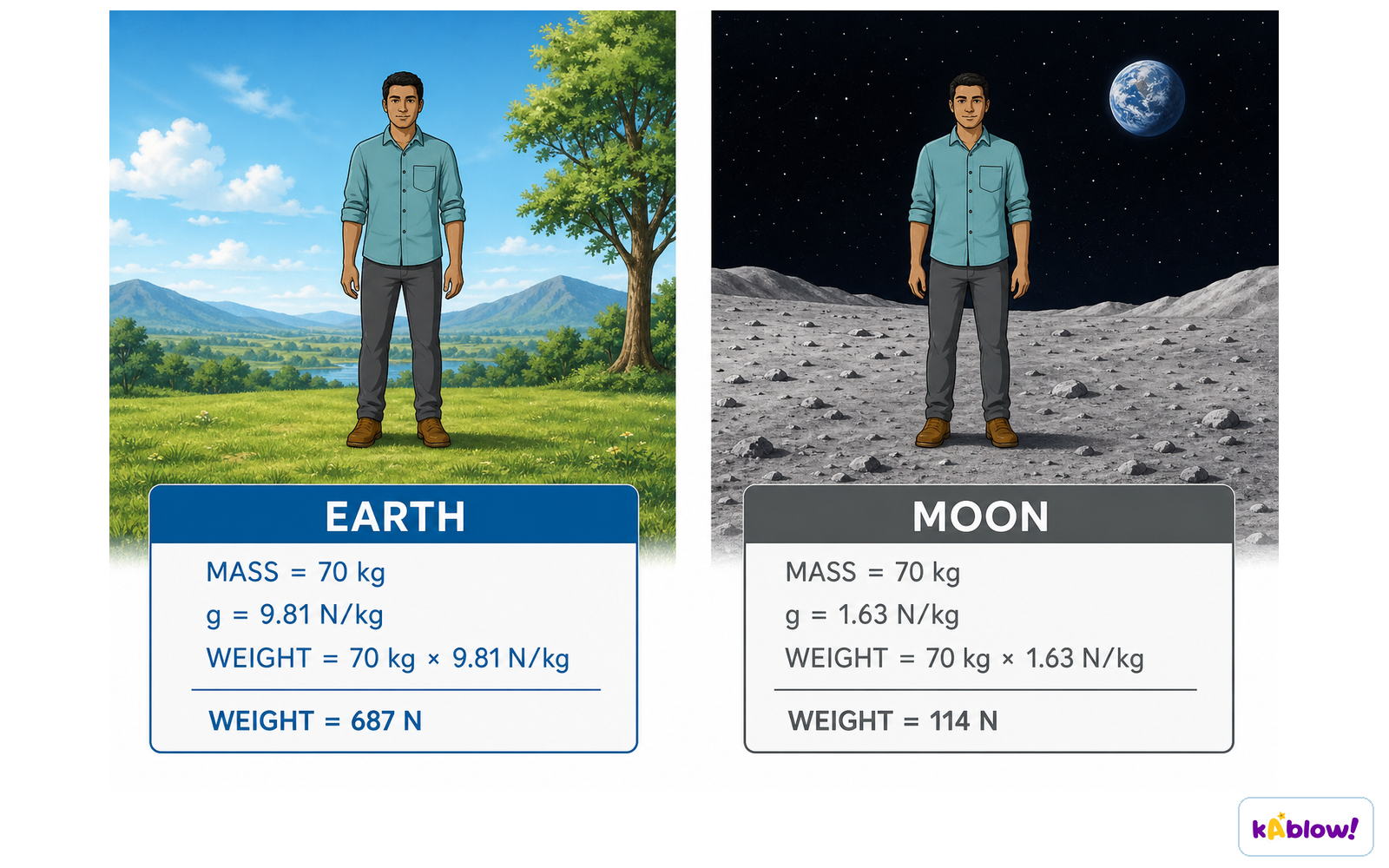
Calculating Weight
- The equation linking weight, mass and gravitational field strength is: W = m × g.
- W is weight in newtons (N), m is mass in kilograms (kg), and g is gravitational field strength in newtons per kilogram (N/kg).
- On Earth, g is approximately 9.8 N/kg (often taken as 10 N/kg for simpler calculations).
- Weight and mass are directly proportional: doubling the mass doubles the weight (for a given g).
- An object in free fall falls solely under gravity and accelerates towards Earth at about 9.8 m/s².
- To find mass from weight, rearrange: m = W ÷ g.
Resultant Forces
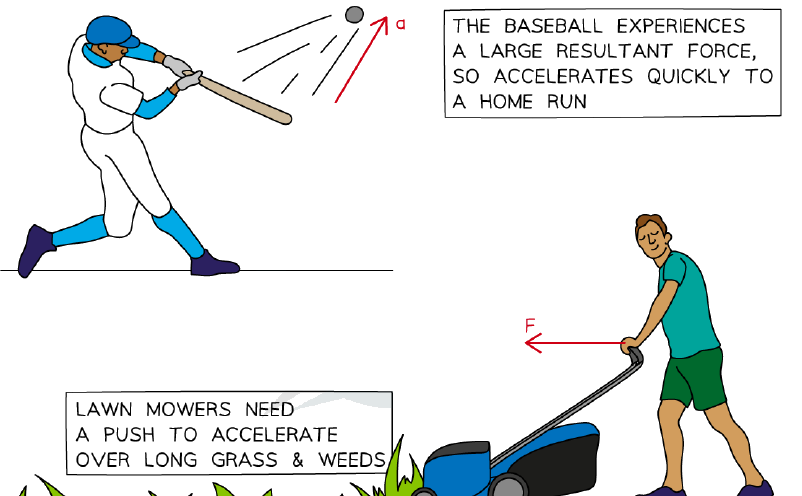
- A resultant force is a single force that has the same effect as all the original forces acting together.
- Forces acting in the same direction are added; forces acting in opposite directions are subtracted.
- If the forces cancel out completely, the resultant force is zero and the forces are balanced.
- If the forces do not cancel out, there is an unbalanced force (resultant force) and the object's motion changes.
- Always state both the magnitude and direction of a resultant force (e.g., '2 N to the left').
- Example: a tug-of-war with 80 N left and 100 N right gives a resultant of 20 N to the right.
Illustrations of a baseball player hitting a ball and a person pushing a lawnmower, demonstrating resultant forces and acceleration.
Free Body Diagrams
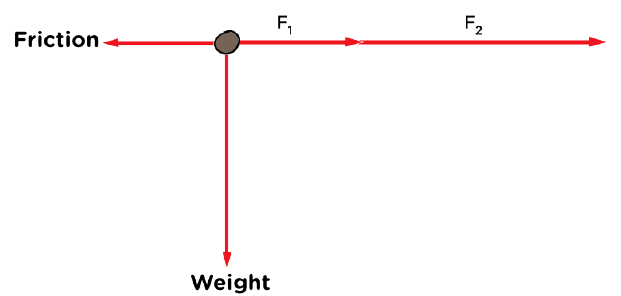
- A free body diagram shows all the forces acting on a single object as labelled arrows.
- Each arrow is scaled to the magnitude of the force and points in the direction the force acts.
- Forces are drawn acting from the centre of mass of the object.
- Common forces to include: weight (down), normal contact force (perpendicular to surface), friction (opposing motion), tension (along string/rope), upthrust (upwards in a fluid).
- Free body diagrams help identify balanced and unbalanced forces and can be used to find the resultant force.
- If the force arrows form a closed loop, the forces are balanced (no resultant force).
A free-body diagram: two applied forces (F1, F2), friction, and weight drawn as arrows from a central point representing the object.
Balanced and Unbalanced Forces
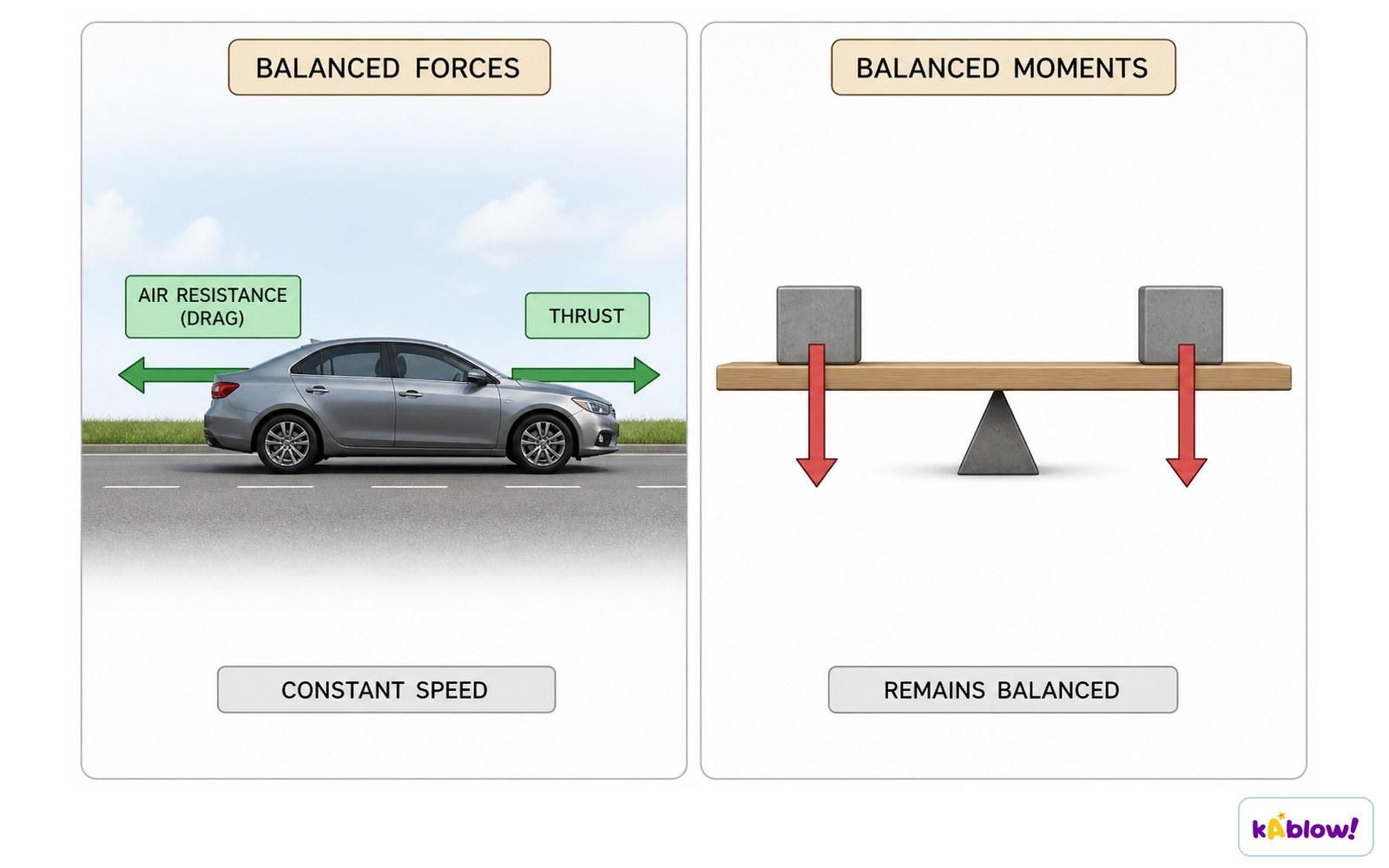
- Balanced forces produce no resultant force; the object remains at rest or moves at constant velocity.
- Unbalanced forces produce a resultant force; the object accelerates, decelerates, or changes direction.
- An object moving at constant speed in a straight line has balanced forces acting on it.
- If the resultant force on an object is zero, it is in equilibrium.
- When several forces act at angles, the resultant can be found by resolving forces into horizontal and vertical components or by using a scale drawing.
- A single force can be resolved into two perpendicular components that together have the same effect.
A car with balanced forces at constant speed, and a seesaw with balanced moments, illustrating equilibrium.
Slides
Sign up free to view the lesson slides
Step through every slide for this topic — plus flashcards and revision notes — with a free account.
Questões de prática
Prévia grátis — 8 de 65 perguntas. Cadastre-se para ver todas.
1.Which of the following is a vector quantity?
Easy- AVelocity
- BSpeed
- CMass
- DDistance
2.Which of the following is a contact force?
Easy- AFriction
- BGravitational force
- CElectrostatic force
- DMagnetic force
3.A student has a mass of 50 kg. What is their weight on Earth? Use g = 9.8 N/kg.
Medium- A490 N
- B50 N
- C9.8 N
- D0.2 N
4.Mass is a scalar quantity and weight is a vector quantity.
EasyTrue or false?
5.A resultant force of zero means that no forces are acting on the object.
EasyTrue or false?
6.Which of the following are non-contact forces? (Select all that apply.)
Medium- AGravitational force
- BElectrostatic force
- CMagnetic force
- DFriction
- EAir resistance
7.Match each force with its correct description.
Medium- Weight
- Friction
- Tension
- Upthrust
- The force of gravity on a mass
- A force that opposes motion between surfaces in contact
- A pulling force transmitted through a cable or rope
- The upward force exerted by a fluid on an object
8.Place the steps for calculating the resultant force of two forces acting in opposite directions in the correct order.
Medium- Identify the direction of the larger force
- Subtract the smaller force from the larger force
- State the magnitude and direction of the resultant force
Unlock all 65 questions, flashcards & more
Crie uma conta grátis para ver todas as perguntas, os slides, flashcards e resumos de revisão deste tópico.