Static electricity
Aprenda jogando
Responda a estas perguntas para ganhar energia, depois pesque e explore. Sem precisar de conta.
Notas de aula
Electric Charge and Particles
- The charge of a particle can be positive, negative, or neutral (no charge).
- Electrons are negatively charged, protons are positive, and neutrons are neutral.
- In a neutral atom, the number of electrons equals the number of protons, so the overall charge is zero.
- An object becomes negatively charged when it gains electrons and positively charged when it loses electrons.
- When two charged objects are close, they exert a force on each other: attractive if opposite charges, repulsive if like charges.
- Attraction and repulsion between charged objects are examples of non-contact forces.
Charging by Friction
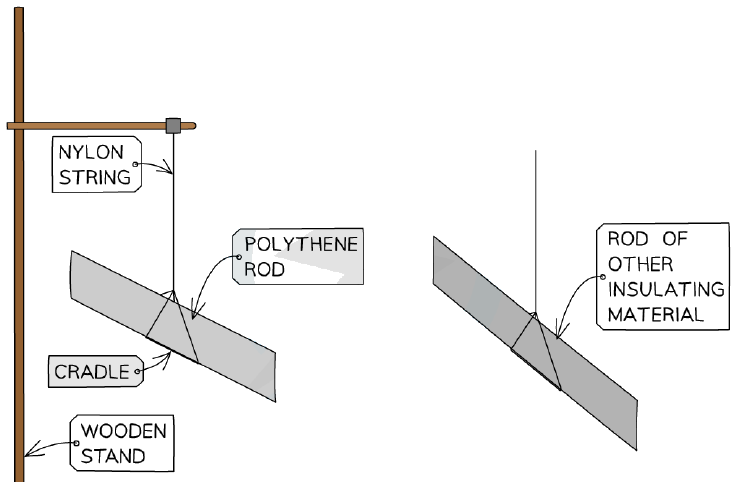
- When certain insulating materials are rubbed together, they become electrically charged – this is charging by friction.
- The charges remain on the insulators and cannot easily flow away.
- Charging by friction happens because negatively charged electrons are transferred from one material to the other.
- The material that gains electrons becomes negatively charged; the material that loses electrons becomes positively charged.
- For example, rubbing an acetate rod with a cloth transfers electrons from the rod to the cloth: the rod becomes positive, the cloth negative.
- If a polythene rod is rubbed with a cloth, electrons transfer from the cloth to the rod: the rod becomes negative, the cloth positive.
- Only electrons move – positive charge is not transferred.
Apparatus for demonstrating charging by friction using a polythene rod and another insulating material.
Static Electricity and Sparking
- Static electricity is caused by a build-up of stationary charge on the surface of insulators.
- A spark occurs when there is a large potential difference between two objects, causing a current to flow between them.
- Sparking can happen when a charged person touches an earthed metal object, like a door handle.
- An earthed conductor is a wire (often copper) that allows current to flow to the Earth; current takes the path of lower resistance.
- If the electric field becomes strong enough, it can force charges through insulators like air, causing an electrical discharge (spark).
- Examples include the small shock from a car door and lightning.
Examples of Static Electricity
- Rubbing a balloon on a woolly jumper transfers electrons to the balloon, making it negatively charged and the jumper positively charged.
- The balloon sticks to a neutral wall because the negative balloon repels electrons in the wall, leaving a positive region that attracts the balloon.
- A charged comb can pick up small pieces of paper: the comb repels negative charges in the paper, leaving a positive surface that is attracted to the comb.
- Hair sticks up after combing with a plastic comb because strands gain the same charge and repel each other.
- Dust accumulation on surfaces is another example of static electricity.
Dangers of Static Electricity
- A spark near flammable gases or liquids can cause a fire or explosion.
- When refuelling aeroplanes, friction between fuel and pipes can build up static charge; a spark could ignite the fuel.
- The risk is reduced by connecting the fuel tank to the Earth with a bonding line – a copper wire that carries excess charge to the ground.
- Lightning is an extreme example of sparking: charge builds up in clouds and discharges to the ground.
- Electrocution is another danger of static electricity.
Uses of Static Electricity
- Photocopiers use static electricity: an image is projected onto a positively charged plate, which loses charge in light areas.
- Negatively charged toner powder sticks to the remaining positive areas and is then transferred to paper and heated to fix it.
- Inkjet printers work similarly, using negatively charged ink droplets attracted to the correct place on the page.
- Insecticide sprayers give droplets an electrostatic charge so they repel each other, forming a fine mist that covers a large area.
- The charged droplets are also attracted to the Earth, reducing drift.
- Spray painting of cars uses the same principle.
Electric Fields
- A charged object creates an electric field around itself – a region where a charged object experiences a force.
- Electric field lines point away from positive charges and towards negative charges.
- The field is strongest close to the charged object (field lines closer together) and weaker further away (field lines further apart).
- Around an isolated charged sphere, field lines are radial: away from a positive sphere, towards a negative sphere.
- Between two parallel plates, the field is uniform: straight, parallel lines from positive to negative.
- The force on a charged object in a field is stronger when the distance between the objects is smaller.
Fields and Static Phenomena
- The electric field explains the non-contact force between charged objects: a second charged object in the field experiences a force.
- If the charges are the same, the force is repulsive; if opposite, the force is attractive.
- The force becomes stronger as the distance between the charged objects decreases.
- If an electric field becomes strong enough, charges are forced through insulators like air, creating a spark.
- This explains sparking when a charged person touches a conductor.
- Earthing removes excess charge: a positively charged object attracts electrons from Earth, while a negatively charged object sends electrons to Earth.
Slides
Sign up free to view the lesson slides
Step through every slide for this topic — plus flashcards and revision notes — with a free account.
Questões de prática
Prévia grátis — 8 de 61 perguntas. Cadastre-se para ver todas.
1.Which particle is transferred when an insulating material becomes charged by friction?
Easy- AElectron
- BProton
- CNeutron
- DAtom
2.An object becomes negatively charged when it:
Easy- Agains electrons
- Bloses electrons
- Cgains protons
- Dloses protons
3.Two charged objects are brought close together and attract each other. Which statement about their charges is correct?
Easy- AThey carry opposite charges
- BThey carry the same charge
- CBoth must be neutral
- DBoth must be positive
4.Which of the following statements about electric field lines is correct?
Easy- AThey point away from positive charges and towards negative charges
- BThey point away from negative charges and towards positive charges
- CThey point from negative to positive charges
- DThey have no direction
5.A positively charged object is connected to earth by a wire. What happens to the charge on the object?
Medium- AElectrons flow from earth to the object and neutralise it
- BElectrons flow from the object to earth
- CProtons flow from earth to the object
- DNothing happens because the object is an insulator
6.A negatively charged rod is held near a small piece of paper. The paper is attracted to the rod. Why?
Medium- AThe rod repels electrons in the paper, leaving a positive region that is attracted
- BThe paper has a positive charge
- CThe rod transfers electrons to the paper
- DThe paper is an insulator so it cannot be attracted
7.A student rubs a polythene rod with a cloth. The rod becomes negatively charged. Which row correctly describes the charge on the cloth?
Medium- APositive, equal in size
- BPositive, larger
- CNegative, equal in size
- DNegative, smaller
8.Which of these is a correct definition of an electric field?
Medium- AA region where a charged object experiences a force
- BA region where a magnetic material experiences a force
- CA region where only positive charges can exist
- DA region where electrons are always stationary
Unlock all 61 questions, flashcards & more
Crie uma conta grátis para ver todas as perguntas, os slides, flashcards e resumos de revisão deste tópico.