Waves in air, fluids and solids
Aprenda jogando
Responda a estas perguntas para ganhar energia, depois pesque e explore. Sem precisar de conta.
Notas de aula
Wave Basics
- Waves transfer energy and information without transferring matter.
- Waves are oscillations or vibrations about a fixed point.
- Ripples on water cause particles to oscillate up and down; sound waves cause air particles to vibrate back and forth.
- Objects floating on water (like a duck) bob up and down but do not travel with the wave, showing that matter is not transferred.
Describing Wave Motion
- Amplitude is the distance from the undisturbed position to the peak or trough of a wave, measured in metres (m).
- Wavelength is the distance from one point on a wave to the same point on the next wave, measured in metres (m).
- Frequency is the number of waves passing a point each second, measured in hertz (Hz).
- Time period is the time taken for one complete wave to pass a point, measured in seconds (s).
- Frequency and period are related by: f = 1/T.
- Wave speed is the speed at which energy is transferred through a medium.
- Wavefronts are lines representing each wave; the distance between them is the wavelength.
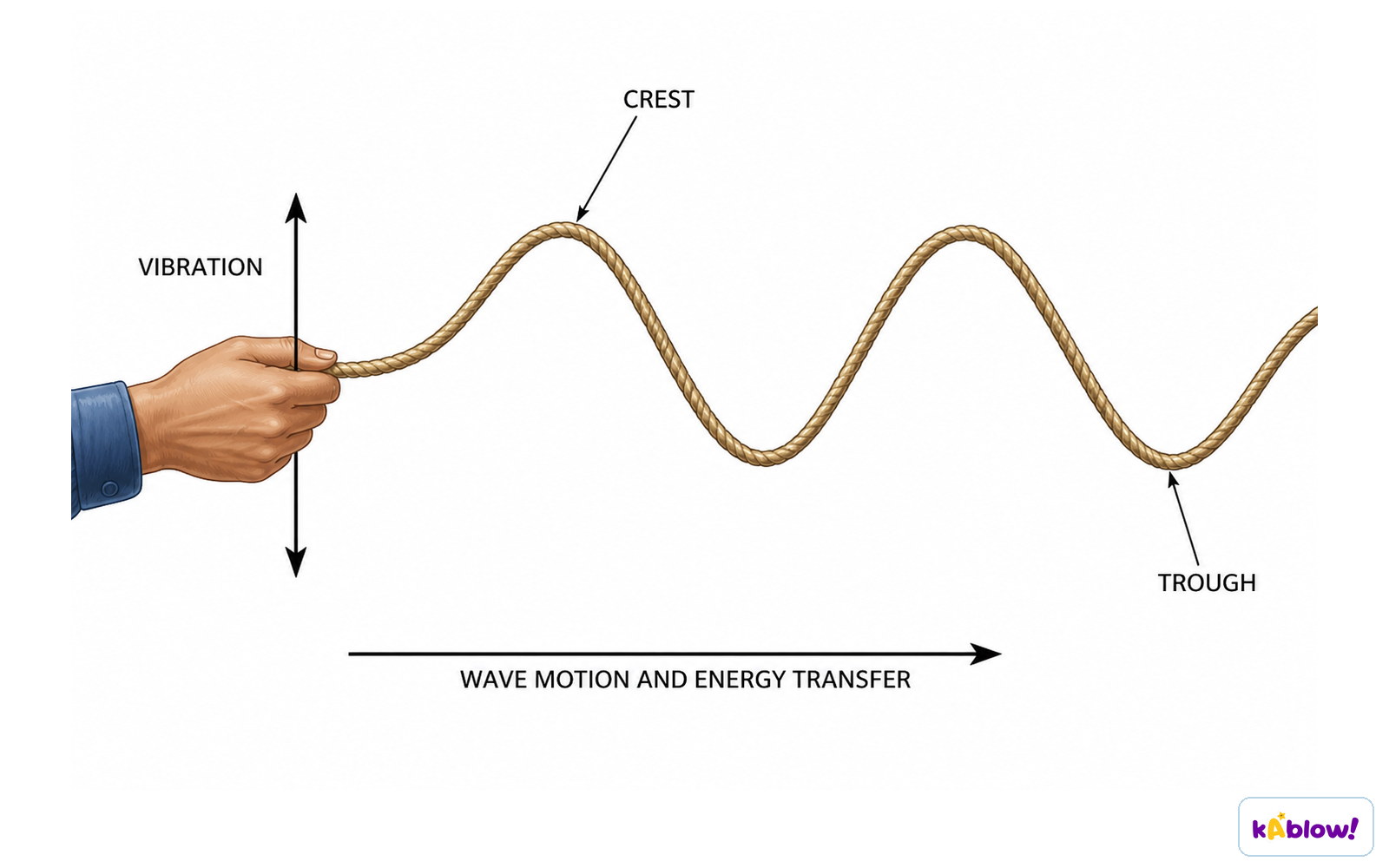
Transverse wave motion in a rope: the vibration is at 90 degrees to the direction of wave motion and energy transfer, with the crest and trough labelled.
Transverse and Longitudinal Waves
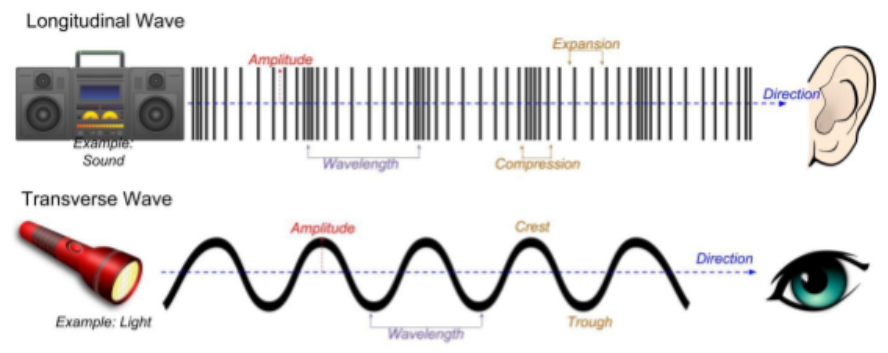
- Transverse waves vibrate at 90° (perpendicular) to the direction of energy transfer.
- Examples of transverse waves: ripples on water, vibrations in a guitar string, S-waves, electromagnetic waves.
- Longitudinal waves vibrate parallel to the direction of energy transfer.
- Longitudinal waves consist of compressions (regions of higher density) and rarefactions (regions of lower density).
- Examples of longitudinal waves: sound waves, P-waves, pressure waves in liquids or gases.
- Transverse waves can travel in solids and on the surfaces of liquids; longitudinal waves can travel in solids, liquids and gases.
- Only electromagnetic waves (transverse) can travel through a vacuum; longitudinal waves cannot.
Longitudinal and transverse waves.
The Wave Equation
- Wave speed can be calculated using: v = f × λ (wave speed = frequency × wavelength).
- v is wave speed in metres per second (m/s), f is frequency in hertz (Hz), λ is wavelength in metres (m).
- Wave speed can also be calculated using: v = x / t (speed = distance / time).
- The wave equation can be rearranged to find frequency (f = v/λ) or wavelength (λ = v/f).
- All waves obey the wave equation.
Measuring Wave Speed
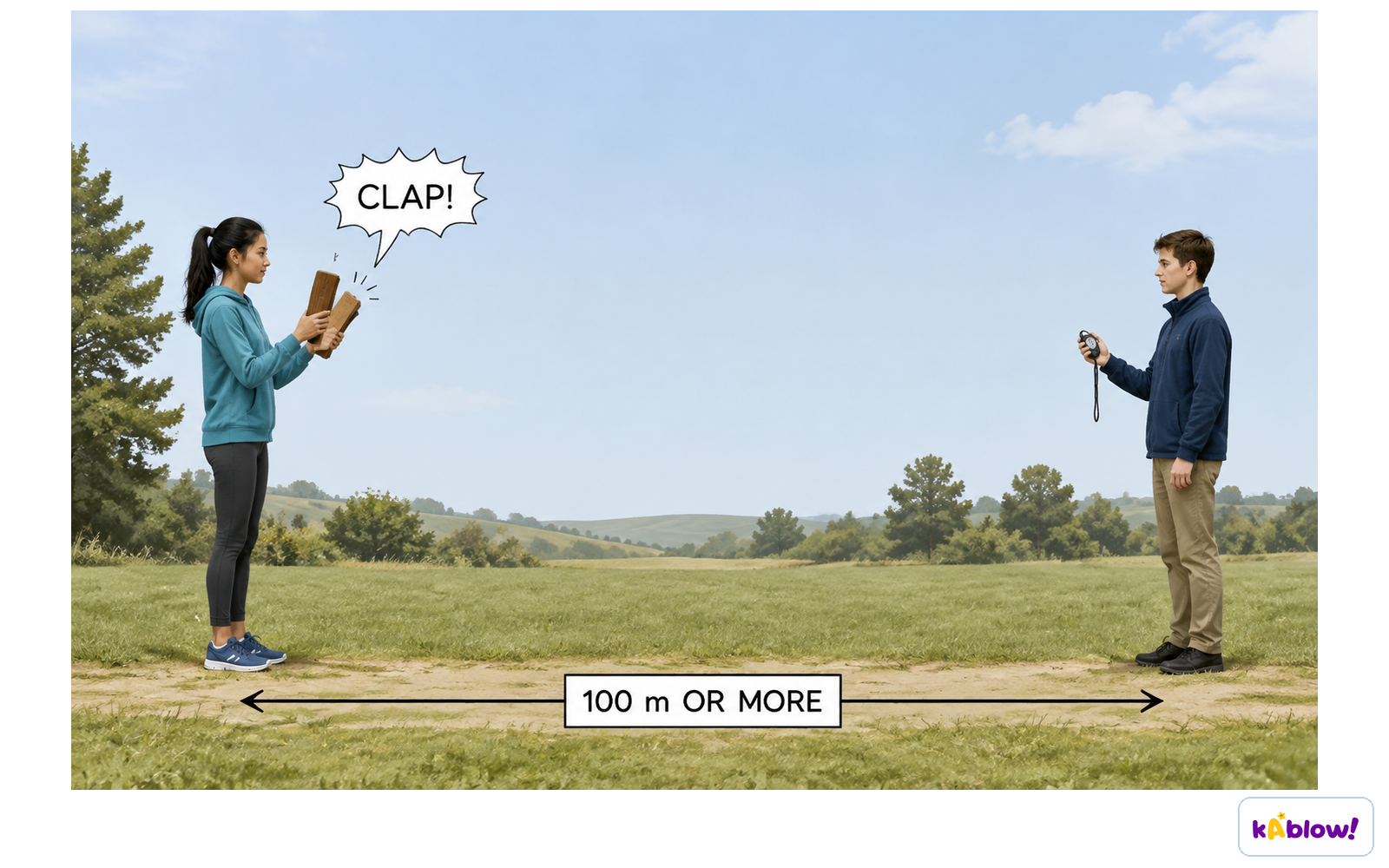
- Speed of sound in air can be measured between two points: measure distance with a trundle wheel, time the sound with a stopwatch.
- Using echoes: clap blocks in rhythm with echoes, measure distance to wall, time 20 claps, total distance = 20 × 2 × distance.
- Using an oscilloscope: two microphones connected to an oscilloscope, measure time difference for sound to travel between them.
- Speed of ripples on water: measure distance between two points, time how long a ripple takes to travel, repeat and average.
- The oscilloscope method is most accurate because timing is automatic; the two-point method is least accurate due to short time intervals.
Measuring the speed of sound between two points
Reflection, Absorption and Transmission
- When waves meet a boundary between two materials, they can be reflected, absorbed or transmitted.
- A reflected sound wave is called an echo.
- Reflection occurs at the boundary between two different materials.
- Transmission is when a wave passes through a material; absorption is when a wave's energy is taken in by a material.
- Ray diagrams can be used to illustrate the reflection of a wave at a surface.
Sound Waves
- Sound waves are longitudinal waves consisting of compressions and rarefactions.
- Sound waves cause pressure variations in the air, so they are pressure waves.
- When sound waves hit a solid, the pressure variations cause the solid to vibrate in sync with the wave.
- Sound travels fastest in solids, slower in liquids, and slowest in gases because molecules are closer together in solids.
- The human ear detects sound when sound waves cause the eardrum and small bones to vibrate, which creates electrical impulses sent to the brain.
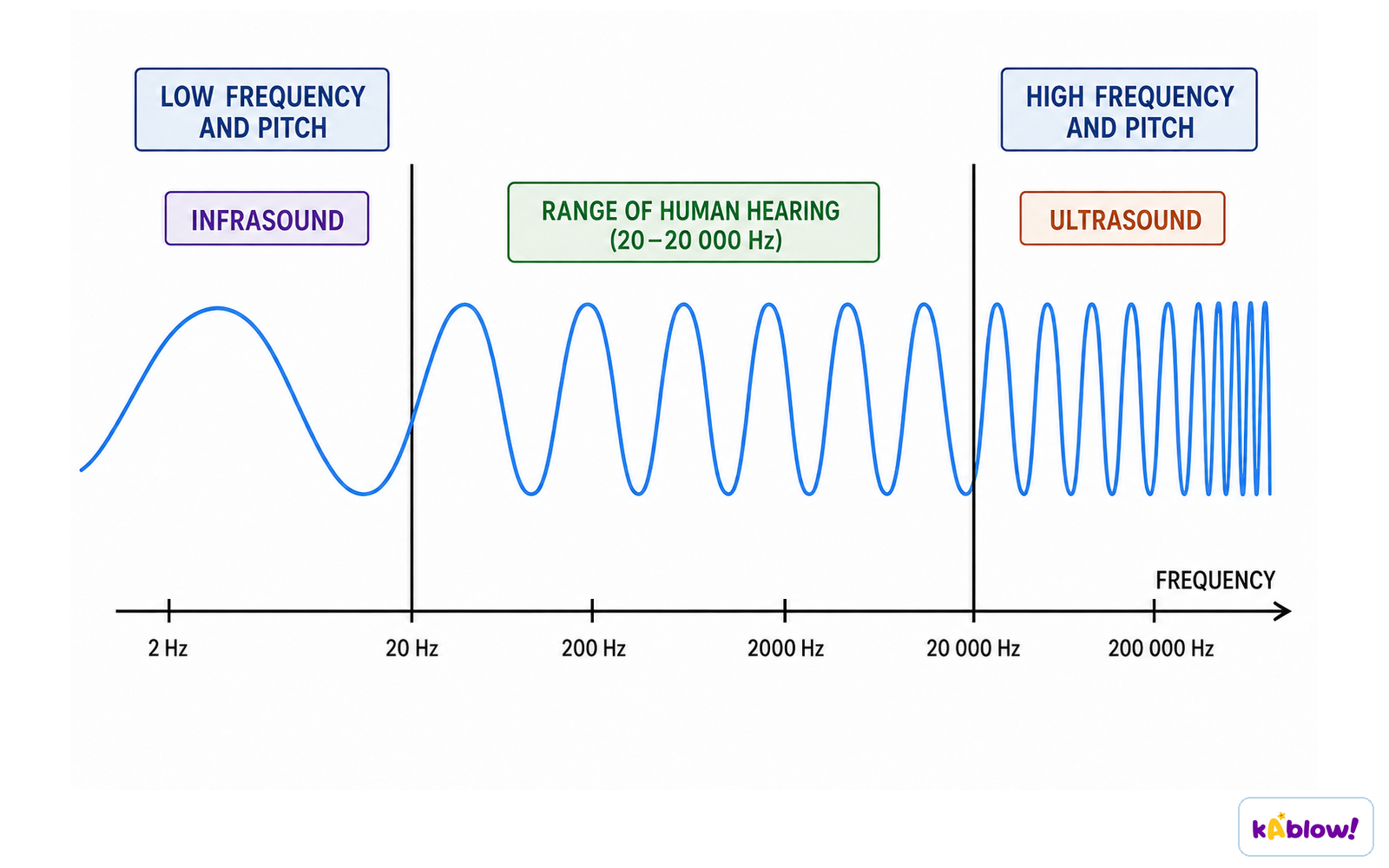
- The range of human hearing is 20 Hz to 20 000 Hz (20 kHz).
Ultrasound and Infrasound
- Ultrasound is sound with a frequency above 20 000 Hz (above the human hearing range).
- Infrasound is sound with a frequency below 20 Hz (below the human hearing range).
- Ultrasound is used in sonar, foetal scanning, and industrial imaging.
- Infrasound is produced by earthquakes (P-waves) and can be used to study the Earth's core.
- Ultrasound waves are partially reflected at boundaries between different media; the time for reflections to return can determine distance.
Frequencies of ultrasound
Seismic Waves and Earth's Structure
- Earthquakes produce P-waves (longitudinal) and S-waves (transverse).
- P-waves travel faster than S-waves, so P-waves are felt first.
- P-waves can travel through solids and liquids; S-waves can only travel through solids.
- S-waves cannot pass through the Earth's liquid outer core, which is why they are not detected on the opposite side of the Earth from an earthquake.
- P-waves refract as they pass through different layers, creating shadow zones that provide evidence about the Earth's internal structure.
- Seismic waves provide evidence that the mantle is solid, the outer core is liquid, and the inner core is solid.
Calculating Depth and Distance
- If wave speed is known, distance can be calculated using: distance = speed × time (x = v × t).
- Echo sounding uses ultrasound to detect objects underwater and measure water depth.
- The sound wave travels to the ocean bottom and back, so total distance = 2 × depth.
- The time for the echo to return is used to calculate depth: depth = (speed × time) / 2.
- For example, a thunderclap heard 4 s after lightning: distance = 330 m/s × 4 s = 1320 m.
Slides
Sign up free to view the lesson slides
Step through every slide for this topic — plus flashcards and revision notes — with a free account.
Questões de prática
Prévia grátis — 8 de 64 perguntas. Cadastre-se para ver todas.
1.Which type of wave is a sound wave travelling through air?
Easy- ATransverse
- BLongitudinal
- CElectromagnetic
- DStationary
2.In a longitudinal wave, the particles vibrate at right angles to the direction in which the wave transfers energy.
EasyTrue or false?
3.Which row correctly names the two features labelled on a longitudinal wave?
Easy- ACompression = region of lower density; rarefaction = region of higher density
- BCompression = region of higher density; rarefaction = region of lower density
- CCompression = highest point; rarefaction = lowest point
- DCompression = region of constant density; rarefaction = region of changing pressure
4.Which statement about the movement of particles in a sound wave travelling through air is correct?
Medium- AAir particles travel along with the wave from the source to the listener.
- BAir particles vibrate about fixed positions and do not travel with the wave.
- CAir particles move at right angles to the direction of energy transfer.
- DAir particles are permanently pushed away from the source.
5.Sound waves travel fastest in solids and slowest in gases.
EasyTrue or false?
6.What is the normal range of frequencies that a healthy human ear can hear?
Easy- A2 Hz to 2000 Hz
- B20 Hz to 20 000 Hz
- C200 Hz to 200 000 Hz
- D20 Hz to 2000 Hz
7.What name is given to a sound wave that is reflected from a surface?
Easy- AAn echo
- BA refraction
- CA rarefaction
- DAn ultrasound
8.Which of the following statements about sound waves are correct? (select all that apply)
Medium- AThey are longitudinal waves.
- BThey consist of compressions and rarefactions.
- CThey can travel through a vacuum.
- DThey cause pressure variations in the air.
- EThey travel faster in gases than in solids.
Unlock all 64 questions, flashcards & more
Crie uma conta grátis para ver todas as perguntas, os slides, flashcards e resumos de revisão deste tópico.