Food chains and food webs
Aprenda jogando
Responda a estas perguntas para ganhar energia, depois pesque e explore. Sem precisar de conta.
Para educadores: slides de aula, resumos de revisão prontos para usar de Food chains and food webs (MYP Biology, Year 1) — use na sua aula ou rode o tópico como atividade interativa de turma que seus aprendizes jogam como um jogo ao vivo.
Notas de aula
Big idea: who eats what, and where the energy goes
- Big idea (key concept): Relationships. Living things in an ecosystem depend on each other. What happens to one organism affects others.
- Related concept: Energy. The links between organisms are really links for passing energy along, starting with the Sun.
- Global context: Globalization and sustainability. People are part of food webs too. Fishing, farming and invasive species change food webs around the world, so understanding them helps us look after the planet.
- Producers make their own food. Plants and algae use light energy to make sugars by photosynthesis.
- Consumers cannot make their own food, so they get energy by eating other organisms.
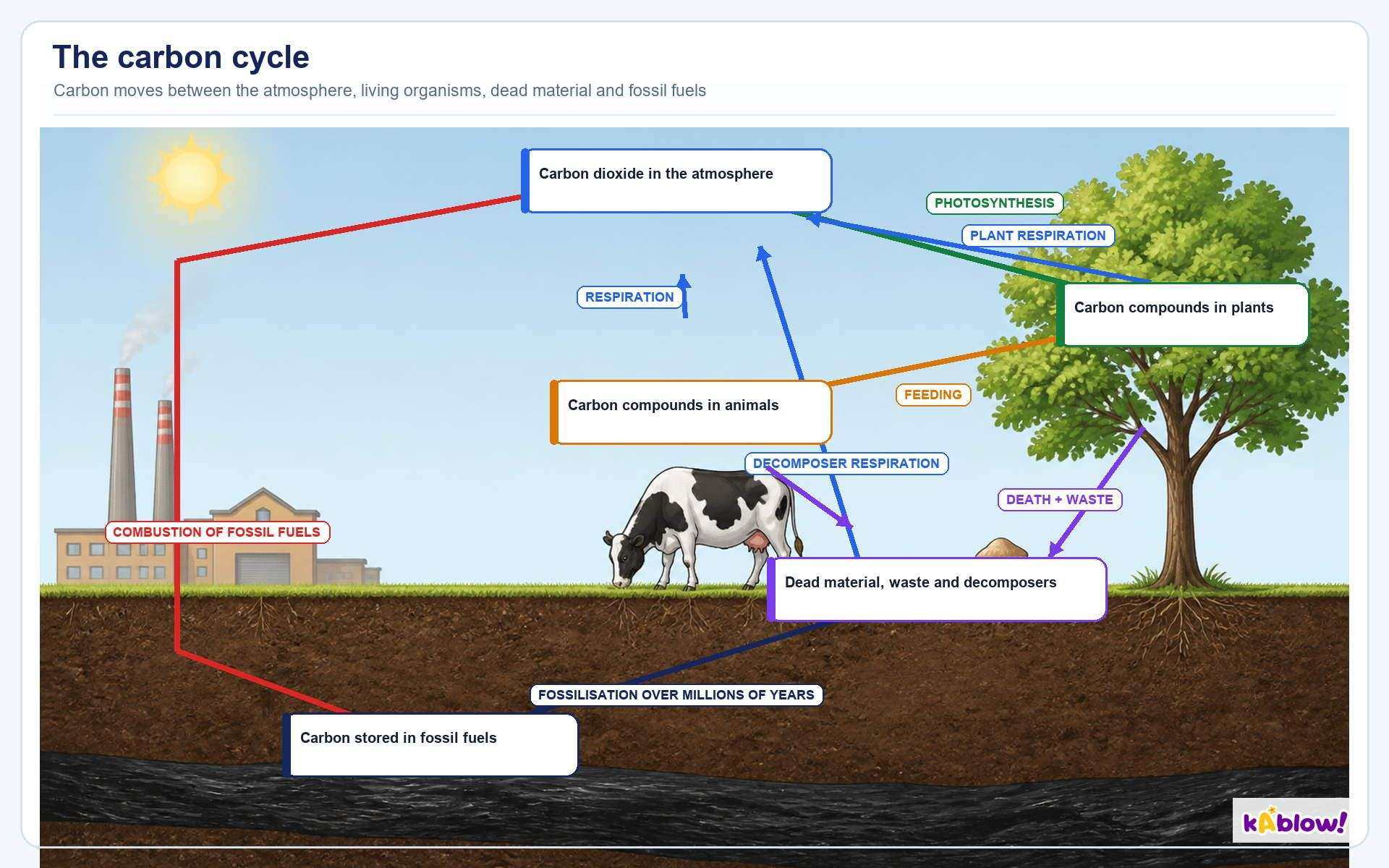
- Decomposers, such as fungi and many bacteria, break down dead plants, dead animals and waste, and return nutrients to the soil.
Decomposers return nutrients to the soil
Reading a food chain
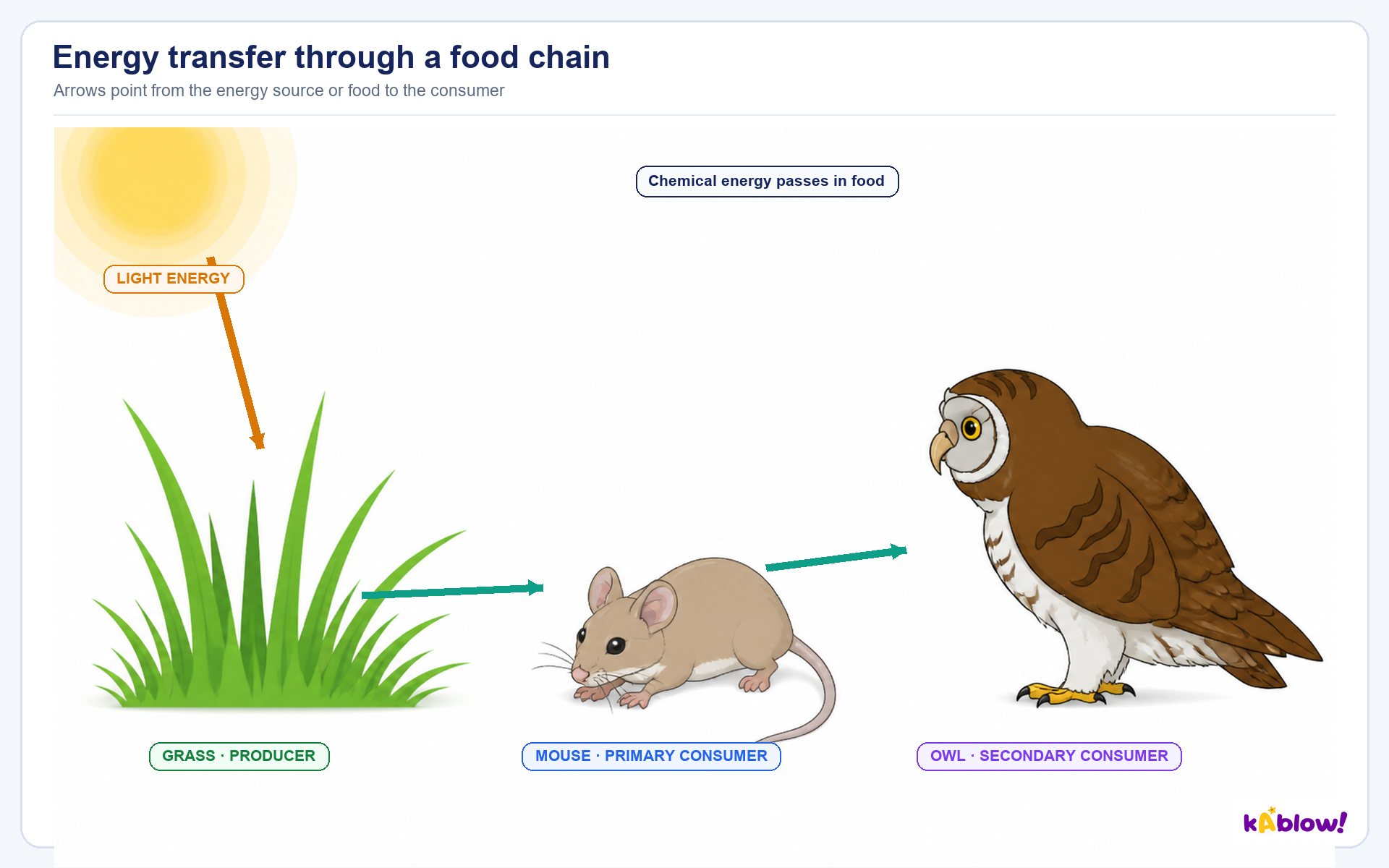
- A food chain shows the feeding links between organisms, for example: Sun → grass → mouse → owl.
- Each arrow means ‘gives energy to’. It points from the organism that is eaten to the organism that eats it.
- A food chain always starts with a producer, because only producers can capture the energy in sunlight.
- Animals that eat only plants are herbivores. Animals that eat only other animals are carnivores. Animals that eat both are omnivores.
- In grass → mouse → owl, the grass is the producer, the mouse is the primary consumer and the owl is the secondary consumer.
A food chain
Predators, prey and trophic levels
- A predator hunts and eats other animals. The animal it eats is its prey.
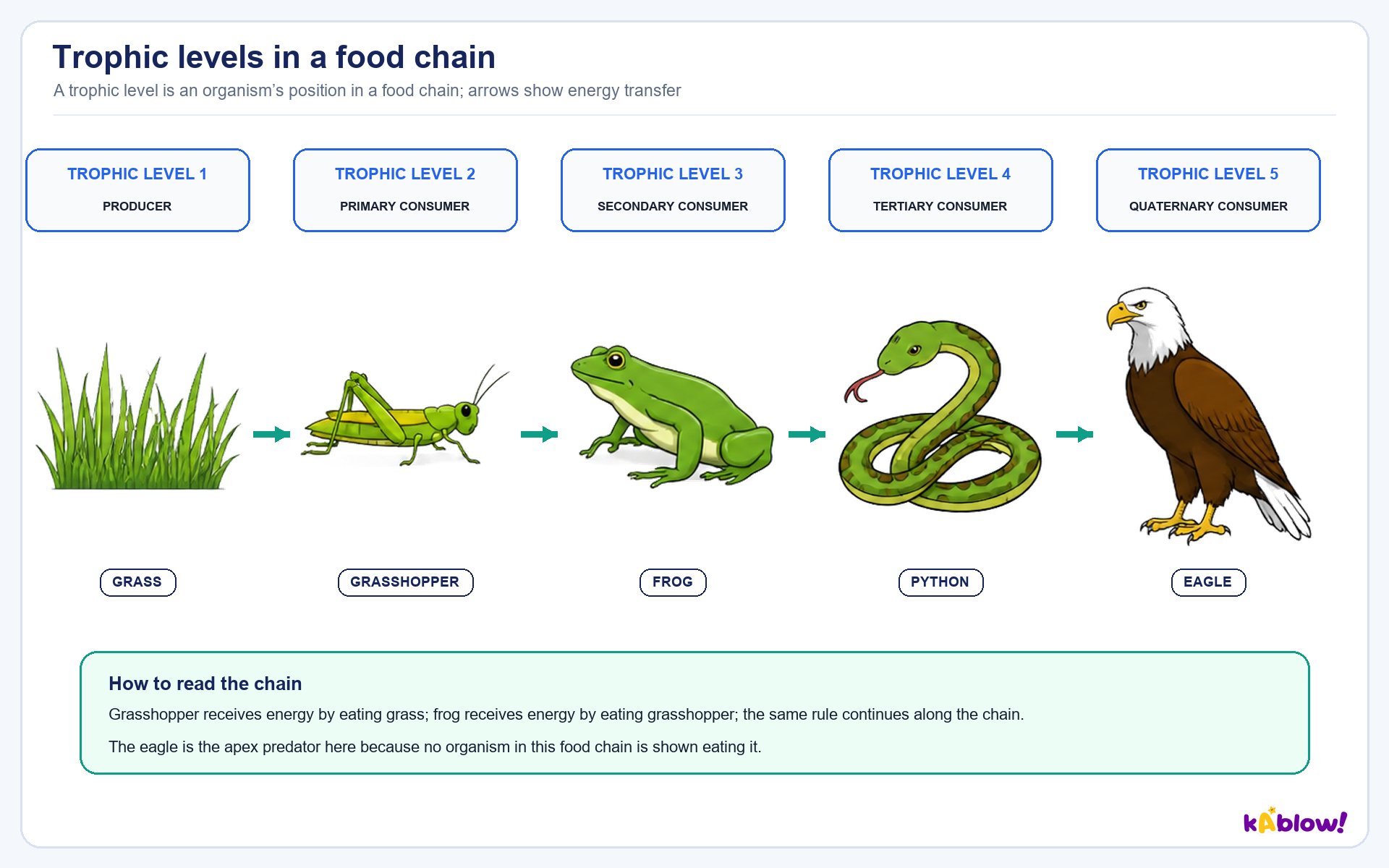
- A trophic level is a feeding step in a chain. Level 1 is the producer, level 2 is the primary consumer, level 3 is the secondary consumer, and so on.
- In grass → grasshopper → frog → python → eagle, the frog is a secondary consumer, the python is a tertiary consumer and the eagle is a quaternary consumer.
- An animal at the top of a food chain, with no natural predators, is an apex predator.
- One animal can be in more than one trophic level. A python that eats a frog is a tertiary consumer, but a python that eats a mouse that ate grass is a secondary consumer.
Trophic levels
Food webs and what happens when one organism is removed
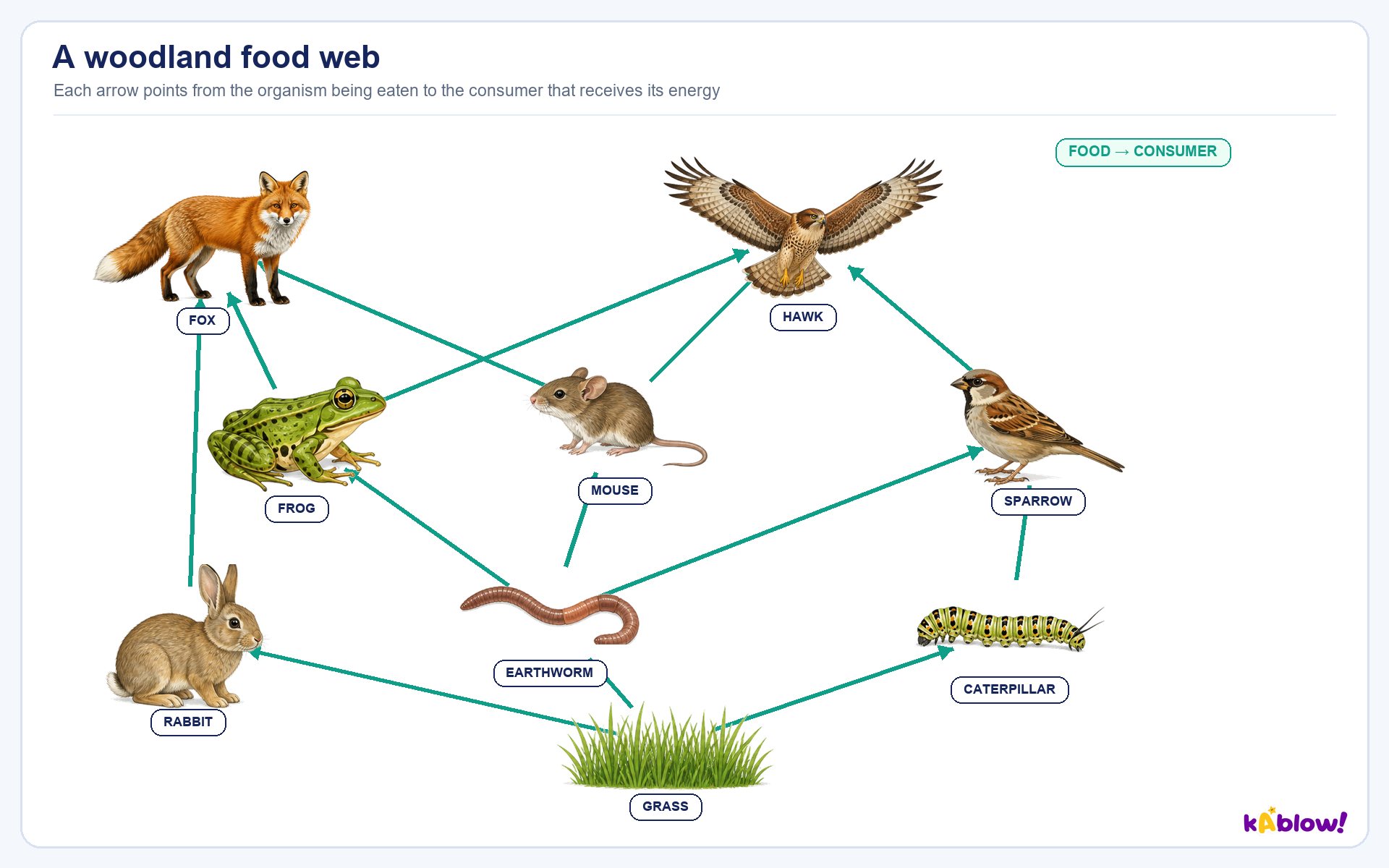
- Most animals eat more than one thing, and are eaten by more than one thing. Many food chains linked together make a food web.
- A food web is a better model of an ecosystem than a single chain because it shows all the links, not just one path.
- If one organism is removed, the organisms that ate it lose a food source and may decrease. The organisms it used to eat may increase because fewer are being eaten.
- These changes can spread through the web, so organisms that are not directly linked can still be affected.
- Sustainability: if too many large fish are caught, the small fish they eat can increase, and this can unbalance the whole food web. Careful fishing limits help protect it.
A food web shows the interdependence of organisms
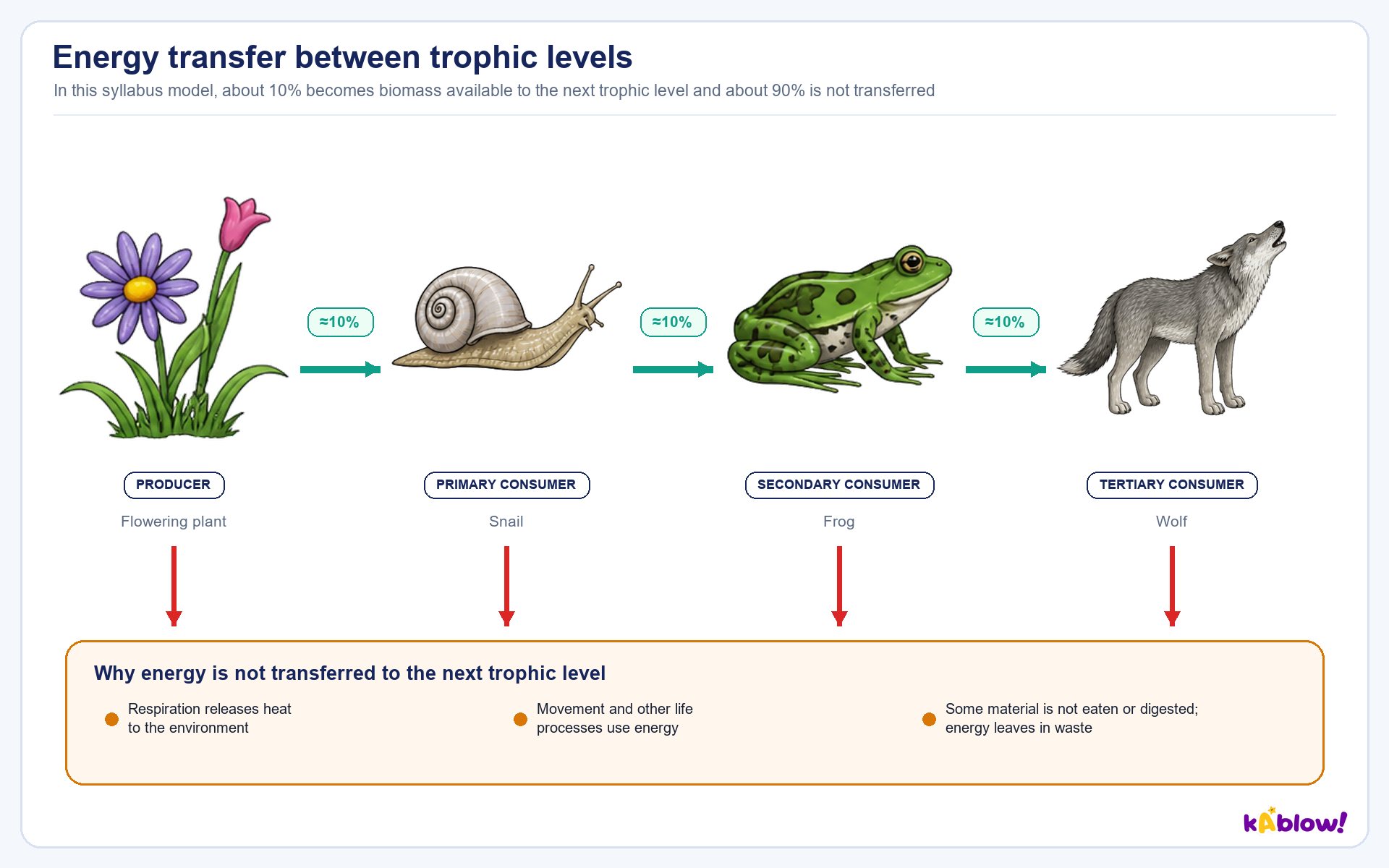
Energy along a food chain
- The original source of energy for almost all food chains is the Sun. Producers capture a small part of it.
- At each step, only about 10% (one tenth) of the energy is passed on to the next level. This is a rough rule: the real figure varies.
- The rest is lost. Some is released as heat when organisms respire, some is used for movement, and some is in waste or in parts that are not eaten, such as bones.
- Because so much energy is lost at each step, there is less and less energy available higher up the chain. This is why food chains rarely have more than four or five links.
- It is also why top predators are few in number: there is not enough energy to support many of them.
Energy loss along a food chain
Think like a scientist: investigating a food web in the field
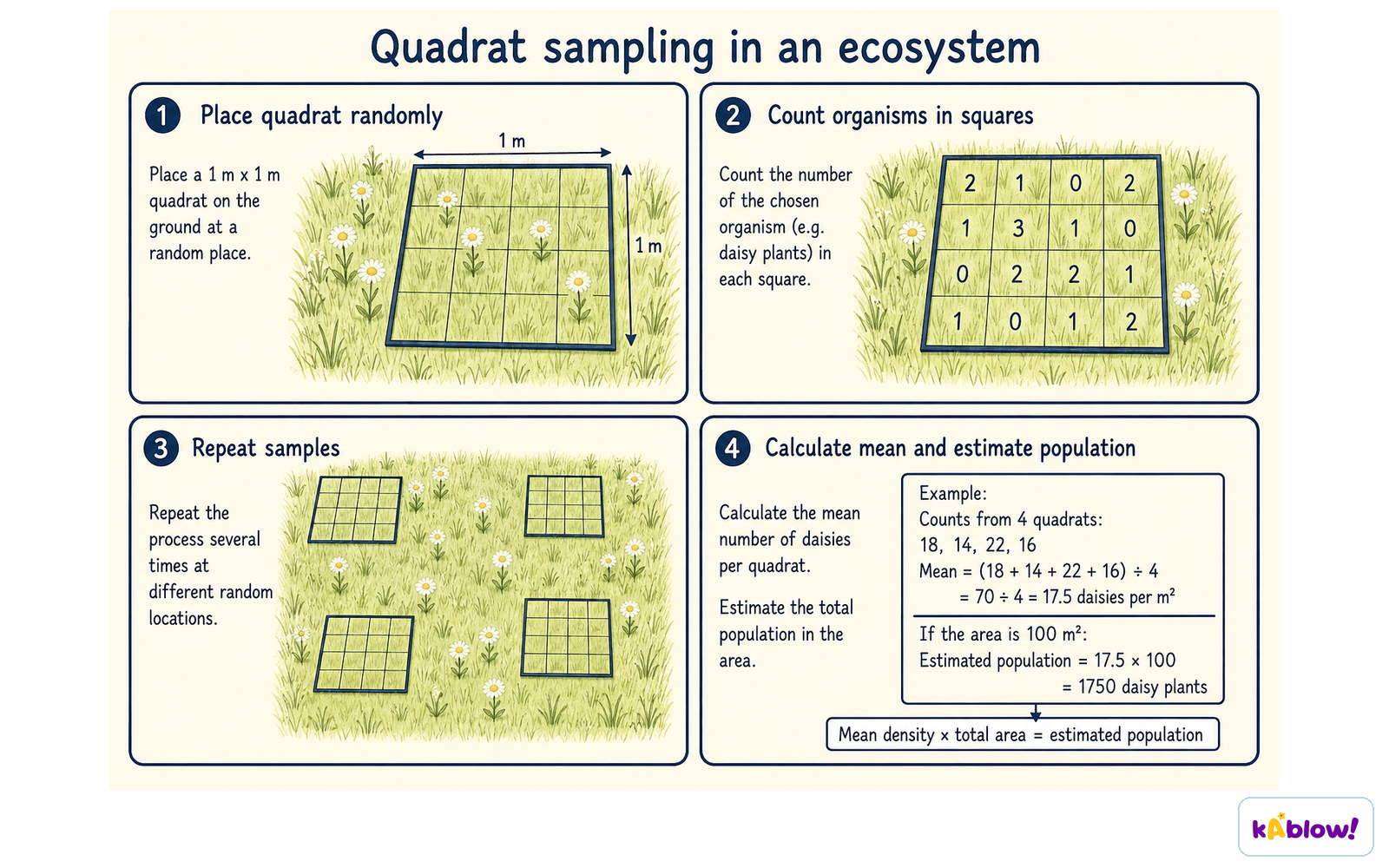
- Scientists cannot count every animal in a meadow, so they take samples. A quadrat is a square frame placed on the ground; you count the organisms inside it.
- Place quadrats randomly so you do not choose the easy places, and use many quadrats, then calculate a mean.
- Inquiry task: plan an investigation to find out whether grass length affects the number of grasshoppers. The independent variable is grass length and the dependent variable is the number of grasshoppers per quadrat.
- Control other variables: same size of quadrat, same time of day, same weather, and the same field.
- Evaluate: Would one quadrat be enough? What could make your results less reliable? How could you improve the method?
Quadrat sampling in an ecosystem
Slides
Sign up free to view the lesson slides
Step through every slide for this topic — plus flashcards and revision notes — with a free account.
Questões de prática
Prévia grátis — 8 de 54 perguntas. Cadastre-se para ver todas.
1.What is a producer?
Easy- AAn animal that eats plants as its food
- BAn organism that makes its own food from light
- CAn organism that breaks down dead matter
- DAn animal that hunts other animals for food
2.Which of these is a producer?
Easy- AAn oak tree
- BA mushroom
- CA fox
- DA rabbit
3.What is a consumer?
Easy- AAn organism that makes food from sunlight
- BAn organism that lives only in water and soil
- CAn organism that breaks down dead plants
- DAn organism that gets energy by eating others
4.What does an arrow in a food chain show?
Easy- AWhich organism is bigger
- BWhich organism eats the other, pointing from eater to food
- CThe direction energy flows, from the eaten organism to the eater
- DWhich organism lives the longest
5.In the food chain grass → rabbit → fox, which organism is the primary consumer?
Easy- AThe fox
- BThe rabbit
- CThe Sun
- DThe grass
6.In the food chain grass → rabbit → fox, what is the fox?
Easy- AA secondary consumer
- BA decomposer
- CA primary consumer
- DA producer
7.What is the original source of energy for almost all food chains?
Easy- AThe soil
- BWater
- CPlants
- DThe Sun
8.What is a predator?
Easy- AAn animal that eats only plants
- BAn animal that is hunted by other animals
- CAn animal that hunts and eats other animals
- DAn animal that feeds on dead matter
Unlock all 54 questions, flashcards & more
Crie uma conta grátis para ver todas as perguntas, os slides, flashcards e resumos de revisão deste tópico.
Provas anteriores
A prática com provas anteriores deste tópico chega em breve.
Em breve