Drugs, disease and staying healthy
Aprenda jogando
Responda a estas perguntas para ganhar energia, depois pesque e explore. Sem precisar de conta.
Notas de aula
Big idea: health, relationships and consequences
- Big idea (key concept): Relationships. Your health depends on relationships: between you and the microorganisms around you, between your body and what you put into it, and between your choices and the people around you.
- Related concept: Consequences. Every choice has consequences. Washing your hands, being vaccinated or deciding to smoke each lead to different outcomes for you and for other people.
- Global context: Identities and relationships. Looking after your own health, and the health of the people around you, is part of caring for yourself and others.
- Health is a state of physical, mental and social wellbeing, not just the absence of disease.
- A communicable disease is caused by a pathogen and can spread from one organism to another. A non-communicable disease, such as heart disease or type 2 diabetes, does not spread from person to person.
- A healthy lifestyle includes a balanced diet, regular exercise, enough sleep, good hygiene, avoiding harmful drugs, and looking after your mental health, for example by talking to someone you trust when you feel worried.
Pathogens and how disease spreads
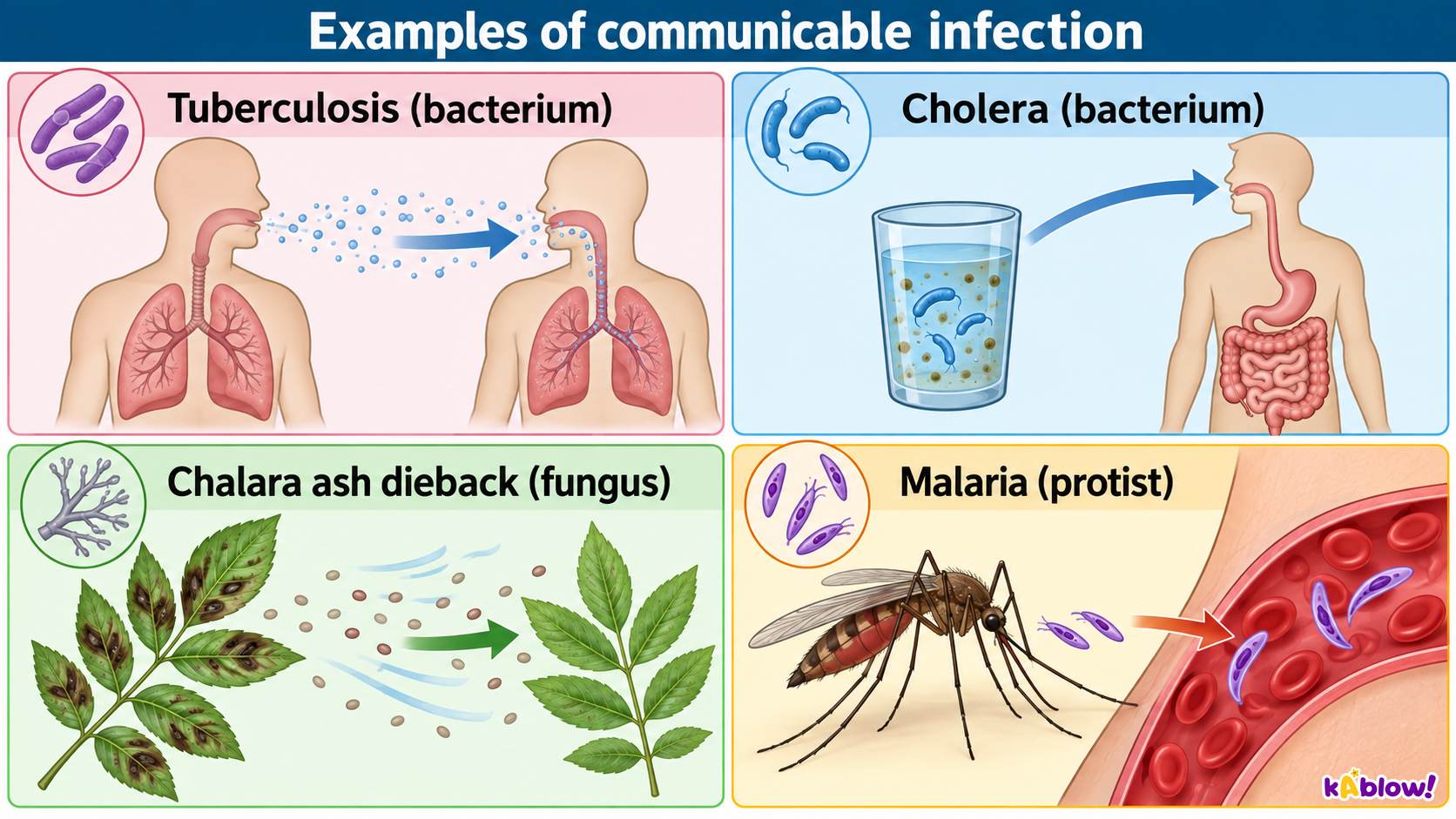
- A pathogen is a microorganism that causes disease. There are four main groups: bacteria (cholera, tuberculosis), viruses (influenza, measles), fungi (athlete's foot, ash dieback in trees) and protists (malaria).
- Bacteria are living cells that can reproduce on their own. Viruses are much smaller, are not cells, and can reproduce only inside the cells of a host, which they damage.
- Pathogens make you ill by reproducing very quickly and damaging cells, and bacteria may also release poisons called toxins.
- Pathogens can spread through the air in droplets from coughs and sneezes, by direct contact, in contaminated food and water, and through vectors: animals that carry a pathogen from one host to another, such as the mosquito that carries malaria.
- The spread of disease can be reduced by washing hands, covering coughs and sneezes, food hygiene, clean drinking water and sewage treatment, controlling vectors with nets, keeping ill people away from others, and vaccination.
Four infectious diseases and how each one spreads
How the body defends itself
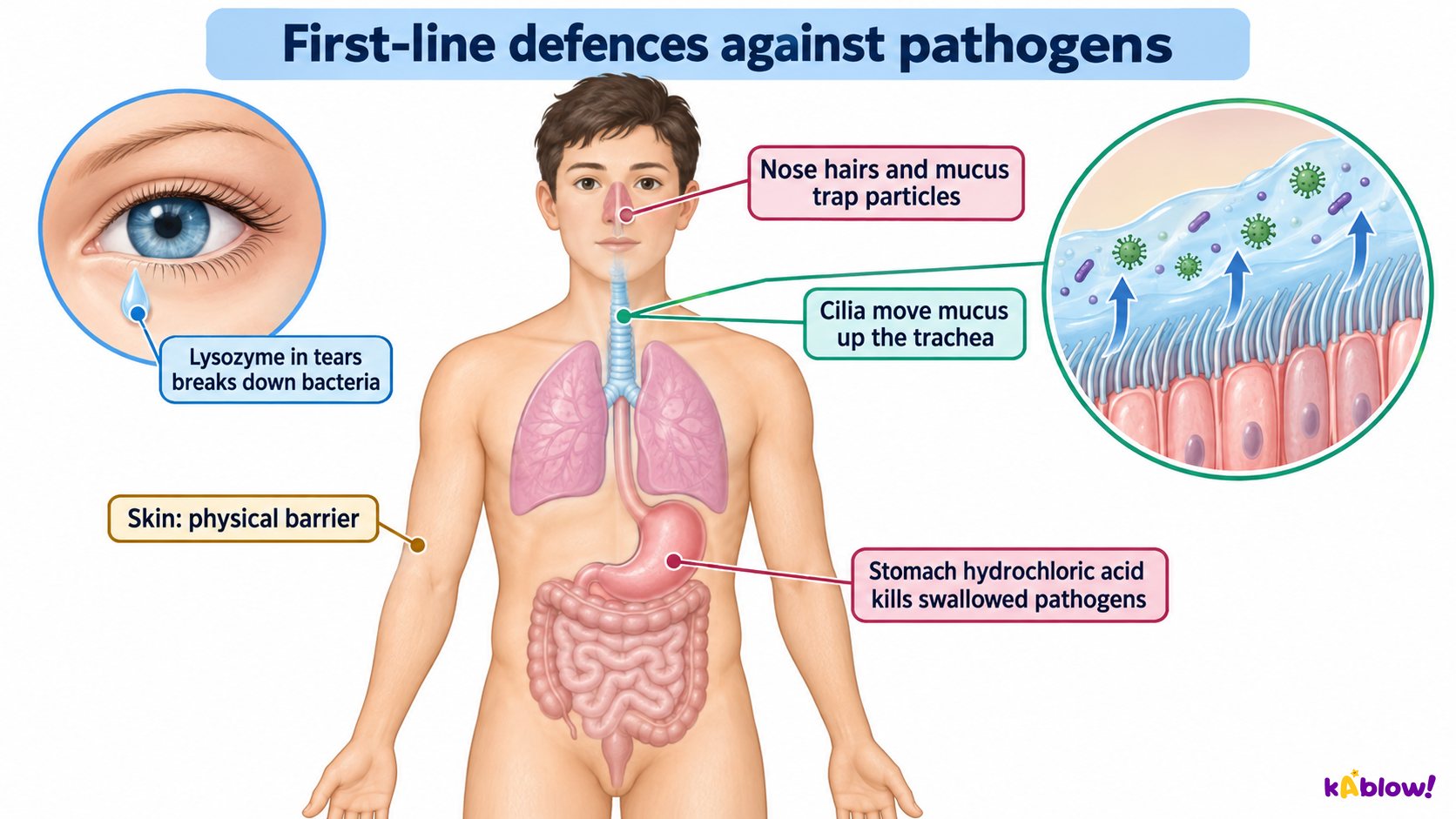
- First-line defences try to stop pathogens getting in. Skin is a physical barrier and blood platelets seal cuts with a scab. Nose hairs and mucus trap particles, and cilia sweep the mucus up the trachea. Tears contain the enzyme lysozyme, which breaks down bacteria, and stomach acid kills many swallowed pathogens.
- If pathogens do get inside, white blood cells take over. Phagocytes engulf pathogens and digest them. This is called phagocytosis, and it works against many kinds of pathogen.
- Lymphocytes make antibodies. An antigen is a molecule on the surface of a pathogen that the body recognises as foreign. Each antibody has a shape that fits the antigen of just one type of pathogen.
- Antibodies stick to pathogens and help phagocytes destroy them. After an infection some lymphocytes stay in the body as memory cells. If the same pathogen returns, memory cells make the right antibodies much faster, often before you feel ill. This is immunity.
The body's first-line defences
Vaccination and herd immunity
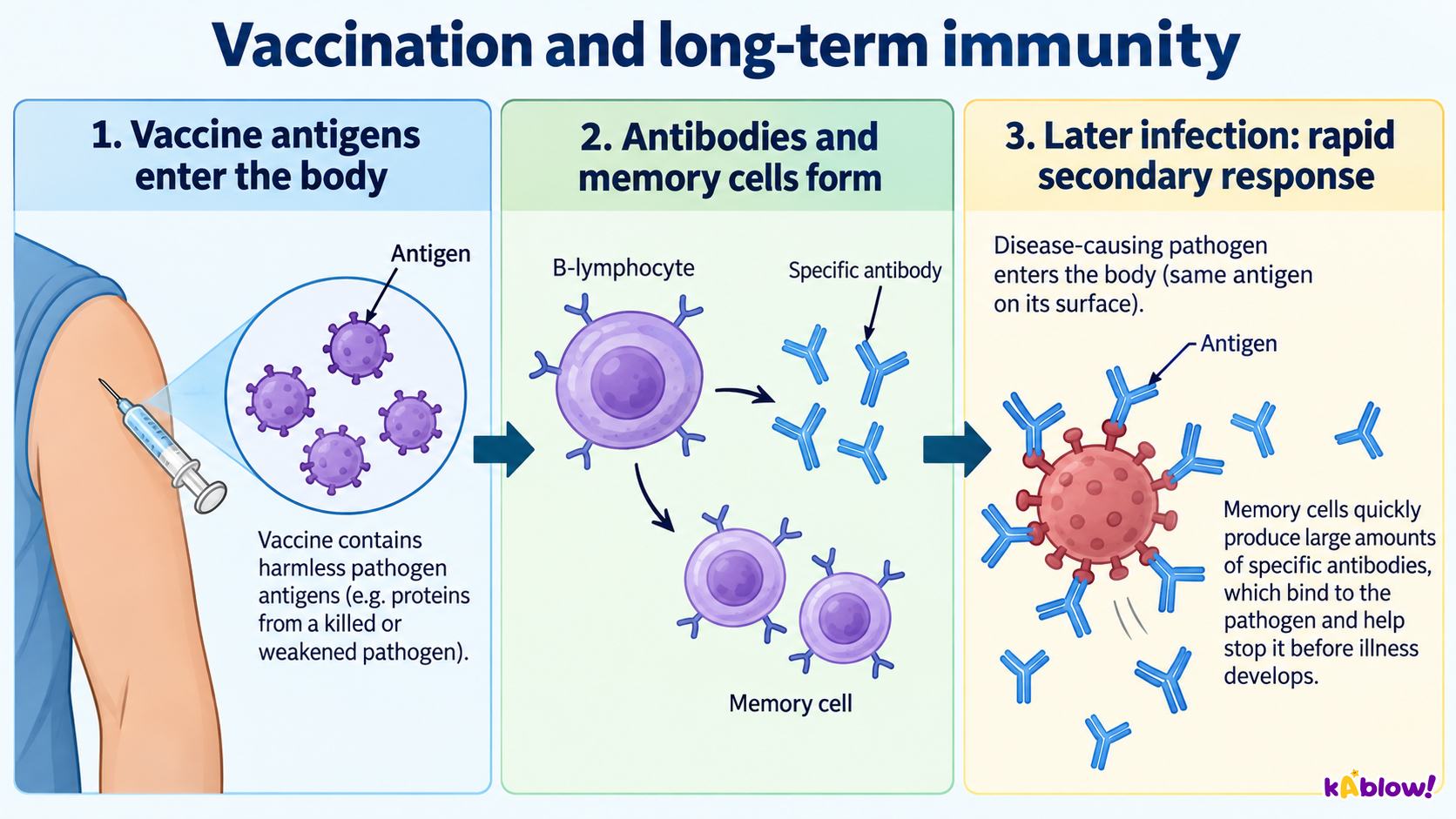
- A vaccine contains harmless forms of a pathogen, such as weakened or killed pathogens or just their antigens. It cannot cause the disease, but it makes lymphocytes produce antibodies and memory cells.
- If the real pathogen enters the body later, the memory cells respond quickly with many antibodies, so the pathogen is destroyed before it can make you ill.
- In 1796 Edward Jenner used cowpox to protect a boy against smallpox. Through worldwide vaccination, smallpox was declared eradicated in 1980.
- Herd immunity happens when enough people in a population are immune that the pathogen has difficulty finding new hosts. For measles, about 95% of people need to be immune.
- Herd immunity protects people who cannot be vaccinated, such as very young babies and people with weakened immune systems.
- A vaccine prevents a disease, while an antibiotic treats a bacterial infection. Vaccines may cause a sore arm or a mild fever, but the risks of the diseases are far greater.
How a vaccine gives long-term immunity
Medicines, antibiotics and other drugs
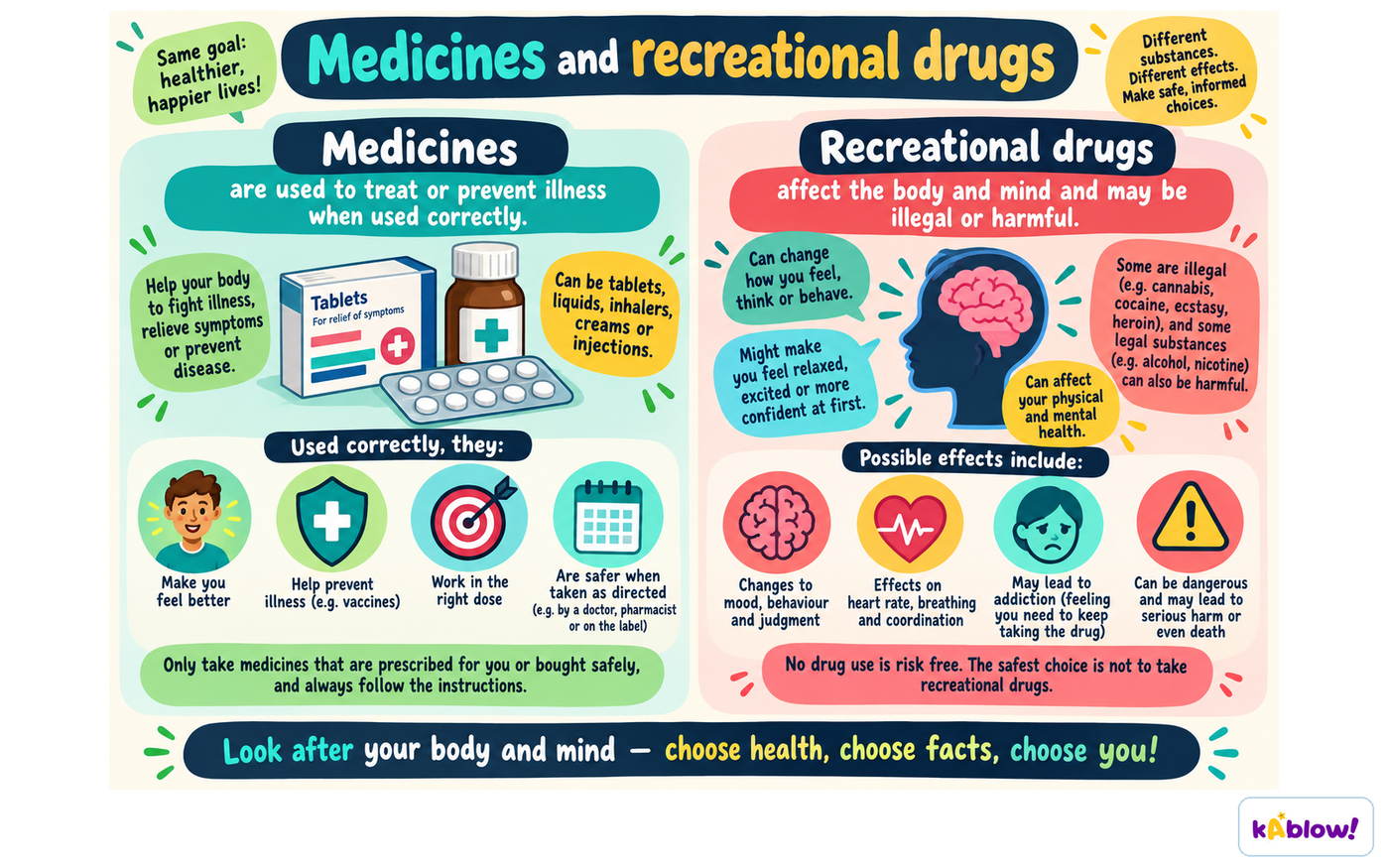
- A drug is a chemical that changes how the body works. Medicines are drugs used to treat or prevent illness when taken correctly, such as painkillers, inhalers and antibiotics.
- Antibiotics, such as penicillin, kill bacteria or stop them growing. They do not work against viruses, so they cannot cure colds or flu.
- Antibiotic resistance happens when bacteria change by random mutation. If one bacterium is resistant, the antibiotic kills the others and the resistant ones survive, reproduce and spread. This is why antibiotics should only be taken when prescribed, and the whole course must be finished.
- Recreational drugs are taken for their effect on mood or behaviour. Some, such as alcohol and nicotine, are legal for adults but still harmful. Others are illegal. No drug use is completely risk-free.
- Alcohol slows the nervous system, so reactions and judgement get worse. Over many years it can damage the liver and brain, and it can harm a developing foetus.
- Tobacco smoke contains nicotine, which is addictive, tar, which contains chemicals that cause cancer, and carbon monoxide, which binds to haemoglobin so the blood carries less oxygen. Smoking can cause lung disease, lung cancer and heart disease. E-cigarettes often contain nicotine and are not risk-free.
- Addiction is a need to keep taking a drug. Stopping can cause unpleasant withdrawal symptoms. A school nurse, doctor or trusted adult can help.
Medicines compared with recreational drugs
Think like a scientist: which antiseptic works best?
- Question: which of three antiseptics stops harmless bacteria growing best? A teacher spreads harmless bacteria over agar jelly in sealed plates. Paper discs are soaked in water or in antiseptic A, B or C and placed on the jelly. The plates are taped shut and left at room temperature for 2 days. A clear area appears around a disc where bacteria cannot grow.
- Variables: the independent variable is the type of liquid on the disc. The dependent variable is the width of the clear zone in mm. Control variables include the size of the disc, the volume of liquid soaked in, the type and amount of bacteria, the temperature and the time.
- Control: the disc soaked in water is the control. It shows that water alone does not stop the bacteria growing, so any clear zone around the other discs is due to the antiseptic.
- Results (mean clear zone, mm): water 0, antiseptic A 14, antiseptic B 9, antiseptic C 16. Repeating the test and calculating a mean makes the results more reliable.
- Safety: plates stay taped shut and are never opened by students. They are incubated at room temperature, not body temperature, and disposed of by the teacher.
- Inquiry task: write a conclusion for the results above. Then evaluate the method: name one source of error, say how you would improve the reliability, and say what extra test you would need before claiming that antiseptic C is safe and effective on skin.
Slides
Sign up free to view the lesson slides
Step through every slide for this topic — plus flashcards and revision notes — with a free account.
Questões de prática
Prévia grátis — 8 de 54 perguntas. Cadastre-se para ver todas.
1.Which of these is the best definition of health?
Easy- ABeing strong enough to play any sport
- BNot having any disease or injury at all
- CPhysical, mental and social wellbeing
- DEating five portions of fruit every day
2.Heart disease is a communicable disease.
EasyTrue or false?
3.Which of these is a non-communicable disease?
Easy- AType 2 diabetes
- BMeasles
- CMalaria
- DAthlete's foot
4.Which of these are part of a healthy lifestyle? (select all that apply)
Medium- ARegular exercise
- BSmoking tobacco
- CA balanced diet
- DSkipping breakfast every day
- EEnough sleep
5.What is a pathogen?
Easy- AA cell that helps to fight infection
- BA medicine that kills harmful bacteria
- CA drug that changes a person's mood
- DA microorganism that causes disease
6.Match each disease to the type of pathogen that causes it.
Easy- Cholera
- Influenza (flu)
- Athlete's foot
- Malaria
- Protist
- Bacterium
- Virus
- Fungus
7.Which statement about viruses is correct?
Easy- AThey are the largest type of pathogen
- BThey reproduce only inside living cells
- CThey are killed by antibiotics
- DThey are made of one large cell
8.Antibiotics can be used to treat flu.
EasyTrue or false?
Unlock all 54 questions, flashcards & more
Crie uma conta grátis para ver todas as perguntas, os slides, flashcards e resumos de revisão deste tópico.