Genetic engineering and biotechnology
Aprenda jogando
Responda a estas perguntas para ganhar energia, depois pesque e explore. Sem precisar de conta.
Notas de aula
Big idea: editing the instructions of life
- Big idea (key concept): Systems. Every cell runs on a system of genes, proteins and enzymes. Genetic engineering changes one part of that system, and the change can ripple through the organism, the farm or the environment.
- Related concept: Consequences. New technology brings benefits and risks. Scientists, farmers, patients and governments judge them differently, so we practise weighing evidence as well as values.
- Global context: Fairness and development. Who gets the medicines, who can afford the seeds, and who decides the rules? These are questions about fairness between people and between countries.
- Selective breeding means choosing parents with useful features, breeding them, and repeating over many generations. It only uses variation that already exists in the species, and it takes a long time.
- Genetic engineering means taking a gene from one organism and putting it into the cells of another so that it has a new feature. The gene can come from a different species, and the change appears in a single generation. An organism changed this way is called genetically modified (GM).
The steps and tools of genetic engineering
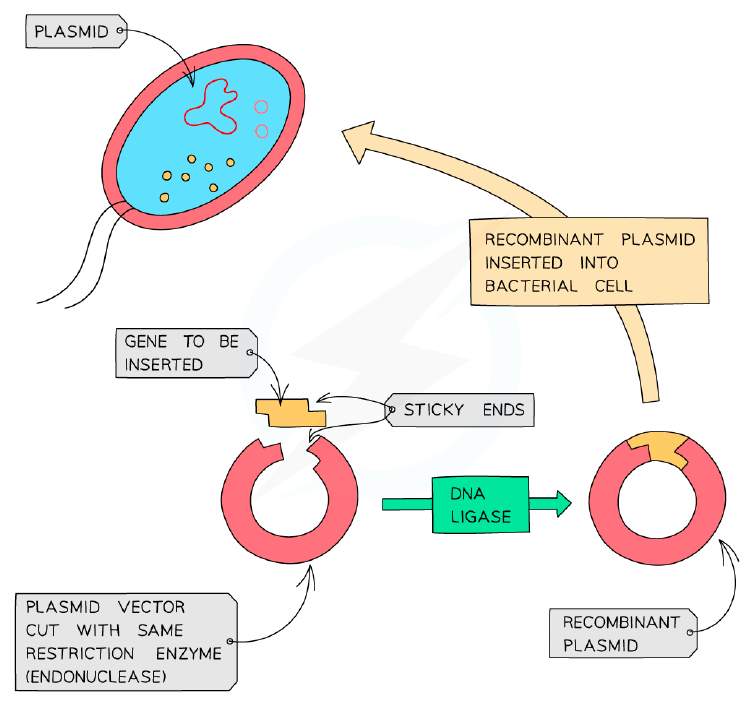
- Step 1: find and cut out the gene. Restriction enzymes are enzymes that cut DNA at a specific base sequence. Often they leave short single-stranded ends called sticky ends.
- Step 2: choose a vector. A vector carries the gene into the host cell. A common vector is a plasmid, a small ring of DNA found in bacteria. Viruses can also be used as vectors.
- Step 3: cut the plasmid with the same restriction enzyme. The cut plasmid has sticky ends that are complementary to the ends of the gene, so the two fit together.
- Step 4: join them. The enzyme DNA ligase joins the gene to the plasmid. The result is a recombinant plasmid, which contains DNA from two sources.
- Step 5: put the plasmid into host cells such as bacteria, then grow the cells. Plasmids often carry a marker gene (for example one that gives antibiotic resistance) so that scientists can pick out the bacteria that took up the plasmid.
- Step 6: collect the product. Bacteria reproduce quickly, so one modified cell soon becomes millions. The genetic code is almost the same in all organisms, so a bacterium can read a human gene and build the human protein.
Building a recombinant plasmid
Uses: medicines and crops
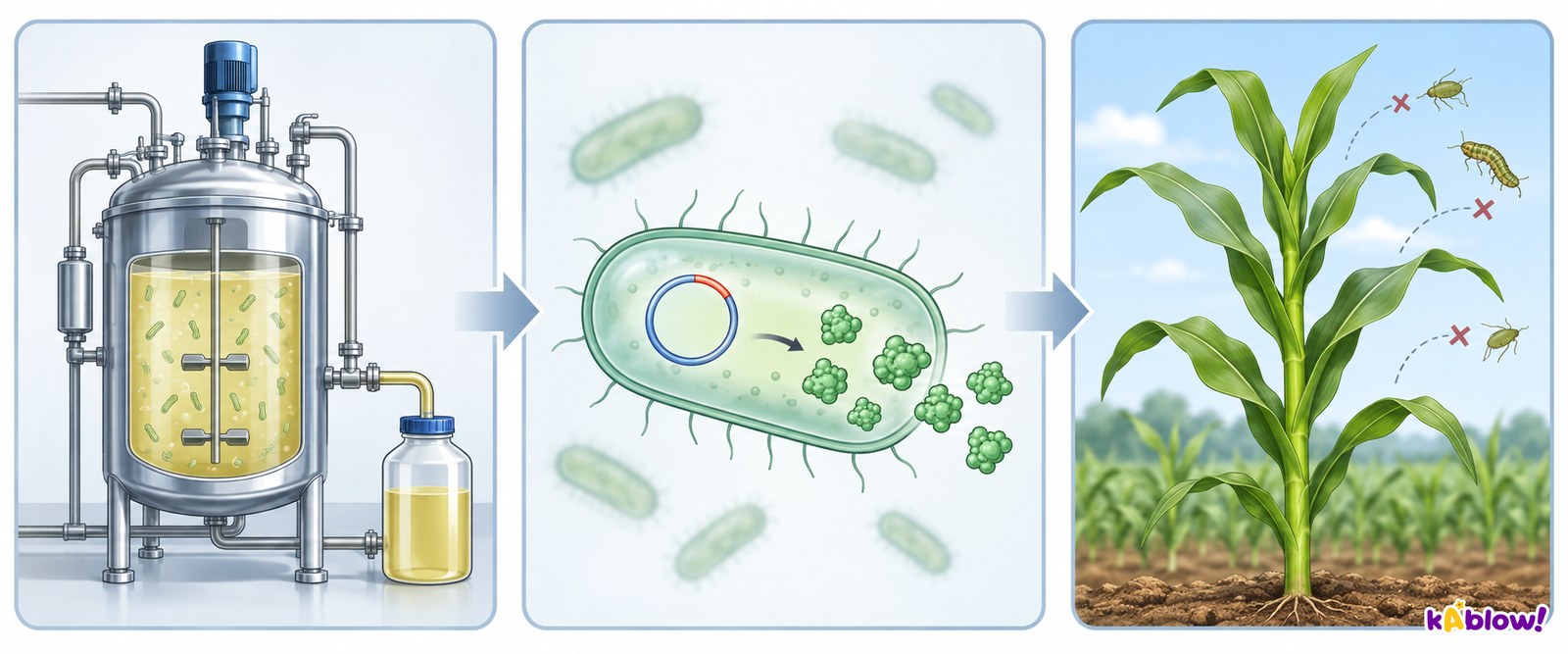
- Human insulin. People with type 1 diabetes cannot make enough insulin. Until the early 1980s insulin was extracted from the pancreases of pigs and cattle. Today the human insulin gene is put into bacteria, which are grown in large tanks. The insulin they make has the same amino acid sequence as human insulin.
- Insect-resistant crops. The Bt gene comes from a soil bacterium. When it is put into a crop such as maize, the plant makes a protein that is toxic to certain insect pests, for example some caterpillars. In many studies this has meant farmers use less insecticide on these crops.
- Nutrient-enriched crops. Golden Rice has been modified to make β-carotene, which the body can turn into vitamin A. It was developed to help tackle vitamin A deficiency, a serious problem in some countries. How useful it will be compared with other approaches is still debated.
- Other aims include crops that tolerate a particular herbicide, crops that tolerate drought or salty soil, and animals that make useful proteins in their milk.
- Each use has a specific purpose. Judging a technology means asking: what problem does it solve, and for whom?
Three uses of genetic modification
Cloning
- A clone is an organism that is genetically identical to its parent. Cloning does not add any new alleles, but it can copy a valuable plant or animal exactly.
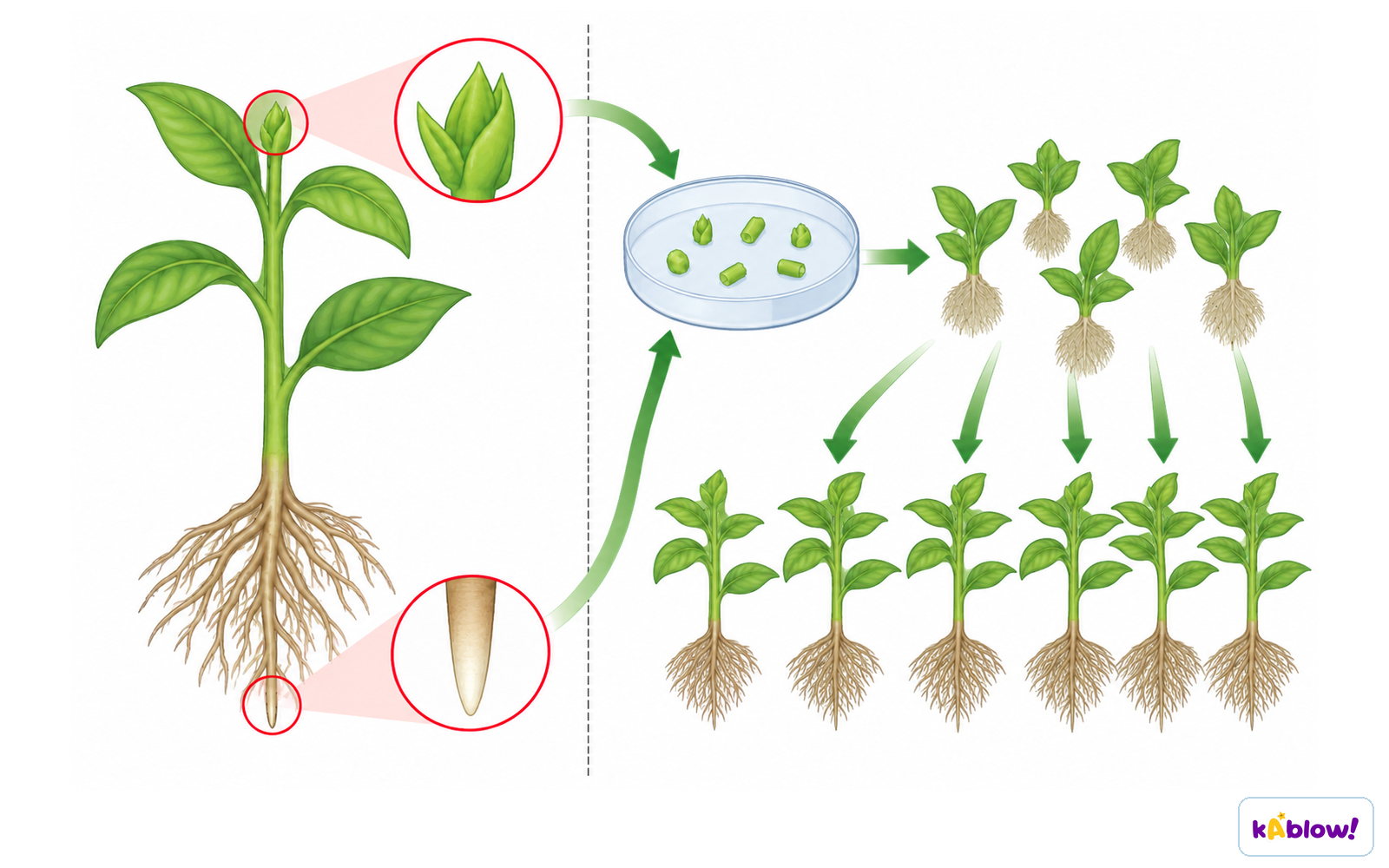
- Plant tissue culture. Small pieces of tissue from the meristem at a shoot or root tip are placed on a sterile jelly (agar) containing nutrients and plant hormones. Their cells divide by mitosis and grow into many identical plantlets. Growers use this to produce thousands of identical plants, or to save rare species.
- Animal cloning by nuclear transfer. The nucleus is removed from an unfertilised egg cell. A nucleus from a body cell of the animal to be copied is put in its place. A small electric shock makes the egg start dividing, and the embryo is placed in a surrogate mother. This is how Dolly the sheep was produced in 1996. Many attempts failed for each success.
- Because clones share the same alleles, a whole crop of clones can be wiped out by the same disease. There is less genetic variation to give some individuals a chance of surviving.
- Clones can still differ, because the environment (food, light, injury) affects how they grow.
Cloning plants by tissue culture
Benefits, risks and ethics: evaluating the evidence
- Possible benefits. More affordable and reliable medicines; crops that lose less to pests and so may need less insecticide; foods with added nutrients; faster results than selective breeding.
- Concerns that people raise. Genes might spread by pollen to wild relatives or non-GM crops. A herbicide-tolerant crop can encourage heavy use of one herbicide, and weeds may become resistant. Some people worry about effects on other insects, or on health, and ask for long-term monitoring. Seeds may be patented, so small farmers can find them expensive.
- What the evidence says. Regulators test GM foods before they are approved, and many scientific reviews have found approved GM foods as safe to eat as their non-GM equivalents. Environmental effects depend on the crop, the trait and how it is farmed, so each case is judged separately.
- Science and values. Evidence can tell us whether a protein is toxic to insects. It cannot alone tell us whether it is right to alter an organism's genes, how to share the benefits, or how much risk is acceptable. Those are value judgements, and different people and cultures weigh them differently.
- Useful questions to ask: Who did the study and who paid for it? How many plants, animals or people were tested? Was it repeated by independent scientists? Who benefits and who carries the risk? What are the alternatives?
Think like a scientist: testing a claim
- Claim: a seed company says its new insect-resistant maize loses less leaf to caterpillars. How could you test it fairly?
- Take leaf discs of the same size from GM maize and from ordinary (non-GM) maize of the same variety, grown in the same soil and light. Place equal numbers of discs in dishes with the same number and age of caterpillars.
- The independent variable is the type of maize (GM or non-GM). The dependent variable is the leaf area eaten after 24 hours, or the mass of leaf eaten.
- Control variables: disc size, number and age of caterpillars, temperature, time, and the leaf age. Use at least five dishes per type and calculate a mean so that chance matters less.
- Inquiry task 1: write a method for this test and say how you would record the results. Inquiry task 2: a farm trial found the GM crop had a higher mean yield at three of four farms, and the seed company paid for the trial. Evaluate how far the data supports the claim, and say what extra evidence you would want.
Slides
Sign up free to view the lesson slides
Step through every slide for this topic — plus flashcards and revision notes — with a free account.
Questões de prática
Prévia grátis — 8 de 51 perguntas. Cadastre-se para ver todas.
1.What is genetic engineering?
Easy- AChoosing parents with useful features and breeding them over many generations
- BMoving a gene from one organism into another to give it a new feature
- CMaking an identical copy of an organism from one of its cells
- DMixing two different foods to make a new product
2.Which process uses only the variation that already exists in a species?
Easy- ASelective breeding
- BGenetic engineering using a plasmid
- CMoving a gene between two species
- DCutting DNA with a restriction enzyme
3.Genetic engineering can move a gene from one species into a different species.
EasyTrue or false?
4.Selective breeding changes an organism's genes directly in a single generation.
EasyTrue or false?
5.Which type of enzyme cuts DNA at a specific base sequence?
Easy- AA DNA ligase enzyme
- BA lipase enzyme
- CA restriction enzyme
- DAn amylase enzyme
6.Which enzyme joins a gene into a cut plasmid?
Easy- ARestriction enzyme
- BProtease
- CCatalase
- DDNA ligase
7.What is a vector in genetic engineering?
Easy- AA carrier, such as a plasmid, that takes a gene into a cell
- BAn enzyme that digests a gene so that it can be read
- CA disease-causing bacterium found in the soil sample
- DA machine that measures the amount of DNA in a cell
8.Complete the sentence.
EasyA small ring of DNA in a bacterium that can be used as a vector is called a ____.
Unlock all 51 questions, flashcards & more
Crie uma conta grátis para ver todas as perguntas, os slides, flashcards e resumos de revisão deste tópico.