Transport across membranes
Aprenda jogando
Responda a estas perguntas para ganhar energia, depois pesque e explore. Sem precisar de conta.
Notas de aula
Big idea: moving substances in and out of cells
- Big idea (key concept): Systems. A cell is a system with a boundary. The boundary has to let in the things the cell needs and keep in or remove the things it does not.
- Related concept: Transport. Every substance that enters or leaves a cell is transported across the cell membrane by one of three processes: diffusion, osmosis or active transport.
- Global context: Scientific and technical innovation. Saline drips, kidney dialysis machines and oral rehydration drinks are all designed using the rules in this lesson.
- Cells take in oxygen, glucose, water and mineral ions and get rid of carbon dioxide, urea and other waste. All of it has to cross the cell membrane.
- The membrane is a thin double layer of lipids with protein molecules embedded in it. It is partially permeable: small molecules such as oxygen, carbon dioxide and water pass through easily, large molecules such as starch and protein cannot, and ions and glucose usually need channel or carrier proteins.
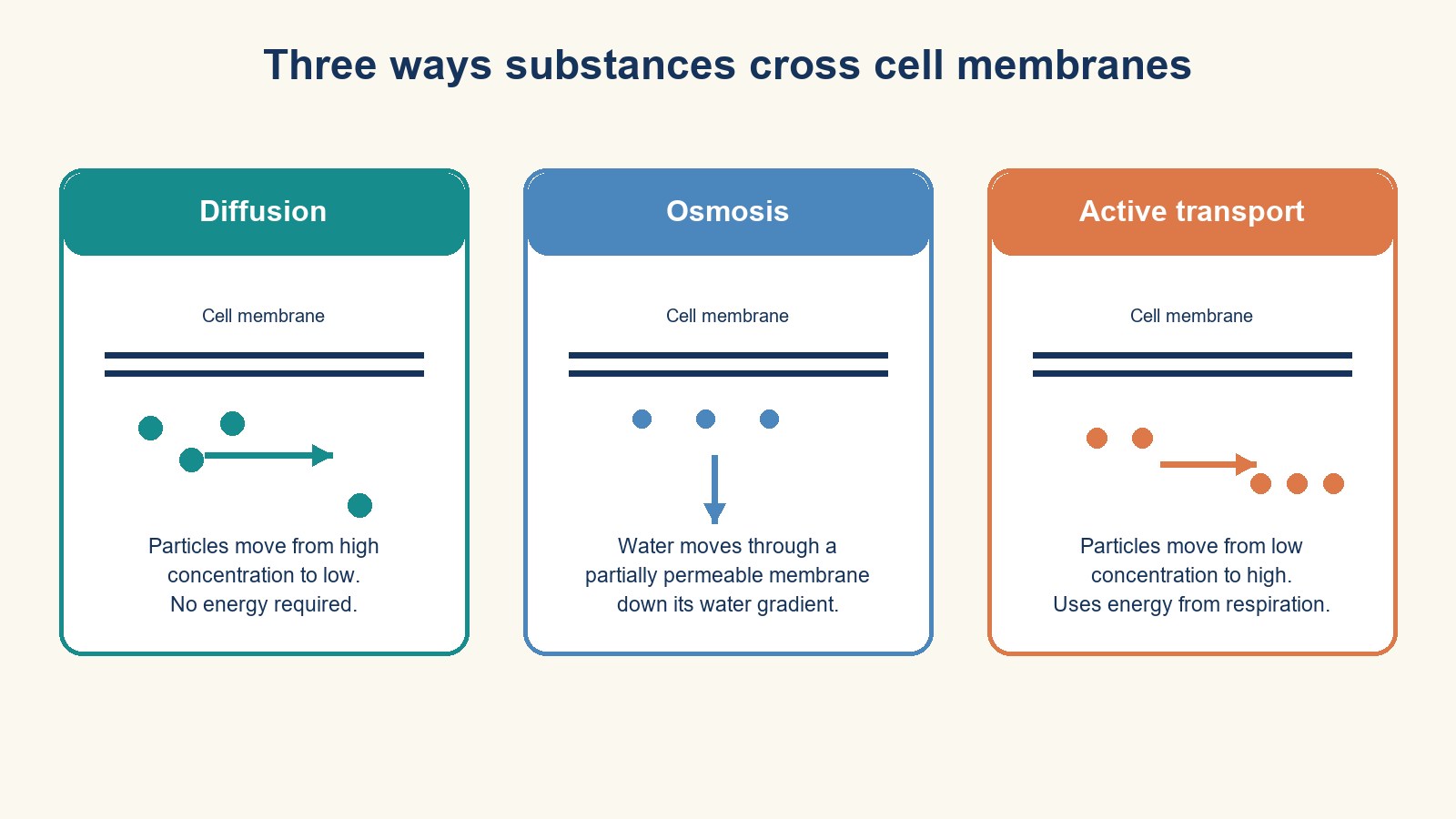
- Diffusion and osmosis are passive: they use the energy the particles already have, not energy from respiration. Active transport needs energy from respiration.
Diffusion, osmosis and active transport compared
Diffusion and what affects its rate
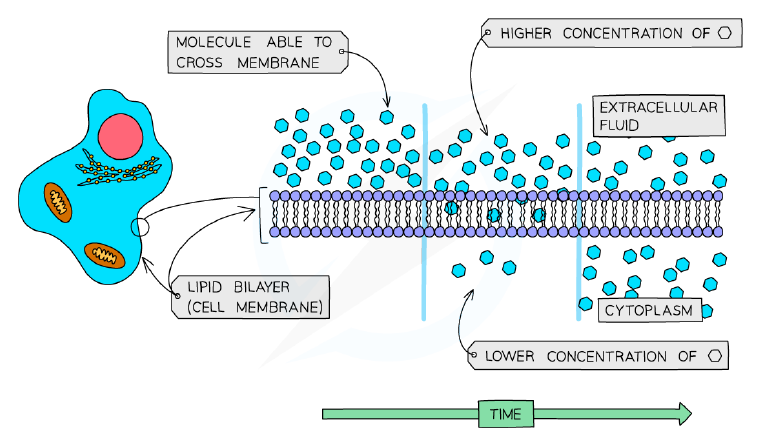
- Diffusion is the net movement of particles from a region of higher concentration to a region of lower concentration, down a concentration gradient. It happens because particles move randomly.
- Particles move in both directions. There is more movement down the gradient than up it because there are more particles on the high concentration side. When the concentrations become equal there is no net movement, but the particles keep moving.
- Examples: oxygen moves from the air in the alveoli into the blood, carbon dioxide moves from respiring cells into the blood, and urea moves from liver cells into the blood.
- The rate of diffusion is greater when the concentration gradient is steeper, the temperature is higher (particles move faster), the surface area is larger, and the diffusion distance is shorter (a thinner membrane).
- As a rule, rate is proportional to (surface area x concentration gradient) / distance. Worked example: the surface area is doubled, the gradient is tripled and the distance is doubled. The rate changes by 2 x 3 / 2 = 3, so diffusion is 3 times faster.
- Larger molecules diffuse more slowly than small ones, and a membrane only lets through the substances it is permeable to.
Diffusion across a cell membrane over time
Surface area to volume ratio
- The surface area to volume ratio (SA:V) tells you how much surface there is for each unit of volume. Divide the surface area by the volume.
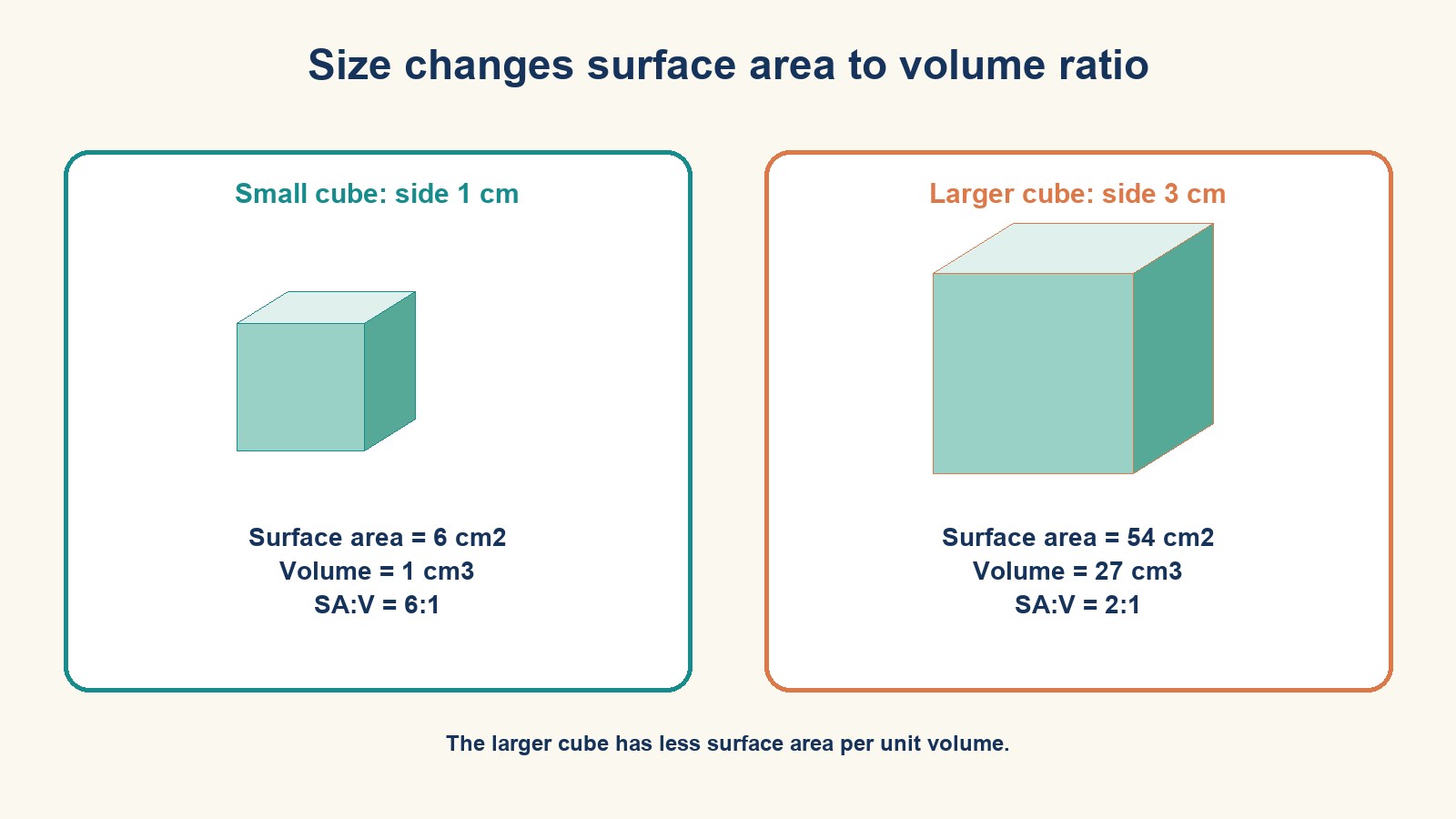
- For a cube of side s: surface area = 6 x s x s, and volume = s x s x s. Worked examples: side 1 cm gives 6 cm² and 1 cm³, so SA:V = 6:1. Side 2 cm gives 24 cm² and 8 cm³, so SA:V = 3:1. Side 4 cm gives 96 cm² and 64 cm³, so SA:V = 1.5:1.
- For a cuboid, add up the areas of all six faces. A 2 cm by 3 cm by 5 cm block has a surface area of 2 x (6 + 10 + 15) = 62 cm² and a volume of 30 cm³, so SA:V = 62 / 30 = 2.07:1.
- As an object gets bigger, its volume grows faster than its surface area. If the side of a cube is tripled, the surface area becomes 9 times larger but the volume becomes 27 times larger, so the SA:V falls to one third.
- A tiny single-celled organism has a large SA:V, so diffusion across its surface can supply the whole cell. A large animal has a small SA:V, so it needs exchange surfaces (lungs, villi) and a transport system (blood) to supply all its cells.
- Exchange surfaces are adapted to speed up diffusion: they have a large surface area (folds, villi, alveoli), a thin wall for a short diffusion distance, and a good blood supply to keep the concentration gradient steep.
A bigger cube has a smaller surface area to volume ratio
Osmosis in animal and plant cells
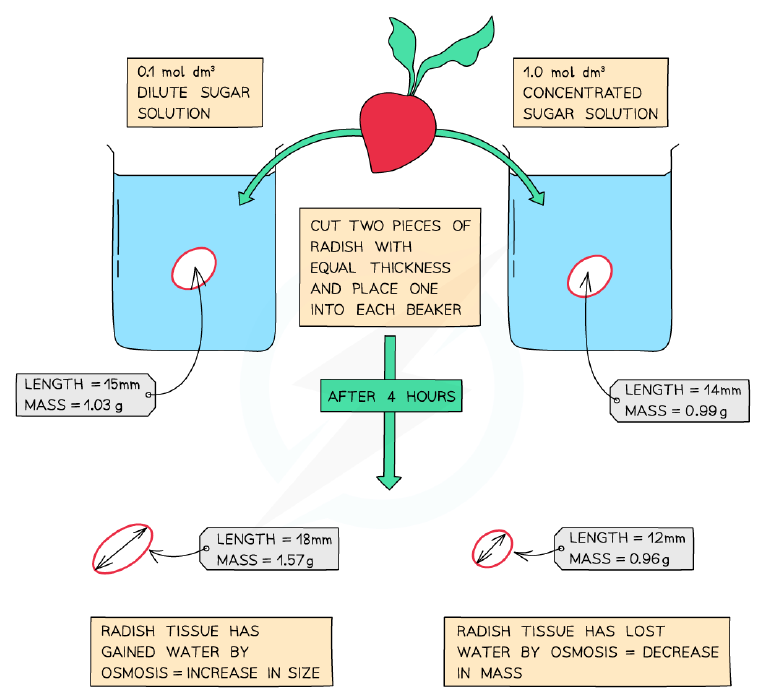
- Osmosis is the net movement of water molecules across a partially permeable membrane from a region of higher water potential (a dilute solution) to a region of lower water potential (a more concentrated solution).
- Water potential is a measure of how freely water molecules can move. Pure water has the highest water potential. Dissolving a solute lowers it.
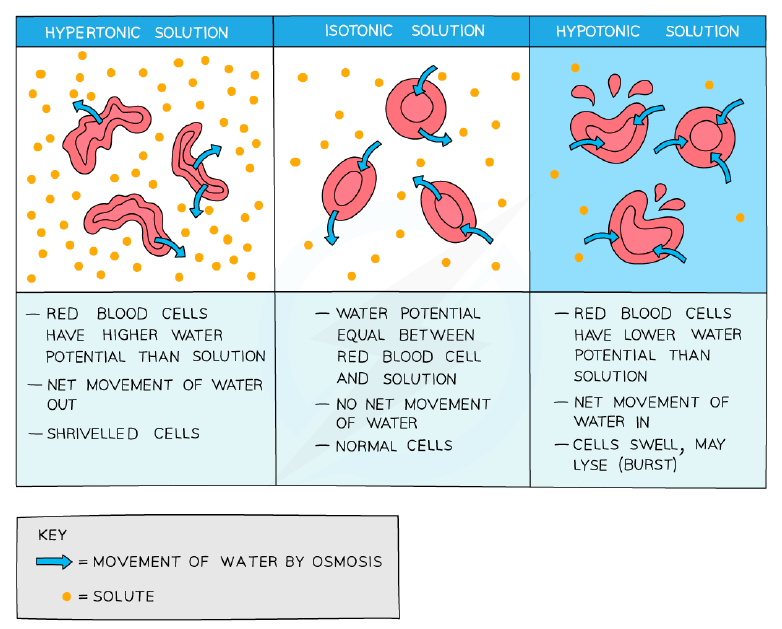
- Animal cells have no cell wall. In a dilute solution (lower solute concentration than the cell) water enters, and the cell swells and may burst. In a concentrated solution water leaves and the cell shrivels. In a solution with the same concentration there is no net movement of water.
- Plant cells have a strong cell wall. In a dilute solution water enters the vacuole and pushes the membrane against the wall. The cell becomes turgid, which helps to support the plant, and it does not burst.
- In a concentrated solution, plant cells lose water, the cytoplasm shrinks and the membrane pulls away from the wall. This is plasmolysis. When the cells of a plant lose turgor the plant wilts.
- Hospitals use drips of about 0.9% salt solution because it matches the concentration of body fluids. Pure water would enter blood cells by osmosis and make them burst.
Red blood cells in three different solutions
Active transport
- Active transport is the movement of particles across a membrane from a region of lower concentration to a region of higher concentration, against the concentration gradient. It needs energy from respiration and carrier proteins in the membrane.
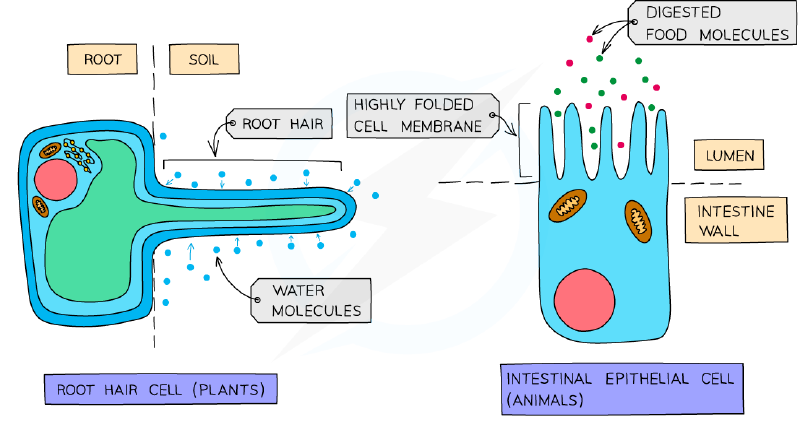
- Root hair cells use active transport to take up mineral ions such as nitrate from the soil water, where the concentration is lower than inside the cell. Without this, plants could not get the ions they need to make proteins.
- In the small intestine, glucose is absorbed into the blood by active transport when its concentration in the gut is lower than in the blood. This lets the body absorb all the glucose it can.
- Cells that do a lot of active transport have many mitochondria, which release energy by respiration.
- If respiration stops, for example because of a poison such as cyanide or a lack of oxygen, active transport stops too. Diffusion and osmosis carry on because they do not use energy from respiration.
- Comparing the three: diffusion moves particles down a gradient with no respiration energy. Osmosis moves only water down its water potential gradient, with no respiration energy. Active transport moves particles up a gradient and needs respiration energy.
Root hair cell and intestinal epithelial cell
Think like a scientist: osmosis in potato cylinders
- Question: what is the concentration of the cell sap in potato cells? Cut potato cylinders with a cork borer, all the same diameter and length, from one potato. Blot each one dry and record its mass. Place one in each of five sucrose solutions (0.0, 0.2, 0.4, 0.6 and 0.8 mol/dm³) for the same time, for example one hour. Blot them dry and find the new mass.
- Variables: the independent variable is the sucrose concentration. The dependent variable is the percentage change in mass. Control variables: the size and surface area of the cylinders, the same potato, the volume of solution, the temperature and the time.
- Why use percentage change? The cylinders do not all start with exactly the same mass. Percentage change = (final mass - initial mass) / initial mass x 100. A cylinder that goes from 3.0 g to 3.6 g has changed by +20%.
- Results (one class experiment): concentration 0.0, 0.2, 0.4, 0.6, 0.8 mol/dm³ gives percentage change +20%, +10%, 0%, -10%, -20%. A graph of these results crosses zero at 0.4 mol/dm³. At that point there is no net osmosis, so the potato cell sap is about 0.4 mol/dm³.
- Safety: cut cylinders on a tile, cut away from your hand, and take care with the cork borer. Wipe up spills.
- Inquiry task: explain why the potato in pure water gains mass and the potato in strong sucrose loses mass. Evaluate the method: say why you would use three cylinders for each concentration and calculate a mean, and design a follow-up that tests whether a different vegetable has a different cell sap concentration.
Radish tissue in dilute and concentrated sugar solution
Slides
Sign up free to view the lesson slides
Step through every slide for this topic — plus flashcards and revision notes — with a free account.
Questões de prática
Prévia grátis — 8 de 55 perguntas. Cadastre-se para ver todas.
1.What does it mean to say that a cell membrane is partially permeable?
Easy- AIt lets every substance pass through freely in both directions
- BIt lets nothing through unless the cell uses energy
- CIt lets some substances through but not others
- DIt lets water through but never any other substance
2.Which molecule can cross a cell membrane most easily without help from a protein?
Easy- AOxygen
- BStarch
- CA protein molecule
- DGlycogen
3.Which part of the cell membrane lets large molecules such as glucose and ions cross it?
Easy- AThe cell wall around the membrane
- BThe nucleus beside the membrane
- CThe layer of cytoplasm inside the membrane
- DProtein channels and carriers
4.Match each term to its meaning.
Easy- Diffusion
- Osmosis
- Active transport
- Partially permeable membrane
- A barrier that lets some substances cross but not others
- Net movement of particles down a concentration gradient
- Net movement of water across a partially permeable membrane
- Movement of particles against a gradient using respiration energy
5.Which statement correctly defines diffusion?
Easy- AThe movement of particles from a lower to a higher concentration using energy
- BThe net movement of particles from a higher to a lower concentration
- CThe movement of water across a membrane from a concentrated solution to a dilute one
- DThe movement of particles only while the cell is alive and respiring
6.Diffusion needs energy from respiration.
EasyTrue or false?
7.A drop of ink spreads through a beaker of still water. Which explanation is correct?
Easy- AWater molecules push the ink particles towards the sides of the beaker
- BRandom movement carries ink particles from high to low concentration
- CThe ink particles use energy to move towards the clean water
- DThe ink particles are pulled outwards by the glass beaker
8.Which of these movements happen by diffusion? (select all that apply)
Medium- AGlucose being absorbed into the blood against a concentration gradient
- BOxygen moving from the alveoli into the blood
- CCarbon dioxide moving from respiring muscle cells into the blood
- DNitrate ions entering a root hair cell from soil where the concentration is lower
Unlock all 55 questions, flashcards & more
Crie uma conta grátis para ver todas as perguntas, os slides, flashcards e resumos de revisão deste tópico.