Biological molecules and food tests
Aprenda jogando
Responda a estas perguntas para ganhar energia, depois pesque e explore. Sem precisar de conta.
Notas de aula
Big idea: large molecules built from small units
- Big idea (key concept): Systems. A living thing is a system of molecules. Carbohydrates, proteins, lipids and DNA each have a job, and the job depends on how the molecule is built.
- Related concept: Structure. In this lesson you keep asking one question: how does the structure of this molecule help it to do its job?
- Global context: Scientific and technical innovation. Food scientists, doctors and forensic teams use simple chemical tests on foods and body fluids. The same tests help to check food labels and to screen for diseases such as diabetes.
- Many biological molecules are polymers: long chains made by joining many small units called monomers. A polymer can be very large but is built from only a few kinds of unit.
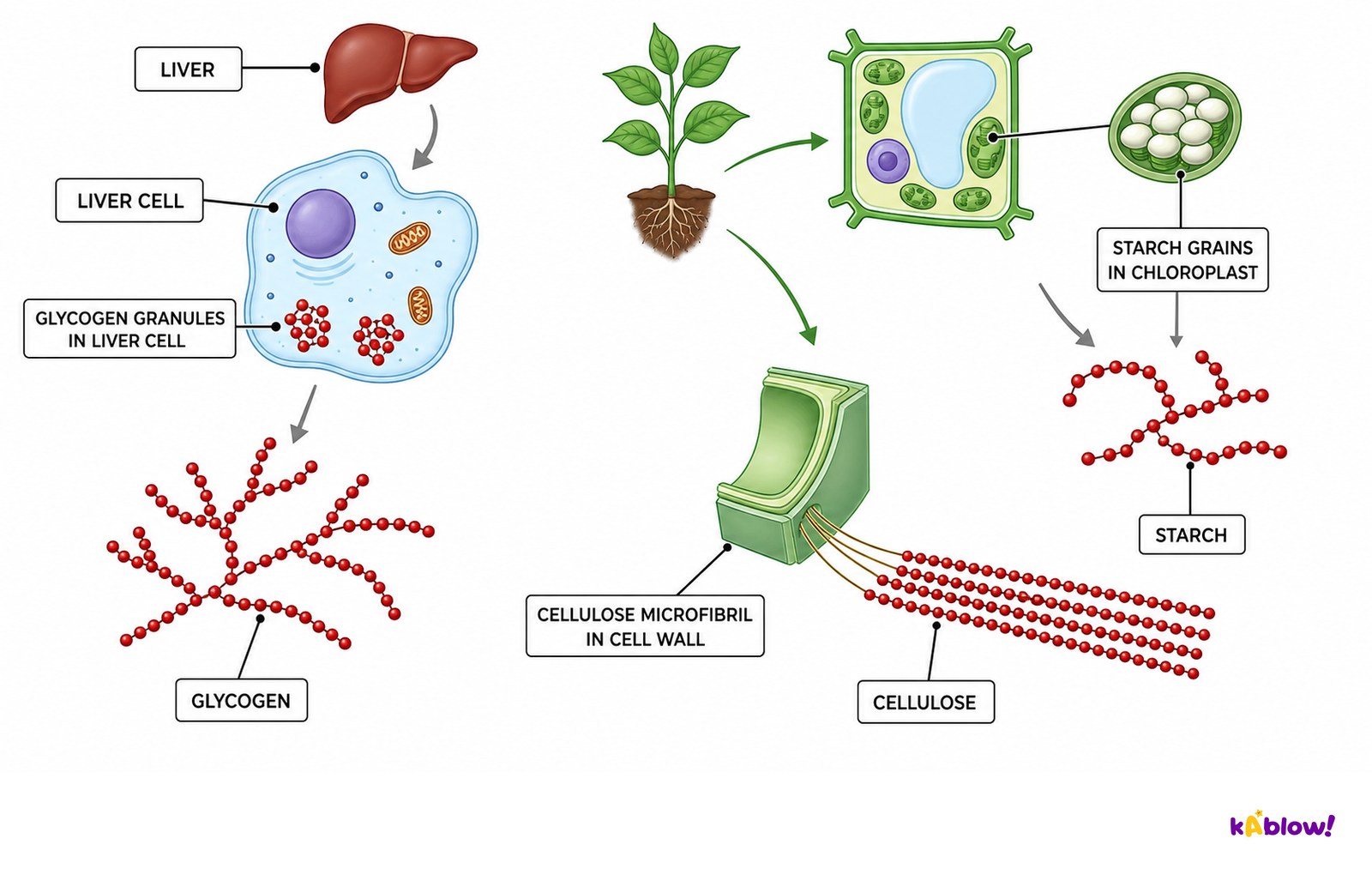
- Carbohydrates contain carbon, hydrogen and oxygen. The simple sugar glucose is the monomer for the polysaccharides starch, glycogen and cellulose. All three are chains of glucose, but the chains are arranged differently.
- Starch is the energy store in plants. It is insoluble, so it does not draw water into cells by osmosis. Glycogen is the energy store in animals, held mainly in the liver and muscles. Cellulose forms long straight chains that bundle into strong fibres in plant cell walls.
Starch, glycogen and cellulose are all chains of glucose
Proteins and lipids: structure decides function
- Proteins contain carbon, hydrogen, oxygen and nitrogen (some also contain sulfur). They are polymers whose monomers are amino acids. There are about 20 different amino acids.
- The order of amino acids in a chain decides how the chain folds into a particular 3D shape. The shape decides the function. This is why proteins can be enzymes (amylase), antibodies, hormones (insulin), transport molecules (haemoglobin) or structural fibres (collagen).
- Denaturation: heat or extreme pH breaks the bonds that hold a protein in shape. The shape changes permanently and the protein stops working. This is why an enzyme stops working above its optimum temperature.
- Lipids (fats and oils) contain carbon, hydrogen and oxygen. One lipid molecule is made of one glycerol and three fatty acids. Fats are solid at room temperature and oils are liquid. Lipids do not dissolve in water but do dissolve in ethanol.
- Lipids are an energy store, they are used for insulation, they cushion organs, and they make up cell membranes. Gram for gram, fat releases about twice as much energy as carbohydrate (about 37 kJ per gram for fat, about 17 kJ per gram for carbohydrate and protein).
- Worked example: a snack has 12 g of fat. Energy from the fat is 12 x 37 = 444 kJ. A meal with 60 g of carbohydrate gives 60 x 17 = 1020 kJ from carbohydrate.
Food tests: starch and reducing sugars
- To test a solid food, crush it with a little water, shake it and filter or let it settle. Test the liquid. Use a fresh clean tube for each test.
- Iodine test for starch: add a few drops of orange-brown iodine solution. If starch is present the colour changes to blue-black. If not, it stays orange-brown.
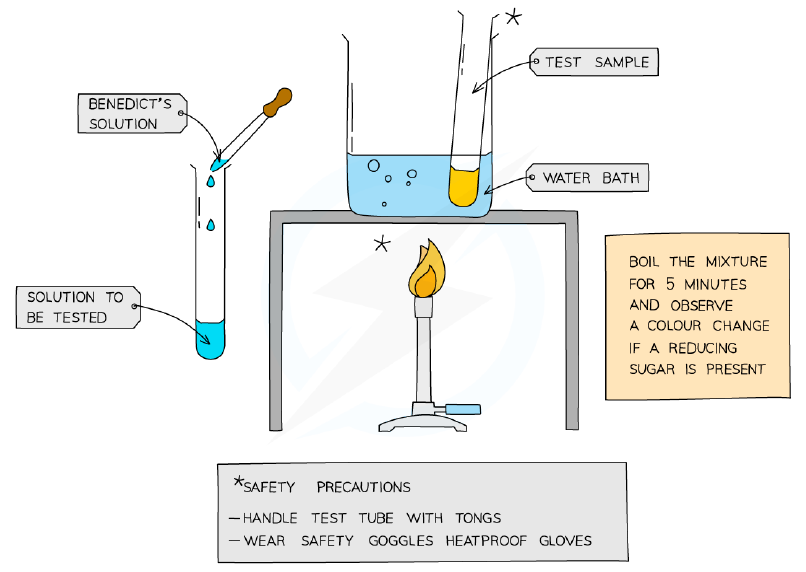
- Benedict's test for reducing sugars (such as glucose and maltose): add Benedict's solution (blue) and heat in a hot water bath for about five minutes. Wear eye protection and use a holder for the tube.
- Colour scale: blue (none) then green, yellow, orange and brick-red (a lot). The more reducing sugar there is, the further along the scale the colour goes, so the test is semi-quantitative.
- Sucrose is a non-reducing sugar. Benedict's solution stays blue with sucrose, so a blue result does not prove that there is no sugar of any kind in the food.
- Starch is not a reducing sugar, so a starchy food such as potato gives blue-black with iodine but stays blue with Benedict's solution. If amylase digests the starch, the mixture then gives a Benedict's colour change.
Apparatus for the Benedict's test
Food tests: protein, lipid and reading results
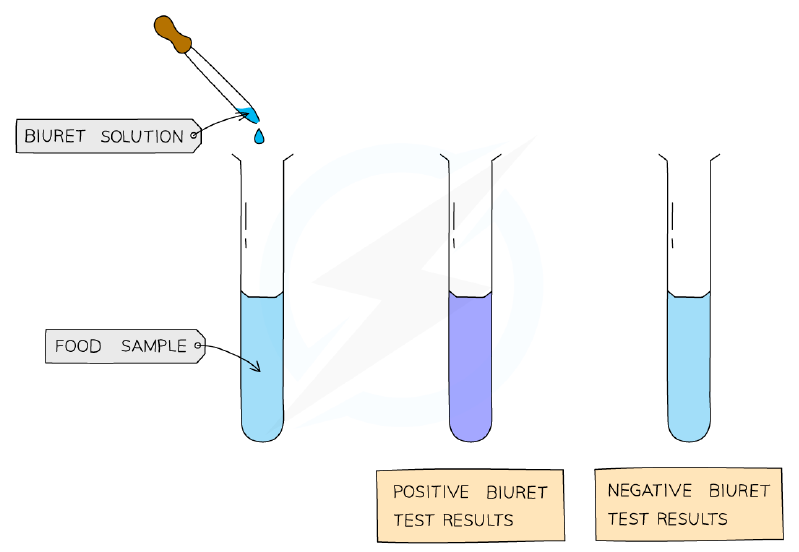
- Biuret test for protein: add biuret reagent (or sodium hydroxide followed by a few drops of dilute copper sulfate). A blue mixture turning purple (violet or lilac) shows protein. It stays blue if protein is absent. Sodium hydroxide is corrosive, so wear eye protection.
- Ethanol emulsion test for lipid: shake the food with ethanol so that any lipid dissolves, then pour the ethanol into a tube of water. A cloudy white emulsion shows lipid. The lipid is not soluble in water, so it forms tiny droplets. A clear liquid means no lipid.
- Summary table. Starch: iodine, blue-black. Reducing sugar: Benedict's (heated), green to brick-red. Protein: biuret, purple. Lipid: ethanol emulsion, cloudy white.
- Reading results. In one test a food gave blue-black with iodine, a green colour with Benedict's, purple with biuret and a cloudy white emulsion. It contains starch, some reducing sugar, protein and lipid, so it is a mixed food such as a biscuit.
- What a result cannot show. A negative test means the nutrient was not detected, not that it is completely absent. Benedict's will not detect sucrose, and a very small amount of a nutrient may give no visible change.
- Percentages: if 7.5 g of a 50 g sample is protein, the percentage is 7.5 / 50 x 100 = 15%. A 200 g portion that is 15% protein and 30% fat has 30 g of protein and 60 g of fat, giving 30 x 17 + 60 x 37 = 510 + 2220 = 2730 kJ.
Positive and negative biuret results
DNA: the molecule that stores instructions
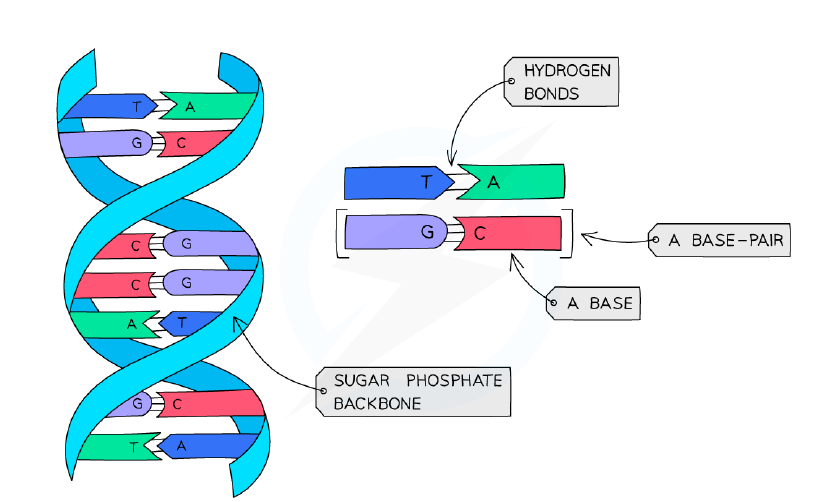
- DNA is a polymer made of units called nucleotides. Each nucleotide has three parts: a sugar, a phosphate group and one of four bases.
- The four bases are A (adenine), T (thymine), C (cytosine) and G (guanine). Two strands twist together into a double helix.
- The sugars and phosphates form the sugar-phosphate backbone on the outside. The bases point inwards and join in complementary pairs: A with T and C with G. Weak hydrogen bonds hold each pair together.
- Using the rule: the strand TACGGA is paired with ATGCCT. If 28% of the bases in a sample of DNA are A, then 28% are T, so A + T = 56%. The other 44% are C and G, which are equal, so G = 22%.
- A gene is a section of DNA, a sequence of bases, that codes for a protein. Each group of three bases codes for one amino acid. A gene of 600 bases can code for up to 200 amino acids. The order of the bases sets the order of the amino acids, which sets the protein's shape and function.
- Size order: a base is part of a nucleotide, a gene is a sequence of many nucleotides, and a chromosome is a long molecule of DNA that carries many genes.
The DNA double helix and its base pairs
Think like a scientist: investigating a food sample
- Question: how does the concentration of glucose affect how fast Benedict's solution changes colour? Make glucose solutions of 0.5, 1, 2 and 4 g per 100 cm³. Put 5 cm³ of each into a tube, add 5 cm³ of Benedict's solution and heat in a water bath at 80 °C. Time how long until the first colour change.
- Variables: the independent variable is the glucose concentration. The dependent variable is the time to the first colour change. Control variables: the volume of sample, the volume of Benedict's solution, the water bath temperature and the size of the tube.
- Results from one experiment: the times were 300, 190, 90 and 45 s. The time falls as the concentration rises. From 0.5 to 4 g per 100 cm³ the time fell by (300 - 45) / 300 x 100 = 85%.
- Reliability: repeat each concentration three times and calculate a mean. For example, repeats of 88, 92 and 90 s give (88 + 92 + 90) / 3 = 90 s. A result far from the others is anomalous and is checked or left out.
- Evaluating the method: judging the first colour change by eye is subjective. Better methods are to use a colorimeter, to compare against colour standards, or to filter the mixture and measure how blue the liquid is that remains.
- Inquiry task: a student says that doubling the concentration always halves the time. Use the results to evaluate this claim, then design a follow-up that tests concentrations of 1, 1.5, 2, 2.5 and 3 g per 100 cm³.
Slides
Sign up free to view the lesson slides
Step through every slide for this topic — plus flashcards and revision notes — with a free account.
Questões de prática
Prévia grátis — 8 de 55 perguntas. Cadastre-se para ver todas.
1.Which simple sugar is the monomer of starch, glycogen and cellulose?
Easy- ASucrose
- BAmino acid
- CFatty acid
- DGlucose
2.Match each carbohydrate to its job.
Easy- Starch
- Glycogen
- Cellulose
- Glucose
- Sugar that cells use in respiration
- Energy store in plant cells
- Strengthens plant cell walls
- Energy store in the liver and muscles
3.Why is starch a good energy store inside plant cells?
Medium- AIt is insoluble, so it does not affect the movement of water into the cell
- BIt dissolves easily, so it can move out of the cell quickly when needed
- CIt is made of amino acids, which the cell can use to make enzymes
- DIt releases more energy per gram than any other substance in the cell
4.Starch and cellulose are both made only from glucose. Which statement best explains why cellulose makes strong cell walls?
Medium- ACellulose is made from a different sugar, which is stronger than glucose
- BCellulose dissolves in the cell sap, which pushes the wall outwards with force
- CCellulose chains are straight and lie side by side in tough fibres
- DStarch is made of amino acids, which are unable to form any fibres at all
5.Glycogen is the main carbohydrate energy store in animals.
EasyTrue or false?
6.Complete the sentence about carbohydrates.
EasyLarge carbohydrates such as starch are made by joining many small ____ molecules together.
7.Proteins are polymers. What is the monomer of a protein?
Easy- AAmino acid
- BGlucose
- CNucleotide
- DFatty acid
8.What decides the 3D shape of a protein molecule?
Medium- AThe number of glucose units that are attached to the outside of the chain
- BThe sequence of its amino acids, which makes the chain fold
- CThe temperature of the room in which the protein is kept
- DThe colour that the protein gives when it is tested with biuret
Unlock all 55 questions, flashcards & more
Crie uma conta grátis para ver todas as perguntas, os slides, flashcards e resumos de revisão deste tópico.