The periodic table
Aprenda jogando
Responda a estas perguntas para ganhar energia, depois pesque e explore. Sem precisar de conta.
Notas de aula
Big idea: a map of the elements
- Big idea (key concept): Systems. The Periodic Table is a system that organises every known element so that patterns can be seen.
- Related concept: Patterns. Elements in the same column behave in similar ways, and their properties change in steady trends as you go down.
- Global context: Orientation in space and time. The table gives every element a place, and it was built up over time as new elements were discovered.
- An element is a substance made of only one type of atom. There are about 118 known elements, and each has a symbol such as Na for sodium or Cl for chlorine.
- In 1869 Mendeleev arranged the elements so that similar ones lined up, and he left gaps for elements that had not been found. He predicted what the missing elements would be like, and later discoveries such as gallium and germanium matched.
- The modern table lists the elements in order of atomic number, the number of protons in an atom of the element.
- Because the table shows patterns, you can use it to predict the properties of an element you have never met.
Reading the table: groups, periods, metals and non-metals
- A group is a vertical column. Elements in the same group have similar properties. The groups are numbered 1 to 7 and then 0 in the older system, or 1 to 18 in the numbers along the top of this table.
- A period is a horizontal row. Going across a period the properties change step by step from metal to non-metal.
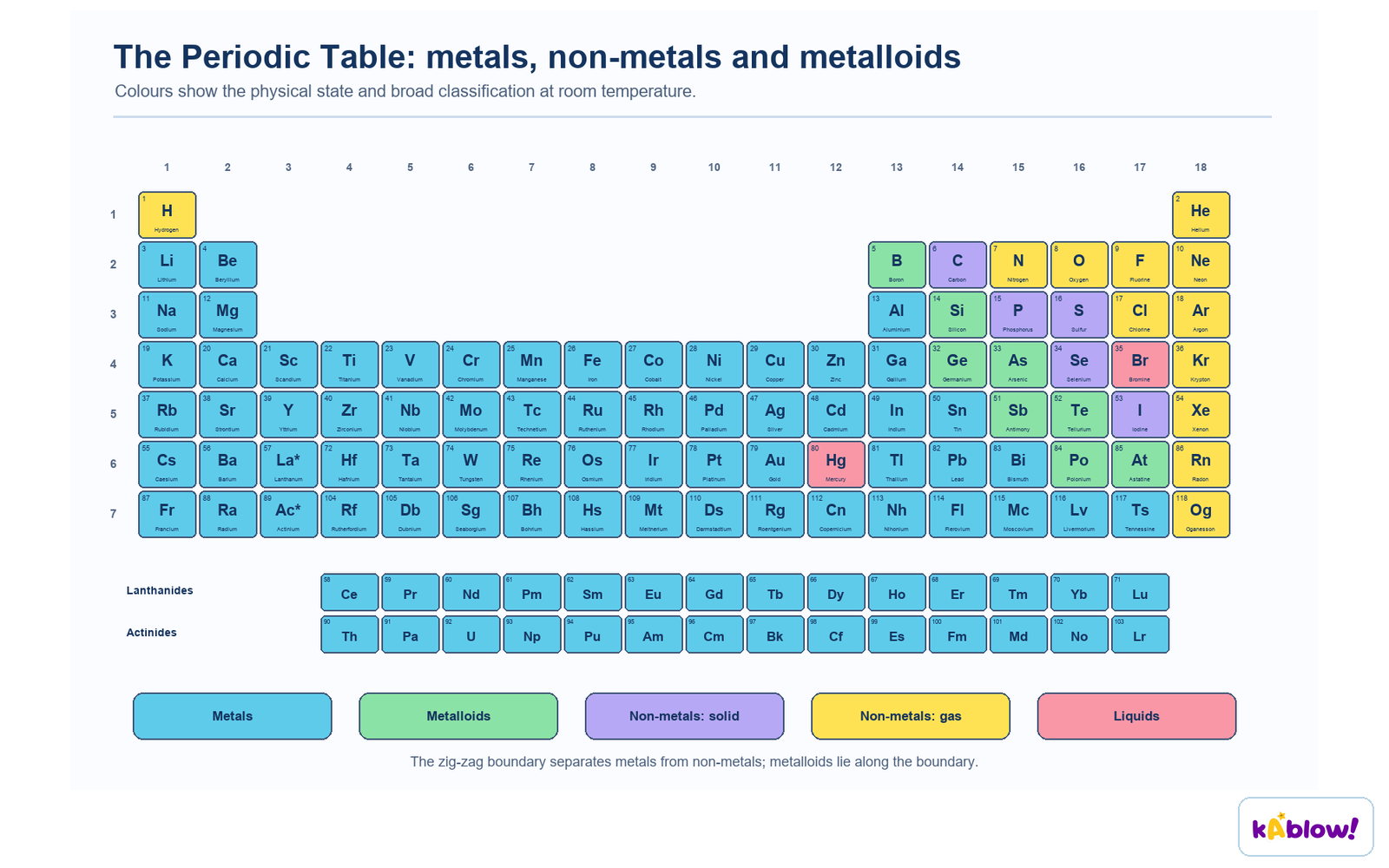
- Most elements are metals. They are on the left and in the middle of the table. Non-metals are on the right, and a zig-zag line separates the two.
- A few elements near the zig-zag line, such as silicon, are metalloids. Their properties are in between those of metals and non-metals.
- Metals are usually shiny, good conductors of heat and electricity, malleable (can be hammered into shape) and ductile (can be pulled into wires). Most are solids with high melting points.
- Non-metals are usually dull, poor conductors (graphite is an exception) and brittle when solid. Many are gases at room temperature.
- Hydrogen sits at the top of the table beside Group 1, but it is a non-metal gas.
The Periodic Table with metals, metalloids and non-metals coloured
Group 1: the alkali metals
- Group 1 (lithium, sodium, potassium, rubidium, caesium and francium) are the alkali metals.
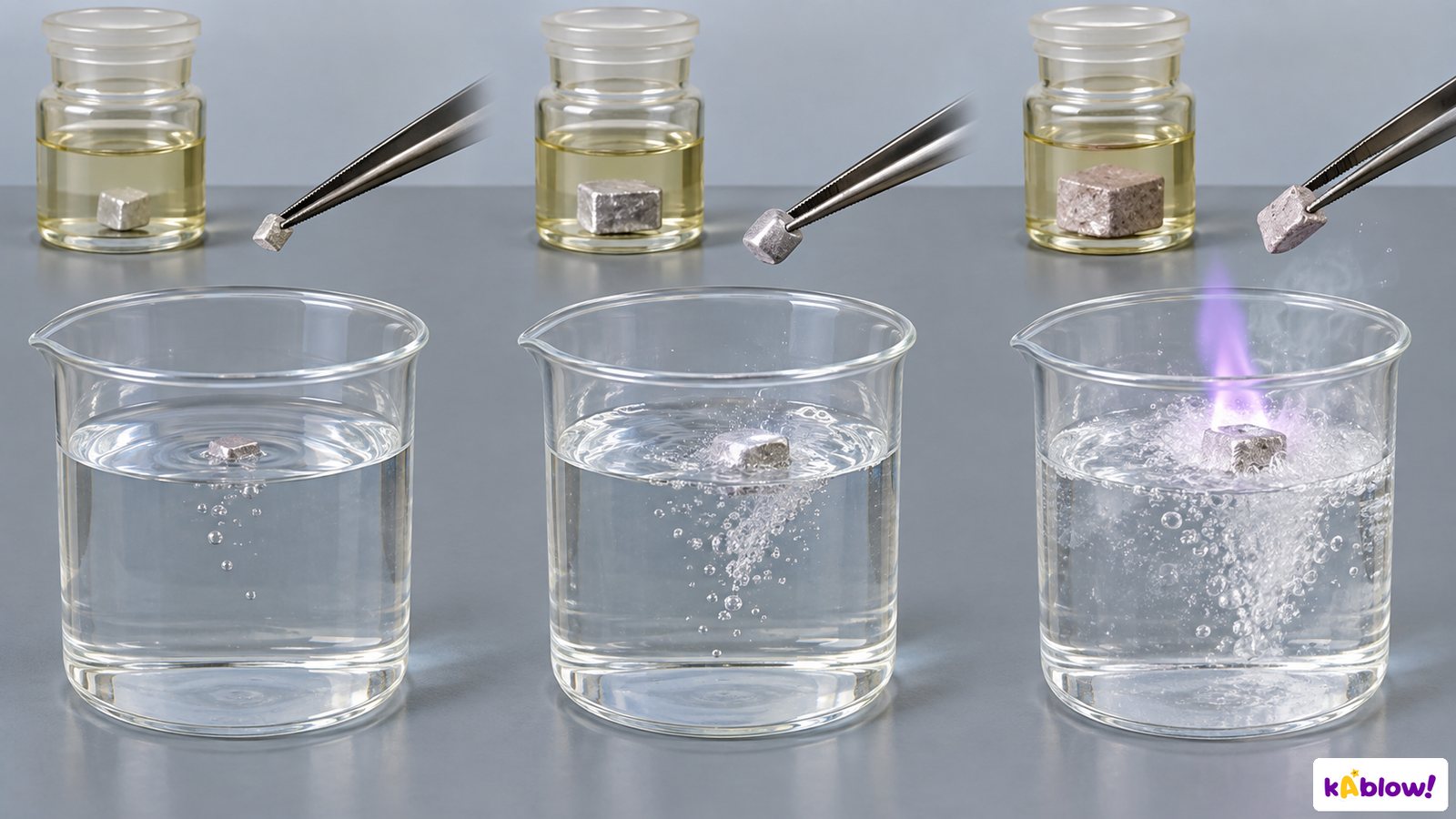
- They are soft enough to cut with a knife, shiny when freshly cut, and have low densities: lithium, sodium and potassium float on water.
- They react quickly with air and water, so they are stored under oil. Learners never handle them: any reaction with water is a teacher demonstration behind a safety screen, with eye protection.
- With water they make hydrogen gas and a metal hydroxide, which dissolves to give an alkaline solution. Universal indicator turns purple.
- Reactivity increases down the group. Lithium fizzes steadily, sodium melts into a ball and shoots across the surface, and potassium reacts so fast that the hydrogen burns with a lilac flame.
- Their melting points decrease down the group: lithium melts at about 181 °C and caesium at about 28 °C.
- Because the group follows a trend, you can predict that rubidium is more reactive than potassium, and that francium is the most reactive of all.
Group 1 metals reacting with water
Group 7: the halogens
- Group 7 (fluorine, chlorine, bromine, iodine and astatine) are the halogens. They are non-metals.
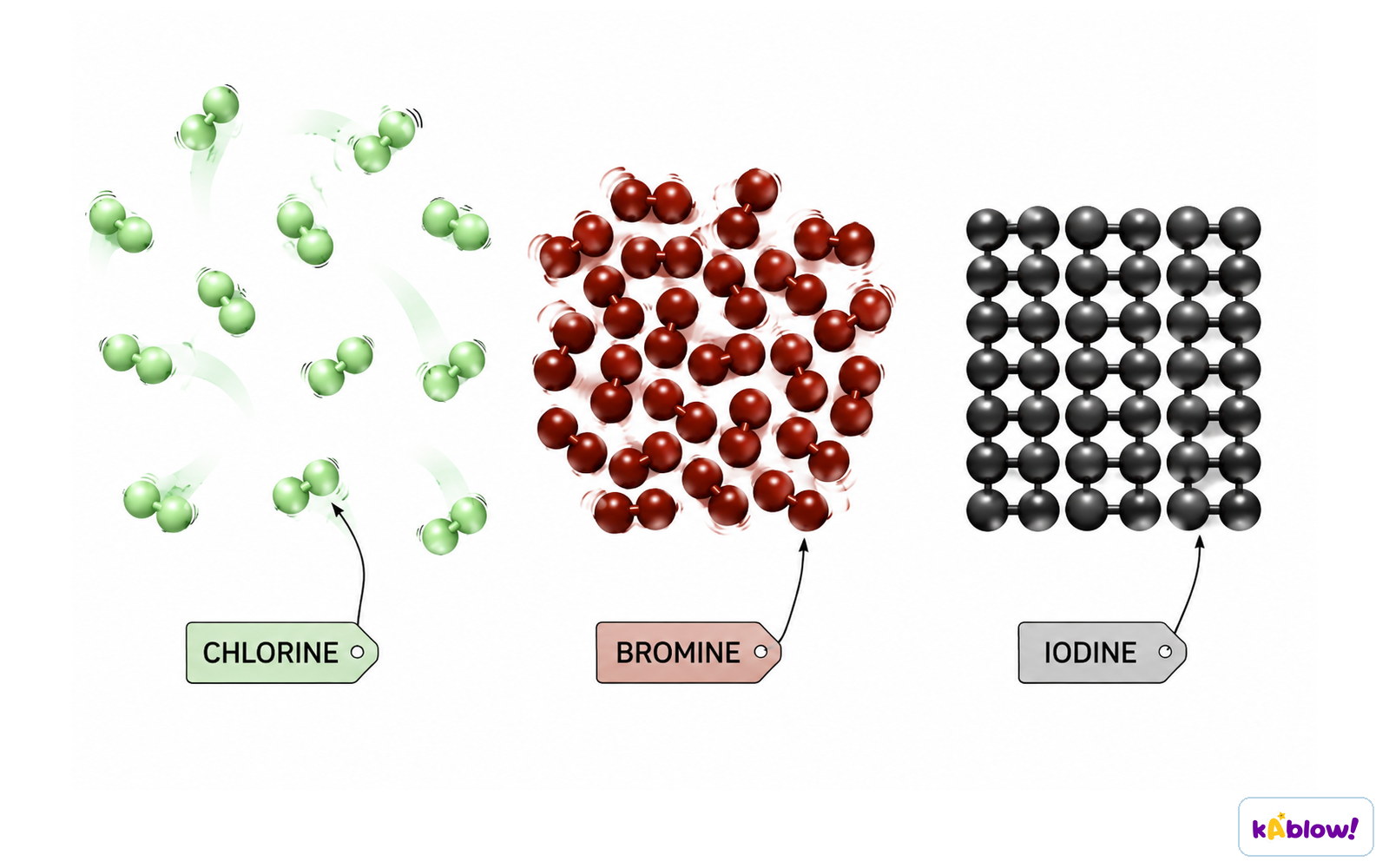
- Halogen elements exist as molecules made of two atoms, written Cl₂, Br₂ and I₂.
- At room temperature chlorine is a pale yellow-green gas, bromine is a red-brown liquid and iodine is a grey-black solid. The state changes from gas to solid down the group.
- Halogens are toxic and corrosive. Chlorine and bromine are only used by teachers in a fume cupboard, or you see them in a sealed container or a video.
- Reactivity decreases down the group. This is the opposite of Group 1: chlorine is more reactive than bromine, and bromine is more reactive than iodine.
- A more reactive halogen can displace a less reactive one. If chlorine is added to potassium bromide solution, chlorine takes the place of bromine and orange-brown bromine appears.
- Prediction: astatine is below iodine, so it should be a solid and less reactive than iodine.
Chlorine, bromine and iodine as two-atom molecules
Group 0 and predicting with the table
- Group 0 (helium, neon, argon, krypton, xenon and radon) are the noble gases, in the far-right column.
- They are very unreactive. Their atoms do not join to each other, so each noble gas exists as single atoms.
- Being unreactive makes them useful: helium fills balloons and airships because it does not burn, neon glows in signs, and argon fills some light bulbs to stop the hot filament reacting with air.
- To predict with the table: find the element, look at its group, then use the group's pattern. Elements in the same group are alike, and trends such as reactivity continue down the group.
- Example: rubidium is in Group 1, so it is a soft, reactive metal that gives an alkaline solution with water. Because it is below potassium, it should be even more reactive.
- Example: astatine is in Group 7, below iodine, so it should be a dark solid and a less reactive halogen than iodine.
- A prediction is a best guess based on evidence. Scientists test predictions, as happened with Mendeleev's missing elements.
Think like a scientist: is it a metal or a non-metal?
- The question: how can you tell whether an unknown solid element is a metal or a non-metal?
- Safe tests (school practical, low-voltage cell and bulb, no heating): look at the surface for shine, test whether it conducts electricity in a simple circuit, and see whether a thin piece bends or snaps.
- The independent variable is the sample you test. The dependent variable is what you observe, such as shiny or dull, bulb lights or not, bends or snaps.
- Control variables: use samples of the same size and shape, the same circuit and the same cell each time, and clean each surface in the same way.
- Evaluate: one property is not enough. Graphite conducts electricity but is a non-metal, and some metals are not very shiny when tarnished. Using several tests gives a more reliable answer.
- Your task: plan an investigation to classify four unknown samples. Draw a results table, say which tests you will use and why, and explain how you will decide when the tests disagree.
Slides
Sign up free to view the lesson slides
Step through every slide for this topic — plus flashcards and revision notes — with a free account.
Questões de prática
Prévia grátis — 8 de 51 perguntas. Cadastre-se para ver todas.
1.What are the vertical columns of the Periodic Table called?
Easy- APeriods
- BGroups
- CSeries
- DBlocks
2.What are the horizontal rows of the Periodic Table called?
Easy- AGroups
- BFamilies
- CPeriods
- DLayers
3.Elements in the same group have similar chemical properties.
EasyTrue or false?
4.The modern Periodic Table arranges the elements in order of their...
Easy- AColour
- BDate of discovery
- CDensity
- DAtomic number
5.Where are most metals found on the Periodic Table?
Easy- AOnly along the very top row
- BMostly on the far right side
- CMostly on the left and in the centre
- DOnly in one single column
6.Which of these is a typical property of a metal?
Easy- ABrittle when solid
- BDull appearance
- CPoor conductor of heat
- DGood conductor of electricity
7.Most solid non-metals are poor conductors of electricity.
EasyTrue or false?
8.Match each element to its chemical symbol.
Easy- Sodium
- Chlorine
- Iron
- Helium
- He
- Fe
- Na
- Cl
Unlock all 51 questions, flashcards & more
Crie uma conta grátis para ver todas as perguntas, os slides, flashcards e resumos de revisão deste tópico.