Crude oil and fuels
Aprenda jogando
Responda a estas perguntas para ganhar energia, depois pesque e explore. Sem precisar de conta.
Notas de aula
Big idea: where our fuels come from
- Big idea (key concept): Systems. Crude oil, refineries, vehicles and the atmosphere are all linked in one big system. What we take from the ground comes back out as gases in the air.
- Related concept: Consequences. Using fuels gives us energy for transport, heating and electricity, but burning them has consequences for air quality and the climate.
- Global context: Globalization and sustainability. Oil is traded across the world, and the choices countries make about energy affect everyone on the planet.
- Crude oil is a thick, dark liquid found in rocks underground. It is a fossil fuel, made from the remains of tiny sea organisms that died millions of years ago.
- Their remains sank, were buried under layers of mud and sand, and over millions of years heat and pressure turned them into oil. Coal and natural gas are also fossil fuels.
- Crude oil is non-renewable because we use it far faster than it forms. It is a mixture of many hydrocarbons, so it is not very useful until it has been separated.
Separating crude oil: fractional distillation
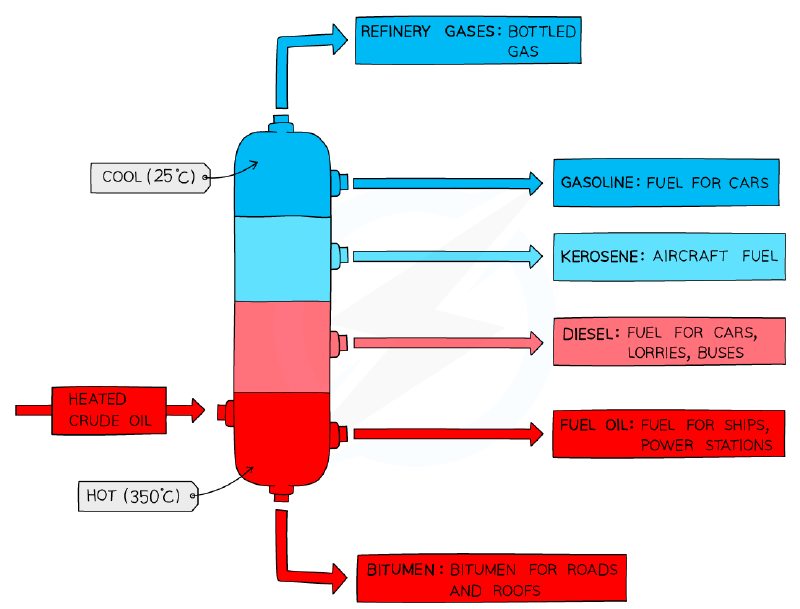
- Crude oil is separated into useful parts called fractions by fractional distillation in a tall fractionating column at an oil refinery.
- The oil is heated until it becomes vapour. The vapours enter the column, which is hot at the bottom and cooler at the top.
- As the vapours rise, each one condenses at the height where the temperature falls to its boiling point. The liquids are drawn off at different levels.
- Small molecules have low boiling points, so they travel to the top: refinery gases (bottled gas) and petrol. Then kerosene (aircraft fuel) and diesel.
- Big molecules have high boiling points, so they condense near the bottom: fuel oil (ships, power stations) and bitumen (roads and roofs).
- The short fractions flow easily and light easily. The long ones are thick and hard to ignite. Cracking breaks long molecules into shorter ones, because there is more demand for fuels like petrol.
A fractionating column and its fractions
Hydrocarbons and alkanes
- A hydrocarbon is a compound made of hydrogen and carbon atoms only. Most of the molecules in crude oil are hydrocarbons.
- The simplest family of hydrocarbons is the alkanes. All the bonds between their atoms are single bonds, so they are called saturated.
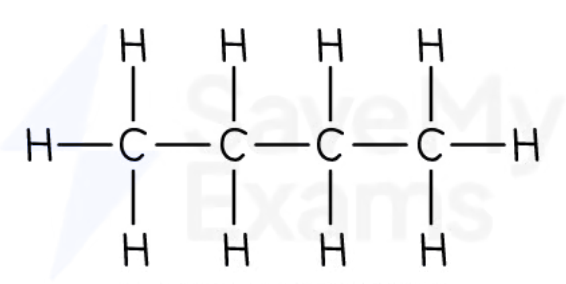
- The first four alkanes are methane (CH₄), ethane (C₂H₆), propane (C₃H₈) and butane (C₄H₁₀). The names get a prefix from the number of carbon atoms: meth-, eth-, prop-, but-.
- A pattern links the formulae: an alkane with n carbon atoms has 2n + 2 hydrogen atoms. Pentane has 5 carbon atoms, so 2 × 5 + 2 = 12 hydrogen atoms: C₅H₁₂.
- The boiling point rises as the chain gets longer: methane boils at about −162 °C, but hexane (C₆H₁₄) boils at about 69 °C. That is why the fractions come off at different heights.
- Methane, ethane, propane and butane are gases at room temperature. Longer alkanes are liquids and the longest are waxy solids.
The displayed formula of butane
Burning fuels: combustion
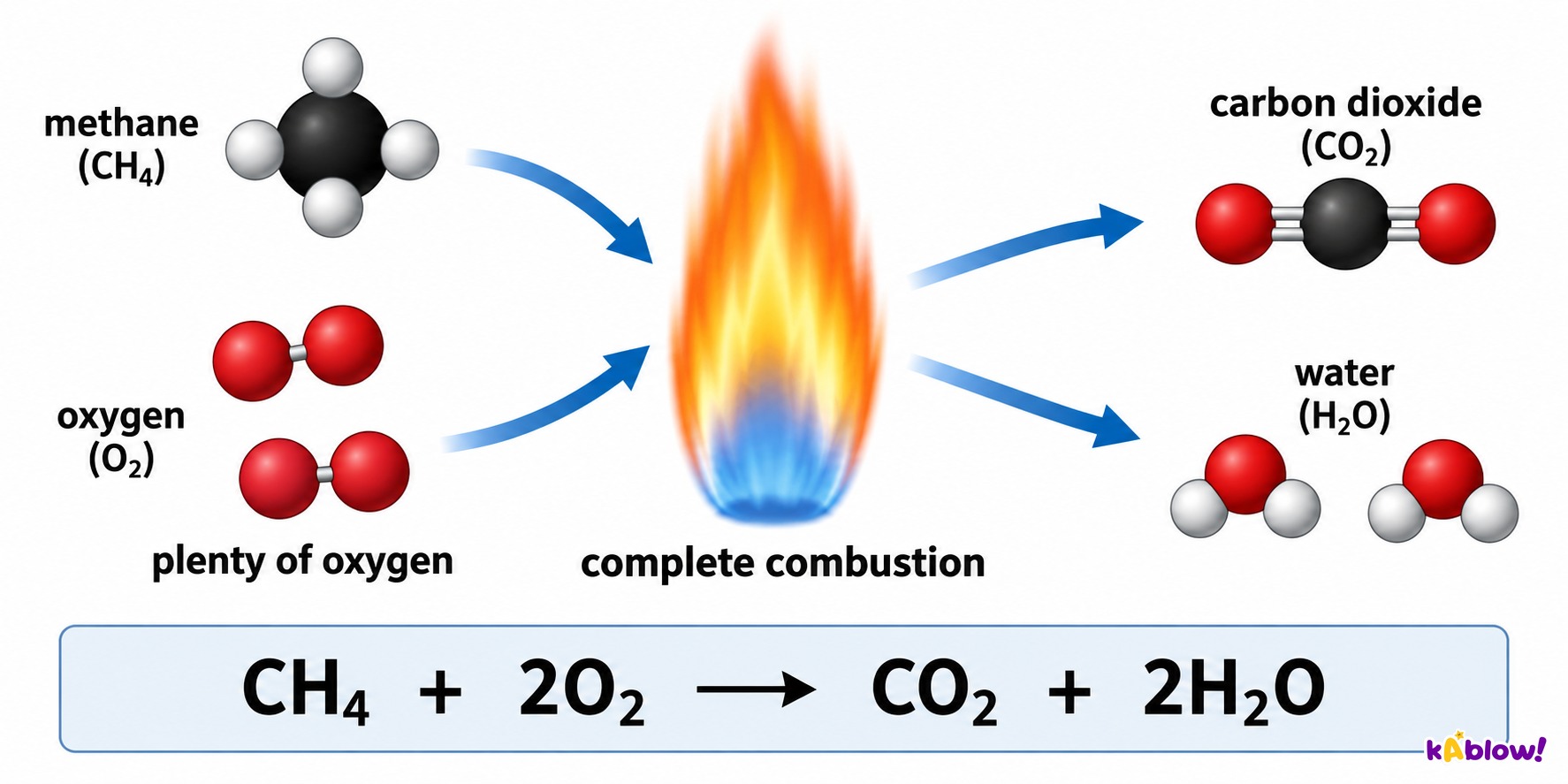
- When a hydrocarbon burns in plenty of oxygen (complete combustion) the products are carbon dioxide and water. Energy is given out as heat and light, so combustion is exothermic.
- Methane + oxygen → carbon dioxide + water. Symbol equation: CH₄ + 2O₂ → CO₂ + 2H₂O. The same atoms are on both sides: 1 C, 4 H and 4 O.
- Propane + oxygen → carbon dioxide + water. C₃H₈ + 5O₂ → 3CO₂ + 4H₂O.
- When there is not enough oxygen (incomplete combustion), some carbon ends up as carbon monoxide (a poisonous gas) or as soot (carbon particles), and less energy is released.
- Carbon monoxide has no colour and no smell, which is why gas appliances must be serviced and rooms ventilated. Many homes have a carbon monoxide alarm.
- Stay safe: burning fuels is done only in school by the teacher, with eye protection and a safe space. Never burn fuels indoors without ventilation.
Methane burning completely in plenty of oxygen
Pollution, climate and alternatives
- Burning fuels releases pollutants. Sulfur dioxide, from sulfur impurities in the fuel, and nitrogen oxides, made when air is heated in engines, dissolve in rain to cause acid rain.
- Acid rain damages limestone buildings, harms trees and can make lakes too acidic for fish. Catalytic converters change carbon monoxide and nitrogen oxides into less harmful gases.
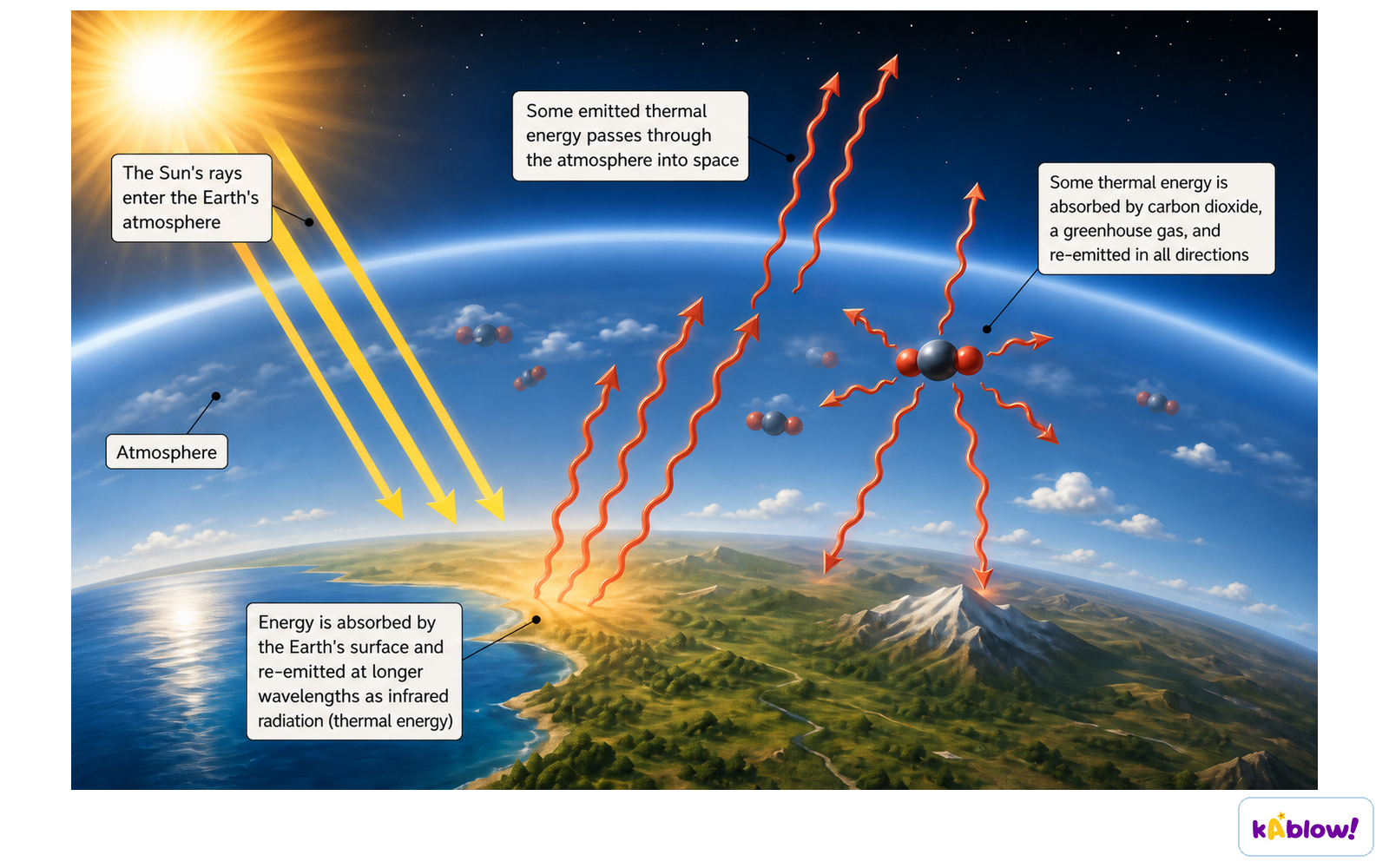
- Burning fossil fuels also releases carbon dioxide that was locked underground for millions of years. Carbon dioxide is a greenhouse gas: it traps some of the energy the Earth gives out.
- More carbon dioxide strengthens the greenhouse effect, so the average temperature of the planet rises. This is the main reason for climate change.
- Alternatives include wind, solar and hydroelectric power, biofuels, and electric vehicles. Each has advantages and limitations: cost, the weather, land use and the materials needed.
- Scientists and governments must evaluate the options: how much carbon dioxide is saved, how reliable the supply is, what it costs, and who is affected.
How carbon dioxide traps energy near the Earth
Think like a scientist: which fuel gives out most energy?
- Question: which of three fuels heats water the most? A teacher runs the investigation using small burners, with eye protection and a heat-proof mat.
- The independent variable is the one you change: the type of fuel.
- The dependent variable is the one you measure: the temperature rise of the water = end temperature − start temperature.
- For a fair test keep the same: the volume of water, the mass of fuel burned, the start temperature, the distance between flame and container, and the type of container.
- Repeat each fuel and take a mean. Use a draught shield and stir the water, to make the results more reliable.
- Inquiry task: the fuel that gives the biggest rise might make more soot or cost more. Plan an investigation to compare three fuels, then evaluate it: list two sources of energy loss, and say what else you would need to know before choosing a fuel.
Slides
Sign up free to view the lesson slides
Step through every slide for this topic — plus flashcards and revision notes — with a free account.
Questões de prática
Prévia grátis — 8 de 55 perguntas. Cadastre-se para ver todas.
1.What is crude oil?
Easy- AA mixture of metals found in the ground
- BA single pure compound made of one kind of molecule
- CA mixture of many different hydrocarbons
- DAn element found in the ground
2.Crude oil was formed from the remains of which living things?
Easy- ATiny sea organisms that lived millions of years ago
- BTrees that grew in forests only a few decades ago
- CDinosaurs and other large animals that lived on land
- DRocks that were melted by volcanoes deep underground
3.Crude oil is a renewable resource that can be replaced within a few years.
EasyTrue or false?
4.What is a hydrocarbon?
Easy- AA compound containing hydrogen and oxygen only
- BA mixture of water and carbon
- CAny substance that burns
- DA compound containing only hydrogen and carbon
5.What is the formula of methane?
Easy- ACH₂
- BCH₄
- CC₂H₆
- DCO₂
6.What is the formula of propane?
Easy- AC₃H₆
- BC₂H₈
- CC₃H₈
- DC₄H₁₀
7.Complete the sentence.
EasyMethane, ethane, propane and butane are all members of a family of hydrocarbons called the ____.
8.Fractional distillation separates the parts of crude oil according to their...
Easy- Acolours
- Bdensities of the containers
- Cmelting points
- Dboiling points
Unlock all 55 questions, flashcards & more
Crie uma conta grátis para ver todas as perguntas, os slides, flashcards e resumos de revisão deste tópico.