Chemical formulae and relative masses
Aprenda jogando
Responda a estas perguntas para ganhar energia, depois pesque e explore. Sem precisar de conta.
Notas de aula
Big idea: chemical formulae and relative masses
- Key concept: Relationships. A formula gives the ratio of atoms or ions. Relative formula mass is the sum of their relative atomic masses and has no unit.
- Related concepts: Models and evidence. Use a scientific explanation to make predictions, then test it against observations.
- Global context: Scientific and technical innovation. Correct formulae connect particle ratios to masses measured in the laboratory.
Molecular Formulae
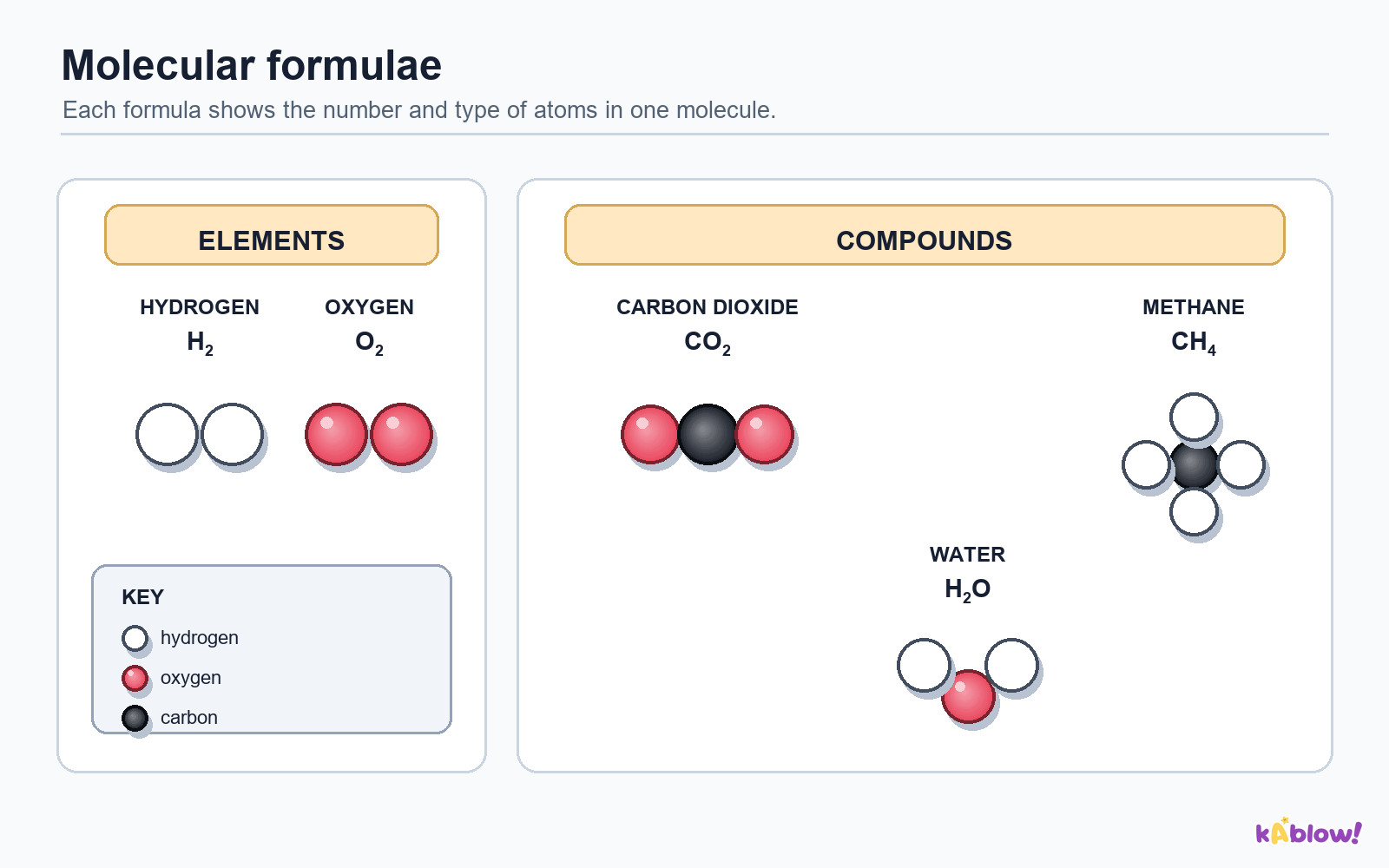
- A molecular formula shows the type and number of atoms in a molecule (e.g., H₂O, CH₄).
- Seven elements exist as diatomic molecules: H₂, N₂, O₂, F₂, Cl₂, Br₂, I₂.
- Atoms combine in fixed ratios to achieve full outer electron shells.
- The molecular formula can be deduced from the relative number of atoms present (e.g., ammonia = NH₃).
Ball-and-stick models of common elements and compounds
Empirical Formulae
- The empirical formula is the simplest whole number ratio of atoms in a compound.
- An ionic compound has a formula unit rather than discrete molecules; its formula gives the simplest whole-number ratio of ions (for example NaCl).
- For molecular compounds, the empirical formula may differ (e.g., C₂H₄ has empirical formula CH₂).
- To find the empirical formula, divide the number of atoms of each element by the greatest common factor.
Formulae of Ionic Compounds
- Ionic compounds are neutral overall; the total positive charge equals the total negative charge.
- Use direct comparison of charges: e.g., Fe²⁺ and SO₄²⁻ give FeSO₄.
- Use the swap-and-drop method for different charges: e.g., Cu²⁺ and Cl⁻ give CuCl₂.
- Common polyatomic ions: CO₃²⁻, SO₄²⁻, OH⁻, NO₃⁻, NH₄⁺.
Writing Word Equations
- Word equations show reactants and products using full chemical names: reactants → products.
- The arrow means 'to form' or 'produces'.
- Reaction conditions or catalysts can be written above the arrow.
- Example: sodium hydroxide + hydrochloric acid → sodium chloride + water.
Writing Symbol Equations
- Symbol equations use chemical formulae and must be balanced to conserve mass.
- Include state symbols: (s) solid, (l) liquid, (g) gas, (aq) aqueous.
- Write diatomic non-metals as molecules: H₂, N₂, O₂, F₂, Cl₂, Br₂, I₂.
- Balance by adjusting coefficients (numbers in front of formulae), never change subscripts.
Balancing Ionic Equations
- Ionic compounds in aqueous solution dissociate into ions.
- Steps: write balanced symbol equation, replace ionic compounds with ions, cancel spectator ions.
- Spectator ions appear unchanged on both sides and are removed.
- Example: 2I⁻(aq) + Cl₂(aq) → 2Cl⁻(aq) + I₂(aq).
Relative Atomic Mass (Ar) & Relative Molecular Mass (Mr)
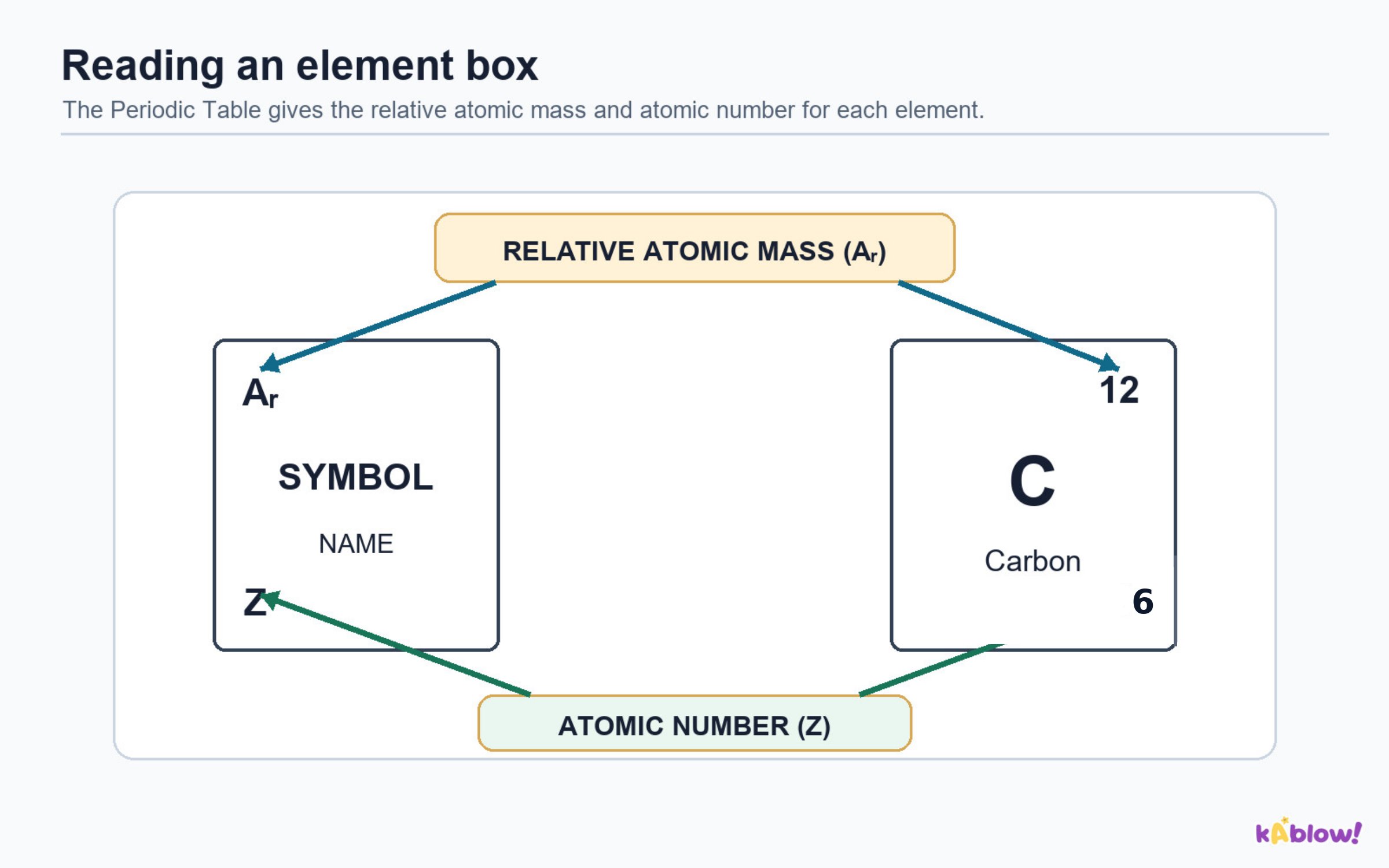
- Relative atomic mass (Ar) is the mass of an atom compared to carbon-12 (Ar = 12).
- Ar values are found on the Periodic Table; e.g., H = 1, C = 12, O = 16.
- Relative molecular mass (Mr) is the sum of Ar of all atoms in a molecule.
- For ionic compounds, the term relative formula mass is used (e.g., NaCl = 58.5).
Key for chemical symbols on the Periodic Table
Reacting Masses
- The Law of Conservation of Mass states total mass of reactants equals total mass of products.
- Use balanced equations and Ar/Mr to calculate masses of reactants or products.
- Example: 2Ca + O₂ → 2CaO; 80 g Ca reacts with 32 g O₂ to form 112 g CaO.
- Mass ratios are fixed; scaling up or down uses the same ratio.
Think like a scientist
- Compare calculated formula masses for teacher-selected compounds using one agreed table of relative atomic masses.
- Comparison: the chemical formula being considered. Outcome: the calculated relative formula mass.
- Control: use the same relative atomic mass values. Explain why this makes the comparison fairer.
- Evidence: Use a consistent method, repeated observations where appropriate and a table with labelled quantities and units. Keep unexpected results and investigate their cause.
- Safety: Practical activities need teacher supervision and an appropriate risk assessment. Use the provided data or simulation where the investigation specifies it.
- Inquiry task: State a testable question, predict the outcome using the science, then explain how your observations would support or challenge the prediction.
Evaluate the science
- Correct formulae connect particle ratios to masses measured in the laboratory.
- Changing a subscript changes the substance; balancing an equation changes coefficients instead.
- Evaluation task: Link your conclusion to evidence, identify a limitation and suggest a specific improvement. Distinguish a measured result from an explanation of its cause.
Slides
Sign up free to view the lesson slides
Step through every slide for this topic — plus flashcards and revision notes — with a free account.
Questões de prática
Prévia grátis — 8 de 52 perguntas. Cadastre-se para ver todas.
1.A molecule contains carbon, hydrogen and oxygen. For every carbon atom there are twice as many hydrogen atoms but the same number of oxygen atoms. What is the formula of the molecule?
Medium- AC2H6O
- BC2H4O2
- CC4H8O2
- DC2H2O2
2.Theobromine is a stimulant found in chocolate and in tea leaves. What is the formula of theobromine?
Easy- AC6H5N4O2
- BC7H8N4O2
- CC7H8N3O2
- DC7H7N4O2
3.Hydrogen reacts with elements from Group VII to produce compounds called hydrogen halides. An example is when a molecule of hydrogen reacts with a molecule of fluorine to produce hydrogen fluoride. What is the correct equation for the reaction?
Easy- A2H + 2F → 2HF
- BH2 + F2 → H2F2
- C2H + 2F → H2F2
- DH2 + F2 → 2HF
4.Leucine is an essential amino acid used in the synthesis of proteins in the body. What is the relative molecular mass of leucine? (Ar: C=12, H=1, N=14, O=16)
Medium- A144
- B86
- C125
- D131
5.When magnesium carbonate is heated, the products are magnesium oxide and carbon dioxide. MgCO3(s) → MgO(s) + CO2(g). What mass of magnesium oxide is formed when 21 g of magnesium carbonate thermally decomposes? (Ar: Mg=24, C=12, O=16)
Medium- A10 g
- B11 g
- C20 g
- D22 g
6.What is the balanced equation for the reaction of methane and oxygen?
Medium- ACH4(g) + 2O2(g) → CO2(g) + H2O(g)
- BCH4(g) + O2(g) → CO2(g) + 2H2O(g)
- C2CH4(g) + 4O2(g) → 2CO2(g) + H2O(g)
- DCH4(g) + 2O2(g) → CO2(g) + 2H2O(g)
7.A compound contains two atoms of oxygen and one atom of calcium. It also contains hydrogen in sufficient amounts so that the overall charge of the molecule is neutral. What is the molecular formula for the compound?
Medium- ACa(OH)4
- BCa(OH)2
- CH4CaO2
- DCaO2H2
8.Dilute sulfuric acid and barium chloride solution react to produce barium sulfate and hydrochloric acid: H2SO4 + BaCl2 → BaSO4 + 2HCl. Which row represents the correct state symbols for the reaction?
Medium- AH2SO4 (aq), BaCl2 (l), BaSO4 (s), HCl (aq)
- BH2SO4 (l), BaCl2 (aq), BaSO4 (aq), HCl (l)
- CH2SO4 (aq), BaCl2 (aq), BaSO4 (s), HCl (aq)
- DH2SO4 (l), BaCl2 (aq), BaSO4 (l), HCl (aq)
Unlock all 52 questions, flashcards & more
Crie uma conta grátis para ver todas as perguntas, os slides, flashcards e resumos de revisão deste tópico.