Membranes & Membrane Transport
Aprenda jogando
Responda a estas perguntas para ganhar energia, depois pesque e explore. Sem precisar de conta.
Notas de aula
Lipid Bilayers: Structure and Properties
- Phospholipids form the basic structure of cell membranes, arranged as a phospholipid bilayer.
- A phospholipid is made of a hydrophilic phosphate head bonded to two hydrophobic hydrocarbon (fatty acid) tails.
- Because they have both hydrophilic and hydrophobic parts, phospholipids are amphipathic.
- The phosphate head is polar and therefore soluble in water; the fatty acid tails are nonpolar and insoluble in water.
- In water, phospholipids orient with heads towards the water and tails away, forming a monolayer; at sufficient concentration, two layers form a bilayer with tails facing inwards and heads outwards.
- The bilayer has a hydrophobic core and hydrophilic outer layers, creating a barrier that controls which molecules pass through.
Lipids and proteins in the cell membrane
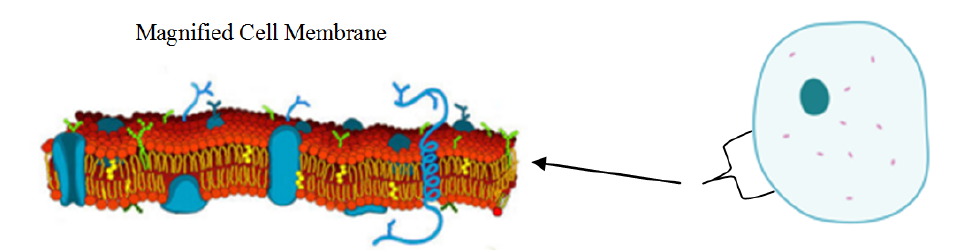
Membrane Proteins: Types and Functions
- Integral proteins are partially hydrophobic (amphipathic), embedded in the phospholipid bilayer, and may span one or both layers.
- Peripheral proteins are hydrophilic, attached to the surface of integral proteins or to the membrane via a hydrocarbon chain, and can be inside or outside the cell.
- Membrane protein content varies with cell function; mitochondria and chloroplast membranes have the highest protein content due to many electron carriers.
- Transport proteins allow ions and polar molecules to cross; they include channel proteins (pores) and carrier proteins (change shape).
- Each transport protein is specific to a particular ion or molecule, allowing the cell to control what enters or leaves.
- Other functions include receptors for hormones/neurotransmitters, immobilised enzymes with active sites on the membrane surface, cell adhesion, and cell-to-cell recognition via glycoproteins.
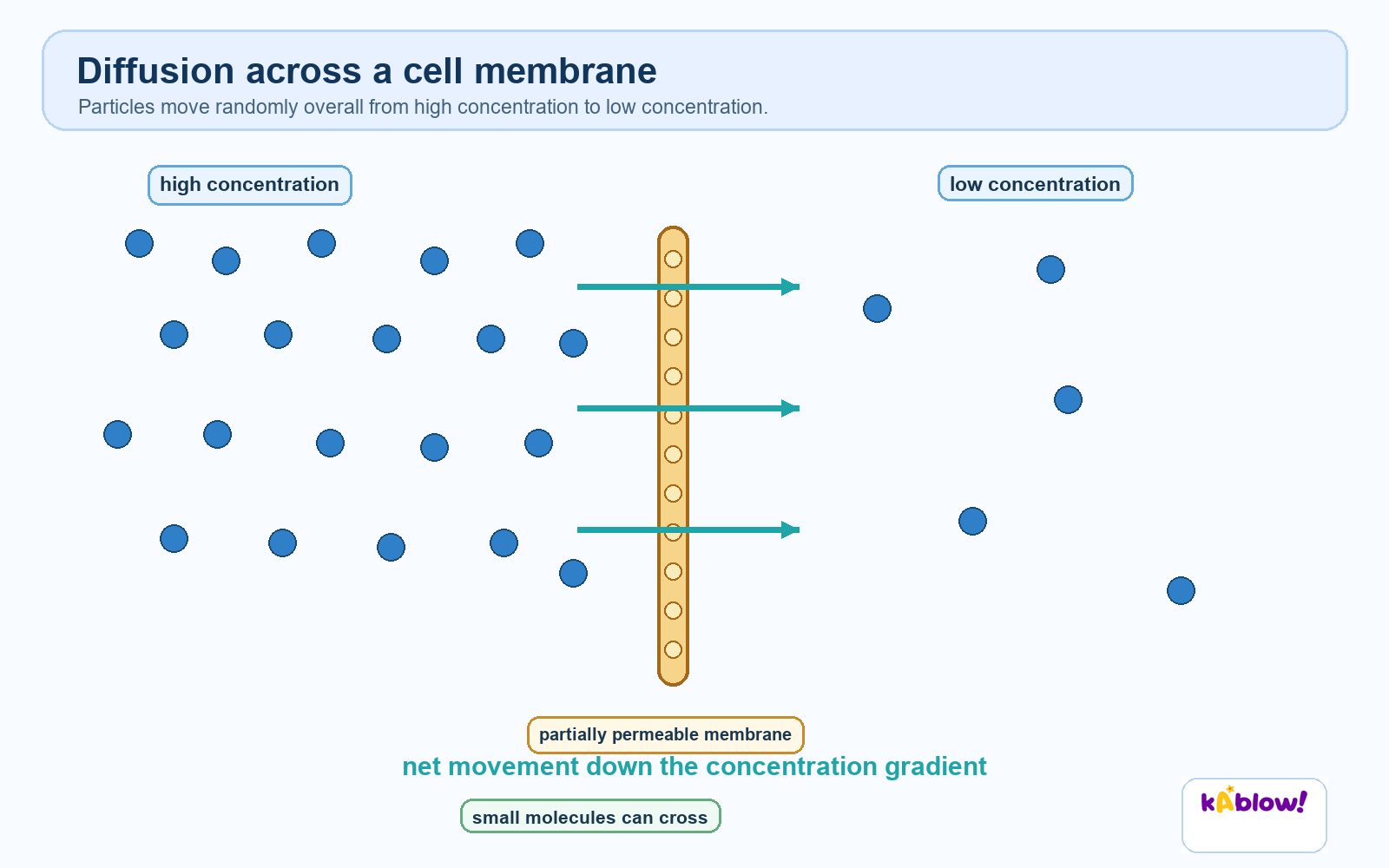
Simple Diffusion
- Simple diffusion is the net movement of molecules or ions from a region of higher concentration to lower concentration due to random motion (kinetic energy).
- Molecules move down a concentration gradient directly between the phospholipids; eventually equilibrium is reached.
- Oxygen diffuses into cells (used in respiration, creating a low internal concentration) and carbon dioxide diffuses out (produced by respiration, creating a high internal concentration).
- Rate of diffusion increases with a steeper concentration gradient, higher temperature, and greater surface area.
- Small, nonpolar molecules diffuse fastest as they are soluble in the nonpolar bilayer; large molecules diffuse more slowly; uncharged molecules diffuse faster than charged ones.
- Small polar molecules (e.g. urea) can diffuse at low rates, but most polar molecules and ions cannot pass through the hydrophobic core.
Diffusion across the cell membrane
Osmosis
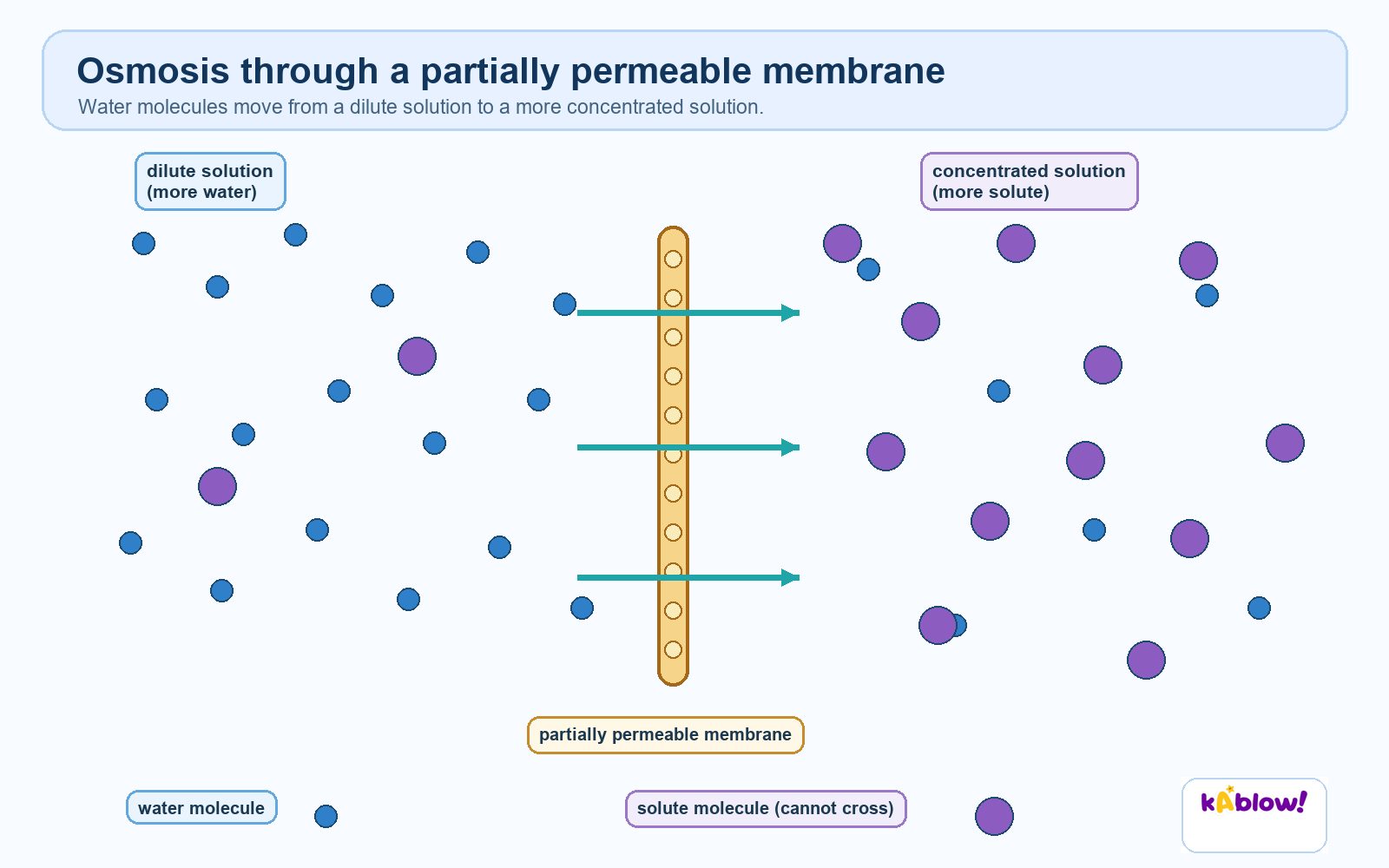
- Osmosis is the diffusion of water molecules from a dilute solution (high water concentration) to a solution with a higher solute concentration (low water concentration) across a partially permeable membrane.
- Water moves down its concentration gradient, so osmosis is a type of diffusion.
- Osmosis can also be defined as the net movement of water from higher water potential to lower water potential.
- Water can move directly between phospholipids, but aquaporins (channel proteins) allow water to pass more freely.
- Water is unusual as a polar molecule that can pass directly across cell membranes.
Osmosis through a partially permeable membrane
Facilitated Diffusion
- Facilitated diffusion is the passive movement of substances down a concentration gradient with the help of transport proteins.
- It is needed for large molecules, polar molecules, and ions that cannot cross the phospholipid bilayer directly.
- Channel proteins form pores and allow charged substances (e.g. ions) to diffuse; some are gated and can open or close to control ion exchange.
- Carrier proteins change shape to transport a substance: the substance binds to a specific site, causing a shape change that moves it across the membrane.
- Transport proteins are highly specific, and the direction of movement depends on the relative concentrations on each side of the membrane.
- Facilitated diffusion is passive and does not require energy.
Active Transport
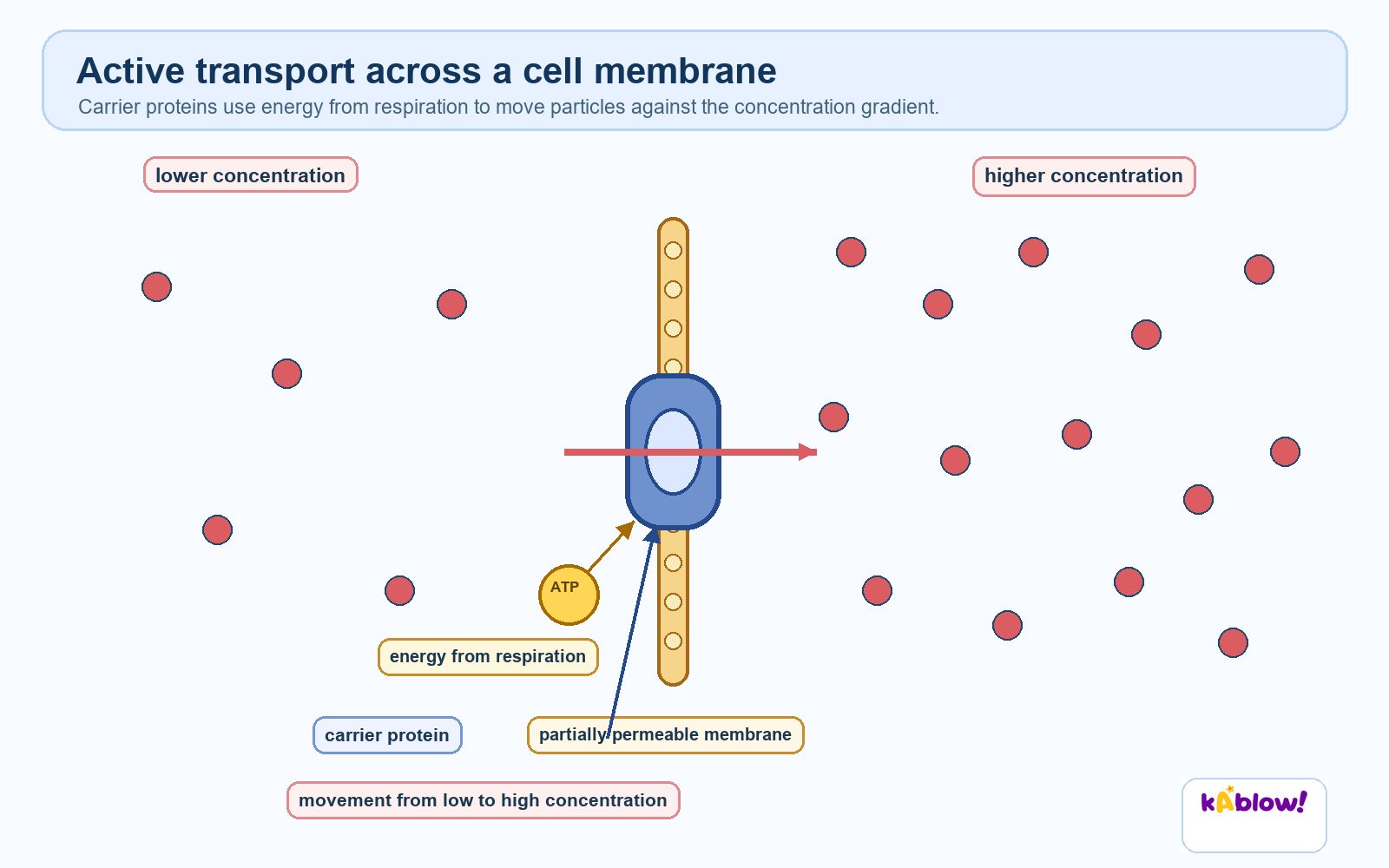
- Active transport is the movement of molecules and ions across a membrane from a region of lower concentration to higher concentration, using energy from respiration.
- It occurs against (up) a concentration gradient and requires carrier proteins (sometimes called pumps).
- Energy is needed to allow the carrier protein to change shape and transfer the substance across the membrane.
- The energy is provided by ATP produced during respiration; ATP is hydrolysed to release energy.
- Unlike facilitated diffusion, active transport is active and requires energy, although both use carrier proteins.
Active transport by carrier proteins
Selective Permeability
- Selective permeability is the ability of the membrane to differentiate between different types of molecules, allowing some through while blocking others.
- Facilitated diffusion and active transport are mechanisms that allow selective permeability.
- Simple diffusion provides less control because it depends only on size and hydrophobic/hydrophilic nature of molecules.
- Simple diffusion is not selective for small, nonpolar molecules (they diffuse easily) but is selective for large or polar molecules, which require transport proteins.
Glycolipids & Glycoproteins
- Glycoproteins are membrane proteins with a carbohydrate chain attached on the extracellular side.
- Glycolipids are lipids with carbohydrate chains attached, also located on the outer surface of cell membranes.
- The carbohydrate chain enables them to act as receptor molecules, binding substances at the cell surface.
- Receptor types include signalling receptors (bind hormones and neurotransmitters), receptors for endocytosis, and receptors for cell adhesion and stabilisation.
- Some act as cell markers (antigens) for cell identification, e.g. allowing the immune system to distinguish body cells from pathogens.
The Fluid Mosaic Model
- The fluid mosaic model was first outlined in 1972 by Singer and Nicolson and explains how biological molecules are arranged in cell membranes.
- Membranes are described as fluid because phospholipids and proteins can move around within their own layers.
- They are described as mosaic because the scattered pattern of proteins within the phospholipid bilayer looks like a mosaic when viewed from above.
- The model includes four main components: phospholipids, cholesterol, glycoproteins and glycolipids, and integral and peripheral proteins.
- The model helps explain passive and active movement, cell-to-cell interactions, and cell signalling.
- Membranes form partially permeable barriers between the cell and its environment, between cytoplasm and organelles, and within organelles; they also compartmentalise different regions of the cell.
- For a two-dimensional diagram, label the phospholipid bilayer (heads and tails), integral proteins (channel/carrier), peripheral proteins, glycoproteins, and cholesterol (OH group next to phosphate heads).
Slides
Sign up free to view the lesson slides
Step through every slide for this topic — plus flashcards and revision notes — with a free account.
Questões de prática
Prévia grátis — 8 de 60 perguntas. Cadastre-se para ver todas.
1.Which term describes a molecule that has both hydrophilic and hydrophobic regions?
Easy- AAmphipathic
- BHydrophilic
- CHydrophobic
- DNonpolar
2.Which part of a phospholipid is hydrophobic?
Easy- APhosphate head
- BHydrocarbon tails
- CGlycerol backbone
- DCarbohydrate chain
3.Which of the following molecules would diffuse most rapidly directly through the phospholipid bilayer?
Easy- AOxygen
- BGlucose
- CSodium ions
- DUrea
4.What is the main difference between facilitated diffusion and active transport?
Medium- AFacilitated diffusion requires energy, active transport does not
- BActive transport requires energy, facilitated diffusion does not
- CFacilitated diffusion uses channel proteins, active transport uses carrier proteins
- DActive transport moves substances down the concentration gradient, facilitated diffusion moves them against it
5.Which of the following statements about the fluid mosaic model is correct?
Medium- AThe phospholipids are fixed in position and cannot move
- BThe proteins are arranged in a regular, repeating pattern
- CThe phospholipids and proteins can move laterally within the membrane
- DThe membrane is a rigid, solid structure
6.Osmosis is a type of diffusion that requires energy from ATP.
EasyTrue or false?
7.Glycolipids and glycoproteins are located on the inner surface of the cell membrane.
EasyTrue or false?
8.A red blood cell is placed in a solution with a higher solute concentration than its cytoplasm. What will happen to the cell?
Medium- AIt will swell and burst
- BIt will shrink as water moves out by osmosis
- CIt will remain unchanged
- DIt will actively pump water out
Unlock all 60 questions & more
Crie uma conta grátis para ver todas as perguntas, os slides, flashcards e resumos de revisão deste tópico.