How Much? The Amount Of Chemical Change
Aprenda jogando
Responda a estas perguntas para ganhar energia, depois pesque e explore. Sem precisar de conta.
Notas de aula
Balancing Equations
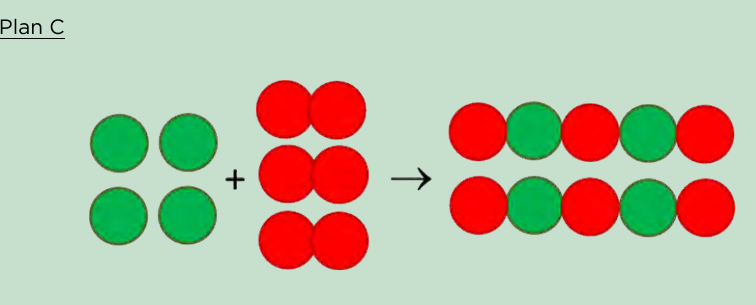
- A symbol equation uses chemical symbols to show the number and type of atoms in reactants and products; a word equation uses only words.
- Atoms cannot be created or destroyed in a chemical reaction, so the number of each atom must be the same on both sides — the equation must be balanced.
- When balancing: do not change any formulae; place coefficients in front of formulae; do not split polyatomic ions (e.g., SO₄²⁻, NO₃⁻) unless needed.
- For combustion of organic compounds, balance carbon first, then hydrogen, then oxygen.
- Use state symbols: (s) solid, (l) liquid, (g) gas, (aq) aqueous.
- Some elements are diatomic in their natural state and must be written with a subscript 2: H₂, N₂, O₂, F₂, Cl₂, Br₂, I₂.
A balanced chemical equation
Reacting Mass Calculations
- The number of moles is calculated using: number of moles = mass of substance (g) / molar mass (g mol⁻¹).
- Be clear about the particle type: 1 mole of CaF₂ contains 1 mole of CaF₂ formula units, but 1 mole of Ca²⁺ ions and 2 moles of F⁻ ions.
- The stoichiometry (mole ratio) from the balanced equation links the amounts of reactants and products.
- To find the mass of product: calculate moles of reactant, use the mole ratio, then convert moles to mass using mass = moles × molar mass.
- In reacting mass calculations, you can work in any mass unit (g, tonnes, etc.) as long as you are consistent, because masses are in proportion to the balanced equation.
- Example: burning 6.0 g of Mg (M = 24.31) gives 0.25 mol Mg, which produces 0.25 mol MgO (M = 40.31), mass = 10.08 g.
Avogadro's Law & Molar Volume of Gas
- Avogadro's Law states that equal volumes of gases at the same temperature and pressure contain the same number of molecules.
- At standard temperature and pressure (STP) — 0 °C (273 K) and 100 kPa — one mole of any gas occupies 22.7 dm³ mol⁻¹.
- Volume of gas = amount of gas (mol) × 22.7 dm³ mol⁻¹; amount of gas (mol) = volume of gas (dm³) / 22.7 dm³ mol⁻¹.
- The stoichiometry of a reaction and Avogadro's Law allow deduction of exact volumes of gaseous reactants and products, e.g., 50 cm³ propane requires 250 cm³ O₂ and forms 150 cm³ CO₂ (ratio 1:5:3).
- If gas volumes are not in the same ratio as the coefficients, the limiting reactant determines the amount of product.
- To find the limiting reactant with gas volumes, divide each volume by its coefficient; the smallest result is the limiting reactant.
Concentration Calculations
- Volumetric analysis uses the volume and concentration of a standard solution to find the concentration of an unknown solution, commonly via titration.
- In a titration, a known volume (e.g., 20 or 25 cm³) is measured with a pipette into a conical flask; the other solution is added from a burette until the indicator changes colour; concordant results are needed.
- Problem-solving steps: write the balanced equation; determine moles of the known substance; use the mole ratio; calculate the unknown quantity.
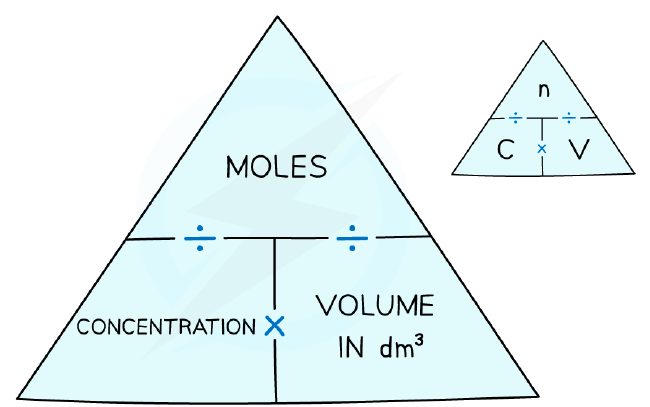
- Moles = volume (dm³) × concentration (mol dm⁻³); concentration = moles / volume (dm³); volume = moles / concentration.
- For monoprotic acid–base reactions (one H⁺ or one OH⁻ per formula unit), the shortcut C₁V₁ = C₂V₂ can be used, and volumes may be in cm³ as units cancel.
- Back titration finds an unknown indirectly: react it with excess reagent, then titrate the excess; use mole ratios to deduce the amount of the original substance.
Concentration, moles and volume
Limiting & Excess Reactants
- The limiting reactant is the reactant that is not in excess and determines how much product can form; the excess reactant is left over.
- To identify the limiting reactant: calculate moles of each reactant, divide each by its coefficient from the balanced equation, and the smallest result is limiting.
- Example: 10 mol C with 3 mol H₂ for C + 2H₂ → CH₄: H₂ is limiting because 3 mol H₂ requires only 1.5 mol C, leaving C in excess.
- Example: 9.2 g Na (0.40 mol) and 8.0 g S (0.25 mol) for 2Na + S → Na₂S: Na gives 0.40/2 = 0.20 (lowest), so Na is limiting and S is in excess.
Percentage Yield Calculations
- The theoretical yield is the maximum amount of product possible from the limiting reactant, assuming perfect conversion with no losses.
- The experimental (actual) yield is the amount of product actually collected; differences arise from side reactions, loss during transfer or purification, and incomplete reaction.
- Percentage yield = (actual yield / theoretical yield) × 100.
- Ensure actual and theoretical yields have the same unit before applying the formula.
- Example: theoretical yield 6.5 g, actual 5.8 g gives (5.8 / 6.5) × 100 = 89.2%.
- Example: 6.5 g Zn (0.10 mol) with excess CuSO₄ gives theoretical 6.4 g Cu; actual 4.8 g gives (4.8 / 6.4) × 100 = 75%.
Atom Economy
- Atom economy measures how efficiently reactants are converted into the desired product; higher atom economy means less waste and a more sustainable process.
- Atom economy = (molecular mass of desired product / sum of molecular masses of ALL reactants) × 100.
- Alternatively, atom economy = (mass of desired product / total mass of all products) × 100.
- In addition reactions, atom economy is always 100% because all atoms end up in the single product, e.g., CH₂=CH₂ + Br₂ → CH₂BrCH₂Br.
- A low atom economy means more resources are needed and more waste must be managed, increasing environmental and economic costs.
- Other factors for process efficiency include rate, quantities of catalysts and solvents, energy use, and economic efficiency.
- Example: Fe₂O₃ + 3CO → 2Fe + 3CO₂ has atom economy = (2 × 55.8) / [159.6 + (3 × 28.0)] × 100 = 45.8%.
Slides
Sign up free to view the lesson slides
Step through every slide for this topic — plus flashcards and revision notes — with a free account.
Questões de prática
Prévia grátis — 8 de 67 perguntas. Cadastre-se para ver todas.
1.Which statement best defines a symbol equation?
Easy- AA shorthand way of describing a chemical reaction using chemical symbols to show the number and type of each atom
- BA longer way of describing a chemical reaction using only words to show the reactants and products
- CA diagram showing the physical states of reactants and products
- DA list of the molar masses of all substances in a reaction
2.During a chemical reaction, atoms can be created or destroyed.
EasyTrue or false?
3.Which state symbol represents a substance dissolved in water?
Easy- A(s)
- B(l)
- C(g)
- D(aq)
4.Which of the following elements are diatomic in their natural state and must be written with a subscript 2 in equations? (select all that apply)
Easy- AHydrogen
- BNitrogen
- CCarbon
- DOxygen
- ESulfur
5.Which one of the following is the correct net ionic equation for the reaction between CaCl2 and AgNO3?
Easy- ACa2+ (aq) + 2AgNO3 (aq) → 2Ag+ (s) + Ca(NO3)2 (aq)
- BCaCl2 (aq) + 2Ag+ (aq) → 2AgCl (s) + Ca2+ (aq)
- CCa2+ (aq) + 2NO3- (aq) → Ca(NO3)2 (aq)
- DAg+ (aq) + Cl- (aq) → AgCl (s)
6.When the following equation is balanced correctly, using the smallest whole number coefficients, which row represents the coefficients? _ Mg3N2 (s) + _ H2O (l) → _ Mg(OH)2 (aq) + _ NH3 (aq)
Easy- A1, 6, 3, 2
- B1, 3, 3, 1
- C2, 6, 2, 2
- D2, 6, 3, 2
7.Which one of the following is the correct net ionic equation for the reaction between NaC2H3O2 (aq) and HCl (aq)?
Easy- AC2H3O2- (aq) + HCl (aq) → CCl (aq) + 2H+ (aq) + CO2 (aq)
- BC2H3O2- (aq) + H+ (aq) → HC2H3O2 (aq)
- CNa+ (aq) + Cl- (aq) → NaCl (aq)
- DNaC2H3O2 (aq) + H+ (aq) → HC2H3O2 (aq) + Na+ (aq)
8.When calcium carbonate is heated it decomposes according to the following equation: CaCO3 (s) → CaO(s) + CO2 (g) If 6.00 g of calcium carbonate is heated and produces 2.73 g of calcium oxide, what is the percentage yield of calcium oxide? (Mr CaCO3 = 100.09; CaO = 56.08)
Medium- A18%
- B81%
- C90%
- D0.81%
Unlock all 67 questions & more
Crie uma conta grátis para ver todas as perguntas, os slides, flashcards e resumos de revisão deste tópico.