Electron Pair Sharing Reactions
Aprenda jogando
Responda a estas perguntas para ganhar energia, depois pesque e explore. Sem precisar de conta.
Notas de aula
Nucleophiles
- A nucleophile is an electron-rich species that can donate a pair of electrons.
- 'Nucleophile' means 'nucleus/positive charge loving' — nucleophiles are attracted to positively charged species.
- Neutral nucleophiles include H₂O, NH₃, ROH (alcohols) and RNH₂ (amines).
- Charged nucleophiles include OH⁻, Cl⁻, CN⁻ and carbanions (R⁻).
- OH⁻ is a stronger nucleophile than H₂O because it carries a full negative charge, while the oxygen in H₂O has only a partial negative charge.
- This makes OH⁻ more reactive and more likely to donate its lone pair quickly.
Nucleophilic Substitution
- Nucleophilic substitution is a reaction in which a nucleophile attacks a carbon atom carrying a partial positive charge.
- An atom with a partial negative charge is replaced by the nucleophile.
- Halogenoalkanes undergo nucleophilic substitution because the C–X bond is polar — the carbon is δ⁺ and the halogen is δ⁻.
- The bond that forms and the bond that breaks must both involve the carbon atom bonded to the leaving group.
- In the hydrolysis of a halogenoalkane, the nucleophile is OH⁻ and an aqueous solution of NaOH or KOH with ethanol is used.
- The reaction is very slow at room temperature, so the mixture is warmed.
- Example: CH₃CH₂Br + OH⁻ → CH₃CH₂OH + Br⁻ (bromoethane → ethanol), with Br⁻ as the leaving group.
- Halogens make good leaving groups because they form relatively weak bonds with carbon and their high electronegativity pulls electron density away from carbon.
Rate of Nucleophilic Substitution
- The rate depends on the halogen: the stronger the C–X bond, the slower the reaction.
- Bond enthalpy trend: C–F > C–Cl > C–Br > C–I.
- Fluoroalkanes are unreactive, while iodoalkanes react very quickly.
- When the nucleophile is neutral (e.g. H₂O), the initial product is positive and then deprotonates, losing H⁺ to form a neutral product.
- Example: CH₃CH₂Cl + H₂O → CH₃CH₂OH₂⁺ → CH₃CH₂OH + H⁺.
Heterolytic Fission
- Heterolytic fission is the breaking of a covalent bond so that both bonding electrons are taken by the more electronegative atom.
- This forms a negative ion (which gains both electrons) and a positive ion (left with none).
- In mechanism diagrams, a curly double-headed arrow shows the movement of a pair of electrons from the bond to one atom.
- For example, when an H–Cl bond breaks heterolytically, the electrons move to chlorine forming Cl⁻, leaving H⁺.
- The negative ion is electron-rich, can donate a pair of electrons and is a nucleophile.
- The positive ion is electron-deficient, can accept a pair of electrons and is an electrophile.
Nucleophile–Electrophile Interaction
- A nucleophile can donate a pair of electrons to an electrophile, forming a coordinate covalent bond.
- This is the opposite direction to heterolytic bond breaking and is key to many organic mechanisms, such as nucleophilic substitution.
- A nucleophile 'loves' a positive charge and an electrophile 'loves' a negative charge.
Electrophiles
- An electrophile is a species that forms a covalent bond when it reacts with a nucleophile by accepting electrons.
- Electrophiles are electron-deficient and typically have a full or partial positive charge.
- Neutral electrophiles include HX (hydrogen halides), X₂ (halogens), H₂O and RX (halogenoalkanes).
- Positively charged electrophiles include H⁺, NO₂⁺ (nitronium), NO⁺ (nitrosonium) and carbocations (R⁺).
Electrophilic Addition Reactions
- Electrophilic addition is the reaction of an electrophile with a carbon–carbon double bond, C=C.
- The C=C double bond is an area of high electron density, making it attractive to electrophiles.
- The C=C bond breaks, forming a single C–C bond and a new bond from each carbon to the electrophile.
- Electrophilic addition includes addition of steam (H₂O) to form alcohols, hydrogen halides (HX) to form halogenoalkanes, and halogens (X₂) to form dihalogenoalkanes.
- Alkenes are unsaturated and the atoms around the C=C bond are planar with a bond angle of 120°.
- The C=C bond consists of one σ-bond and a weaker π-bond; the π-bond can be broken and replaced by stronger σ-bonds.
- This allows alkenes to undergo addition reactions, which are not possible for saturated alkanes, making alkenes more reactive than alkanes.
Addition across a carbon–carbon double bond
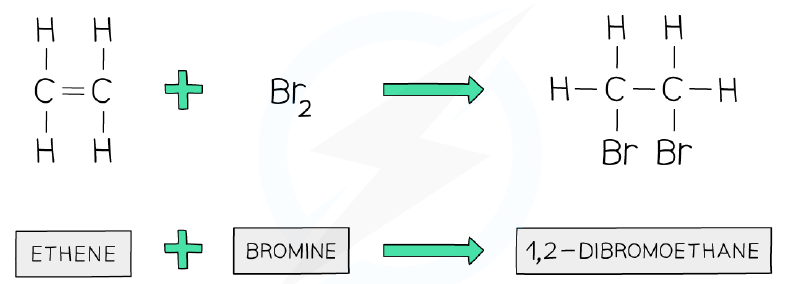
Addition of Water (Hydration)
- Hydration occurs when alkenes are treated with steam at 300 °C and 60 atmospheres pressure.
- An acid catalyst such as sulfuric acid (H₂SO₄) or phosphoric acid (H₃PO₄) is used.
- Water is added across the double bond, converting the alkene into an alcohol.
- Example: CH₂=CH₂ + H₂O → CH₃CH₂OH (ethene → ethanol).
- The reaction proceeds via an intermediate in which H⁺ and HSO₄⁻ ions are added across the double bond.
- The intermediate is quickly hydrolysed by water, regenerating the sulfuric acid catalyst.
- This industrial route to ethanol is faster and more efficient than fermentation.
Addition of Halogens (Halogenation)
- Alkenes react with halogens in an electrophilic addition called halogenation.
- The π-bond breaks and is replaced by two new C–X bonds, forming a dihalogenoalkane.
- This reaction occurs readily at room temperature.
- Bromine water is an orange/yellow solution of Br₂(aq) and is used to test for unsaturation.
- If a C=C bond is present, an addition reaction occurs and the coloured solution becomes decolourised.
- If no C=C bond is present, there is no reaction and the solution remains orange/yellow.
- The bromine water test is the standard test for unsaturation in alkenes.
Addition of Hydrogen Halides (Hydrohalogenation)
- Alkenes react with hydrogen halides (e.g. HCl, HBr) to form halogenoalkanes.
- This is an electrophilic addition reaction that occurs rapidly at room temperature.
- All hydrogen halides react with alkenes in this way.
- The reaction is fastest in the order HI > HBr > HCl because weaker H–X bonds break more easily.
Slides
Sign up free to view the lesson slides
Step through every slide for this topic — plus flashcards and revision notes — with a free account.
Questões de prática
Prévia grátis — 8 de 61 perguntas. Cadastre-se para ver todas.
1.Which of these compounds would act as a nucleophile?
Easy- AC6H12
- BH+
- COH-
- DAl
2.Ethene reacts with steam in the presence of sulfuric acid: C2H4 + H2O → CH3CH2OH. What type of reaction is this?
Easy- Aacid / base
- Baddition
- Chydrolysis
- Dsubstitution
3.Which reaction is an example of nucleophilic substitution?
Easy- AC6H6 + Br2 → C6H5Br + HBr
- BCH2=CH2 + HBr → CH3CH2Br
- CC3H7Br + H2O → C3H7OH + HBr
- DC2H6 + Br2 → C2H5Br + HBr
4.Bromomethane, CH3Br, can be made by reacting methanol with hydrogen bromide: CH3OH + HBr → CH3Br + H2O. What type of reaction is this?
Easy- Acondensation
- Belectrophilic substitution
- Cfree radical substitution
- Dnucleophilic substitution
5.What reagents and conditions are needed to convert but-2-ene into butane?
Easy- AConcentrated sulfuric acid, steam, 300 °C
- BHydrogen gas, Ni catalyst, 150 °C
- CAcidified potassium dichromate, heating under reflux
- DHydrogen bromide, room temperature
6.Which reaction(s) can alkenes undergo? I. Addition II. Hydration III. Reduction
Medium- AI and II only
- BI and III only
- CII and III only
- DI, II and III
7.In the hydrolysis of bromoethane by aqueous sodium hydroxide, what is the nature of the attacking group and of the leaving group?
Medium- Aattacking group: electrophile; leaving group: electrophile
- Battacking group: electrophile; leaving group: nucleophile
- Cattacking group: nucleophile; leaving group: electrophile
- Dattacking group: nucleophile; leaving group: nucleophile
8.The synthesis of ethyl butanoate can be carried out in three steps: C4H9Br → C4H9OH → C3H7COOH → C3H7COOC2H5. What is the correct classification of the steps I, II and III?
Medium- AI substitution; II oxidation; III condensation
- BI addition; II substitution; III condensation
- CI oxidation; II substitution; III condensation
- DI substitution; II oxidation; III substitution
Unlock all 61 questions & more
Crie uma conta grátis para ver todas as perguntas, os slides, flashcards e resumos de revisão deste tópico.