The Metallic Model
Aprenda jogando
Responda a estas perguntas para ganhar energia, depois pesque e explore. Sem precisar de conta.
Notas de aula
Metallic Bonding
- Metal atoms are tightly packed in lattice structures.
- Outer shell electrons become delocalised and are free to move throughout the structure.
- Metal atoms become positively charged when they lose their outer electrons.
- The positive charges repel each other, keeping the neatly arranged lattice in place.
- There are very strong electrostatic forces between the positive metal centres and the 'sea' of delocalised electrons.
Metallic bonding and malleability
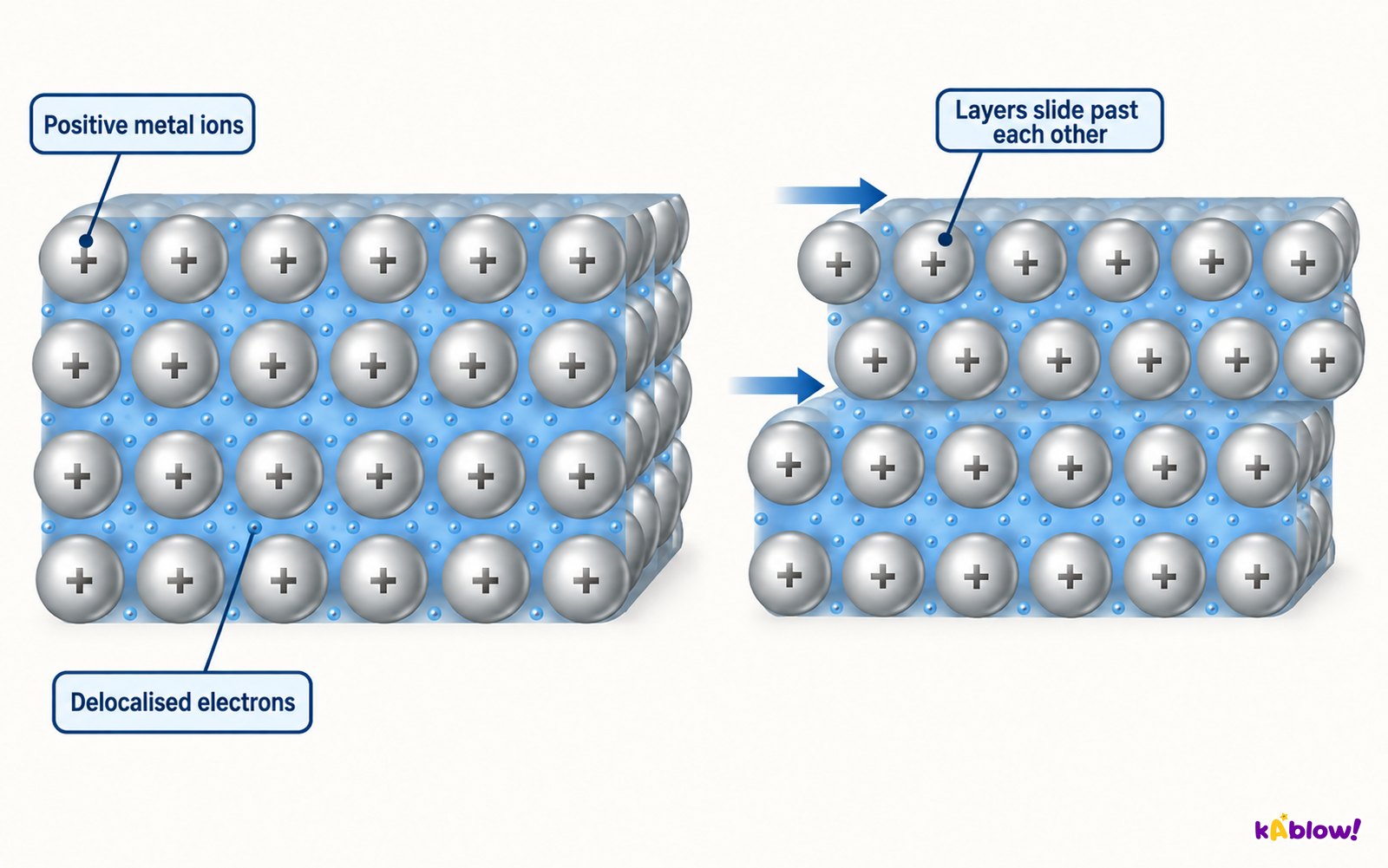
Properties of Metals: Malleability and Ductility
- Metals are malleable (can be hammered into sheets) and ductile (can be drawn into wires).
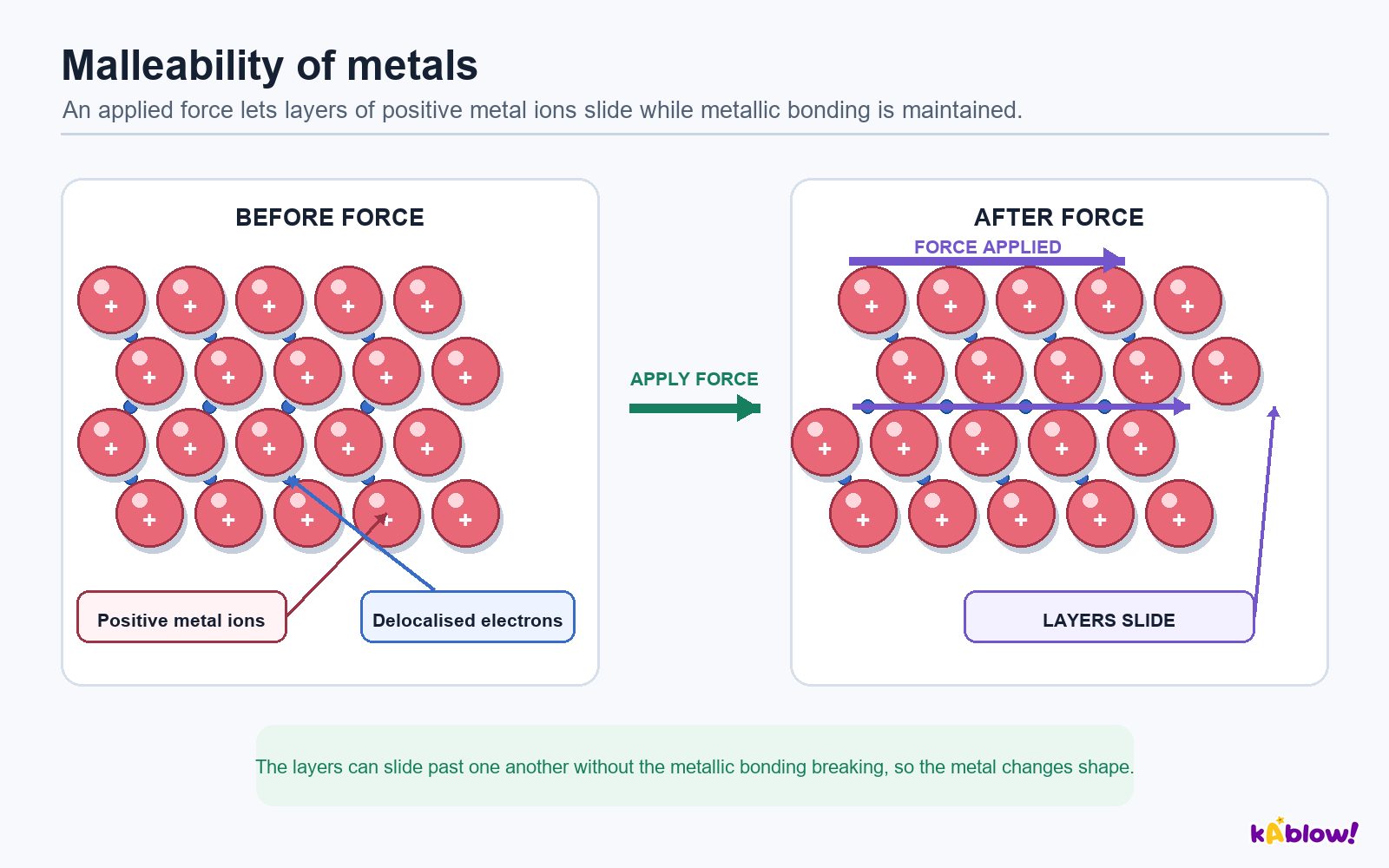
- The layers of metal ions can slide over each other when a force is applied.
- The delocalised electrons allow the metal to retain its structure without breaking the bonds.
Malleability of metals
Properties of Metals: Strength and Hardness
- Metals are typically strong and hard.
- This is due to the strong electrostatic attraction between cations and electrons.
- The closely packed structure of the metal ions also contributes to strength and hardness.
Properties of Metals: Electrical Conductivity
- Metals conduct electricity in both the solid and liquid states.
- Mobile delocalised electrons can freely move and conduct electricity.
- When a potential difference is applied, delocalised electrons repel away from the negative terminal and move towards the positive terminal.
- As the number of outer electrons increases across a period, the number of delocalised charges also increases: Na = 1, Mg = 2, Al = 3.
- Therefore, the ability to conduct electricity increases across a period.
Properties of Metals: Thermal Conductivity
- Metals are good thermal conductors due to the behaviour of their cations and delocalised electrons.
- When heated, cations vibrate more vigorously and transfer kinetic energy as they collide with neighbouring cations.
- Delocalised electrons are free to move and carry increased kinetic energy rapidly throughout the metal.
Properties of Metals: Melting and Boiling Points
- Metals have high melting and boiling points.
- This is due to the strong electrostatic forces of attraction between the cations and delocalised electrons in the metallic lattice.
- These forces require large amounts of energy to overcome.
- As the number of mobile charges increases across a period, melting and boiling points increase due to stronger electrostatic forces.
Uses of Metals
- The metal chosen for a particular job depends on properties such as malleability/ductility, melting/boiling point, density, reactivity, electrical conductivity, strength, toxicity, lustre, thermal conductivity, strength-to-weight ratio, corrosion resistance, and sonority.
- Aluminium is used in food cans because it is non-toxic and resistant to corrosion and acidic food stuffs.
- Copper is used in electrical wiring because it is a good electrical conductor and malleable/ductile.
- Stainless steel is used for cutlery as it is strong and resistant to corrosion.
Factors Affecting the Strength of Metallic Bonds
- The charge on the metal ion: greater charge means more delocalised electrons and a greater charge difference between ions and electrons, leading to stronger electrostatic attraction.
- The radius of the metal ion: smaller ionic radii exert a greater attraction on the sea of delocalised electrons, meaning a stronger metallic bond.
- The strength of electrostatic attraction can be increased by: increasing the number of delocalised electrons per metal atom, increasing the number of positive charges on the metal centres, and decreasing the size of the metal ions.
Trends in Melting Points of Metals
- Across a period (e.g., Na, Mg, Al): the charge on the metal ion increases and the ionic radius decreases, leading to stronger metallic bonding and higher melting points.
- Melting point data for Period 3 metals: Na = 371 K, Mg = 922 K, Al = 933 K.
- Down a group (e.g., Group 1): the size of the cation increases, which decreases the attraction between the outer electrons and the metallic lattice, so melting point decreases.
- Melting point data for Group 1 metals: Na = 371 K, K = 337 K, Rb = 312 K.
- The stronger the metallic bonding, the more energy is needed to break the metallic lattice, so the higher the melting point.
- These are trends, not rules; other factors such as metal packing structure can cause subtle differences (e.g., Al melting point is not much higher than Mg).
Slides
Sign up free to view the lesson slides
Step through every slide for this topic — plus flashcards and revision notes — with a free account.
Questões de prática
Prévia grátis — 8 de 63 perguntas. Cadastre-se para ver todas.
1.Which of the following types of bonds does the statement 'electrostatic attraction between cations and delocalised electrons' best describe?
Easy- Ahydrogen
- Bionic
- Cdipole-dipole
- Dmetallic
2.Which of the following materials only contains one type of bonding?
Easy- Agraphite
- Bbrass
- Cice
- Diodine crystals
3.Substance L has the following properties: melting point 660 °C; electrical conductivity: when solid — yes, when molten — yes. What is likely to be the identity of substance L?
Easy- AGraphite
- BLi2O
- CNaCl
- DAl
4.What is the correct order of decreasing melting points for Group 1 metals?
Easy- ANa > K > Rb > Cs
- BNa > K > Cs > Rb
- CCs > Rb > K > Na
- DK > Na > Rb > Cs
5.Which of the following metals would have the highest melting point?
Medium- ANa
- BMg
- CAl
- DK
6.Which of the following species has the highest melting point? (Electron configurations are given.)
Medium- A1s2 2s2 2p6 3s1
- B1s2 2s2 2p6 3s2
- C1s2 2s2 2p6 3s2 3p1
- D1s2 2s2 2p6 3s2 3p2
7.Which of the following metals will have the greatest ability to conduct electricity?
Medium- ALi
- BMg
- CNa
- DAl
8.Sodium and magnesium are both Period 3 elements. Why is sodium more reactive than magnesium? (Select all that apply.)
Medium- ASodium has a larger atomic radius
- BSodium has a smaller nuclear charge
- CSodium's outer electron is less strongly attracted to the nucleus
- DSodium has more delocalised electrons
- ESodium has a higher melting point
Unlock all 63 questions & more
Crie uma conta grátis para ver todas as perguntas, os slides, flashcards e resumos de revisão deste tópico.