Wave Model
Aprenda jogando
Responda a estas perguntas para ganhar energia, depois pesque e explore. Sem precisar de conta.
Notas de aula
Properties of Waves
- Travelling waves are oscillations that transfer energy from one place to another without transferring matter.
- Waves are generated by oscillating sources; the oscillations travel away from the source.
- Oscillations can propagate through a medium (e.g. air, water) or in a vacuum, depending on the type of wave.
- Key properties of travelling waves: displacement, wavelength, amplitude, period, frequency, wave speed.
- Displacement is the distance of a point on the wave from its equilibrium position; it is a vector (can be positive or negative), measured in metres (m).
- Wavelength λ is the length of one complete oscillation, measured from the same point on two consecutive waves (e.g. crest to crest); unit: metres (m).
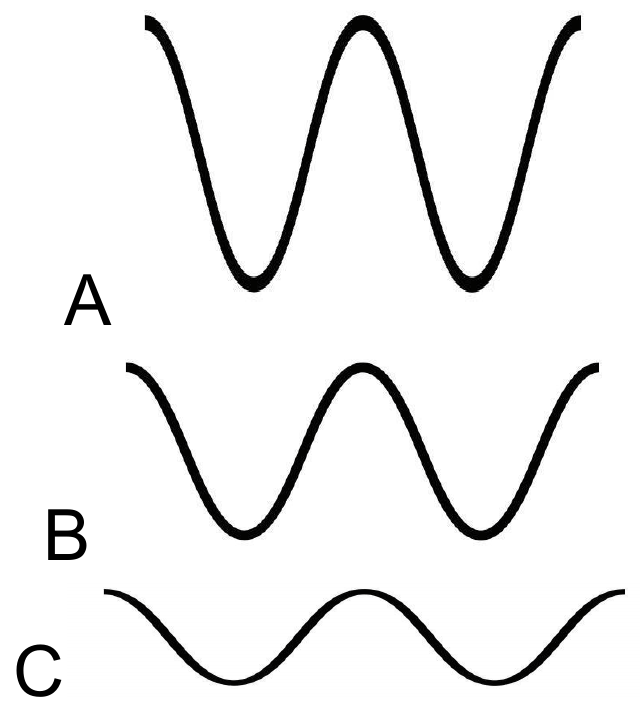
- Amplitude A is the maximum displacement from the equilibrium position (x = 0); it can be positive or negative depending on direction; unit: metres (m).
- The horizontal line where displacement is zero is called the equilibrium position.
Three waves of different amplitude, A, B and C.
Period, Frequency and Wave Speed
- Period T is the time taken for one complete oscillation to pass a fixed point; measured in seconds (s).
- Frequency f is the number of complete oscillations passing a fixed point per second; measured in Hertz (Hz).
- Frequency and period are related by: f = 1 / T.
- Wave speed v is the distance travelled by the wave per unit time; measured in metres per second (m s⁻¹).
- The wave equation is: v = f λ = λ / T.
- For a wave of constant speed: as wavelength increases, frequency decreases; as wavelength decreases, frequency increases.
- When interpreting graphs: if the x-axis is time, the distance for one full wave is the period; if the x-axis is distance, it is the wavelength.
- Always convert units correctly: for frequency in Hz, time period must be in seconds (not milliseconds).
Transverse Waves
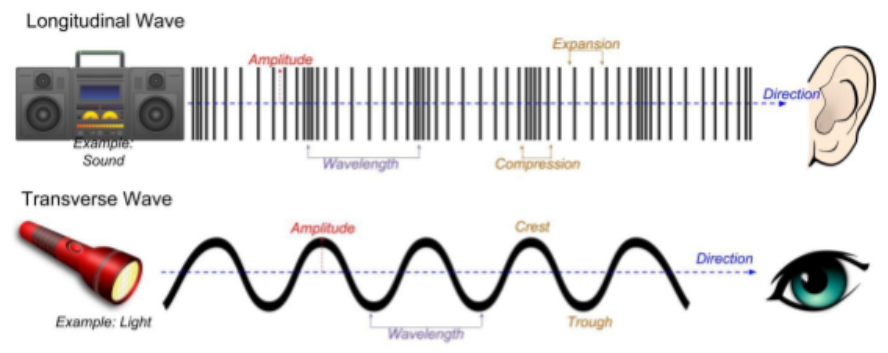
- Transverse waves are waves in which the oscillations are perpendicular to the direction of motion and energy transfer.
- In a transverse wave, each particle vibrates up and down (or side to side) about a fixed point.
- Transverse waves show areas of peaks (crests) and troughs.
- Examples of transverse waves: electromagnetic waves (e.g. radio, visible light, UV) and mechanical waves (e.g. vibrations on a guitar string).
- Transverse waves transfer energy even if there is no resultant displacement of the medium.
- Transverse waves do not need particles to propagate, so they can travel through a vacuum (e.g. UV radiation from the Sun reaching Earth).
Longitudinal and transverse waves.
Longitudinal Waves
- Longitudinal waves are waves in which the oscillations are parallel to the direction of motion and energy transfer.
- In a longitudinal wave, each particle vibrates left and right (back and forth) about a fixed point.
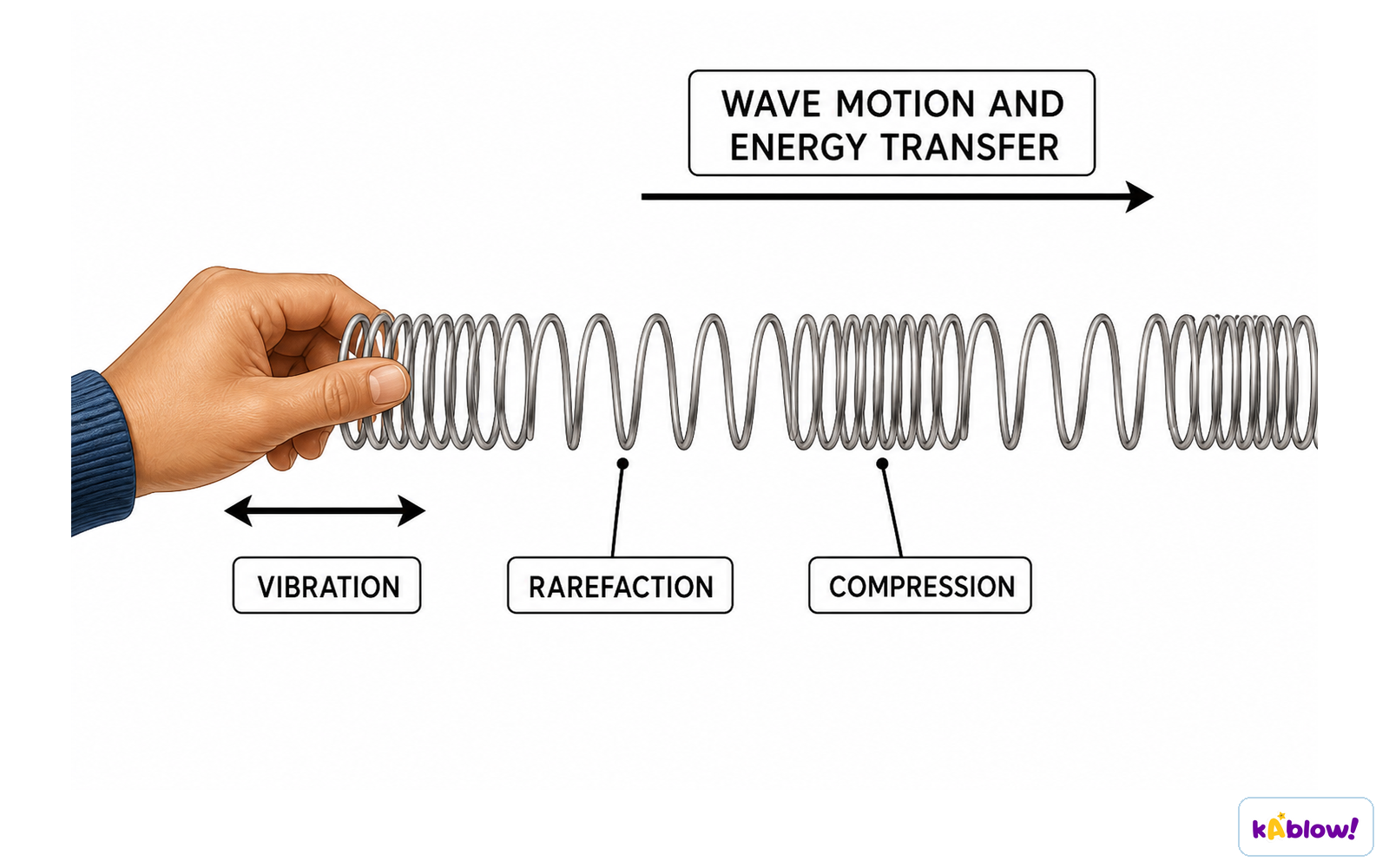
- As a longitudinal wave propagates, areas of low and high pressure are observed: a rarefaction is an area of low pressure (particles further apart); a compression is an area of high pressure (particles closer together).
- Examples of longitudinal waves: sound waves and ultrasound waves.
- Longitudinal waves are mechanical waves; they need particles to propagate and cannot travel through a vacuum (e.g. no sound in outer space).
- Longitudinal waves transfer energy: particles vibrate as they receive energy, and compressions cause nearby particles to vibrate with more energy, producing a compression further along the medium.
Longitudinal wave motion
Sound Waves
- Sound waves are longitudinal waves and require a medium in which to propagate.
- Sound waves are generated by oscillating sources, which produce a change in density of the surrounding medium; the wave travels as a series of compressions and rarefactions.
- Sound waves form a continuous spectrum based on frequency.
- Humans can hear sounds with frequencies in the range 20 Hz to 20 kHz (the audible range); sounds below and above this range cannot be detected by the human ear.
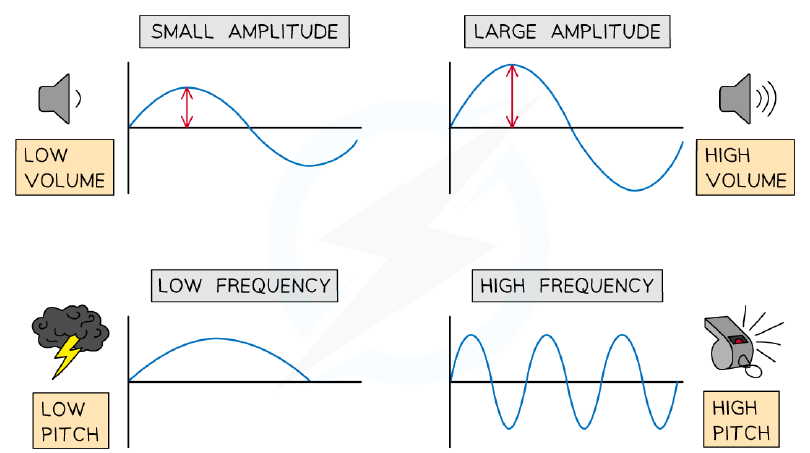
- The frequency of a sound wave determines its pitch: high pitch = high frequency (short wavelength); low pitch = low frequency (long wavelength).
- The amplitude of a sound wave determines its volume: large amplitude = high volume; small amplitude = low volume.
- Sound travels at about 340 m s⁻¹ in air at room temperature; the higher the air temperature, the greater the speed of sound (higher average kinetic energy of particles).
- Sound travels fastest through solids (particles closely packed, pass oscillations quickly) and slowest in gases (particles spread out, less efficient transfer).
Pitch and amplitude of sound waves
Electromagnetic Waves
- An electromagnetic wave is generated by the combined oscillation of an electric and a magnetic field.
- These fields oscillate perpendicularly to each other and to the direction of motion of the wave (the direction of energy transfer).
- Electromagnetic waves are transverse waves and can travel through a vacuum.
- All electromagnetic waves travel at the speed of light in vacuum: c = 3 × 10⁸ m s⁻¹, regardless of frequency.
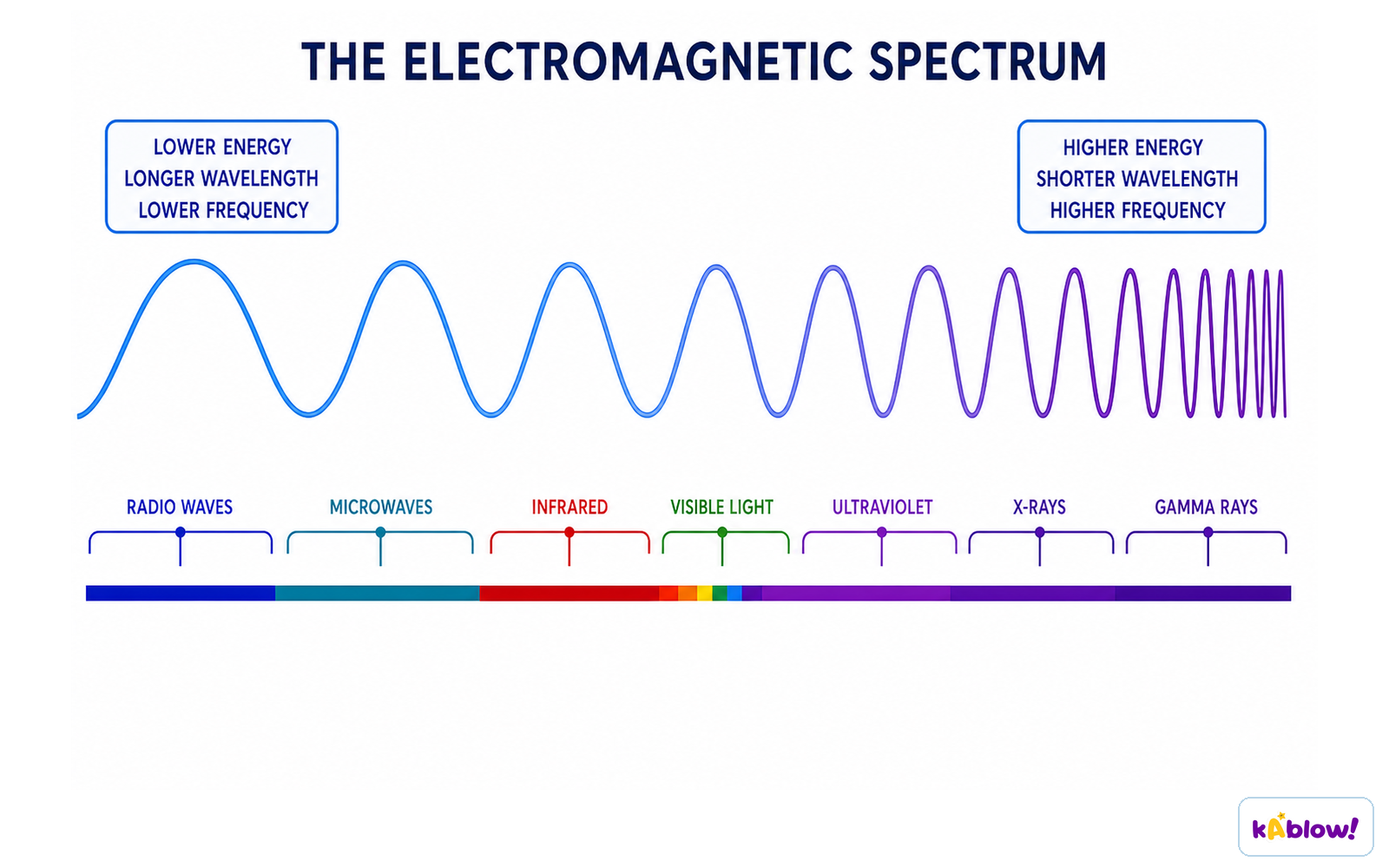
- Electromagnetic waves form a continuous spectrum based on frequency (or wavelength); the shorter the wavelength (higher the frequency), the greater the energy of the wave.
- Humans can only sense electromagnetic waves with wavelengths in the range 700 nm to 400 nm (the visible spectrum); longer and shorter wavelengths are invisible to the human eye.
- The frequency of an electromagnetic wave can be calculated using the wave equation v = f λ with v = c = 3 × 10⁸ m s⁻¹.
The electromagnetic spectrum, showing the seven regions in order of decreasing wavelength (increasing frequency), from radio waves to gamma rays.
Comparing Mechanical and Electromagnetic Waves
- Mechanical waves require a medium (fluid or solid) to propagate; electromagnetic waves do not require a medium.
- Mechanical waves can be transverse or longitudinal; electromagnetic waves are only transverse.
- Mechanical waves cannot travel through a vacuum; electromagnetic waves can travel through a vacuum.
- Mechanical waves are produced by the oscillation of particles in a medium; electromagnetic waves are produced by oscillating charged particles.
- Examples of mechanical waves: sound waves, waves on the surface of the ocean, seismic waves; examples of electromagnetic waves: radio waves, UV rays, X-rays.
- Mechanical waves travel much slower than the speed of light; electromagnetic waves travel at the speed of light.
- A common misconception: mechanical waves are not only longitudinal; they can also be transverse (e.g. seismic waves, water waves).
Worked Examples and Exam Tips
- To find amplitude from a graph: identify the maximum displacement from the equilibrium position (x = 0), and convert units if necessary (e.g. cm to m).
- To find frequency from a graph: identify the period T (time for one complete oscillation), convert to seconds, then use f = 1 / T.
- To find wavelength from a graph: identify the distance for one complete wave (e.g. crest to crest), then use λ = v / f or λ = v T.
- Example: a wave with period 1.0 μs (1.0 × 10⁻⁶ s) and speed 100 cm s⁻¹ (1.0 m s⁻¹) has frequency 1 × 10⁶ Hz and wavelength 1.0 × 10⁻⁶ m.
- Example: blue light with wavelengths 450–490 nm has frequencies 6.1 × 10¹⁴ – 6.7 × 10¹⁴ Hz (using c = 3.00 × 10⁸ m s⁻¹).
- You do not need to memorise the order or wavelengths of the electromagnetic spectrum (given in the data booklet), but you must remember that all electromagnetic waves travel at the speed of light c.
- Exam questions often ask you to describe the motion of particles in a medium: in transverse waves particles move up and down; in longitudinal waves particles move left and right.
- Particles do not travel 'along' the wave; they oscillate about fixed points, creating the illusion that the whole wave moves together.
Slides
Sign up free to view the lesson slides
Step through every slide for this topic — plus flashcards and revision notes — with a free account.
Questões de prática
Prévia grátis — 8 de 62 perguntas. Cadastre-se para ver todas.
1.Which of the following best defines a travelling wave?
Easy- AOscillations that transfer energy from one place to another without transferring matter
- BOscillations that transfer matter from one place to another without transferring energy
- CA disturbance that transfers both energy and matter from one place to another
- DA stationary pattern of nodes and antinodes that does not transfer energy
2.Which quantity is defined as the maximum displacement of an oscillating wave from its equilibrium position?
Easy- AWavelength
- BAmplitude
- CPeriod
- DFrequency
3.The frequency f and period T of a travelling wave are related by which equation?
Easy- Af = T
- Bf = 1/T
- Cf = T/2
- Df = 2T
4.A wave has a wavelength of 2.0 m and a frequency of 5.0 Hz. What is its speed?
Medium- A0.4 m/s
- B2.5 m/s
- C10 m/s
- D20 m/s
5.For a wave of constant speed, what happens to the frequency as the wavelength increases?
Medium- AIt increases
- BIt decreases
- CIt stays the same
- DIt becomes zero
6.Which statement correctly describes a transverse wave?
Medium- AThe oscillations are parallel to the direction of energy transfer
- BThe oscillations are perpendicular to the direction of energy transfer
- CThe wave consists of compressions and rarefactions
- DThe wave requires a medium to propagate
7.Which of the following is an example of a longitudinal wave?
Medium- AVisible light
- BRadio waves
- CSound waves
- DVibrations on a guitar string
8.Which statement about electromagnetic waves is correct?
Medium- AThey are longitudinal waves and require a medium
- BThey are transverse waves and can travel through a vacuum
- CThey are transverse waves and require a medium
- DThey are longitudinal waves and can travel through a vacuum
Unlock all 62 questions & more
Crie uma conta grátis para ver todas as perguntas, os slides, flashcards e resumos de revisão deste tópico.