Structure Of The Atom
Aprenda jogando
Responda a estas perguntas para ganhar energia, depois pesque e explore. Sem precisar de conta.
Notas de aula
Rutherford's Gold Foil Experiment
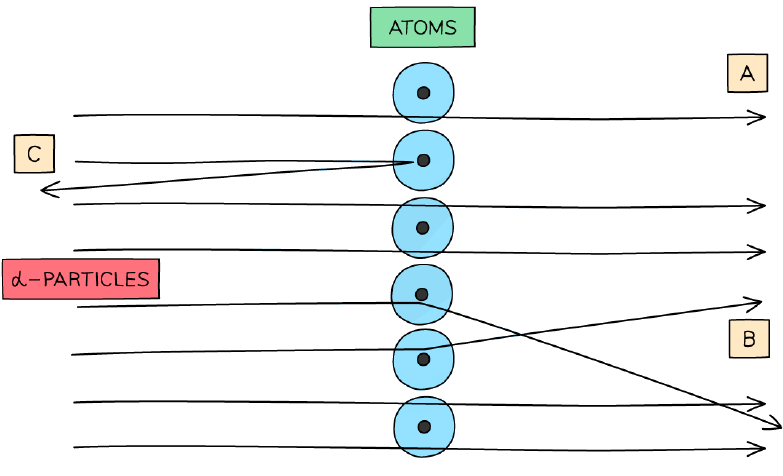
- α particles (helium nuclei) were fired at a thin gold foil in an evacuated chamber.
- The lead container produced a collimated beam of α particles because lead absorbs them.
- The gold foil was extremely thin (~10⁻⁶ m) so α particles could pass through; gold is malleable.
- The evacuated chamber prevented α particles from colliding with air molecules (they travel only ~5 cm in air).
- Observations: most α particles passed straight through; some deflected by small angles (<10°); a few deflected back by angles >90°.
- These results led to the nuclear model: a small, dense, positively charged nucleus surrounded by electrons, with the atom mostly empty space.
Rutherford's Alpha Scattering Experiment
Nuclear Notation
- Atoms consist of protons, neutrons (in the nucleus), and electrons (orbiting the nucleus).
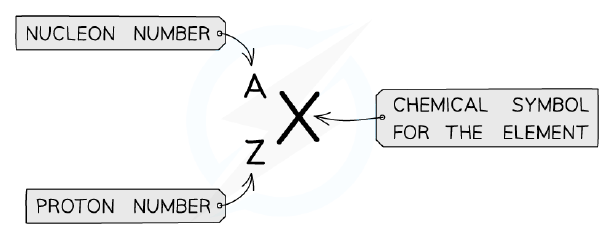
- Proton number (Z) = number of protons; nucleon number (A) = total number of protons and neutrons.
- A nucleus is represented as AZX , where X is the chemical symbol.
- Protons have charge +1e and mass ~1 u; neutrons have charge 0 and mass ~1 u; electrons have charge –1e and mass ~1/2000 u.
- Isotopes are nuclei with the same number of protons but different numbers of neutrons.
- Ionisation is the removal of an electron from an atom; excitation is an electron moving to a higher energy level without leaving the atom.
Nuclide notation
Emission Spectra
- Produced by heating a low-pressure gas, which excites electrons to higher energy levels.
- When electrons de-excite, they emit photons of specific energies.
- Each transition corresponds to a specific wavelength, producing a discrete line on a black background.
- The emission spectrum provides evidence that electrons occupy discrete energy levels.
Absorption Spectra
- Produced by passing white light through a cool, low-pressure gas.
- Photons with energy exactly equal to an energy level difference are absorbed.
- This results in dark lines on a continuous coloured background.
- The dark lines occur at the same wavelengths as the bright lines in the emission spectrum of the same element.
Spectra and Chemical Composition
- Each element produces a unique set of spectral lines, like a fingerprint.
- Therefore, elements can be identified by their emission or absorption spectra.
- Examples: hydrogen has a strong red line at 656 nm; sodium has a yellow line at 589 nm; mercury has lines below 450 nm (blue).
- Street lights and neon signs use electrical discharge to excite atoms, which then emit characteristic colours.
Photon Energy
- A photon is a massless 'packet' or 'quantum' of electromagnetic energy.
- Photon energy is given by E = hf or E = rac{hc}{\lambda} .
- h is Planck's constant (J s), c is the speed of light (m s⁻¹), λ is wavelength (m).
- Energy is directly proportional to frequency and inversely proportional to wavelength.
- The energy difference between two levels is \Delta E = hf = E2 - E1 .
- The larger the energy difference, the shorter the wavelength of the emitted or absorbed photon.
Atomic Energy Levels and Transitions
- Electrons occupy discrete energy levels; the lowest is the ground state.
- Excitation: electron absorbs a photon and moves to a higher level.
- De-excitation: electron emits a photon and moves to a lower level.
- Ionisation: electron is removed completely; ionisation energy is the minimum energy to remove an electron from the ground state.
- Energy level diagrams show horizontal lines: ground state at bottom (most negative energy), excited states above, ionisation at 0 eV (or ∞).
- The number of possible transitions from n=4 to n=1 is 6, producing 6 different wavelengths.
Calculating Photon Energy and Wavelength
- Use E = hf = rac{hc}{\lambda} to find photon energy or wavelength.
- For a transition, \Delta E = E2 - E1 = rac{hc}{\lambda} .
- To convert eV to J, multiply by 1.6 imes 10-19 .
- Example: a transition with \Delta E = 2.86 eV gives \lambda = 435 nm.
- The number of photons per second is rac{ ext{power}}{ ext{energy of one photon}} .
Slides
Sign up free to view the lesson slides
Step through every slide for this topic — plus flashcards and revision notes — with a free account.
Questões de prática
Prévia grátis — 8 de 64 perguntas. Cadastre-se para ver todas.
1.Which of the following best defines a photon?
Easy- AA massless packet or quantum of electromagnetic energy
- BA negatively charged particle orbiting the nucleus
- CA positively charged particle found in the nucleus
- DA continuous wave of electromagnetic energy
2.Excitation is
Easy- Awhen an electron is removed from or added to an atom.
- Bwhen an electron moves down an energy level emitting a photon.
- Cwhen an electron is given enough energy to move up an energy level, but not enough to leave the atom.
- Dwhen an electron is given enough energy to move up an energy level, and sometimes leave the atom.
3.Which of the following is not a feature of an emission spectrum?
Easy- AWhen an electron transitions from a higher energy level to a lower energy level, this results in the emission of a photon
- BAn emission spectrum contains a set of discrete wavelengths, represented by coloured lines on a black background
- CAn emission spectrum is evidence to show that electrons in atoms can only transition between discrete energy levels
- DAn emission spectrum consists of a continuous spectrum containing all the colours with dark lines at certain wavelengths
4.Which of the following was not an observation made in Rutherford's scattering experiment?
Easy- AMost of the α-particles went straight through the foil
- BSome α-particles deflected through small angles of less than 10°
- COnly a small number of α-particles deflected straight back at angles greater than 90°
- DThe gold foil emits α particles
5.In the Geiger-Marsden-Rutherford experiment, α particles are fired at a thin gold foil. Two key observations are: I. most α particles pass through the foil undeflected; II. a few α particles are deflected by large angles. Which row correctly explains these observations?
Medium- AI: most α-particles miss the gold atoms; II: gold atoms are mostly empty space
- BI: the atom is mostly empty space so most α-particles do not interact with the nucleus; II: the nucleus is small, dense and positively charged
- CI: the charge on the nucleus is insufficient to cause deflection; II: gold nuclei are small compared to the atom
- DI: most α-particles have enough energy to pass through the atom without interacting with it; II: the charge on the nucleus is insufficient to cause large angle deflection
6.Which of the following statements about emission and absorption spectra are correct? (select all that apply)
Medium- AAn emission spectrum is produced when electrons transition from higher to lower energy levels.
- BAn absorption spectrum consists of bright lines on a black background.
- CEach element produces a unique pattern of spectral lines.
- DAn absorption spectrum is produced by passing white light through a cool, low-pressure gas.
- EThe dark lines in an absorption spectrum occur at different wavelengths from the bright lines in the emission spectrum of the same element.
7.In an atom, protons and neutrons are found in the nucleus while electrons orbit the nucleus.
EasyTrue or false?
8.The ionisation energy of an atom is the minimum energy required to remove an electron from the ground state.
EasyTrue or false?
Unlock all 64 questions & more
Crie uma conta grátis para ver todas as perguntas, os slides, flashcards e resumos de revisão deste tópico.