Group Properties And Trends
Aprenda jogando
Responda a estas perguntas para ganhar energia, depois pesque e explore. Sem precisar de conta.
Notas de aula
Group I Properties
- Group I metals are called alkali metals because they form alkaline solutions with water.
- They have one electron in their outer shell.
- Physical properties: soft, shiny when cut, good conductors of heat/electricity, low melting points (decrease down group), low densities.
- Stored under oil to prevent reaction with oxygen and water vapour in air.
- React with water to form metal hydroxide and hydrogen gas: 2M + 2H₂O → 2MOH + H₂.
- Reactivity increases down the group: Li fizzes slowly, Na more vigorous, K burns with lilac flame.
- Melting point decreases down group; density generally increases (exception early group).
- Predict properties of unknown alkali metals using trends: e.g., Rb reacts very violently, Cs may explode.
Electron configuration of sodium (Group I) showing one outer electron.
Group VII Properties
- Group VII elements are halogens: non-metals, poisonous, diatomic (F₂, Cl₂, Br₂, I₂, At₂).
- They have seven electrons in outer shell and gain one electron to form halide ions.
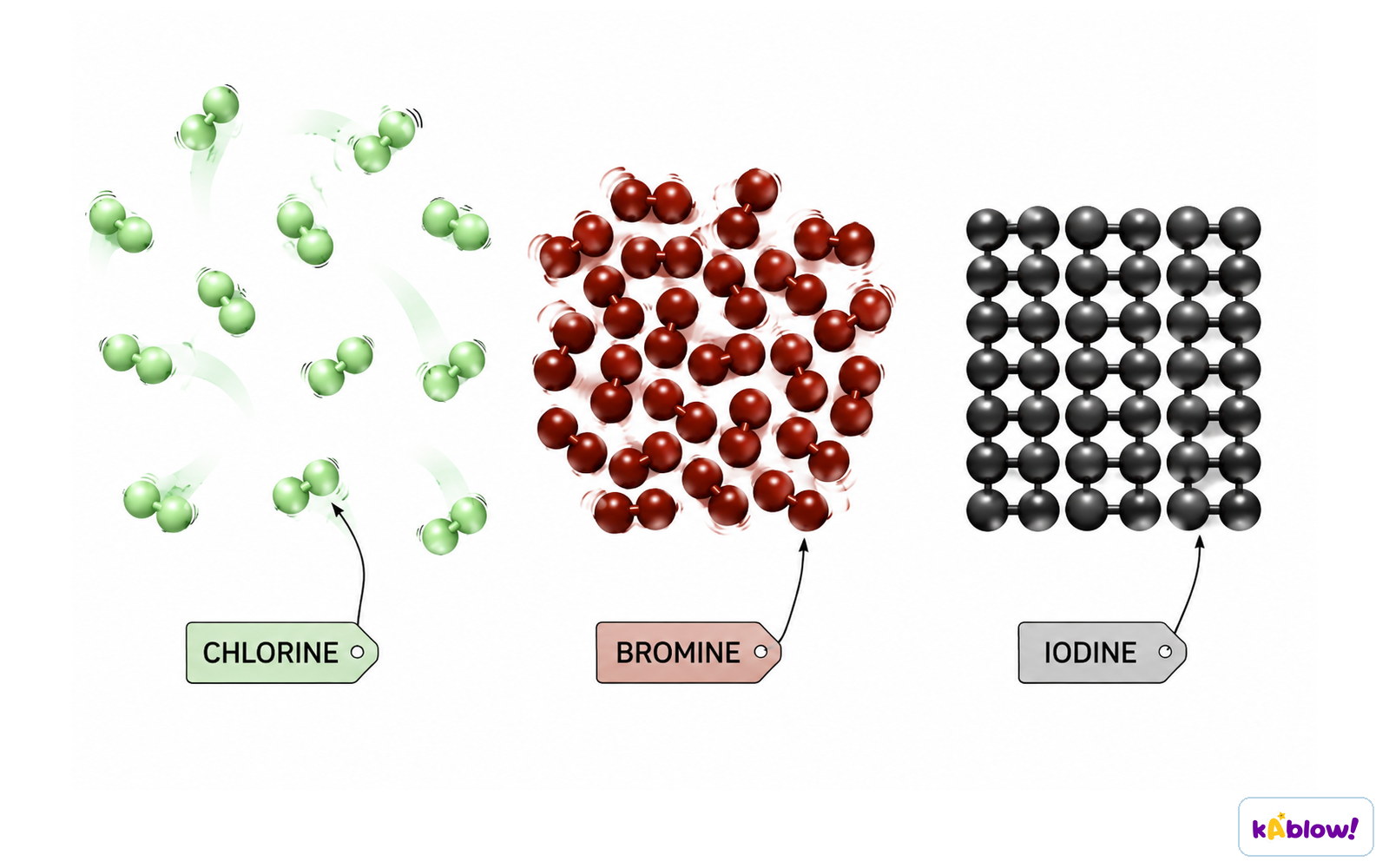
- Physical state changes down group: Cl₂ pale green gas, Br₂ red-brown liquid, I₂ grey-black solid.
- Density increases down group; melting/boiling points increase down group.
- Reactivity decreases down group (opposite to Group I).
- Reason: atomic radius increases and electron shielding increases, so attraction for an incoming electron weakens.
- Colour darkens down group: F₂ yellow, Cl₂ green, Br₂ red-brown, I₂ violet vapour, At₂ black.
Physical states of the halogens at room temperature
Group VII Displacement Reactions
- A more reactive halogen displaces a less reactive halogen from an aqueous halide solution.
- Reactivity order: Cl₂ > Br₂ > I₂.
- Chlorine displaces bromide: 2KBr + Cl₂ → 2KCl + Br₂ (solution turns orange/yellow).
- Chlorine displaces iodide: 2KI + Cl₂ → 2KCl + I₂ (solution turns brown).
- Bromine displaces iodide: MgI₂ + Br₂ → MgBr₂ + I₂ (solution turns brown).
- No reaction occurs if the halogen is less reactive than the halide (e.g., Br₂ with KCl).
- Aqueous colours: Cl₂ very pale green (dilute appears colourless), Br₂ orange, I₂ brown.
Summary table of displacement reactions
Transition Elements
- Transition elements are metals found in the centre of the Periodic Table between Group 2 and 3.
- Typical metallic properties: lustrous, hard, strong, good conductors, high melting points (except Hg).
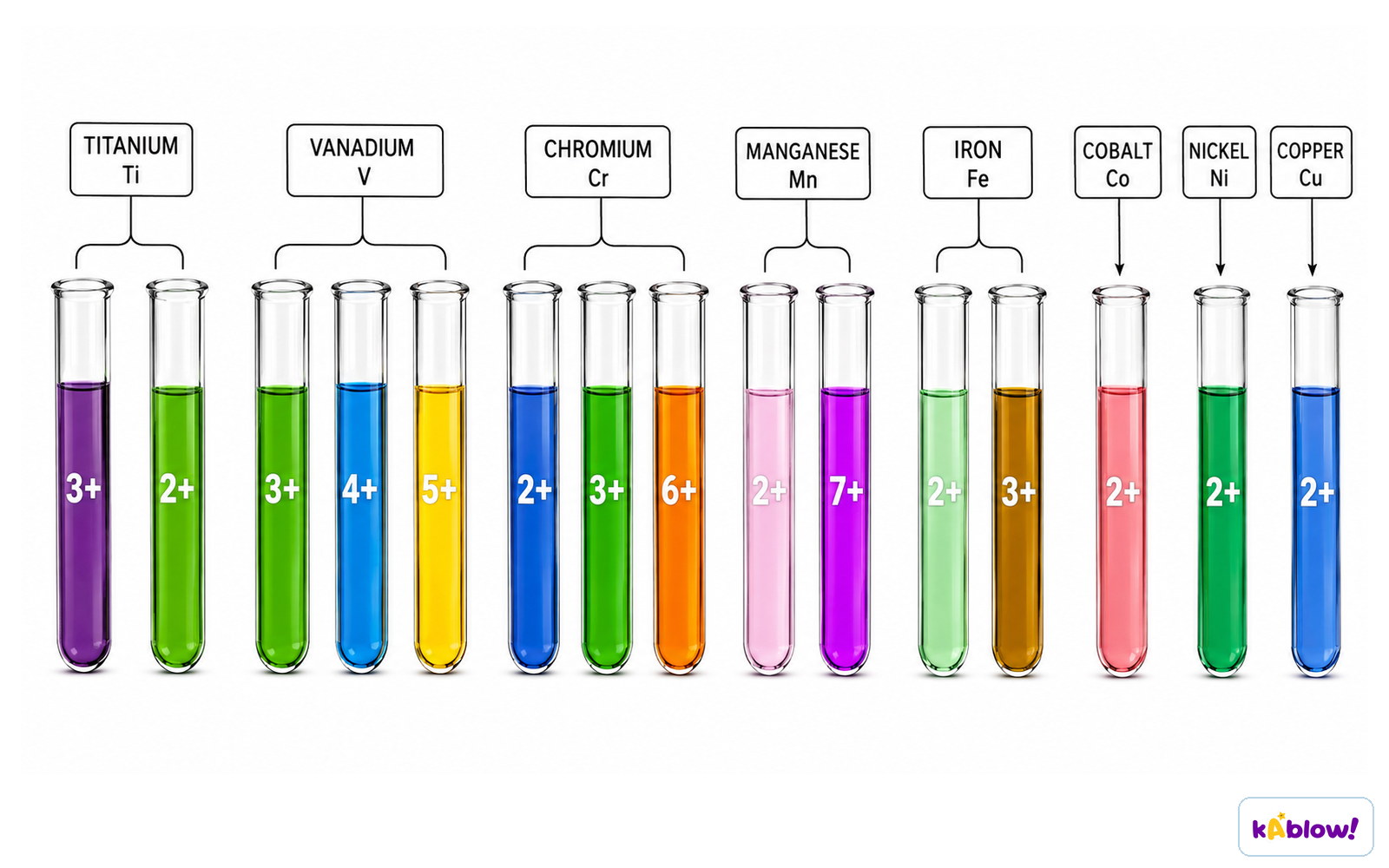
- Unique properties: form ions with different charges (e.g., Fe²⁺ and Fe³⁺).
- They are useful as catalysts (e.g., iron in Haber process).
- They form coloured compounds (e.g., copper sulfate blue, copper oxide black, copper carbonate green).
- Scandium and zinc are not considered transition elements because they do not form coloured compounds and have only one oxidation state.
Coloured compounds formed by transition metal ions
Noble Gases
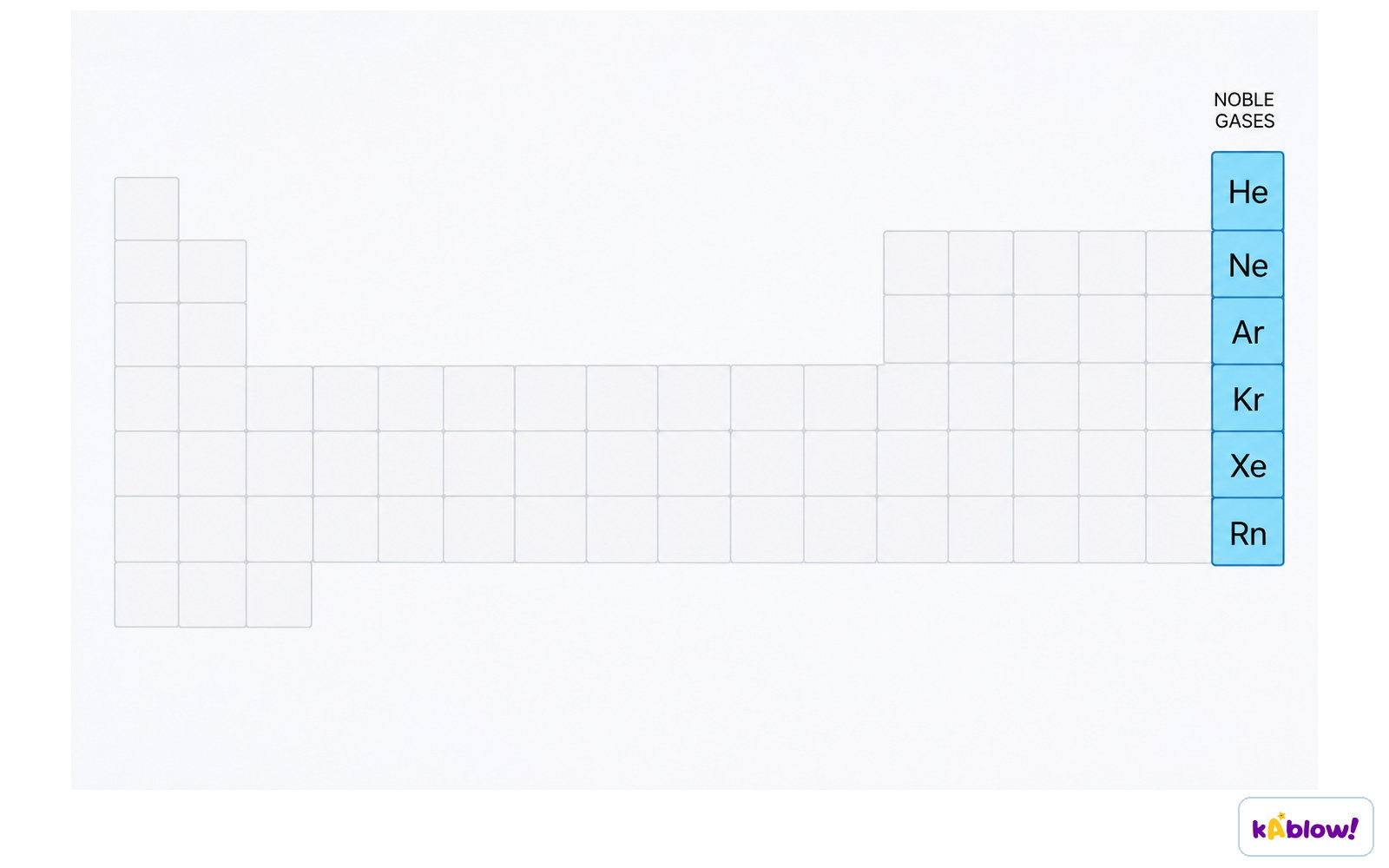
- Noble gases are in Group VIII (Group 18): non-metals, monatomic, colourless, gaseous.
- They have full outer electron shells (e.g., He: 2, Ne: 2,8, Ar: 2,8,8).
- Full outer shells make them unreactive (inert) – they do not easily form bonds.
- They have very low melting and boiling points.
The noble gases are located at the right of the Periodic Table
Slides
Sign up free to view the lesson slides
Step through every slide for this topic — plus flashcards and revision notes — with a free account.
Questões de prática
Prévia grátis — 8 de 53 perguntas. Cadastre-se para ver todas.
1.Complete the sentence.
EasyGroup I metals are called the ____ metals because they form alkaline solutions when they react with water.
2.Which of the following is a physical property of Group I metals?
Easy- AThey are hard and brittle
- BThey have high melting points compared to other metals
- CThey are soft and can be cut easily
- DThey are gases at room temperature
3.The reactivity of Group I metals decreases as you move down the group.
EasyTrue or false?
4.State the colour of iodine in aqueous solution.
Easy5.Which halogen is a red-brown liquid at room temperature?
Easy- AChlorine
- BBromine
- CIodine
- DAstatine
6.How many electrons are in the outer shell of a halogen atom?
Easy- A7
- B6
- C9
- D8
7.Arrange the following halogens in order of increasing reactivity (least reactive first).
Medium- Iodine
- Bromine
- Chlorine
8.Predict the colour of astatine based on the trend in Group VII.
Medium
Unlock all 53 questions, flashcards & more
Crie uma conta grátis para ver todas as perguntas, os slides, flashcards e resumos de revisão deste tópico.