General Properties Of Waves
Aprenda jogando
Responda a estas perguntas para ganhar energia, depois pesque e explore. Sem precisar de conta.
Notas de aula
Wave Motion & Energy Transfer
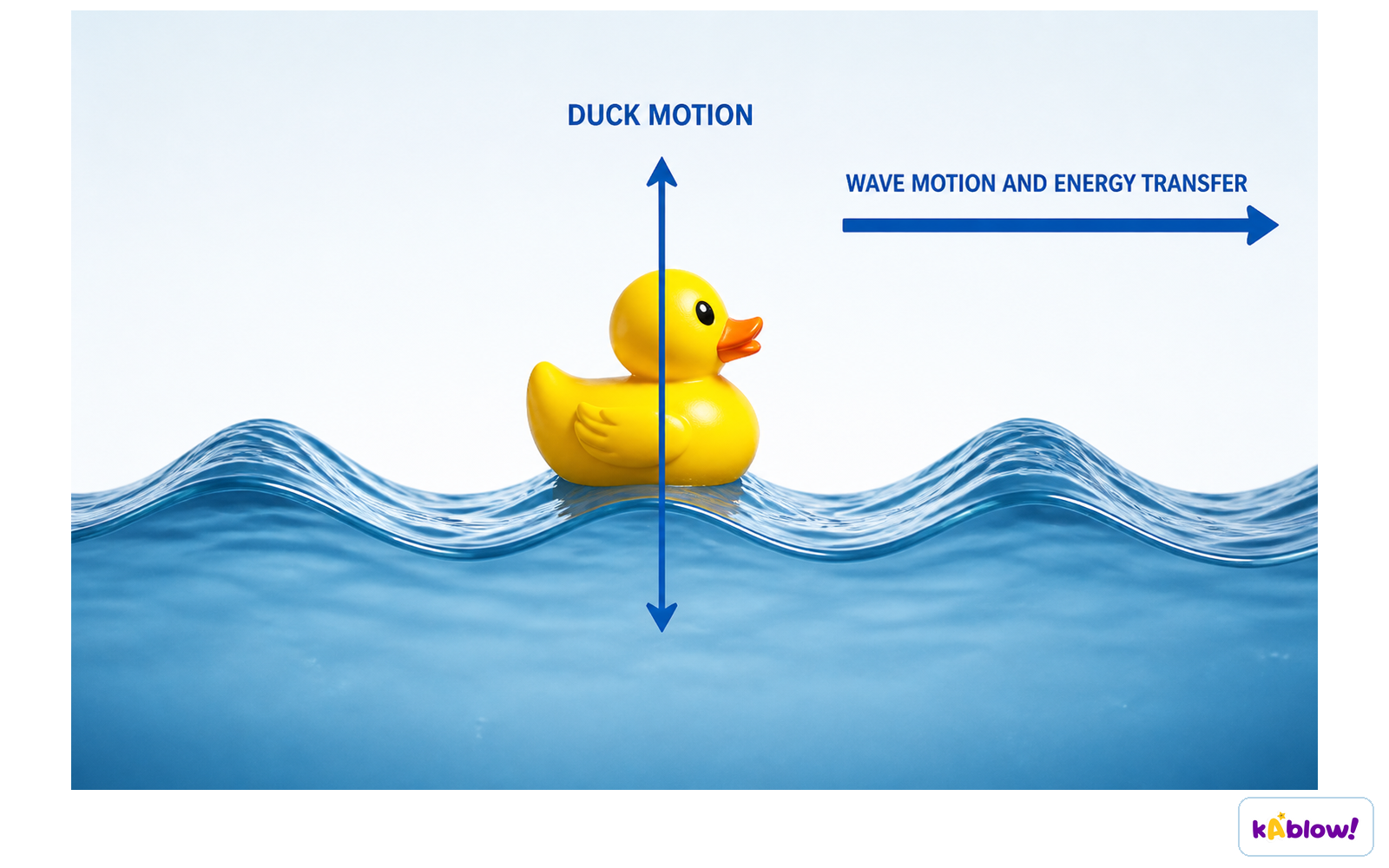
- Waves transfer energy without transferring matter.
- Objects floating on water bob up and down but do not travel with the wave, showing no net movement of matter.
- Waves are described as oscillations or vibrations about a fixed point.
- Wave motion can be demonstrated using vibrations in ropes, springs, or water waves in a ripple tank.
A toy duck bobbing up and down on water waves, illustrating that waves transfer energy but not matter.
Features of Waves
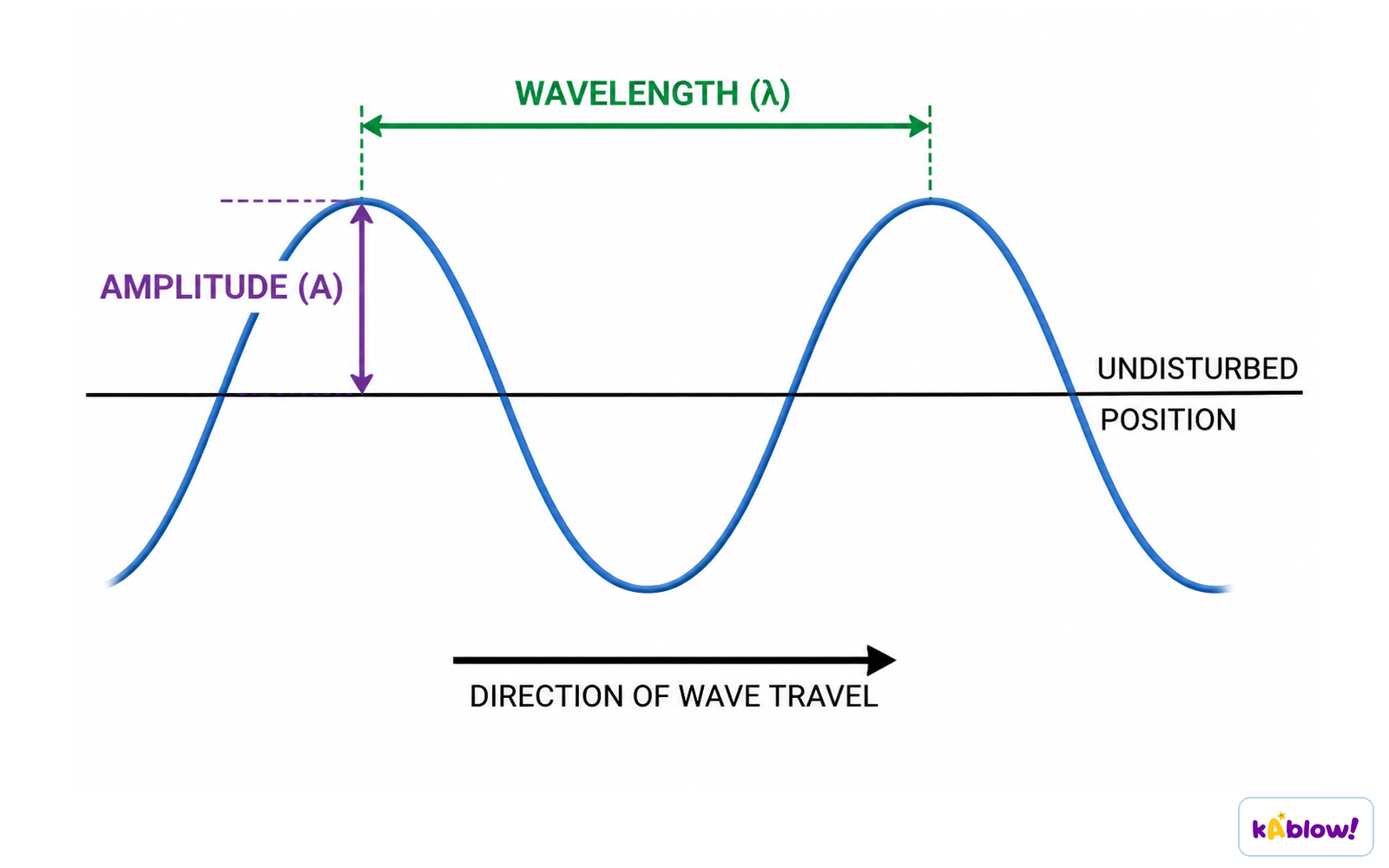
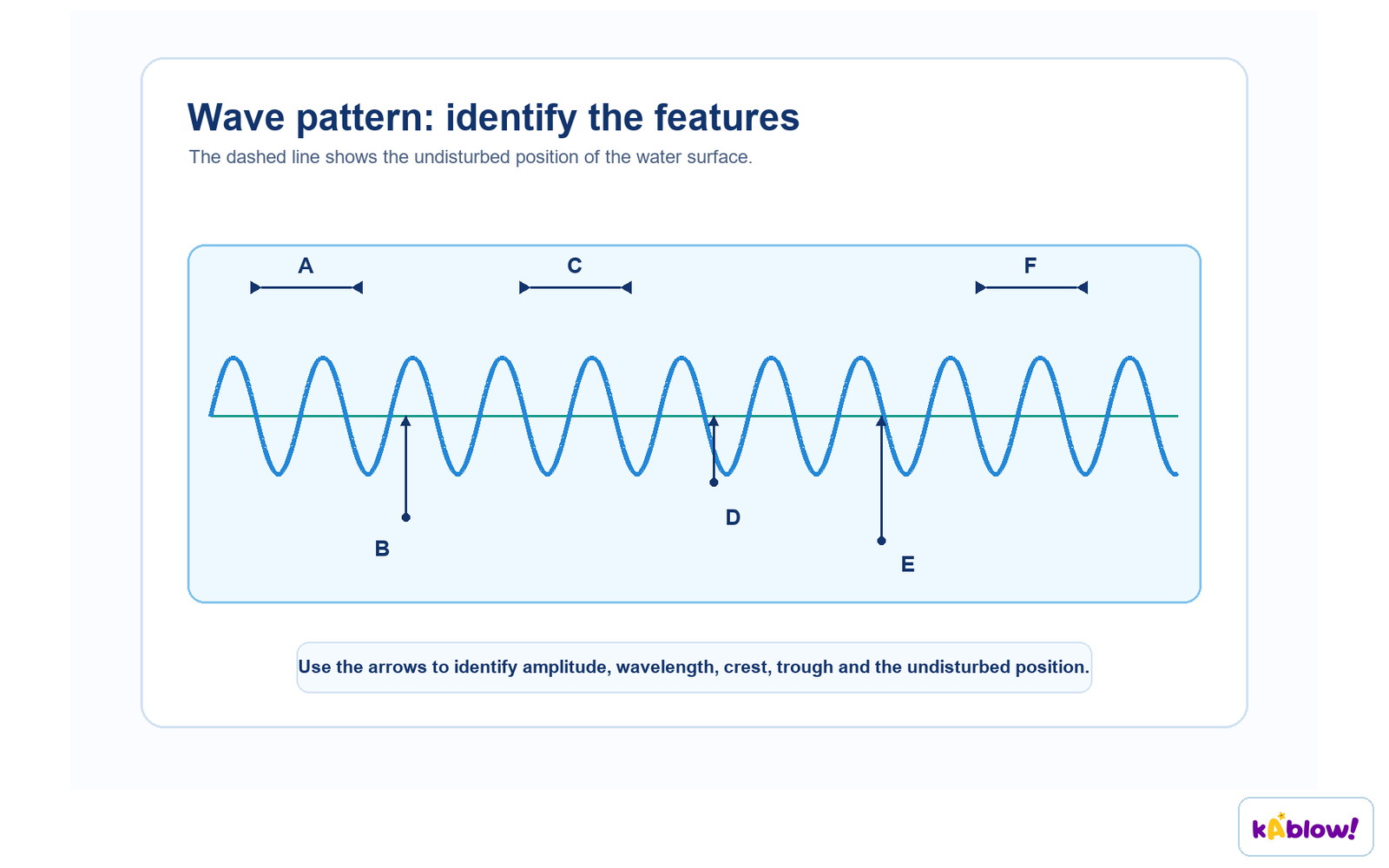
- Wavelength (λ): distance from one point on a wave to the same point on the next wave (e.g., crest to crest). Measured in metres (m).
- Frequency (f): number of waves passing a point per second. Measured in hertz (Hz).
- Amplitude (A): maximum displacement from the undisturbed position to a peak or trough. Measured in metres (m).
- Crest (peak): highest point above the equilibrium; trough: lowest point below equilibrium.
- Wave speed (v): distance travelled by a wave each second. Measured in m/s.
- Wavefronts represent waves from above; spacing between wavefronts indicates wavelength.
Diagram showing the amplitude and wavelength of a transverse wave, measured from the undisturbed position.
The Wave Equation
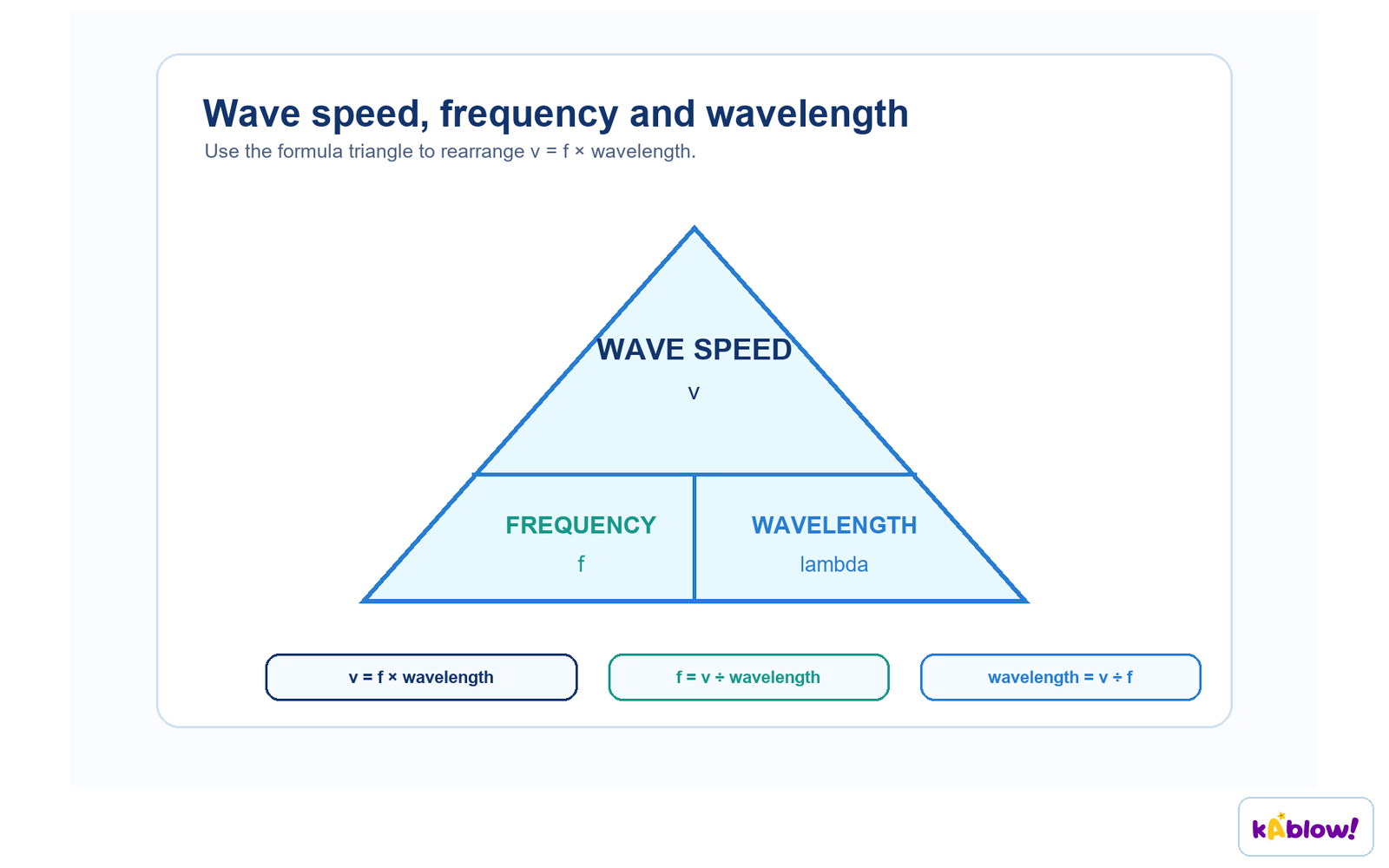
- Wave speed equation: v = f × λ (v = wave speed in m/s, f = frequency in Hz, λ = wavelength in m).
- Both transverse and longitudinal waves obey the wave equation.
- Frequency and time period (T) are related: f = 1/T.
- Example: A wave with speed 0.15 m/s and period 2 s has frequency 0.5 Hz and wavelength 0.30 m.
The wave speed formula triangle: v = f x wavelength.
Transverse Waves
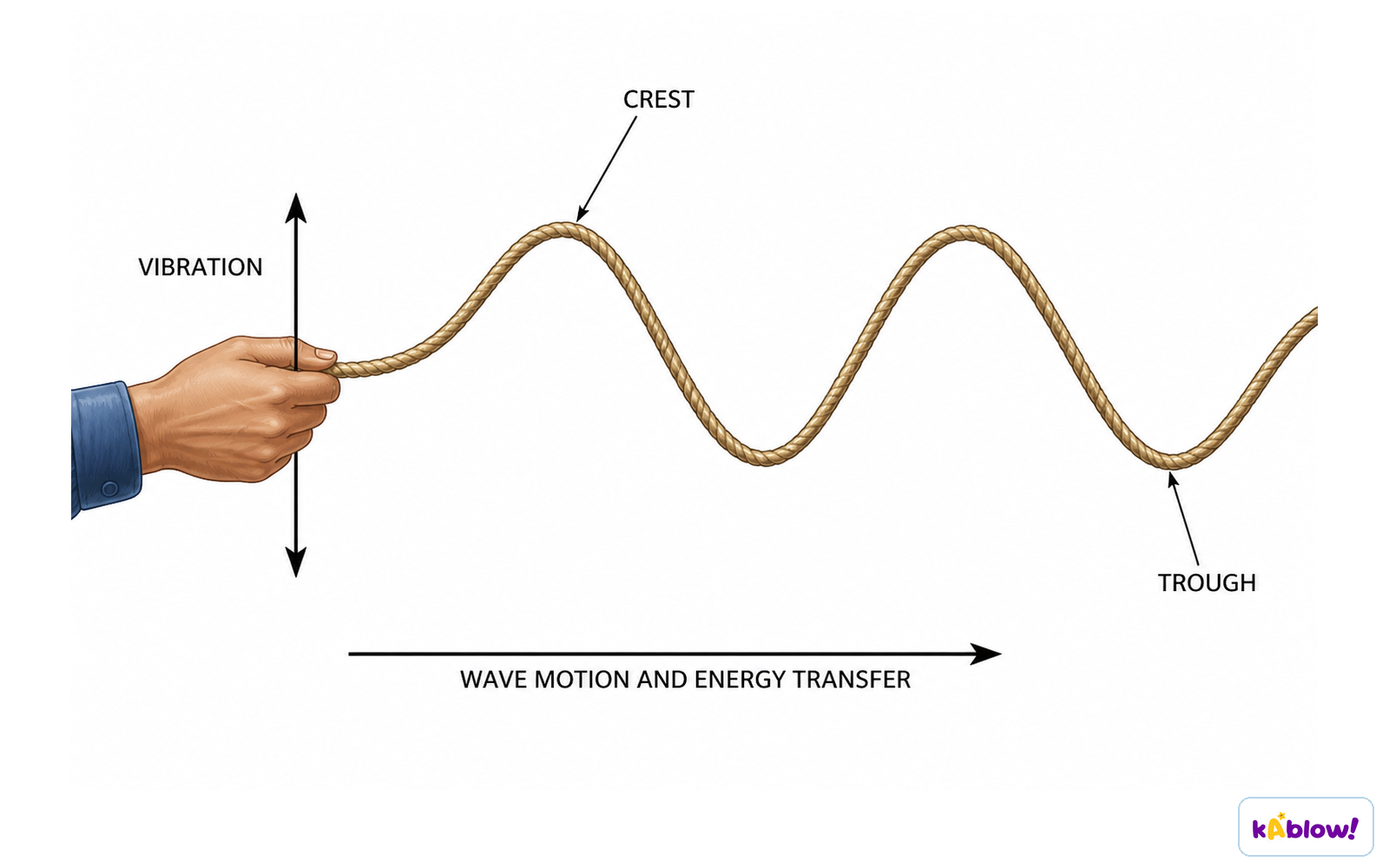
- Transverse waves: vibrations are perpendicular to the direction of energy transfer.
- They have peaks and troughs.
- Can travel through solids and on liquid surfaces, but not through liquids or gases (except electromagnetic waves in vacuum).
- Examples: electromagnetic waves (light, radio), water ripples, seismic S-waves.
Transverse wave motion in a rope: vibration at 90 degrees to the direction of wave motion and energy transfer, with wave peak and wave trough labelled.
Longitudinal Waves
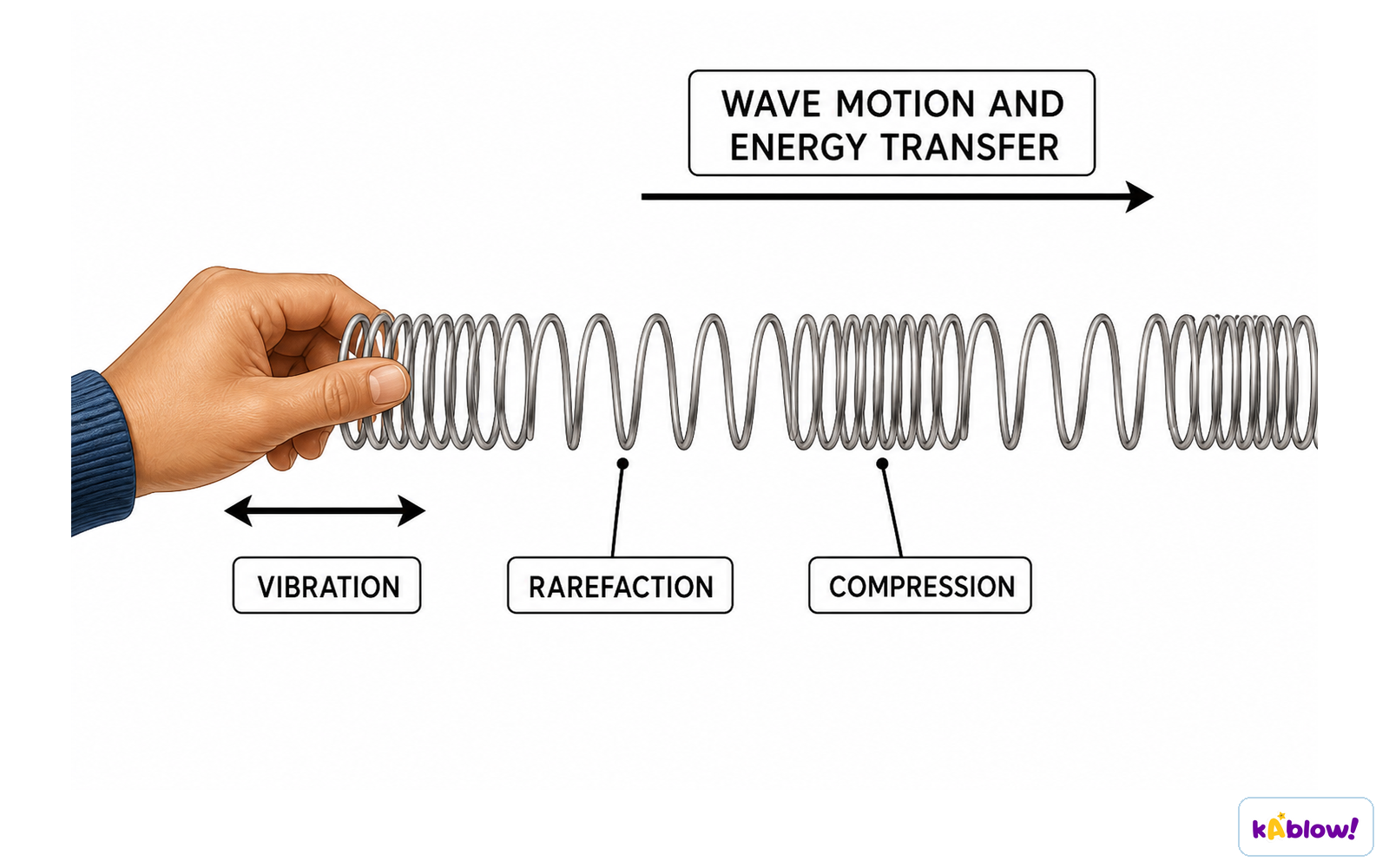
- Longitudinal waves: vibrations are parallel to the direction of energy transfer.
- They consist of compressions (particles close together) and rarefactions (particles spread apart).
- Can travel through solids, liquids, and gases, but not through a vacuum.
- Examples: sound waves, seismic P-waves.
Longitudinal wave motion in a spring, showing compression and rarefaction relative to the direction of wave motion and energy transfer.
Reflection & Refraction
- Reflection: a wave hits a boundary and stays in the original medium; angle of incidence equals angle of reflection.
- Refraction: a wave passes into a different medium, changing speed, wavelength, and direction (frequency remains constant).
- Angles are measured from the normal (line perpendicular to the boundary).
- When waves slow down (enter denser medium), they bend towards the normal; when they speed up, they bend away from the normal.
An identical image of a tree is seen in the water due to reflection.

Diffraction
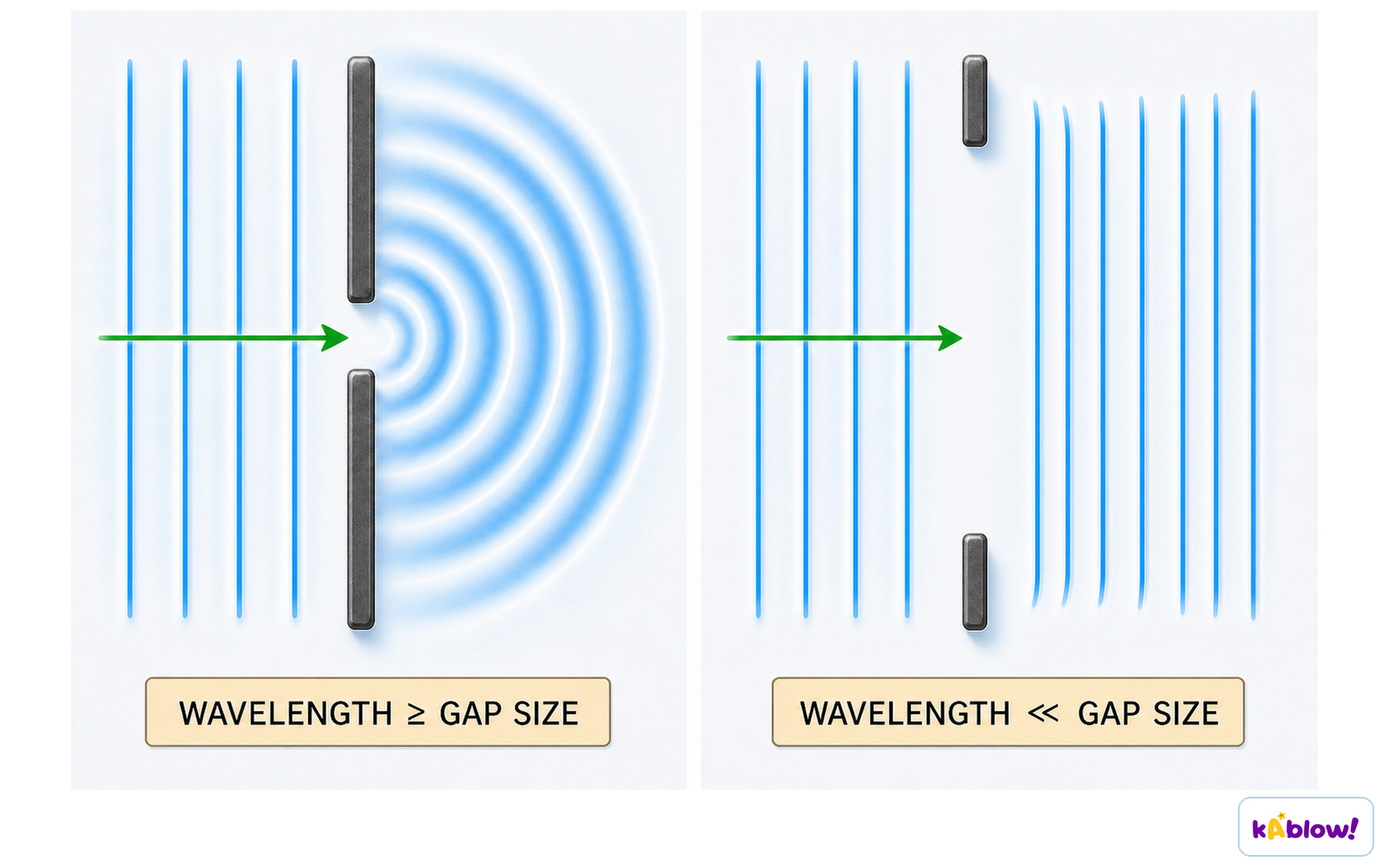
- Diffraction: waves spread out when passing through a narrow gap or around an obstacle.
- The effect is most pronounced when the gap width is approximately equal to the wavelength.
- As gap size increases relative to wavelength, diffraction becomes less noticeable.
- Diffraction does not change the wavelength of the wave.
Diffraction through a gap: when the wavelength is greater than the gap size the waves spread out a lot; when the wavelength is much less than the gap size they spread out very little.
Slides
Sign up free to view the lesson slides
Step through every slide for this topic — plus flashcards and revision notes — with a free account.
Questões de prática
Prévia grátis — 8 de 56 perguntas. Cadastre-se para ver todas.
1.Which of the following correctly describes what waves transfer?
Easy- AMatter
- BEnergy
- CBoth matter and energy
- DNeither matter nor energy
2.State the term used to describe the distance from one point on a wave to the same point on the next wave.
Easy3.A wave has a frequency of 5 Hz and a wavelength of 2 m. Calculate the wave speed in m/s.
Easy- A12
- B9
- C11
- D10
4.In a transverse wave, the direction of vibration is parallel to the direction of energy transfer.
EasyTrue or false?
5.Complete the sentence about longitudinal waves.
EasyIn a longitudinal wave, the regions where particles are close together are called ____ and the regions where particles are spread apart are called ____.
6.A wave travels from air into glass. Which of the following changes occurs?
Medium- AIts frequency increases
- BIts wavelength decreases
- CIts speed increases
- DIts direction remains unchanged
7.The time period of a wave is 0.02 s. Calculate its frequency in Hz.
Easy- A50
- B55
- C45
- D60
8.Name the wave effect that occurs when a wave passes through a narrow gap and spreads out.
Easy
Unlock all 56 questions & more
Crie uma conta grátis para ver todas as perguntas, os slides, flashcards e resumos de revisão deste tópico.