Computational thinking and abstraction
Aprenda jogando
Responda a estas perguntas para ganhar energia, depois pesque e explore. Sem precisar de conta.
Notas de aula
What is Computational Thinking?
- Computational thinking (CT) is a way of solving problems by formulating them so that a computer could carry out the solution.
- It involves expressing problems and solutions as computational steps and algorithms.
- CT is a fundamental skill for everyone, not just computer scientists (Jeannette Wing, 2006).
- It helps with everyday tasks like packing a backpack or deciding when to rent vs. buy.
- CT includes logic, assessment, patterns, automation, and generalization.
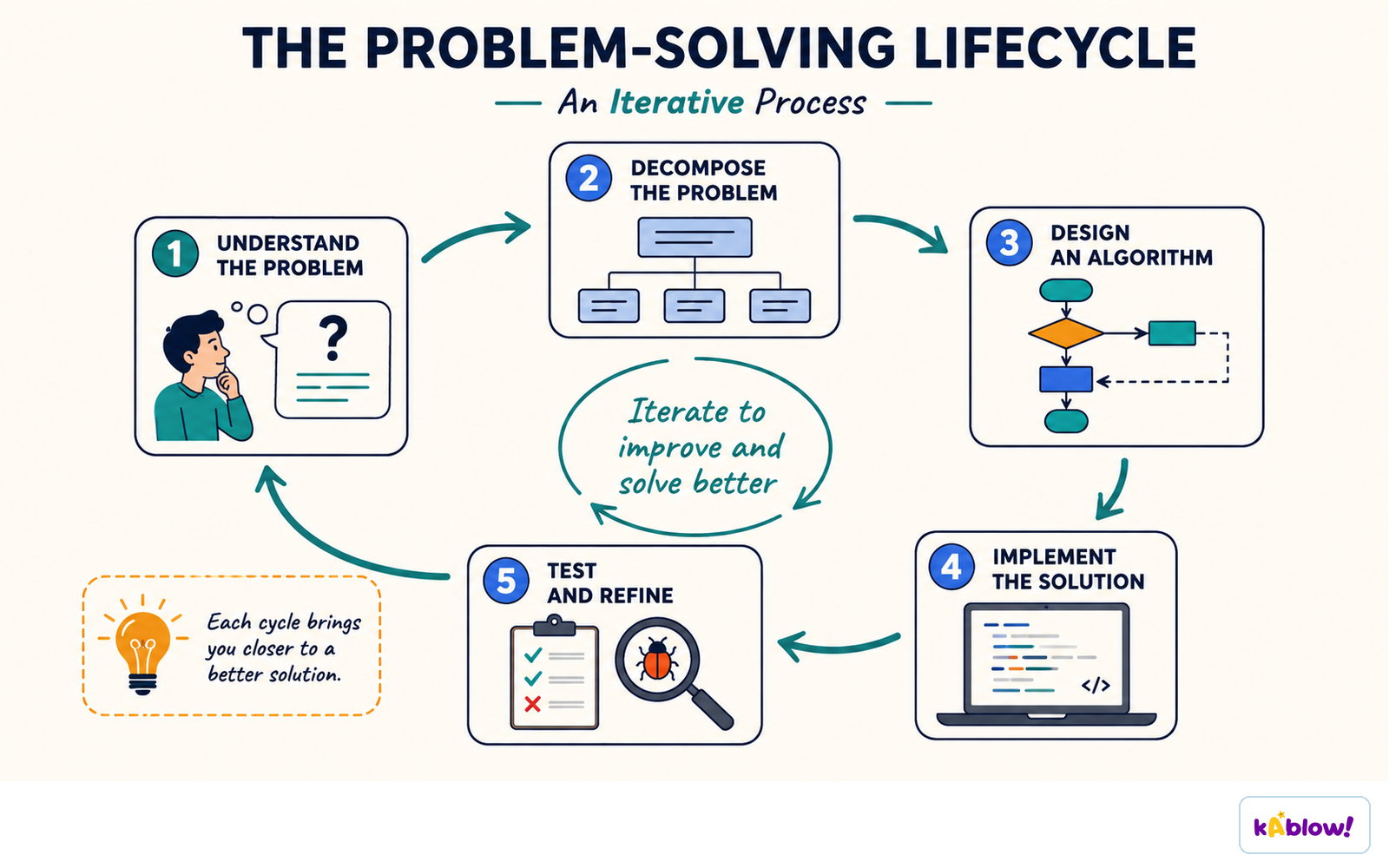
Problem solving is a cycle: understand, decompose, design, implement, test, refine.
The Four Pillars of Computational Thinking
- Decomposition – breaking a complex problem into smaller, more manageable parts.
- Pattern recognition – spotting similarities and trends in data or problems.
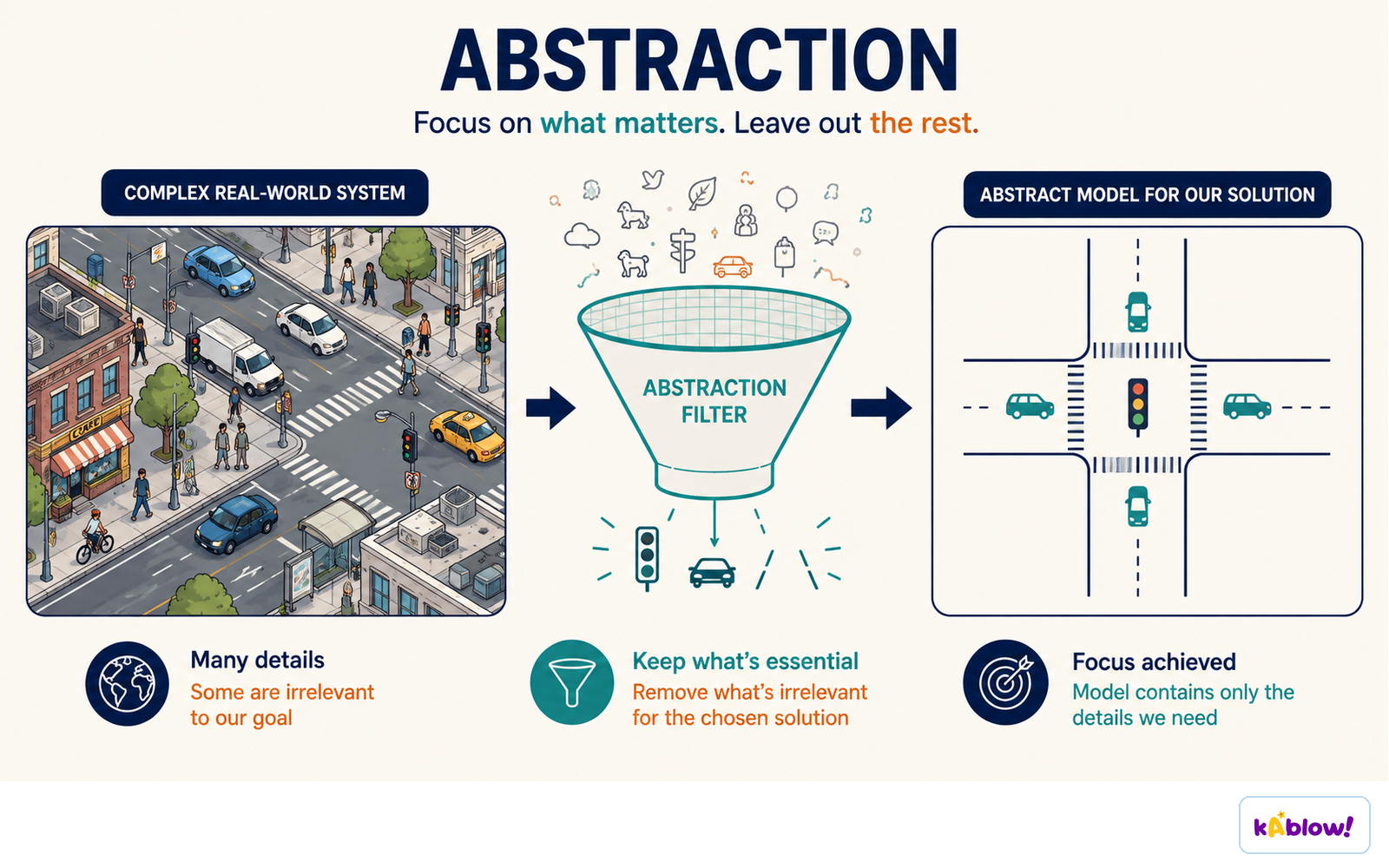
- Abstraction – focusing on important details and ignoring irrelevant ones.
- Algorithm design – creating step-by-step instructions to solve a problem.
- These four work together: decompose → find patterns → abstract → build an algorithm.
Abstraction in Detail
- Abstraction is the process of hiding unnecessary detail and keeping only what is essential.
- It allows us to create models of real-world systems, like maps or game worlds.
- A good abstraction captures the state (data) and behaviour (rules) of a system.
- Example: a tube map shows stations and lines but hides road details and distances.
- Abstraction is used in simulations to model physical systems (e.g., weather, traffic).
- It helps manage complexity by reducing a problem to its core features.
Abstraction keeps the details that matter for the problem and leaves the rest out.
The Three A's of Computational Thinking
- Abstraction – formulating the problem by deciding what to include and what to ignore.
- Automation – expressing the solution as a set of steps (an algorithm) that can be executed.
- Analysis – executing and evaluating the solution to check it works correctly.
- This is an iterative process – you may go back and refine the abstraction or algorithm.
Computational Thinking in the Curriculum
- The UK has included computational thinking in its national curriculum since 2012.
- Other countries like Singapore, Australia, China, Korea, and New Zealand have also adopted it.
- In the US, the 'Computer Science for All' initiative aims to teach CS skills to all students.
- CT is sometimes called the 'fifth C' alongside communication, critical thinking, collaboration, and creativity.
- It applies beyond STEM – to social sciences and language arts.
Examples of Abstraction in Everyday Life
- Maps – show roads and landmarks but omit building interiors and traffic lights.
- Game worlds – model physics and characters but simplify real-world complexity.
- Weather simulations – use data like temperature and pressure, ignoring minor details.
- Backpack packing – you abstract the items by size and weight, not colour or brand.
- Finding lost mittens – you search likely places, ignoring irrelevant rooms.
Why Abstraction Matters
- It lets us solve complex problems by focusing on what's important.
- It enables reuse – a good abstraction can be applied to many similar problems.
- It makes solutions easier to understand and communicate.
- It is essential for programming – you abstract data and processes into code.
- It helps in evaluation – you can test a model against reality.
Slides
Sign up free to view the lesson slides
Step through every slide for this topic — plus flashcards and revision notes — with a free account.
Questões de prática
Prévia grátis — 8 de 61 perguntas. Cadastre-se para ver todas.
1.What is computational thinking?
Easy- AThe thought processes involved in formulating problems so their solutions can be represented as computational steps and algorithms
- BThe process of writing computer programs in a specific programming language
- CThe use of computers to solve mathematical problems only
- DThe study of computer hardware and software
2.Computational thinking is only useful for computer scientists.
EasyTrue or false?
3.Which of the following is NOT one of the four characteristics that define computational thinking?
Medium- ADecomposition
- BPattern recognition
- CGeneralization/abstraction
- DAutomation
4.Which of the following are examples of computational thinking concepts? (select all that apply)
Medium- ADecomposition
- BPattern recognition
- CAbstraction
- DAutomation
- ECollaboration
5.Abstraction in computational thinking involves hiding unnecessary details to focus on the important aspects of a problem.
EasyTrue or false?
6.Which of the following is an example of abstraction in everyday life?
Easy- AUsing a map to navigate a city
- BMemorizing every street name in a city
- CWriting a list of all the steps to bake a cake
- DCounting the number of cars in a parking lot
7.Match each computational thinking concept with its description.
Medium- Decomposition
- Pattern recognition
- Abstraction
- Breaking a problem into smaller parts
- Identifying similarities in data
- Hiding unnecessary details
8.Put the steps of the 'three As' iterative process in the correct order.
Medium- Analysis
- Abstraction
- Automation
Unlock all 61 questions, flashcards & more
Crie uma conta grátis para ver todas as perguntas, os slides, flashcards e resumos de revisão deste tópico.