The muscular system
Aprenda jogando
Responda a estas perguntas para ganhar energia, depois pesque e explore. Sem precisar de conta.
Notas de aula
Overview of the Muscular System
- The muscular system consists of over 600 muscles that work together to enable movement, maintain posture, and perform vital functions like breathing and digestion.
- Muscles are attached to bones by tough, fibrous tissues called tendons.
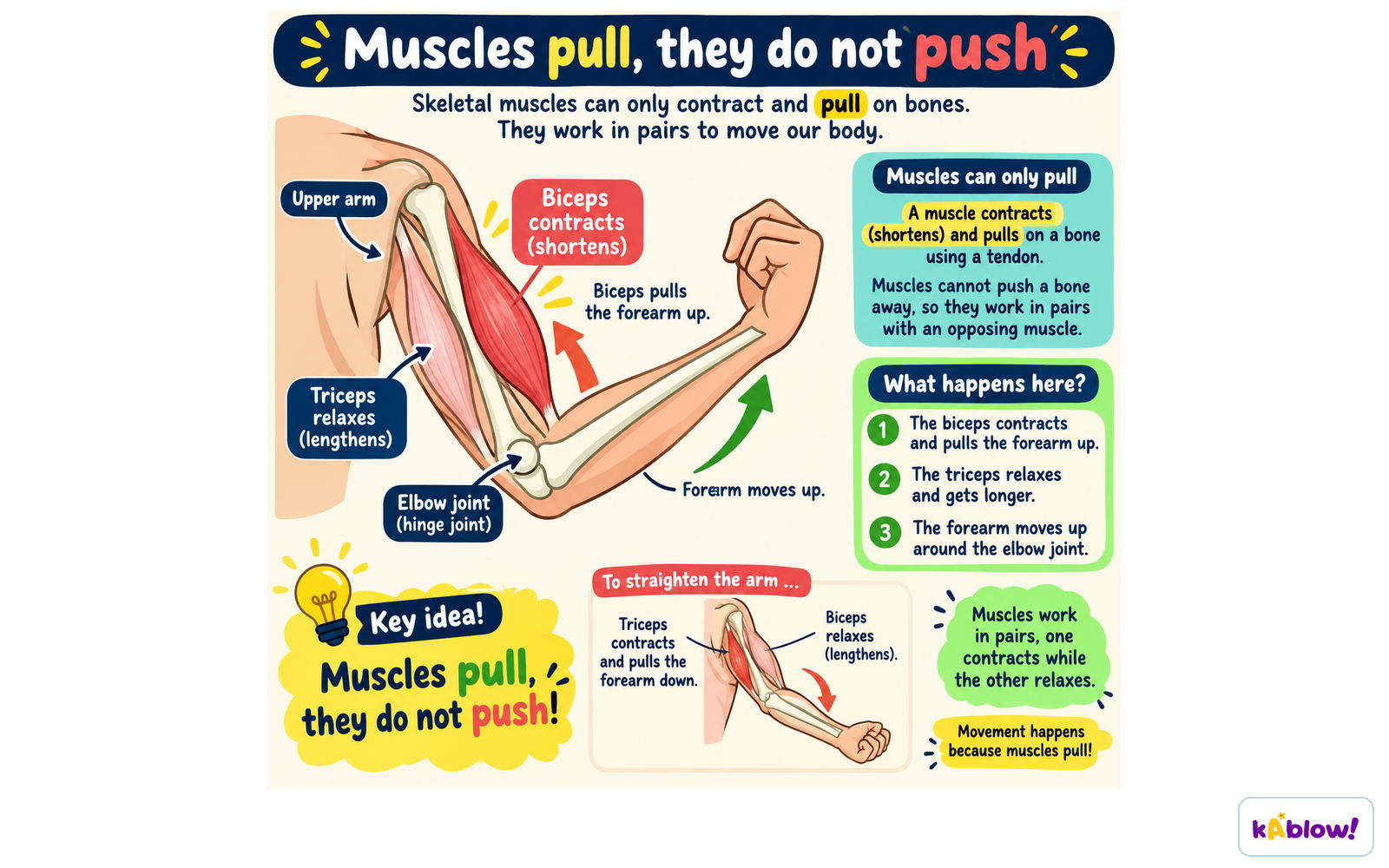
- When muscles contract, they pull on bones, creating movement at joints (where two or more bones meet).
- Muscles can only pull; they cannot push.
Muscles create movement by contracting and pulling on bones. Opposing muscles work together because muscles cannot push.
Antagonistic Muscle Pairs
- Muscles work in antagonistic pairs: one muscle contracts (shortens) while the other relaxes (lengthens).
- This coordinated action allows for smooth, controlled movement.
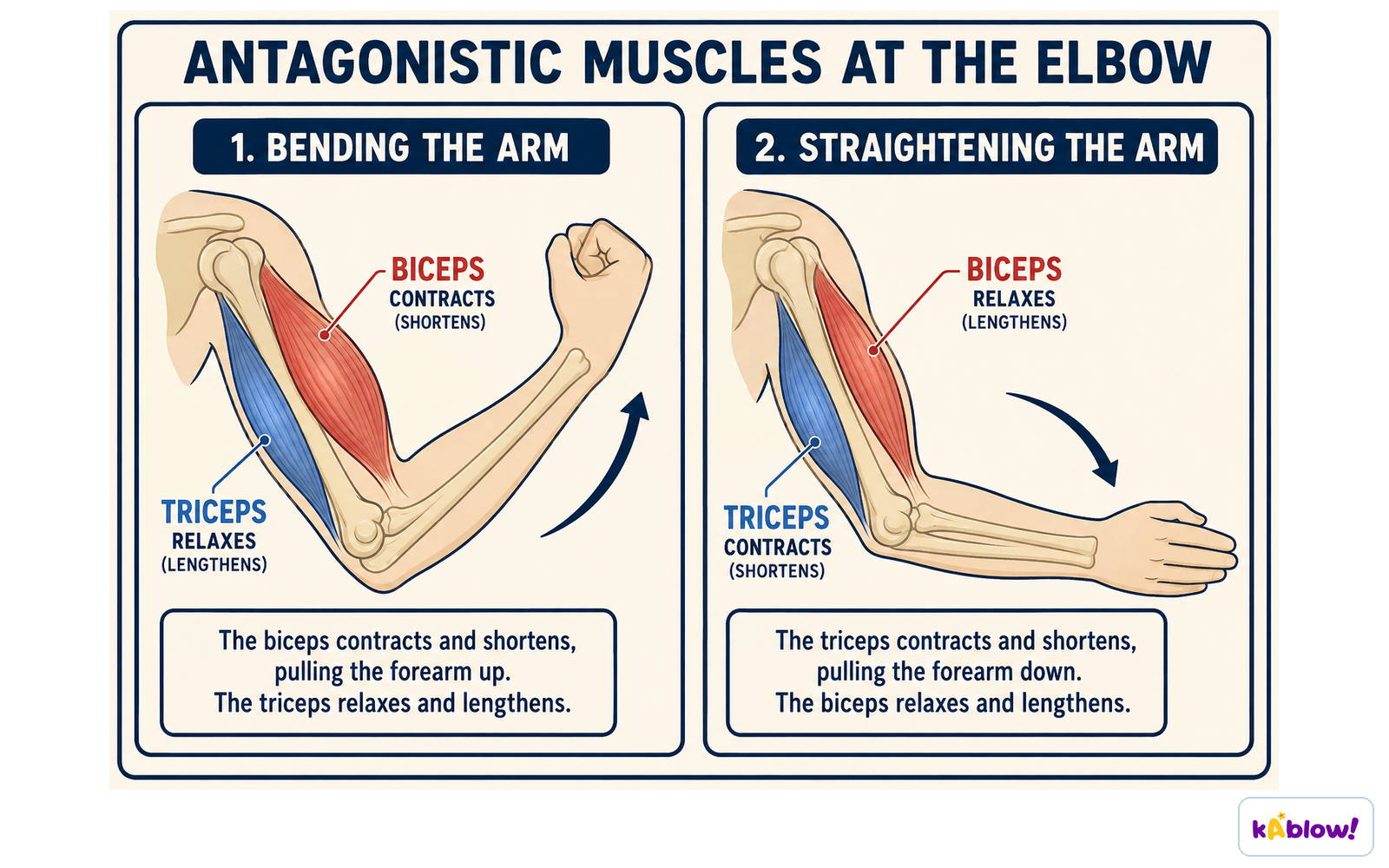
Arm Movement: Biceps and Triceps
- To straighten the arm, the triceps contract and the biceps relax.
- To bend the arm, the biceps contract and the triceps relax.
Bending the elbow contracts the biceps and relaxes the triceps. Straightening reverses the action.
Leg Movement: Hamstring and Quadriceps
- To bend the leg, the hamstring contracts and the quadriceps relax.
- To straighten the leg, the quadriceps contract and the hamstring relax.
Cardiac Muscle
- The heart is made of cardiac muscle, a special type of muscle that works involuntarily.
- Cardiac muscle contracts rhythmically and continuously to pump blood throughout the body.
The Diaphragm and Breathing
- The diaphragm is a muscle located below the lungs that plays a key role in breathing.
- When you inhale, the diaphragm contracts and flattens, allowing the lungs to expand and fill with air.
Slides
Sign up free to view the lesson slides
Step through every slide for this topic — plus flashcards and revision notes — with a free account.
Questões de prática
Prévia grátis — 8 de 49 perguntas. Cadastre-se para ver todas.
1.How many muscles are there in the human body?
Easy- AOver 600
- BApproximately 300
- CExactly 1000
- DOver 200
2.What type of muscle is the heart made of?
Easy- ACardiac muscle
- BSkeletal muscle
- CSmooth muscle
- DVoluntary muscle
3.Tendons attach muscles to which part of the body?
Easy- ABones
- BOther muscles
- CSkin
- DJoints
4.When the arm is straightened, which muscles contract and relax?
Easy- ATriceps contract, biceps relax
- BBiceps contract, triceps relax
- CBoth contract
- DBoth relax
5.What is the role of the diaphragm during inhalation?
Easy- AIt contracts and flattens
- BIt relaxes and domes upward
- CIt contracts and domes upward
- DIt relaxes and flattens
6.Which of the following statements about antagonistic muscles is true?
Medium- AThey work in pairs to produce movement
- BThey both contract at the same time
- CThey can both push and pull
- DThey are found only in the arms
7.Which muscles are antagonistic in the leg?
Easy- AHamstring and quadriceps
- BBiceps and triceps
- CCardiac and smooth
- DDiaphragm and intercostals
8.The statement 'When a muscle contracts, it pushes on the bone it is attached to' is:
Medium- AFalse, because muscles can only pull
- BTrue, because muscles push bones
- CFalse, because muscles do not contract
- DTrue, because contraction creates push
Unlock all 49 questions, flashcards & more
Crie uma conta grátis para ver todas as perguntas, os slides, flashcards e resumos de revisão deste tópico.