Ceramics, polymers and composites
Aprenda jogando
Responda a estas perguntas para ganhar energia, depois pesque e explore. Sem precisar de conta.
Notas de aula
Ceramics
- Made by heating materials (e.g., clay) to high temperatures in a kiln.
- The heating process changes the properties of the starting material.
- Ceramics are hard but brittle – they break if dropped.
- They are resistant to high temperatures, making them suitable for cookware.
- Examples: pottery, bricks, tiles.
Polymers
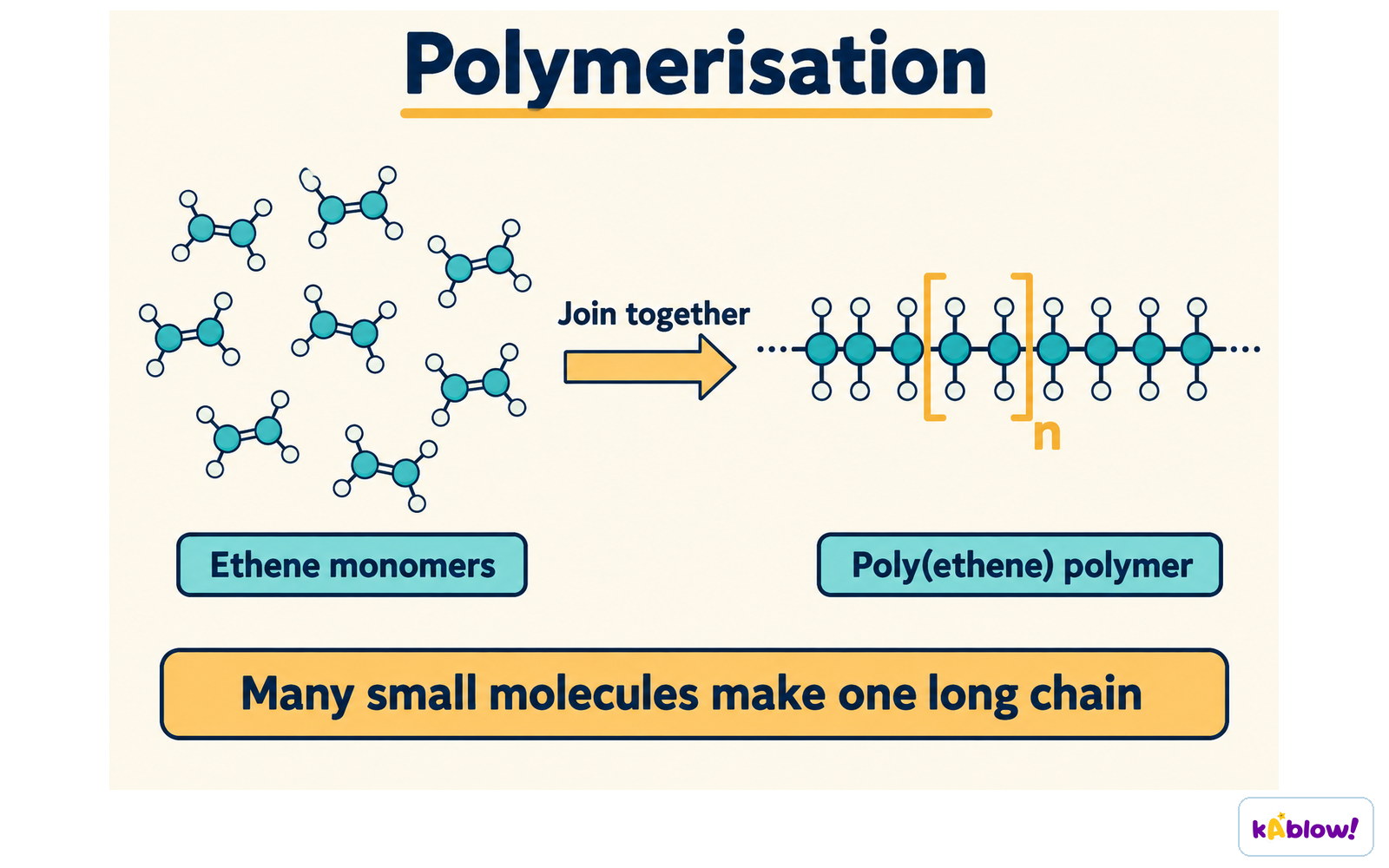
- Polymers are long chains of molecules made by joining many small molecules called monomers.
- Two main types: natural (e.g., rubber, silk) and synthetic (e.g., polythene, PVC).
- Polymers can be flexible or rigid, are lightweight, and can be moulded into shapes.
- They are electrical and thermal insulators – e.g., PVC insulates electrical wires.
- Polymers are very unreactive – useful for water bottles but causes environmental challenges as they do not break down quickly.
Ethene monomers join to form poly(ethene). The polymer contains a repeating chain of carbon atoms joined by single bonds.
Composites
- Composites are made by combining two or more different materials to create a new material with improved properties.
- Each material in a composite keeps its own properties, but together they make the composite stronger, lighter, or more durable.
- Fibreglass: glass fibres + plastic – lightweight like plastic, strong like glass; used for boat and car bodies.
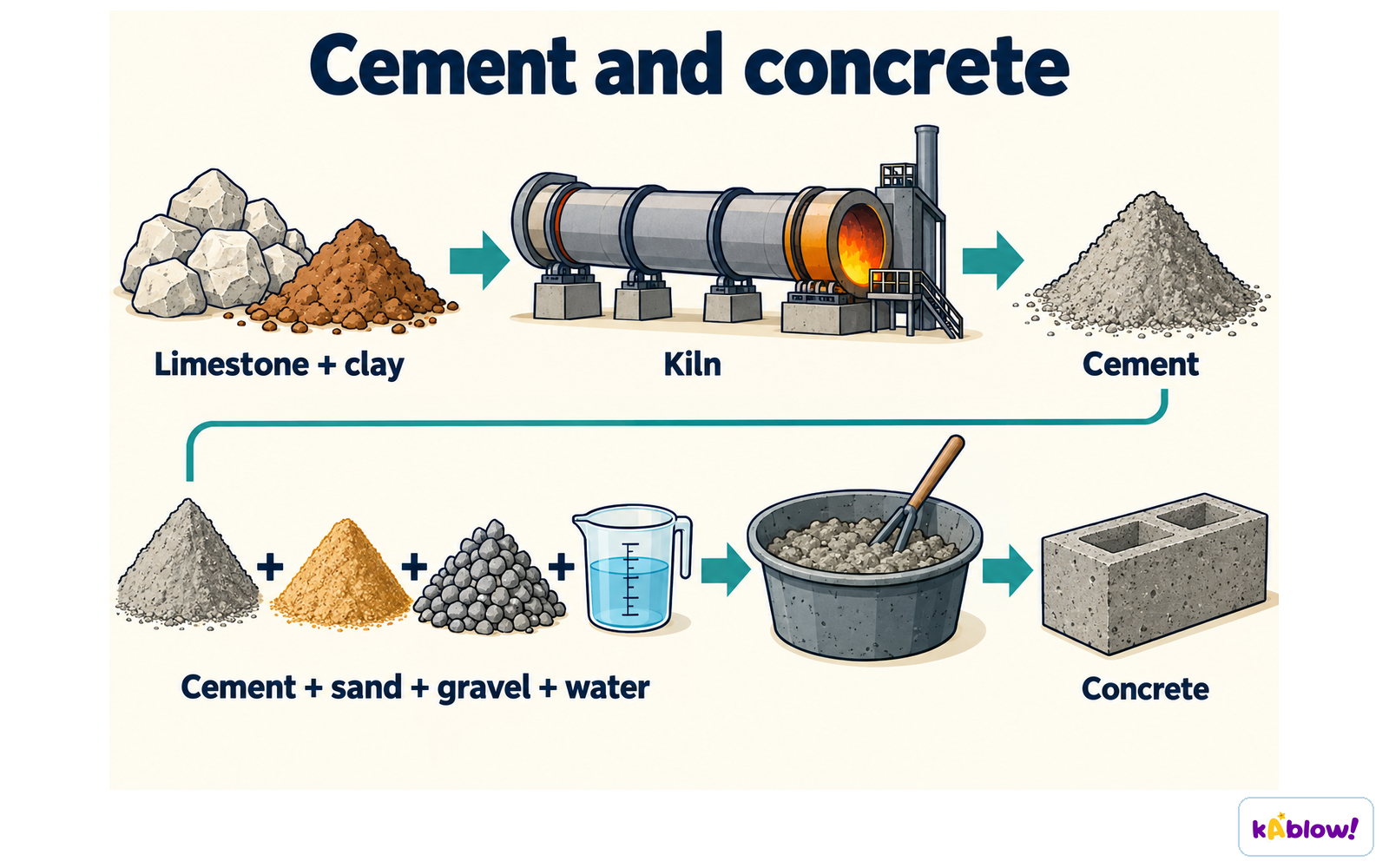
- Concrete: cement + sand + gravel – withstands high compressive forces; used in bridges, roads, buildings.
- Carbon fibre: carbon fibres + polymers – strong and lightweight; used in high-end sports cars, bicycles, sports equipment.
Concrete is a composite made using cement, sand, gravel and water. Cement is manufactured by heating limestone and clay in a kiln.
Key Comparisons
- Ceramics are hard and brittle; polymers are flexible and lightweight; composites combine properties of different materials.
- Polymers are insulators; ceramics are heat-resistant; composites can be designed for specific strengths.
Particle arrangement in solids, liquids, and gases – relevant to understanding material properties.
Slides
Sign up free to view the lesson slides
Step through every slide for this topic — plus flashcards and revision notes — with a free account.
Questões de prática
Prévia grátis — 8 de 61 perguntas. Cadastre-se para ver todas.
1.Which of the following is a property of ceramics?
Easy- AThey are hard and brittle.
- BThey are flexible and lightweight.
- CThey conduct electricity well.
- DThey are made by joining monomers.
2.Which of the following is a natural polymer?
Easy- APolythene
- BPVC
- CSilk
- DFibreglass
3.Concrete is an example of which type of material?
Easy- ACeramic
- BPolymer
- CComposite
- DMonomer
4.Which of the following statements about polymers is true?
Easy- AThey are good conductors of electricity.
- BThey are usually very reactive.
- CThey are electrical and thermal insulators.
- DThey are made by heating clay in a kiln.
5.Which material is used as an electrical insulator around wires?
Easy- AClay
- BPVC
- CFibreglass
- DConcrete
6.What is the difference between a polymer and a monomer?
Easy- APolymers are small molecules; monomers are long chains.
- BMonomers join together to form polymers.
- CPolymers are natural; monomers are synthetic.
- DMonomers are made from polymers.
7.Which of the following is a composite material?
Easy- ASilk
- BPolythene
- CCarbon fibre
- DClay
8.Why are ceramics suitable for use in cookware?
Easy- AThey are good conductors of heat.
- BThey are resistant to high temperatures.
- CThey are flexible and lightweight.
- DThey are unreactive with food.
Unlock all 61 questions, flashcards & more
Crie uma conta grátis para ver todas as perguntas, os slides, flashcards e resumos de revisão deste tópico.