Hormonal coordination in humans
விளையாடிக் கற்றுக்கொள்ளுங்கள்
ஆற்றல் சம்பாதிக்க இந்த கேள்விகளுக்குப் பதிலளியுங்கள், பின்னர் மீன் பிடித்து ஆராயுங்கள். கணக்கு தேவையில்லை.
பாட குறிப்புகள்
The Human Endocrine System
- The endocrine system is made up of glands that secrete chemical messengers called hormones directly into the bloodstream.
- Hormones are carried in the blood to target organs or cells, where they produce a specific effect.
- Compared to the nervous system, hormonal responses are slower but act for longer.
- The pituitary gland in the brain is the 'master gland'; it secretes hormones that act on other glands to stimulate further hormone release.
- Key endocrine glands include the pituitary, thyroid, pancreas, adrenal glands, ovaries (females) and testes (males).
Adrenaline and the 'Fight or Flight' Response
- Adrenaline is produced by the adrenal glands in response to danger or stress.
- It increases heart rate and breathing rate so that glucose and oxygen are delivered to muscles faster, and carbon dioxide is removed more quickly.
- It diverts blood flow towards muscles and away from non-essential organs such as the alimentary canal.
- It causes blood vessels in muscles to dilate, allowing more blood to circulate through them.
- It triggers the breakdown of glycogen to glucose in the liver and muscles, raising blood glucose for increased respiration.
- Adrenaline also dilates the pupils to let more light reach the retina.
Thyroxine and Negative Feedback
- Thyroxine is released from the thyroid gland and stimulates the basal metabolic rate (BMR) – the speed of chemical reactions in the body at rest.
- Thyroxine levels are controlled by negative feedback, which keeps conditions within a narrow optimal range.
- If thyroxine is too high, TRH production in the hypothalamus is inhibited, reducing TSH release from the pituitary, so less thyroxine is made.
- If thyroxine falls too low, TRH is released, increasing TSH from the pituitary, which stimulates the thyroid to release more thyroxine.
- Hyperthyroidism (overactive thyroid) raises BMR and protein synthesis; hypothyroidism (underactive thyroid) can cause heart and nerve problems.
Control of Blood Glucose Concentration
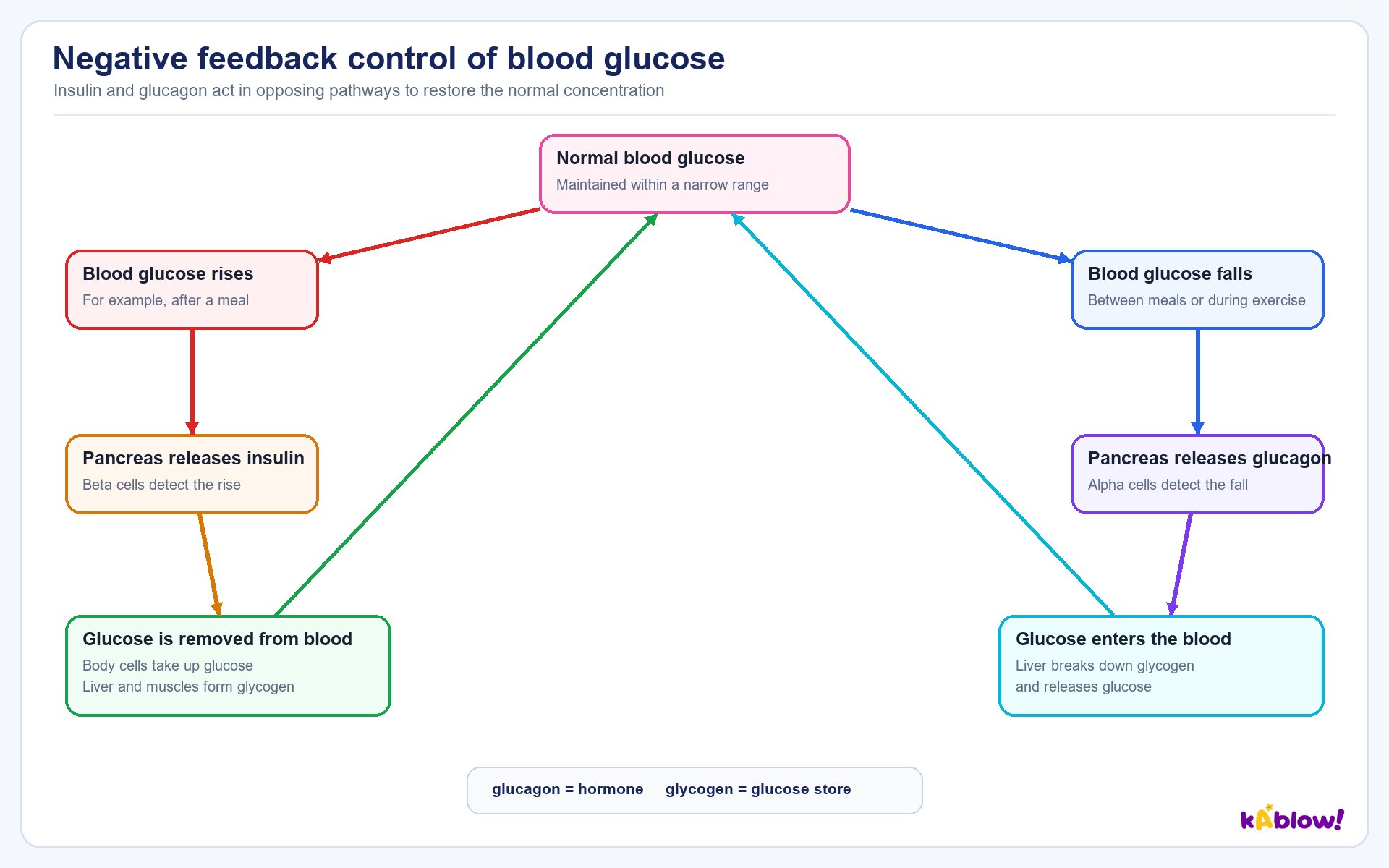
- Blood glucose concentration is monitored and controlled by the pancreas.
- When blood glucose is too high, the pancreas secretes insulin, which causes glucose to move from the blood into cells, especially liver and muscle cells.
- In liver and muscle cells, excess glucose is converted to glycogen for storage.
- When blood glucose is too low, the pancreas secretes glucagon, which converts stored glycogen back into glucose and releases it into the blood.
- Insulin and glucagon work together in a negative feedback cycle to keep blood glucose within a narrow range.
- Glucagon is a hormone; glycogen is the storage polysaccharide – don't confuse them.
Negative feedback regulation of blood glucose levels
Diabetes
- Type 1 diabetes occurs when the pancreas fails to produce sufficient insulin; it is usually caused by the immune system destroying insulin-producing cells.
- Type 1 diabetes leads to uncontrolled high blood glucose and is treated with insulin injections.
- Type 2 diabetes occurs when body cells no longer respond to insulin (insulin resistance), even though insulin is still produced.
- Type 2 diabetes is treated with a carbohydrate-controlled diet and an exercise regime.
- Obesity is a major risk factor for Type 2 diabetes.
Water and Nitrogen Balance
- Water is lost from the body via the lungs during exhalation and from the skin in sweat; these losses are not controlled.
- Excess water, ions and urea are removed by the kidneys in urine.
- If cells lose or gain too much water by osmosis, they do not function efficiently.
- Deamination in the liver breaks down excess amino acids into ammonia, which is toxic and immediately converted to urea for safe excretion.
- The kidneys filter the blood and selectively reabsorb useful substances such as glucose, some ions and water.
- ADH (antidiuretic hormone) from the pituitary gland controls the permeability of kidney tubules to water, adjusting water reabsorption by negative feedback.
Hormones in Human Reproduction
- During puberty, reproductive hormones cause secondary sex characteristics to develop.
- Testosterone is the main male reproductive hormone, produced by the testes; it stimulates sperm production.
- Oestrogen is the main female reproductive hormone, produced by the ovaries; it causes secondary sex characteristics and regulates the menstrual cycle.
- Ovulation is the release of a mature egg from the ovary, occurring approximately every 28 days.
- The menstrual cycle has four stages: menstruation, thickening of the uterus lining, ovulation (around day 14), and maintenance of the lining.
Hormonal Control of the Menstrual Cycle
- FSH (follicle-stimulating hormone) from the pituitary causes an egg to mature in the ovary and stimulates oestrogen production.
- Oestrogen from the ovaries causes growth and repair of the uterus lining and inhibits FSH production.
- A peak in oestrogen stimulates the release of LH (luteinising hormone) from the pituitary.
- LH triggers ovulation and stimulates the ovary to produce progesterone.
- Progesterone from the corpus luteum maintains the uterus lining.
- If no fertilisation occurs, the corpus luteum breaks down, progesterone falls, and the lining breaks down (menstruation).
- If fertilisation occurs, the corpus luteum continues to produce progesterone, and later the placenta secretes progesterone to maintain the lining.
Contraception
- Contraception methods can be hormonal, non-hormonal, chemical, surgical or natural.
- Oral contraceptives contain hormones (oestrogen and/or progesterone) that inhibit FSH production so no eggs mature.
- Progesterone-only injections, implants or skin patches slowly release hormone to inhibit egg maturation and release for months or years.
- Barrier methods such as condoms and diaphragms prevent sperm from reaching the egg; condoms also protect against STIs.
- Intrauterine devices (IUDs) prevent implantation or release a hormone that thickens cervical mucus and thins the uterus lining.
- Spermicidal agents kill or disable sperm.
- Surgical methods (vasectomy, female sterilisation) are permanent but difficult to reverse.
- Natural methods include abstinence and the rhythm method (avoiding intercourse during the fertile period).
Treating Infertility
- Infertility can be caused by insufficient reproductive hormones or problems with the reproductive system.
- Clomifene therapy uses a drug to stimulate FSH and LH release, encouraging egg maturation and ovulation.
- Clomifene can cause multiple eggs to be released, increasing the chance of twins or triplets.
- IVF (in vitro fertilisation) involves giving FSH and LH to mature several eggs, collecting and fertilising them outside the body, and inserting one or two embryos into the uterus.
- IVF success rate is around 30% and can be emotionally and physically stressful.
- Fertility treatments raise ethical issues, including multiple births, embryo ownership, and genetic testing of embryos.
ஸ்லைடுகள்
Sign up free to view the lesson slides
Step through every slide for this topic — plus flashcards and revision notes — with a free account.
பயிற்சி கேள்விகள்
இலவச முன்னோட்டம் — 59-இல் 8 கேள்விகள். அனைத்தையும் பார்க்க பதிவு செய்யவும்.
1.Which is not an example of a secondary sex characteristic?
Easy- AIncrease in height
- BDevelopment of facial hair
- CSperm production
- DMaturation of eggs
2.Which hormone is responsible for causing the development of secondary sex characteristics in males?
Easy- AOestrogen
- BAdrenaline
- CTestosterone
- DInsulin
3.Match each description to the correct stage of the menstrual cycle.
Medium- Loss of lining from the uterus
- The lining starts to thicken
- Egg travels down the oviduct
- Lining is maintained ready for a fertilised egg
- Menstruation
- Uterus lining thickening
- Ovulation
- Maintenance of lining
4.Which gamete does testosterone play a role in the development of?
Medium- AEgg
- BSperm
- CZygote
- DEmbryo
5.What changes are associated with a decrease in the concentration of progesterone in the blood?
Medium- AThe uterus lining increases in thickness.
- BThe uterus lining is maintained.
- CBlood concentration of oestrogen increases.
- DThe uterus lining decreases in thickness.
6.An increase in the secretion of luteinising hormone (LH) triggers ovulation in women. On a graph of hormone levels during the menstrual cycle, which line represents LH?
Medium- ALine A
- BLine B
- CLine C
- DLine D
7.Which of the contraceptive methods most likely contains hormones?
Medium- ACondom
- BDiaphragm
- CContraceptive implant
- DCopper intrauterine device
8.A woman uses 'natural methods' of contraception and avoids sexual intercourse during her most fertile period. When in the menstrual cycle should she avoid having sexual intercourse, if she does not want to conceive?
Medium- ADays 1 - 4
- BDays 7 - 10
- CDays 13 - 16
- DDays 20 - 23
Unlock all 59 questions, flashcards & more
இந்த தலைப்பிற்கான ஒவ்வொரு கேள்வியையும், ஸ்லைடுகளையும், ஃப்ளாஷ் கார்டுகளையும் மற்றும் திருப்புதல் குறிப்புகளையும் பார்க்க இலவச கணக்கை உருவாக்கவும்.