Organisation of an ecosystem
விளையாடிக் கற்றுக்கொள்ளுங்கள்
ஆற்றல் சம்பாதிக்க இந்த கேள்விகளுக்குப் பதிலளியுங்கள், பின்னர் மீன் பிடித்து ஆராயுங்கள். கணக்கு தேவையில்லை.
பாட குறிப்புகள்
Levels of Organisation
- Producers are photosynthetic organisms that make biomass for life on Earth, usually green plants or algae.
- Producers make glucose by photosynthesis using light energy from the Sun, then use it to build other biological molecules that form their biomass.
- Every food chain starts with a producer at the first trophic level, which is always the largest level.
- In extreme environments such as underwater volcanic vents, producers are chemoautotrophs that make organic molecules without sunlight.
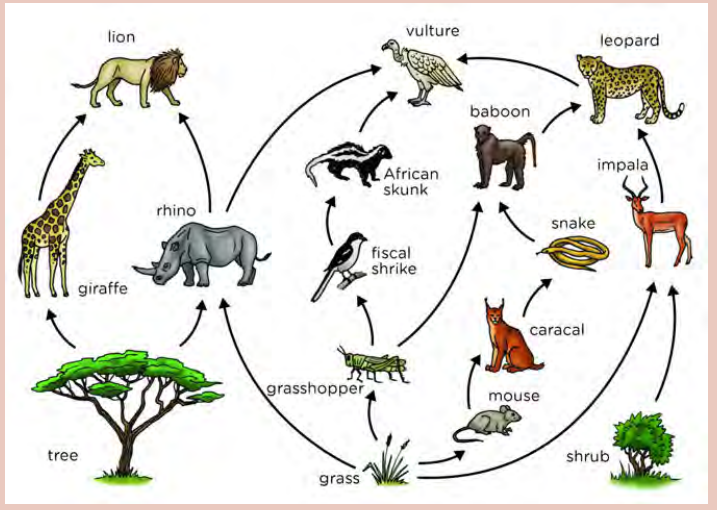
- A food chain shows feeding interactions and the transfer of energy from one organism to the next.
- The arrows in a food chain show the transfer of energy from one level to the next, not 'eats'.
- The source of all energy in a food chain is light energy from the Sun.
Consumers and Feeding Relationships
- Primary consumers eat producers and are herbivores or omnivores.
- Secondary consumers eat primary consumers, and tertiary consumers eat secondary consumers; both are carnivores or omnivores.
- Predators are consumers that kill and eat other animals; the animals they eat are prey.
- In a stable community, predator and prey numbers rise and fall in cycles.
- Predator and prey cycles are out of phase: the predator peak lags behind the prey peak because it takes time for predators to reproduce.
- As prey numbers rise, predator numbers increase; as predators increase, prey numbers then fall.
A savanna food web showing feeding relationships among producers (tree, grass, shrub) and consumers up to top predators (lion, leopard).
Investigating Ecosystems with Quadrats
- Ecology studies the distribution and abundance of species and their interactions with each other and the abiotic environment.
- Quadrats are square frames of wood or wire, often 0.25 m² or 1 m², placed on the ground to record the organisms inside.
- Quadrats measure abundance by recording the number of individuals of a species, species richness, or percentage cover.
- Percentage cover is used when individuals are hard to count, such as grass or moss.
- When estimating percentage cover, count a square if more than half of it is covered by the species.
- Quadrats are placed randomly to avoid bias, using a grid and a random number generator.
- Sampling reduces the time spent counting, but the sample must be large enough and unbiased to represent the whole population.
Transects and Estimating Population Size
- A transect measures how the abundance of a species changes along a changing habitat.
- A tape measure is laid through the habitat and a quadrat is placed at regular intervals, such as every 5 metres.
- At each interval you can record the number of individuals, species richness or percentage cover.
- Transects are useful for investigating how an abiotic factor such as light intensity, moisture, soil depth or altitude affects a species.
- To estimate population size, calculate the mean number per quadrat, then scale it up to the total area.
- You should understand mean, mode and median, calculate arithmetic means, and plot graphs with suitable scales.
The Carbon Cycle
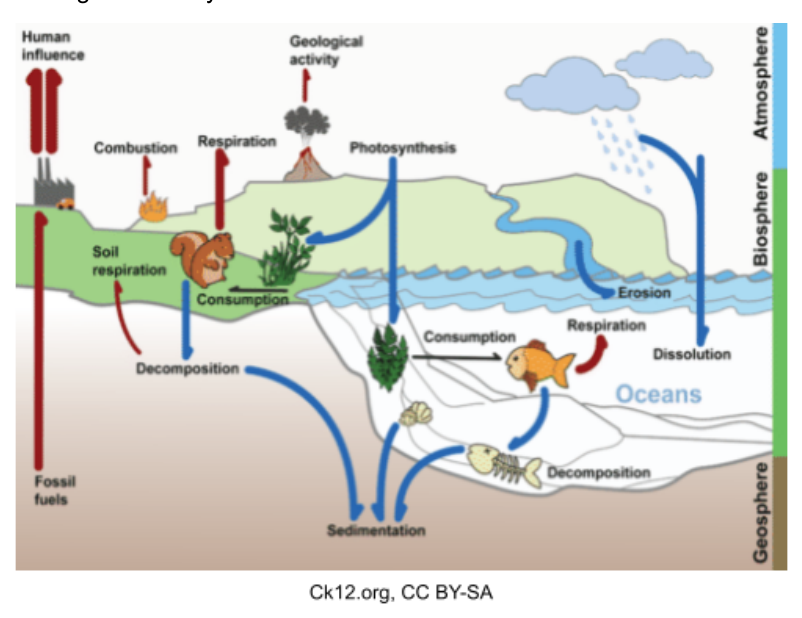
- Elements such as carbon are finite on Earth, so they must be recycled to build future organisms.
- Carbon is removed from the atmosphere as carbon dioxide by plants and algae during photosynthesis.
- Carbon passes to animals and microorganisms when they feed on plants and algae.
- Carbon returns to the atmosphere as carbon dioxide during respiration by plants, animals and microorganisms.
- If organisms die where decomposers are absent, their carbon can form fossil fuels over millions of years.
- Combustion of wood or fossil fuels releases carbon dioxide back into the atmosphere.
- Remember that plants respire too, so they also return carbon dioxide to the atmosphere.
The carbon cycle
The Water Cycle
- The water cycle provides fresh water for plants and animals on land before it drains into the seas.
- Water enters the atmosphere by evaporation from oceans, rivers and lakes, driven by the Sun's energy.
- Transpiration from plants also releases water vapour into the air.
- Rising moist air cools, and water vapour condenses to form clouds.
- Water returns to Earth as precipitation such as rain, snow and sleet.
- Water is continuously evaporated and precipitated, and all life depends on water, including for photosynthesis.
Decomposition and the Role of Microorganisms
- Decomposers break down dead organisms and waste products, returning materials to the environment.
- The main groups of decomposers are bacteria and fungi; detritus feeders such as earthworms and woodlice also help.
- Decomposition (decay) recycles carbon and mineral ions such as magnesium and nitrates.
- Microorganisms return carbon to the atmosphere as carbon dioxide when they respire.
- Temperature, water availability and oxygen availability affect the rate of decay.
- Light intensity does not affect the rate of decay.
- There is a finite number of elements on Earth, so recycling by decomposition is essential.
Uses of Decomposition
- Gardeners and farmers provide optimum conditions of warmth, moisture and oxygen for rapid decay of waste plant matter.
- The compost produced is used as a natural fertiliser for growing plants and crops.
- Once spread on soil, compost is broken down further, recycling minerals such as magnesium and nitrates for plant growth.
- Anaerobic decay occurs when microorganisms break down material without oxygen.
- Anaerobic decay produces methane and carbon dioxide, together called biogas.
- Methane can be burned as a fuel: methane + oxygen → carbon dioxide + water.
- Biogas generators are large containers where plant or animal waste decays anaerobically to produce methane.
Required Practical: Decay in Milk
- This practical investigates the effect of temperature on the rate of decay of fresh milk by measuring pH change.
- Bacteria in milk carry out anaerobic respiration, producing lactic acid which lowers the pH.
- As temperature increases, the rate of decay increases up to a point, because of increased kinetic energy and enzyme activity.
- Over time the rate of decay decreases as bacteria run out of sugars to respire, so the pH stops changing.
- The rate of decay is calculated as the pH change per unit time.
- Storing milk at low temperature slows decay, which is why milk should be kept refrigerated.
Impact of Environmental Change
- Environmental change can alter the distribution of species — where organisms live.
- Key changing factors are temperature, availability of water and composition of atmospheric gases.
- These changes may be seasonal, geographic or caused by human interaction.
- As average temperatures rise with climate change, some plant, bird and insect species are spreading northwards into new areas.
- Wildebeest migrate north and south following the rainfall, which provides fresh grazing and water.
- Oxygen is needed for aerobic respiration; some aquatic animals such as fish need water with high oxygen concentrations.
- Carbon dioxide is needed for photosynthesis, and some species such as lichen are sensitive to air pollution like sulphur dioxide.
ஸ்லைடுகள்
Sign up free to view the lesson slides
Step through every slide for this topic — plus flashcards and revision notes — with a free account.
பயிற்சி கேள்விகள்
இலவச முன்னோட்டம் — 64-இல் 8 கேள்விகள். அனைத்தையும் பார்க்க பதிவு செய்யவும்.
1.Which process is carried out by all ecological producers?
Easy- ARespiration
- BPhotosynthesis
- CDecomposition
- DCombustion
2.Which of the following best describes a grazing animal in a food chain?
Easy- APrimary consumer
- BSecondary consumer
- CProducer
- DHerbivorous predator
3.Which of the following sketch graphs best represents the fluctuations in numbers of predators versus the numbers of prey in a feeding relationship?
Easy- APredator and prey numbers peak at the same time
- BPredator numbers peak before prey numbers
- CPrey numbers peak before predator numbers, with the two cycles out of phase
- DPredator and prey numbers remain constant over time
4.Which of the following is the name for the sampling method where quadrats are laid down along a straight line to sample how wildlife varies along that line?
Easy- ARandom sampling
- BTransect
- CQuadrat
- DBelt transect
5.A scientist wants to use quadrats to investigate species in a field. Which technique is best for deciding where to place the quadrats to collect the sample?
Medium- APlace quadrats down in areas where the species under study is present in large numbers.
- BPick the sunniest areas because more life will grow there.
- CClose your eyes, throw the quadrat and sample the area where it lands.
- DCreate a grid of the field and use a random number generator to find coordinates to place the quadrat down.
6.Which of the following processes is the one by which carbon enters the carbon cycle by being incorporated into the biomass of producers?
Medium- ADecomposition
- BPhotosynthesis
- CAerobic respiration
- DEvaporation
7.Which of the following is not a factor that affects the rate of decay of dead biomass by microorganisms?
Easy- ATemperature
- BLight intensity
- CWater availability
- DOxygen availability
8.What do decomposers do?
Easy- AThey use light energy to make glucose
- BThey break down dead plant and animal matter
- CThey transport oxygen around the body
- DThey absorb water and mineral ions from the soil
Unlock all 64 questions, flashcards & more
இந்த தலைப்பிற்கான ஒவ்வொரு கேள்வியையும், ஸ்லைடுகளையும், ஃப்ளாஷ் கார்டுகளையும் மற்றும் திருப்புதல் குறிப்புகளையும் பார்க்க இலவச கணக்கை உருவாக்கவும்.