Reproduction
விளையாடிக் கற்றுக்கொள்ளுங்கள்
ஆற்றல் சம்பாதிக்க இந்த கேள்விகளுக்குப் பதிலளியுங்கள், பின்னர் மீன் பிடித்து ஆராயுங்கள். கணக்கு தேவையில்லை.
பாட குறிப்புகள்
Sexual Reproduction
- Sexual reproduction involves the fusion of the nuclei of two gametes to form a zygote (fertilised egg cell), producing offspring that are genetically different from each other.
- Fertilisation is the fusion of gamete nuclei; because each gamete comes from a different parent, there is variation in the offspring.
- A gamete is a sex cell: in animals, sperm and egg (ovum); in plants, pollen nucleus and egg (ovum).
- Gametes contain half the number of chromosomes of normal body cells, so they have a haploid nucleus (one copy of each chromosome).
- In humans, a normal body cell contains 46 chromosomes, but each gamete contains 23 chromosomes.
- When male and female gametes fuse, the zygote contains the full 46 chromosomes (half from each parent) and is described as diploid.
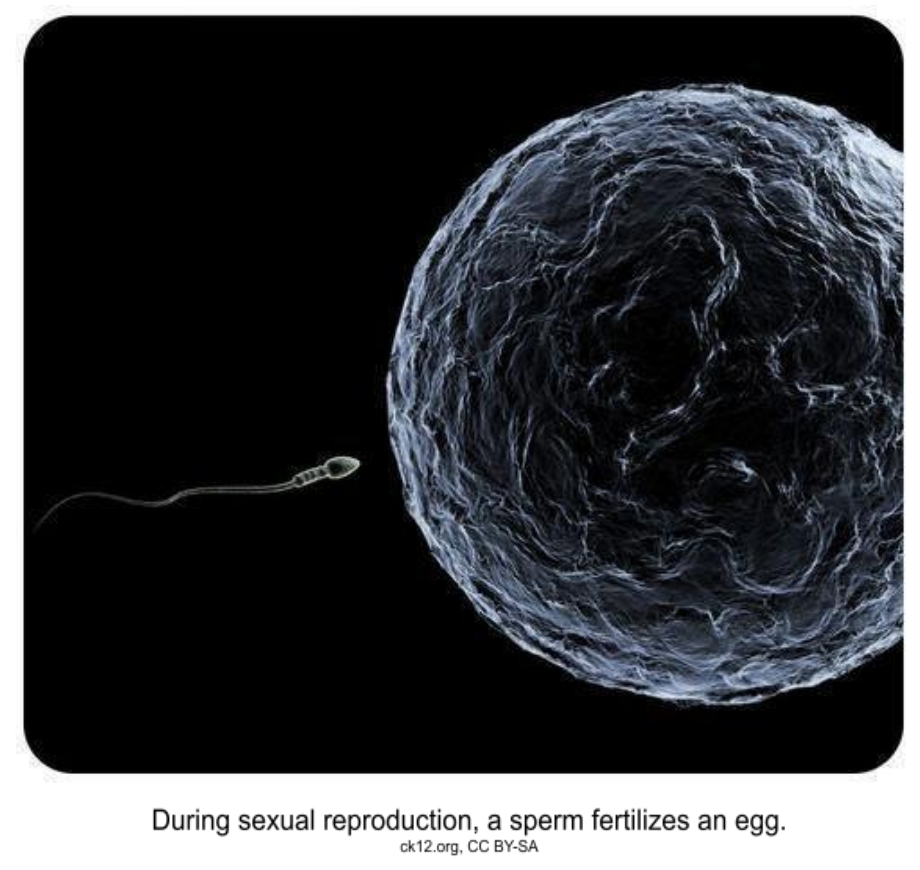
During sexual reproduction, a sperm fertilizes an egg.
Asexual Reproduction
- Asexual reproduction produces genetically identical offspring from one parent.
- It does not involve gametes or fertilisation, so there is no mixing of genetic information.
- The offspring are clones – genetically identical to the parent and to each other.
- Many plants reproduce asexually.
- Bacteria produce exact genetic copies of themselves by a type of asexual reproduction called binary fission.
Comparing Sexual and Asexual Reproduction
- Sexual reproduction involves two parents; asexual reproduction involves one parent.
- Sexual reproduction produces offspring that are genetically different; asexual reproduction produces genetically identical offspring.
- Sexual reproduction involves gametes and fertilisation; asexual reproduction does not.
- Sexual reproduction creates genetic variation in offspring; asexual reproduction creates no genetic variation (except mutations).
- Asexual reproduction can produce many offspring quickly; sexual reproduction is generally slower and produces fewer offspring.
The Role of Meiosis
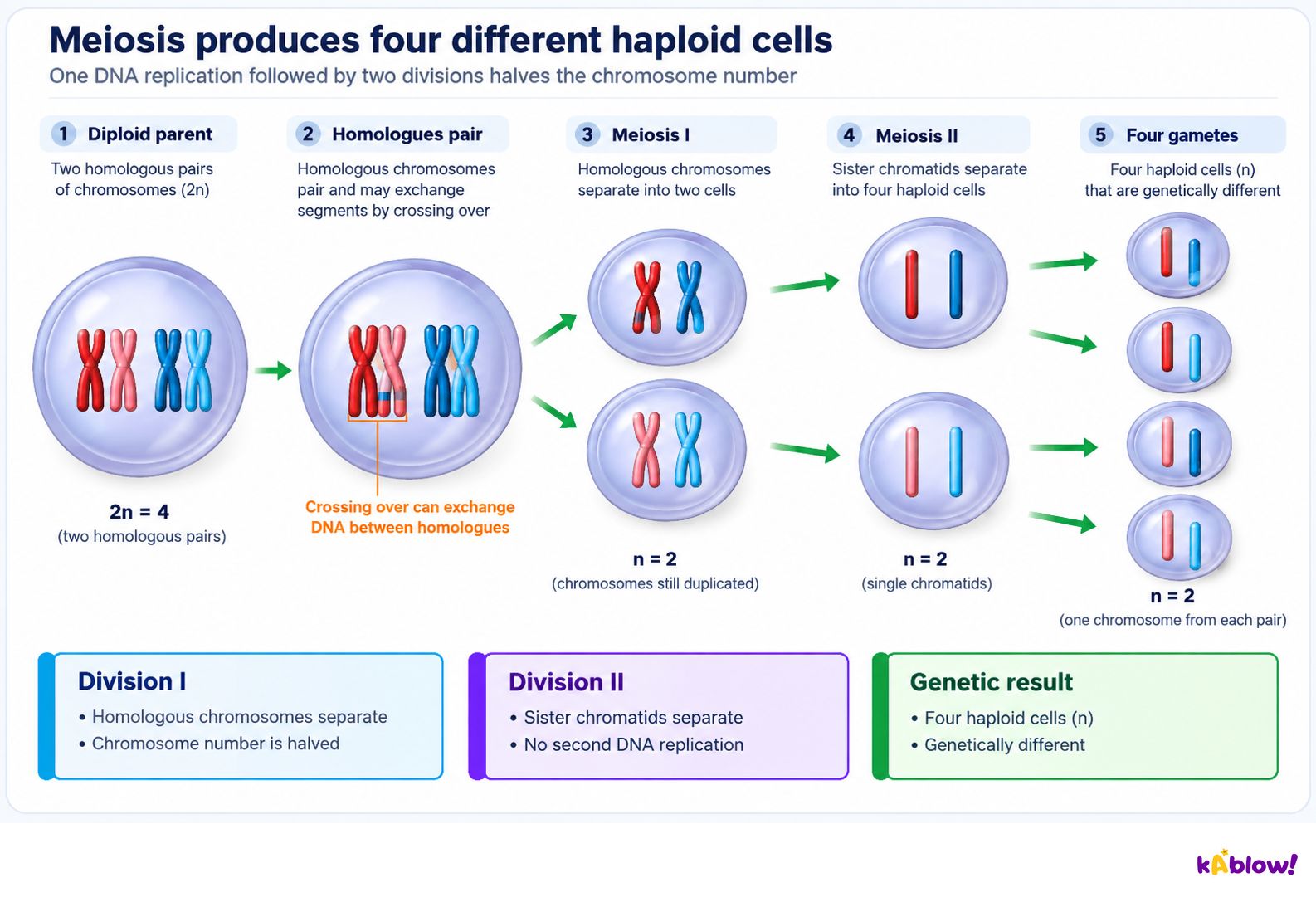
- Cells in reproductive organs divide by meiosis to form gametes (sex cells).
- Meiosis is a reduction division: the chromosome number is halved from diploid to haploid.
- The chromosome number must be halved so that after fertilisation the zygote has the correct diploid number.
- Meiosis involves two divisions, producing four haploid daughter cells.
- Meiosis produces genetic variation by forming new combinations of maternal and paternal chromosomes in each gamete.
- When gametes fuse randomly at fertilisation, each offspring is genetically different from any other.
Meiosis
DNA and the Genome
- The genome is the entire set of genetic material of an organism.
- The Human Genome Project was completed in 2003 after a 13-year project to sequence the whole human genome.
- A gene is a section of DNA that codes for a particular sequence of amino acids, which form proteins.
- DNA (deoxyribonucleic acid) is found in the nucleus of a cell and is a polymer made of two strands coiled into a double helix.
- DNA is made of repeating subunits called nucleotides; each nucleotide has a common sugar and phosphate group with one of four bases attached.
- The four bases are Adenine (A), Cytosine (C), Thymine (T) and Guanine (G).
- Bases pair up by complementary base pairing: A–T and C–G, held together by weak hydrogen bonds.
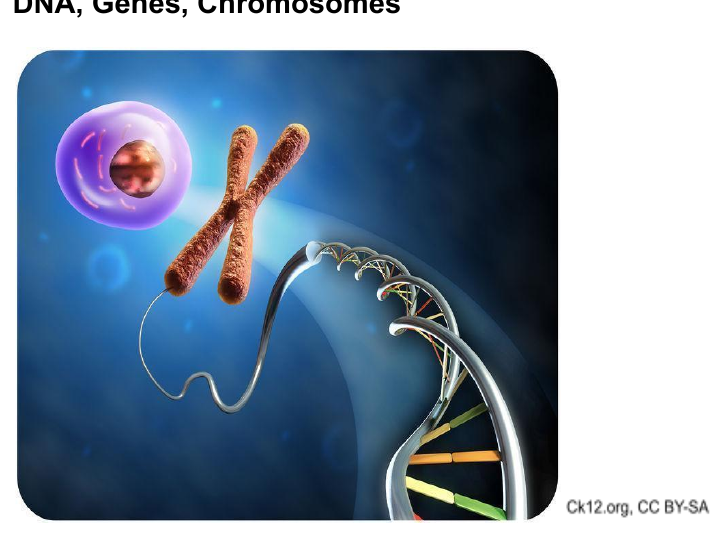
DNA, genes and chromosomes: genes are sections of chromosomes, and chromosomes are made of DNA.
Protein Synthesis
- A gene is a section of DNA with a particular sequence of bases that codes for a particular sequence of amino acids.
- A sequence of three bases codes for a single specific amino acid.
- The order of bases controls the order of amino acids joined together in a polypeptide chain, which folds to form a protein.
- Transcription occurs in the nucleus: DNA unwinds, and RNA polymerase makes a complementary mRNA copy of the gene.
- Translation occurs in the cytoplasm: mRNA attaches to a ribosome, which reads the code in groups of three bases (codons).
- tRNA molecules bring specific amino acids to the ribosome; their anticodons pair with complementary codons on mRNA.
- Peptide bonds form between amino acids until a stop codon is reached, completing the polypeptide chain.
Genetic Variants and Mutations
- A mutation is a random change to the DNA base sequence.
- Genetic variants are different versions of genes caused by mutations.
- Mutations in non-coding DNA can affect phenotype by influencing the binding of RNA polymerase, altering the quantity of protein produced.
- Mutations in coding DNA may change the sequence of amino acids, altering the shape and function of the protein.
- Insertions, deletions and substitutions are types of mutation; insertions and deletions have a knock-on effect on later base triplets.
- Mutations can be caused by ionising radiation (gamma rays, X-rays, UV) and certain chemicals (e.g. tar in tobacco).
- Sickle cell anaemia is caused by a gene mutation that changes haemoglobin, making red blood cells stiff and sickle-shaped.
Key Definitions in Inheritance
- A gene is a short length of DNA on a chromosome that codes for a particular characteristic.
- Alleles are different versions of the same gene; we inherit two alleles for each gene, one from each parent.
- The genotype is the combination of alleles an organism has for a characteristic.
- The phenotype is the observable characteristics of an organism.
- A dominant allele only needs to be inherited from one parent for the characteristic to show.
- A recessive allele must be inherited from both parents for the characteristic to show.
- Homozygous means two identical alleles for a gene; heterozygous means two different alleles.
Predicting Genetic Inheritance
- Monohybrid inheritance is the inheritance of a characteristic controlled by a single gene.
- A Punnett square shows the possible combinations of alleles in offspring and can be used to work out ratios and probabilities.
- In a cross between two heterozygous parents (Tt × Tt), the expected ratio is 3:1 (dominant : recessive).
- The probability of an offspring showing the dominant phenotype is 75%; the recessive phenotype is 25%.
- Family pedigree diagrams trace the inheritance of a characteristic through generations and can be used to work out the probability of inheriting a genetic disorder.
- In pedigree diagrams, males are squares and females are circles; affected individuals are often shaded.
Inheritance of Sex and Other Patterns
- Sex is determined by an entire chromosome pair: females have XX and males have XY.
- The father determines the sex of the child because only he can pass on a Y chromosome.
- Sperm cells determine the sex of the offspring.
- Codominance occurs when both alleles in a genotype are expressed in the phenotype (e.g. blood group inheritance).
- Sex-linked characteristics are controlled by alleles on the sex chromosomes; most are on the X chromosome.
- Males are more likely to show sex-linked recessive conditions (e.g. red-green colour blindness, haemophilia) because they have only one X chromosome.
- Polygenic inheritance involves characteristics controlled by more than one gene, giving a wide range of phenotypes (e.g. eye colour).
Variation
- Variation is the differences between individuals of the same species.
- Continuous variation shows many small degrees of difference and can be measured on a scale (e.g. height, mass); graphs give a smooth bell curve.
- Discontinuous variation shows distinct differences with no in-betweens (e.g. blood group, sex, tongue rolling); graphs give a step-like shape.
- Variation can be caused by genes, the environment, or a combination of both.
- Genetic variation arises from meiosis and the random fusion of gametes at fertilisation.
- Environmental variation is caused by factors outside the organism, such as climate, diet, lifestyle and accidents.
- Discontinuous variation is usually caused by genetic variation alone; continuous features often result from genetic and environmental causes together.
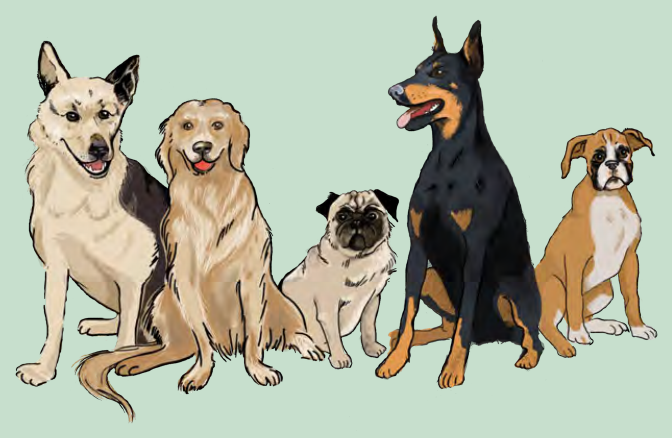
A group of dogs of different breeds, illustrating genetic variation within a species.
ஸ்லைடுகள்
Sign up free to view the lesson slides
Step through every slide for this topic — plus flashcards and revision notes — with a free account.
பயிற்சி கேள்விகள்
இலவச முன்னோட்டம் — 56-இல் 8 கேள்விகள். அனைத்தையும் பார்க்க பதிவு செய்யவும்.
1.How many chromosomes are contained in a human gamete?
Easy- A46
- B48
- C24
- D23
2.When the gametes fuse together at fertilisation, the new cell that is produced is genetically different to each of the parents' cells. What is the new cell called?
Easy- AEmbryo
- BZygote
- CGamete
- DClone
3.In 1953, scientists Watson and Crick published their work on the structure of DNA. What term is used to describe the shape of DNA?
Easy- ADouble helix
- BSingle strand
- CPolypeptide
- DNucleotide
4.What is the definition of the word allele?
Medium- AA section of DNA that codes for a protein
- BThe physical appearance of an organism
- CA variation of a gene
- DThe combination of alleles in an organism
5.What is a genotype?
Medium- AThe physical appearance of an organism
- BA section of DNA that codes for a protein
- CThe alleles present in an organism for a particular gene
- DA change in the DNA sequence
6.Which statement correctly describes asexual reproduction?
Easy- AIt involves the fusion of gamete nuclei
- BIt produces genetically identical offspring from one parent
- CIt always requires two parents
- DIt produces offspring that are genetically different from each other
7.Which of the following statements about meiosis are correct? (Select all that apply)
Medium- AIt produces four daughter cells
- BIt produces gametes
- CIt produces genetically identical cells
- DThe daughter cells contain half the number of chromosomes as the parent cell
- EIt occurs during asexual reproduction
8.Which of the following are advantages of sexual reproduction? (Select all that apply)
Medium- AIt produces genetic variation in the offspring
- BIt requires only one parent
- CIt produces offspring that may be better adapted to a changing environment
- DIt is a fast method of reproduction
- EIt produces genetically identical offspring
Unlock all 56 questions, flashcards & more
இந்த தலைப்பிற்கான ஒவ்வொரு கேள்வியையும், ஸ்லைடுகளையும், ஃப்ளாஷ் கார்டுகளையும் மற்றும் திருப்புதல் குறிப்புகளையும் பார்க்க இலவச கணக்கை உருவாக்கவும்.